SUBSCRIBE TO OUR FREE NEWSLETTER
Daily news & progressive opinion—funded by the people, not the corporations—delivered straight to your inbox.
5
#000000
#FFFFFF
To donate by check, phone, or other method, see our More Ways to Give page.
Daily news & progressive opinion—funded by the people, not the corporations—delivered straight to your inbox.
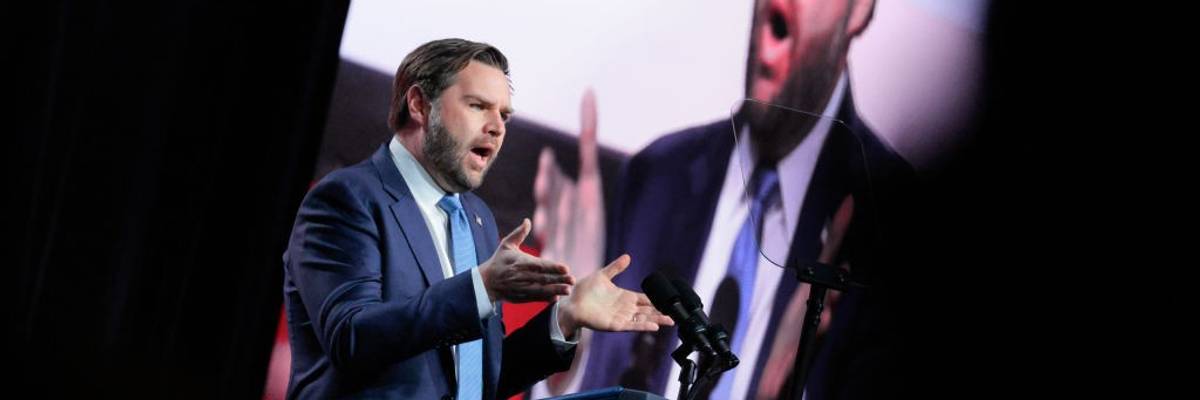
US Vice President JD Vance addresses the National League of Cities: Congressional City Conference at the Marriott Marquis on March 10, 2025 in Washington, DC.
On June 25, Vice President JD Vance told his audience at the Richard M. Nixon Presidential Library and Museum that Nixon got a bum rap. The uncontested historical record proves otherwise.
The Watergate scandal revealed President Richard Nixon’s contempt for the Constitution and his systematic abuse of power. At the time, it was one of the darkest chapters in US history, resulting in the first-ever resignation of an American president.
But on June 25, Vice President JD Vance told his audience at the Richard M. Nixon Presidential Library and Museum that Nixon got a bum rap. The uncontested historical record proves otherwise. Vance’s contrary view demonstrates the depths to which he and President Donald Trump have taken the country.
Vance claimed that Nixon was the victim of a “deep state” conspiracy.
“If you look at the story of how the deep state took down Richard Nixon,” Vance continued, “it’s not all that different from what the same groups of people, the same institutions, tried to do to Donald Trump in the first Trump administration.”
But the supposed “deep state” actors to which Vance referred consisted of Nixon’s top advisers who turned on him, the most conservative Republicans in Congress, a unanimous US Supreme Court, and two intrepid reporters at The Washington Post.
Timothy Naftali, a historian at Columbia University’s School of International Public Affairs and the former director of the Nixon library, told The New York Times: “We have more than enough information from the Nixon era to know that there was no intelligence conspiracy against Richard Nixon. He brought his house of cards down upon himself.”
“You can hear him suborn perjury on the tapes,” Naftali told The Washington Post. “He’s telling an intermediary, what to tell someone who’s about to be interviewed by the FBI, what to say and what not to say. You can hear Nixon being told that money had been found to hire teamsters to go and break the bones of demonstrators. That’s all illegal.”
Prof. Naftali observed that, curiously, Vance had likened Trump to a president who had directed the CIA to subvert the Constitution.
“It’s not as if [Watergate] is a matter of partisan interpretation,” Naftali said. “The evidence is overwhelming. If [Vance] does know all of this, he’s telegraphing the kind of president he hopes to be.”
Vance also claimed that Watergate would have been a 12-hour news story today. He may be correct, but that does not diminish the seriousness of Nixon’s crimes.
As prof. Naftali observed, “It’s not that Nixon looks better in retrospect, it’s that we look worse.”
Dear Common Dreams reader, It’s been nearly 30 years since I co-founded Common Dreams with my late wife, Lina Newhouser. We had the radical notion that journalism should serve the public good, not corporate profits. It was clear to us from the outset what it would take to build such a project. No paid advertisements. No corporate sponsors. No millionaire publisher telling us what to think or do. Many people said we wouldn't last a year, but we proved those doubters wrong. Together with a tremendous team of journalists and dedicated staff, we built an independent media outlet free from the constraints of profits and corporate control. Our mission has always been simple: To inform. To inspire. To ignite change for the common good. Building Common Dreams was not easy. Our survival was never guaranteed. When you take on the most powerful forces—Wall Street greed, fossil fuel industry destruction, Big Tech lobbyists, and uber-rich oligarchs who have spent billions upon billions rigging the economy and democracy in their favor—the only bulwark you have is supporters who believe in your work. But here’s the urgent message from me today. It's never been this bad out there. And it's never been this hard to keep us going. At the very moment Common Dreams is most needed, the threats we face are intensifying. We need your support now more than ever. We don't accept corporate advertising and never will. We don't have a paywall because we don't think people should be blocked from critical news based on their ability to pay. Everything we do is funded by the donations of readers like you. When everyone does the little they can afford, we are strong. But if that support retreats or dries up, so do we. Will you donate now to make sure Common Dreams not only survives but thrives? —Craig Brown, Co-founder |
The Watergate scandal revealed President Richard Nixon’s contempt for the Constitution and his systematic abuse of power. At the time, it was one of the darkest chapters in US history, resulting in the first-ever resignation of an American president.
But on June 25, Vice President JD Vance told his audience at the Richard M. Nixon Presidential Library and Museum that Nixon got a bum rap. The uncontested historical record proves otherwise. Vance’s contrary view demonstrates the depths to which he and President Donald Trump have taken the country.
Vance claimed that Nixon was the victim of a “deep state” conspiracy.
“If you look at the story of how the deep state took down Richard Nixon,” Vance continued, “it’s not all that different from what the same groups of people, the same institutions, tried to do to Donald Trump in the first Trump administration.”
But the supposed “deep state” actors to which Vance referred consisted of Nixon’s top advisers who turned on him, the most conservative Republicans in Congress, a unanimous US Supreme Court, and two intrepid reporters at The Washington Post.
Timothy Naftali, a historian at Columbia University’s School of International Public Affairs and the former director of the Nixon library, told The New York Times: “We have more than enough information from the Nixon era to know that there was no intelligence conspiracy against Richard Nixon. He brought his house of cards down upon himself.”
“You can hear him suborn perjury on the tapes,” Naftali told The Washington Post. “He’s telling an intermediary, what to tell someone who’s about to be interviewed by the FBI, what to say and what not to say. You can hear Nixon being told that money had been found to hire teamsters to go and break the bones of demonstrators. That’s all illegal.”
Prof. Naftali observed that, curiously, Vance had likened Trump to a president who had directed the CIA to subvert the Constitution.
“It’s not as if [Watergate] is a matter of partisan interpretation,” Naftali said. “The evidence is overwhelming. If [Vance] does know all of this, he’s telegraphing the kind of president he hopes to be.”
Vance also claimed that Watergate would have been a 12-hour news story today. He may be correct, but that does not diminish the seriousness of Nixon’s crimes.
As prof. Naftali observed, “It’s not that Nixon looks better in retrospect, it’s that we look worse.”
The Watergate scandal revealed President Richard Nixon’s contempt for the Constitution and his systematic abuse of power. At the time, it was one of the darkest chapters in US history, resulting in the first-ever resignation of an American president.
But on June 25, Vice President JD Vance told his audience at the Richard M. Nixon Presidential Library and Museum that Nixon got a bum rap. The uncontested historical record proves otherwise. Vance’s contrary view demonstrates the depths to which he and President Donald Trump have taken the country.
Vance claimed that Nixon was the victim of a “deep state” conspiracy.
“If you look at the story of how the deep state took down Richard Nixon,” Vance continued, “it’s not all that different from what the same groups of people, the same institutions, tried to do to Donald Trump in the first Trump administration.”
But the supposed “deep state” actors to which Vance referred consisted of Nixon’s top advisers who turned on him, the most conservative Republicans in Congress, a unanimous US Supreme Court, and two intrepid reporters at The Washington Post.
Timothy Naftali, a historian at Columbia University’s School of International Public Affairs and the former director of the Nixon library, told The New York Times: “We have more than enough information from the Nixon era to know that there was no intelligence conspiracy against Richard Nixon. He brought his house of cards down upon himself.”
“You can hear him suborn perjury on the tapes,” Naftali told The Washington Post. “He’s telling an intermediary, what to tell someone who’s about to be interviewed by the FBI, what to say and what not to say. You can hear Nixon being told that money had been found to hire teamsters to go and break the bones of demonstrators. That’s all illegal.”
Prof. Naftali observed that, curiously, Vance had likened Trump to a president who had directed the CIA to subvert the Constitution.
“It’s not as if [Watergate] is a matter of partisan interpretation,” Naftali said. “The evidence is overwhelming. If [Vance] does know all of this, he’s telegraphing the kind of president he hopes to be.”
Vance also claimed that Watergate would have been a 12-hour news story today. He may be correct, but that does not diminish the seriousness of Nixon’s crimes.
As prof. Naftali observed, “It’s not that Nixon looks better in retrospect, it’s that we look worse.”