

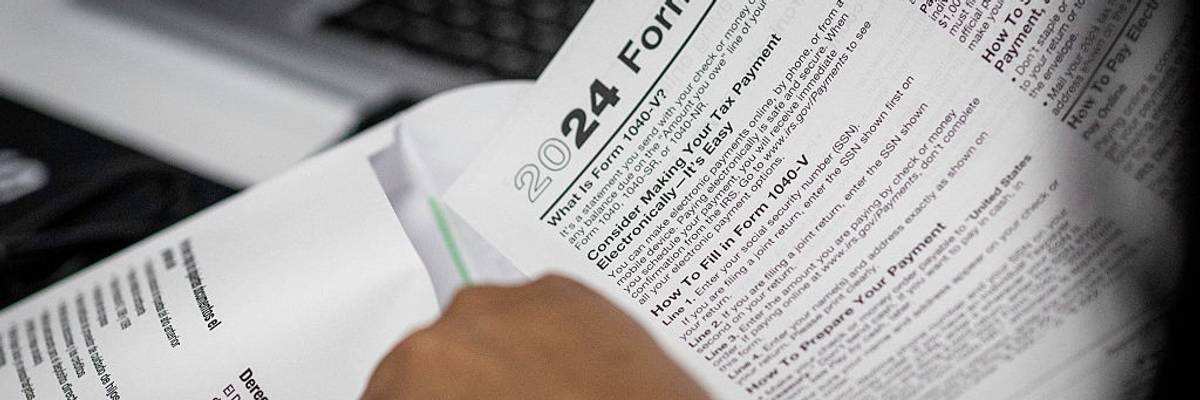
An immigrant receives help in preparing her US income tax forms on March 29, 2025 at an undisclosed location, Connecticut.
No, Friends on the Left, We Shouldn’t Tax Hardworking Americans Into Poverty
Many of those who would adamantly oppose the creation of a society where the income tax impoverishes struggling workers to enable those with seven-figure incomes to pay low rates are working overtime to maintain that very same situation.
Imagine this 2029 scenario: Americans making $1,000,001 or more per year have a slightly higher federal income tax rate than they currently do, while Americans who can’t afford to put food on the table—the ones who make less than what it takes to cover basic living expenses—don’t pay federal income taxes at all. Now imagine that President JD Vance proposes to cut the income tax rates of those with incomes over $1 million and to recover the lost revenue by taxing the working poor even further into poverty.
How many Democratic politicians would vote for that? How many left-leaning think tanks would write white papers supporting it? And how many left-leaning activist groups would lobby in support of it? NONE.
Unfortunately, the very tax structure that hypothetical proposal envisions already exists. Yet, amazingly, many of those who would adamantly oppose the creation of a society where the income tax impoverishes struggling workers to enable those with seven-figure incomes to pay low rates are working overtime to maintain that very same situation.
Recognizing that taxing hardworking people into poverty is both morally wrong and economically asinine, earlier this year, Sen. Chris Van Hollen (D-Md.) and Rep. Don Beyer (D-Va.) introduced the Working Americans’ Tax Cut Act (WATCA). Twenty-one senators and 13 representatives have signed on. The AFL-CIO has endorsed WATCA, as have the American Federation of Teachers, Oxfam, Americans for Tax Fairness, Take on Wall Street, and nearly a dozen other tax and justice organizations.
WATCA is based on the simple concept that workers with incomes equal to or less than the basic cost of living should not be required to divert income needed for basic necessities to pay federal income tax. WATCA provides an exemption from federal income tax for income up to the basic cost of living, $46,000 per year for a single American with no children, and recovers the lost tax revenue with a surtax on incomes over $1 million.
Criticism of WATCA has been fast and furious, coming mostly from folks who purport to advocate for average Americans. Their commentary, which can be found in American Prospect, Democracy, The New York Times, and even Rolling Stone, is chock-full of concocted reasons why continuing to oppressively tax struggling Americans is a fine idea. Mostly, their arguments are a repackaged version of billionaire Republican Sen. Rick Scott’s (R-Fla.) idea that he pushed in 2022 that the income tax requires all Americans to have “skin in the game.” Scott’s idea bombed badly—so badly, in fact, that he shelved it after just a few months.
The Working Americans’ Tax Cut Act fixes a fundamental structural flaw in the federal income tax: We’re taxing those with no ability to pay into poverty, while maintaining top rates that are absurdly low.
The words used by WATCA critics differ, although often not by very much, but the concept is the same. A Roosevelt Institute blog post explains how tax policy should “bind us all to one another.” In an impressive mental gymnastics routine, former Larry Summers acolyte Natasha Sarin acknowledges that ordinary Americans are “right to resent a tax system that’s skewed against them,” but that making those at the top pay their fair share would not be enough, so it’s the civic duty of everyone, no matter their level of income, to pay federal income tax. In Democracy, writers from the Tax Law Center at NYU Law, including two Obama and Biden administration alums, somehow manage to start by recognizing that the income tax "embodies the principle that the government should be financed based on ability to pay” yet end by attacking a proposal based on its recognition of the inability of those with income below the basic cost of living—or income below any threshold for that matter—to pay income tax.
You can’t top the tone-deafness of a billionaire Republican senator insisting that all Americans pay income tax to have “skin in the game.” But you know what comes close? A group of ivory-tower policy wonks ensconced in air-conditioned offices and drawing comfortable six-figure salaries insisting that exempting janitors making $40,000 a year from federal income tax would be a tragic policy mistake. No, they don’t use the phrase “skin in the game,” but they may as well.
And let’s be clear, all Americans have a lot of skin in the tax game whether or not they pay federal income tax. In fact, if Social Security and Medicare taxes were labeled to reflect what they actually are—income taxes—all but the lowest income Americans would be considered to be paying federal income tax.
Other attacks on the Working Americans’ Tax Cut Act are equally off base. The second favored theme is to mischaracterize WATCA as a middle-class tax cut. That attack line seizes on the reality that it’s never possible to craft a tax bill that precisely addresses its underlying policy objective. Exempting income up to the basic cost of living from income tax unavoidably confers an incidental benefit on those with incomes at a slightly higher level, a benefit that is rapidly phased out under WATCA.
So, yes, Americans with incomes considered middle class stand to benefit from WATCA. The benefit, however, becomes vanishingly smaller as income increases into middle-class range. But that didn’t stop former Biden National Economic Council member Bharat Ramamurti from referring to WATCA as a “very sweeping middle-class tax cut” which he suggested reflected poor prioritization. Consider how flat Ramamurti’s criticism would fall had he said that a tax cut for underpaid workers struggling to make rent reflected poor prioritization.
The Working Americans’ Tax Cut Act fixes a fundamental structural flaw in the federal income tax: We’re taxing those with no ability to pay into poverty, while maintaining top rates that are absurdly low. We can quibble about the details of fixing that flaw. Maybe the basic cost of living in America is not exactly $46,000. Maybe the cost-of-living exemption should be phased out over a narrower income range.
When our organization, Patriotic Millionaires, worked with congressional offices to develop WATCA, we fully expected commentary along those lines. But ironically enough, there has been remarkably little of it. Instead, we’re hearing that the fundamental structural flaw—and the misery it inflicts on struggling workers—should be left unaddressed. And as a result of their moral ambivalence, we’re left with a Democratic Party that can’t understand why working-class Americans have left them. We can.
We are at a crossroads
This country and this world are at a monumental crossroads. In a few short weeks, US voters will have an opportunity to beat back the forces of fascism and confront the billionaires who are rigging the economy, our media system, and our democracy, making it increasingly impossible for ordinary people to get by. We’re not just talking about the election. We’re talking about what must be done once these fascist elements are vanquished from power. We need a bolder set of solutions than what either major party has so far been willing to offer and a working-class movement ready to fight like hell for it. Trump didn't emerge from nowhere. The conditions that fueled MAGA authoritarianism were created by decades of radical neoliberal economic policies and a corrupt political system dominated by corporate interests. They slashed taxes on the super-rich, promising that the benefits would trickle down. They said giveaways to the corporate titans would make life more affordable for the rest of us. It was all bullshit. And when a bitter, betrayed populace searches for someone to blame, right-wing demagogues have little trouble finding scapegoats. People know when they're being lied to, but you won't hear any of this from the corporate media. Only independent journalism—powered and funded by people who believe in building a better world—can deliver truly trustworthy daily news. Our Fall Campaign is underway, and we need your help. To power our newsroom through the rest of the year, we need to raise $125,000 by midnight on October 31. So if you share our vision, please contribute whatever you can to sustain our work. |
Imagine this 2029 scenario: Americans making $1,000,001 or more per year have a slightly higher federal income tax rate than they currently do, while Americans who can’t afford to put food on the table—the ones who make less than what it takes to cover basic living expenses—don’t pay federal income taxes at all. Now imagine that President JD Vance proposes to cut the income tax rates of those with incomes over $1 million and to recover the lost revenue by taxing the working poor even further into poverty.
How many Democratic politicians would vote for that? How many left-leaning think tanks would write white papers supporting it? And how many left-leaning activist groups would lobby in support of it? NONE.
Unfortunately, the very tax structure that hypothetical proposal envisions already exists. Yet, amazingly, many of those who would adamantly oppose the creation of a society where the income tax impoverishes struggling workers to enable those with seven-figure incomes to pay low rates are working overtime to maintain that very same situation.
Recognizing that taxing hardworking people into poverty is both morally wrong and economically asinine, earlier this year, Sen. Chris Van Hollen (D-Md.) and Rep. Don Beyer (D-Va.) introduced the Working Americans’ Tax Cut Act (WATCA). Twenty-one senators and 13 representatives have signed on. The AFL-CIO has endorsed WATCA, as have the American Federation of Teachers, Oxfam, Americans for Tax Fairness, Take on Wall Street, and nearly a dozen other tax and justice organizations.
WATCA is based on the simple concept that workers with incomes equal to or less than the basic cost of living should not be required to divert income needed for basic necessities to pay federal income tax. WATCA provides an exemption from federal income tax for income up to the basic cost of living, $46,000 per year for a single American with no children, and recovers the lost tax revenue with a surtax on incomes over $1 million.
Criticism of WATCA has been fast and furious, coming mostly from folks who purport to advocate for average Americans. Their commentary, which can be found in American Prospect, Democracy, The New York Times, and even Rolling Stone, is chock-full of concocted reasons why continuing to oppressively tax struggling Americans is a fine idea. Mostly, their arguments are a repackaged version of billionaire Republican Sen. Rick Scott’s (R-Fla.) idea that he pushed in 2022 that the income tax requires all Americans to have “skin in the game.” Scott’s idea bombed badly—so badly, in fact, that he shelved it after just a few months.
The Working Americans’ Tax Cut Act fixes a fundamental structural flaw in the federal income tax: We’re taxing those with no ability to pay into poverty, while maintaining top rates that are absurdly low.
The words used by WATCA critics differ, although often not by very much, but the concept is the same. A Roosevelt Institute blog post explains how tax policy should “bind us all to one another.” In an impressive mental gymnastics routine, former Larry Summers acolyte Natasha Sarin acknowledges that ordinary Americans are “right to resent a tax system that’s skewed against them,” but that making those at the top pay their fair share would not be enough, so it’s the civic duty of everyone, no matter their level of income, to pay federal income tax. In Democracy, writers from the Tax Law Center at NYU Law, including two Obama and Biden administration alums, somehow manage to start by recognizing that the income tax "embodies the principle that the government should be financed based on ability to pay” yet end by attacking a proposal based on its recognition of the inability of those with income below the basic cost of living—or income below any threshold for that matter—to pay income tax.
You can’t top the tone-deafness of a billionaire Republican senator insisting that all Americans pay income tax to have “skin in the game.” But you know what comes close? A group of ivory-tower policy wonks ensconced in air-conditioned offices and drawing comfortable six-figure salaries insisting that exempting janitors making $40,000 a year from federal income tax would be a tragic policy mistake. No, they don’t use the phrase “skin in the game,” but they may as well.
And let’s be clear, all Americans have a lot of skin in the tax game whether or not they pay federal income tax. In fact, if Social Security and Medicare taxes were labeled to reflect what they actually are—income taxes—all but the lowest income Americans would be considered to be paying federal income tax.
Other attacks on the Working Americans’ Tax Cut Act are equally off base. The second favored theme is to mischaracterize WATCA as a middle-class tax cut. That attack line seizes on the reality that it’s never possible to craft a tax bill that precisely addresses its underlying policy objective. Exempting income up to the basic cost of living from income tax unavoidably confers an incidental benefit on those with incomes at a slightly higher level, a benefit that is rapidly phased out under WATCA.
So, yes, Americans with incomes considered middle class stand to benefit from WATCA. The benefit, however, becomes vanishingly smaller as income increases into middle-class range. But that didn’t stop former Biden National Economic Council member Bharat Ramamurti from referring to WATCA as a “very sweeping middle-class tax cut” which he suggested reflected poor prioritization. Consider how flat Ramamurti’s criticism would fall had he said that a tax cut for underpaid workers struggling to make rent reflected poor prioritization.
The Working Americans’ Tax Cut Act fixes a fundamental structural flaw in the federal income tax: We’re taxing those with no ability to pay into poverty, while maintaining top rates that are absurdly low. We can quibble about the details of fixing that flaw. Maybe the basic cost of living in America is not exactly $46,000. Maybe the cost-of-living exemption should be phased out over a narrower income range.
When our organization, Patriotic Millionaires, worked with congressional offices to develop WATCA, we fully expected commentary along those lines. But ironically enough, there has been remarkably little of it. Instead, we’re hearing that the fundamental structural flaw—and the misery it inflicts on struggling workers—should be left unaddressed. And as a result of their moral ambivalence, we’re left with a Democratic Party that can’t understand why working-class Americans have left them. We can.
- New Evidence that Poor Americans Pay the Highest Taxes and Get Little of the Safety Net ›
- To Save US Democracy, Tax the Rich at 90% ›
- I Want My Taxes to Be Used for Our True National Security: Helping People in Need ›
- Tax on Global Mega-Rich Could Help Lift 2.3 Billion Out of Poverty ›
- Top 1% to Get $117 Billion in Trump Tax Cuts This Year as Bottom 95% Pay More ›
- GOP Megalaw Will Mean Tax Hikes for Many Poor Americans as Soon as 2026: Analysis ›