
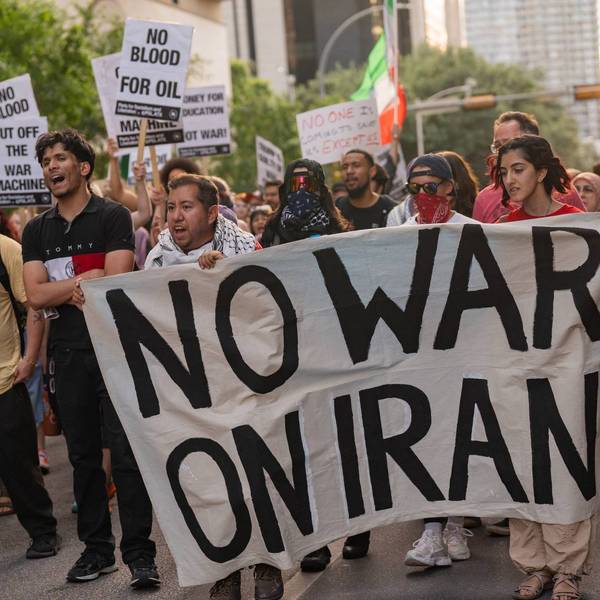
On Saturday, February 28th, Americans woke up to find their country at war with Iran. Breaking news alerts carried word that the United States had joined Israel in an unprecedented joint military operation aimed at overturning the Iranian government. The human cost is already jarring: one week in, Al Jazeera's live tracker counts over 1,300 dead in Iran, at least 11 in Israel, 9 in Gulf states, and six American soldiers. But for millions of Americans already struggling through an affordability crisis, a different and urgent question is forming: what will this war cost their families at the pump, in the store, and in their economic futures?
We know that wars are costly. Having extricated ourselves from protracted Middle East conflicts just three years ago, we have clear reference points which are not reassuring. The Costs of War Project at Brown University's Watson Institute estimates that from late 2001 through FY2022, the U.S. spent or obligated $8 trillion on post-9/11 wars: $5.8 trillion in direct costs and at least $2.2 trillion in future veterans' care through 2050. Every dollar in that accounting was a dollar that did not go toward schools, bridges, or health care.
These numbers reflect a long campaign, advocates of this war will say. President Trump has promised resolution in weeks, perhaps months — not years. His supporters point to Venezuela, where a targeted strike deposed a dictator, or to the June 2025 strikes on Iran's nuclear program, as models of swift, decisive action. The math tells a different story.
Operation Midnight Hammer, the June 2025 Iran strikes, alone cost an estimated $2.04 billion to $2.26 billion, according to the Costs of War Project. The regional operations—Yemen, sustainment, Israel support — costed $4.8B to $7.2B. The January–February 2026 naval buildup added another $450M to $650M. In total, from October 2023 through September 2025, the U.S. spent between $9.65 billion and $12.07 billion on military activities across the wider Middle East. These costs were before a single shot was fired in this new war. These are dollars not spent on healthcare, childcare, or the rising prices Americans keep asking policymakers to address.
There is a cost beyond the spending that comes from buying bombs, and Americans are already paying it. Over the course of about a week, oil prices surged 43% to over $100 a barrel. Their highest in years. As of March 9th, gas hit a nationwide average of $3.48 per gallon. When President Trump delivered his State of the Union two weeks ago, gas stood at $2.92, down from $3.11 at his January 2025 inauguration, a benchmark he routinely cited as proof of his economic stewardship. That ground was surrendered in under seven days. Economists estimate that every $10 rise in crude translates to roughly 25 cents at the pump. And gas pricing is not simply about commutes to school and work. It is about getting goods to consumers, which multiplies inflationary pressure across the entire economy.
Transportation disruption along the Strait of Hormuz is no incidental detail. Nearly 20% of the world's oil passes through that narrow chokepoint, which abuts Iran directly. Iran does not need to win a war to impose economic pain on the United States and out allies, it merely needs to threaten that passage credibly. That is what we are seeing in recent fuel price fluctuation.
Critically, this war does not arrive in a vacuum. Before the first bomb dropped, American consumers were already absorbing the most significant tariff increases as a share of GDP since 1993. An estimated average cost of $600 to $800 per household in 2026, with that figure rising toward $1,000 should remaining tariffs be made permanent, according to Yale Budget Lab's analysis following the Supreme Court's February 20th ruling on emergency tariffs. Inflation had cooled to 2.4% in January but remained above the Fed's 2% target, limiting its ability to respond to new economic shocks. Businesses that in 2025 absorbing tariff costs rather than passing them to customers are now widely reported to be making that shift. The war's oil shock lands directly on top of all of it. The war did not create this affordability crisis. It accelerates one already well underway.
Beyond the debt this war will accumulate there is the inflation it will drive into everyday goods, and the fuel costs it will impose on everyone who drives to work, drops children at school, or simply needs to get somewhere. Things are going to cost more. In good times, that would be frustrating. During an affordability crisis, it is what millions can least afford, literally and figuratively.
What does this all mean in real terms for real people? For an average family making around $85,000, based on some of the current fallout of the conflict and tariff pressures there is a tax of between $3,489 and $3,889 annually. And for low-income families, making around $30,000 the cost is over $3,000. It is important to note that this is not exhaustive in what the costs are these families.
History offers three lessons worth holding onto. First, the United States does not have a reliable track record of quick exits from Middle East conflicts. What begins as weeks becomes years, and what is promised as surgical becomes protracted. Second, the financial costs of war consistently exceed early projections; the $8 trillion post-9/11 reckoning was not visible in the confident early days of those campaigns. Third, the burden of those costs, through inflation, debt, higher prices on everyday goods, and lives falls hardest not on those who wage wars. The cost of war falls hardest on those who fill their tanks, buy their groceries, and pay their bills: the poor, the underemployed, and those least equipped to absorb rising prices and stagnant wages.
Sadly, there is a war that weary Americans are urgently waiting to see fought. It is the war on affordability. Right now, painfully few shots are being fired on that front.
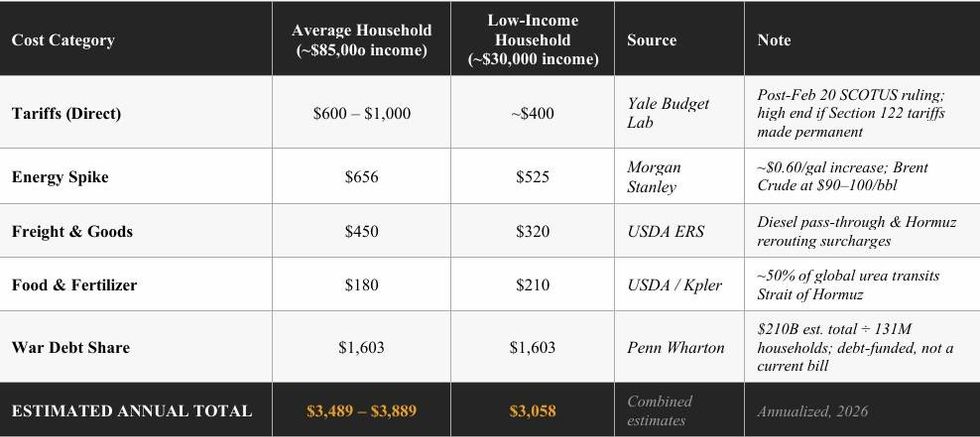
* Sources: Yale Budget Lab "State of Tariffs" Feb 21, 2026 (post-SCOTUS update) · CSIS Cancian & Park "Operation Epic Fury Cost Estimate" Mar 5, 2026 · Penn Wharton Budget Model (Kent Smetters) via Fortune/Daily Beast, Mar 2026 · USDA ERS Farm Policy News · Kpler trade data via Axios Mar 5, 2026 · Morgan Stanley energy analysis Mar 2026 · Stimson Center "Global Markets and the Strait of Hormuz" Mar 4, 2026
**Note: All figures are estimates from independent research institutions. Actual household impact will vary based on income, geography, spending patterns, and the duration and resolution of the Iran conflict. These estimates will be revised as the situation evolves.
On Saturday, February 28th, Americans woke up to find their country at war with Iran. Breaking news alerts carried word that the United States had joined Israel in an unprecedented joint military operation aimed at overturning the Iranian government. The human cost is already jarring: one week in, Al Jazeera's live tracker counts over 1,300 dead in Iran, at least 11 in Israel, 9 in Gulf states, and six American soldiers. But for millions of Americans already struggling through an affordability crisis, a different and urgent question is forming: what will this war cost their families at the pump, in the store, and in their economic futures?
We know that wars are costly. Having extricated ourselves from protracted Middle East conflicts just three years ago, we have clear reference points which are not reassuring. The Costs of War Project at Brown University's Watson Institute estimates that from late 2001 through FY2022, the U.S. spent or obligated $8 trillion on post-9/11 wars: $5.8 trillion in direct costs and at least $2.2 trillion in future veterans' care through 2050. Every dollar in that accounting was a dollar that did not go toward schools, bridges, or health care.
These numbers reflect a long campaign, advocates of this war will say. President Trump has promised resolution in weeks, perhaps months — not years. His supporters point to Venezuela, where a targeted strike deposed a dictator, or to the June 2025 strikes on Iran's nuclear program, as models of swift, decisive action. The math tells a different story.
Operation Midnight Hammer, the June 2025 Iran strikes, alone cost an estimated $2.04 billion to $2.26 billion, according to the Costs of War Project. The regional operations—Yemen, sustainment, Israel support — costed $4.8B to $7.2B. The January–February 2026 naval buildup added another $450M to $650M. In total, from October 2023 through September 2025, the U.S. spent between $9.65 billion and $12.07 billion on military activities across the wider Middle East. These costs were before a single shot was fired in this new war. These are dollars not spent on healthcare, childcare, or the rising prices Americans keep asking policymakers to address.
There is a cost beyond the spending that comes from buying bombs, and Americans are already paying it. Over the course of about a week, oil prices surged 43% to over $100 a barrel. Their highest in years. As of March 9th, gas hit a nationwide average of $3.48 per gallon. When President Trump delivered his State of the Union two weeks ago, gas stood at $2.92, down from $3.11 at his January 2025 inauguration, a benchmark he routinely cited as proof of his economic stewardship. That ground was surrendered in under seven days. Economists estimate that every $10 rise in crude translates to roughly 25 cents at the pump. And gas pricing is not simply about commutes to school and work. It is about getting goods to consumers, which multiplies inflationary pressure across the entire economy.
Transportation disruption along the Strait of Hormuz is no incidental detail. Nearly 20% of the world's oil passes through that narrow chokepoint, which abuts Iran directly. Iran does not need to win a war to impose economic pain on the United States and out allies, it merely needs to threaten that passage credibly. That is what we are seeing in recent fuel price fluctuation.
Critically, this war does not arrive in a vacuum. Before the first bomb dropped, American consumers were already absorbing the most significant tariff increases as a share of GDP since 1993. An estimated average cost of $600 to $800 per household in 2026, with that figure rising toward $1,000 should remaining tariffs be made permanent, according to Yale Budget Lab's analysis following the Supreme Court's February 20th ruling on emergency tariffs. Inflation had cooled to 2.4% in January but remained above the Fed's 2% target, limiting its ability to respond to new economic shocks. Businesses that in 2025 absorbing tariff costs rather than passing them to customers are now widely reported to be making that shift. The war's oil shock lands directly on top of all of it. The war did not create this affordability crisis. It accelerates one already well underway.
Beyond the debt this war will accumulate there is the inflation it will drive into everyday goods, and the fuel costs it will impose on everyone who drives to work, drops children at school, or simply needs to get somewhere. Things are going to cost more. In good times, that would be frustrating. During an affordability crisis, it is what millions can least afford, literally and figuratively.
What does this all mean in real terms for real people? For an average family making around $85,000, based on some of the current fallout of the conflict and tariff pressures there is a tax of between $3,489 and $3,889 annually. And for low-income families, making around $30,000 the cost is over $3,000. It is important to note that this is not exhaustive in what the costs are these families.
History offers three lessons worth holding onto. First, the United States does not have a reliable track record of quick exits from Middle East conflicts. What begins as weeks becomes years, and what is promised as surgical becomes protracted. Second, the financial costs of war consistently exceed early projections; the $8 trillion post-9/11 reckoning was not visible in the confident early days of those campaigns. Third, the burden of those costs, through inflation, debt, higher prices on everyday goods, and lives falls hardest not on those who wage wars. The cost of war falls hardest on those who fill their tanks, buy their groceries, and pay their bills: the poor, the underemployed, and those least equipped to absorb rising prices and stagnant wages.
Sadly, there is a war that weary Americans are urgently waiting to see fought. It is the war on affordability. Right now, painfully few shots are being fired on that front.
* Sources: Yale Budget Lab "State of Tariffs" Feb 21, 2026 (post-SCOTUS update) · CSIS Cancian & Park "Operation Epic Fury Cost Estimate" Mar 5, 2026 · Penn Wharton Budget Model (Kent Smetters) via Fortune/Daily Beast, Mar 2026 · USDA ERS Farm Policy News · Kpler trade data via Axios Mar 5, 2026 · Morgan Stanley energy analysis Mar 2026 · Stimson Center "Global Markets and the Strait of Hormuz" Mar 4, 2026
**Note: All figures are estimates from independent research institutions. Actual household impact will vary based on income, geography, spending patterns, and the duration and resolution of the Iran conflict. These estimates will be revised as the situation evolves.
- Trump's War of Choice in Iran Has Cost US Taxpayers Over $10 Billion in Just 10 Days ›
- Amid Alarm That Trump Has No Plan for Iran, Critic Contends None 'Could Possibly Justify This' ›
- While Cost of Living Soars and Healthcare Taken Away, Trump Spending $1 Billion Per Day in War of Choice With Iran ›
- $1 Billion Daily Cost of Trump's Iran War Could Fund Food Aid, Healthcare for Tens of Millions ›
- Opinion | How the Iran War Could Lead to a Crash Worse Than 2008 | Common Dreams ›
- Opinion | The Costs of Trump's Unnecessary, Illegal War on Iran Keep Mounting | Common Dreams ›
- Trump's Illegal Iran War to Push US Inflation Sharply Higher, OECD Projects | Common Dreams ›
- 'You Should Be Alarmed,' Says Economist as Trump's Iran War Pushes US Gas Past $4 Per Gallon | Common Dreams ›
- Opinion | Let's Be Very Clear: Trump's Iran War Is Making You Poorer | Common Dreams ›
- $2 Billion Per Day Spent by US on Iran War Could Have Saved 87 Million Lives, Says UN Humanitarian Chief | Common Dreams ›
- Opinion | Think of What the US Could Pay For If It Stopped Funding War | Common Dreams ›
- Opinion | Foreign War, Domestic Cost: The Hidden Price of America’s Wars | Common Dreams ›
- Opinion | The Cost of War Comes Due Before the Ballot | Common Dreams ›
On Saturday, February 28th, Americans woke up to find their country at war with Iran. Breaking news alerts carried word that the United States had joined Israel in an unprecedented joint military operation aimed at overturning the Iranian government. The human cost is already jarring: one week in, Al Jazeera's live tracker counts over 1,300 dead in Iran, at least 11 in Israel, 9 in Gulf states, and six American soldiers. But for millions of Americans already struggling through an affordability crisis, a different and urgent question is forming: what will this war cost their families at the pump, in the store, and in their economic futures?
We know that wars are costly. Having extricated ourselves from protracted Middle East conflicts just three years ago, we have clear reference points which are not reassuring. The Costs of War Project at Brown University's Watson Institute estimates that from late 2001 through FY2022, the U.S. spent or obligated $8 trillion on post-9/11 wars: $5.8 trillion in direct costs and at least $2.2 trillion in future veterans' care through 2050. Every dollar in that accounting was a dollar that did not go toward schools, bridges, or health care.
These numbers reflect a long campaign, advocates of this war will say. President Trump has promised resolution in weeks, perhaps months — not years. His supporters point to Venezuela, where a targeted strike deposed a dictator, or to the June 2025 strikes on Iran's nuclear program, as models of swift, decisive action. The math tells a different story.
Operation Midnight Hammer, the June 2025 Iran strikes, alone cost an estimated $2.04 billion to $2.26 billion, according to the Costs of War Project. The regional operations—Yemen, sustainment, Israel support — costed $4.8B to $7.2B. The January–February 2026 naval buildup added another $450M to $650M. In total, from October 2023 through September 2025, the U.S. spent between $9.65 billion and $12.07 billion on military activities across the wider Middle East. These costs were before a single shot was fired in this new war. These are dollars not spent on healthcare, childcare, or the rising prices Americans keep asking policymakers to address.
There is a cost beyond the spending that comes from buying bombs, and Americans are already paying it. Over the course of about a week, oil prices surged 43% to over $100 a barrel. Their highest in years. As of March 9th, gas hit a nationwide average of $3.48 per gallon. When President Trump delivered his State of the Union two weeks ago, gas stood at $2.92, down from $3.11 at his January 2025 inauguration, a benchmark he routinely cited as proof of his economic stewardship. That ground was surrendered in under seven days. Economists estimate that every $10 rise in crude translates to roughly 25 cents at the pump. And gas pricing is not simply about commutes to school and work. It is about getting goods to consumers, which multiplies inflationary pressure across the entire economy.
Transportation disruption along the Strait of Hormuz is no incidental detail. Nearly 20% of the world's oil passes through that narrow chokepoint, which abuts Iran directly. Iran does not need to win a war to impose economic pain on the United States and out allies, it merely needs to threaten that passage credibly. That is what we are seeing in recent fuel price fluctuation.
Critically, this war does not arrive in a vacuum. Before the first bomb dropped, American consumers were already absorbing the most significant tariff increases as a share of GDP since 1993. An estimated average cost of $600 to $800 per household in 2026, with that figure rising toward $1,000 should remaining tariffs be made permanent, according to Yale Budget Lab's analysis following the Supreme Court's February 20th ruling on emergency tariffs. Inflation had cooled to 2.4% in January but remained above the Fed's 2% target, limiting its ability to respond to new economic shocks. Businesses that in 2025 absorbing tariff costs rather than passing them to customers are now widely reported to be making that shift. The war's oil shock lands directly on top of all of it. The war did not create this affordability crisis. It accelerates one already well underway.
Beyond the debt this war will accumulate there is the inflation it will drive into everyday goods, and the fuel costs it will impose on everyone who drives to work, drops children at school, or simply needs to get somewhere. Things are going to cost more. In good times, that would be frustrating. During an affordability crisis, it is what millions can least afford, literally and figuratively.
What does this all mean in real terms for real people? For an average family making around $85,000, based on some of the current fallout of the conflict and tariff pressures there is a tax of between $3,489 and $3,889 annually. And for low-income families, making around $30,000 the cost is over $3,000. It is important to note that this is not exhaustive in what the costs are these families.
History offers three lessons worth holding onto. First, the United States does not have a reliable track record of quick exits from Middle East conflicts. What begins as weeks becomes years, and what is promised as surgical becomes protracted. Second, the financial costs of war consistently exceed early projections; the $8 trillion post-9/11 reckoning was not visible in the confident early days of those campaigns. Third, the burden of those costs, through inflation, debt, higher prices on everyday goods, and lives falls hardest not on those who wage wars. The cost of war falls hardest on those who fill their tanks, buy their groceries, and pay their bills: the poor, the underemployed, and those least equipped to absorb rising prices and stagnant wages.
Sadly, there is a war that weary Americans are urgently waiting to see fought. It is the war on affordability. Right now, painfully few shots are being fired on that front.
* Sources: Yale Budget Lab "State of Tariffs" Feb 21, 2026 (post-SCOTUS update) · CSIS Cancian & Park "Operation Epic Fury Cost Estimate" Mar 5, 2026 · Penn Wharton Budget Model (Kent Smetters) via Fortune/Daily Beast, Mar 2026 · USDA ERS Farm Policy News · Kpler trade data via Axios Mar 5, 2026 · Morgan Stanley energy analysis Mar 2026 · Stimson Center "Global Markets and the Strait of Hormuz" Mar 4, 2026
**Note: All figures are estimates from independent research institutions. Actual household impact will vary based on income, geography, spending patterns, and the duration and resolution of the Iran conflict. These estimates will be revised as the situation evolves.
- Trump's War of Choice in Iran Has Cost US Taxpayers Over $10 Billion in Just 10 Days ›
- Amid Alarm That Trump Has No Plan for Iran, Critic Contends None 'Could Possibly Justify This' ›
- While Cost of Living Soars and Healthcare Taken Away, Trump Spending $1 Billion Per Day in War of Choice With Iran ›
- $1 Billion Daily Cost of Trump's Iran War Could Fund Food Aid, Healthcare for Tens of Millions ›
- Opinion | How the Iran War Could Lead to a Crash Worse Than 2008 | Common Dreams ›
- Opinion | The Costs of Trump's Unnecessary, Illegal War on Iran Keep Mounting | Common Dreams ›
- Trump's Illegal Iran War to Push US Inflation Sharply Higher, OECD Projects | Common Dreams ›
- 'You Should Be Alarmed,' Says Economist as Trump's Iran War Pushes US Gas Past $4 Per Gallon | Common Dreams ›
- Opinion | Let's Be Very Clear: Trump's Iran War Is Making You Poorer | Common Dreams ›
- $2 Billion Per Day Spent by US on Iran War Could Have Saved 87 Million Lives, Says UN Humanitarian Chief | Common Dreams ›
- Opinion | Think of What the US Could Pay For If It Stopped Funding War | Common Dreams ›
- Opinion | Foreign War, Domestic Cost: The Hidden Price of America’s Wars | Common Dreams ›
- Opinion | The Cost of War Comes Due Before the Ballot | Common Dreams ›