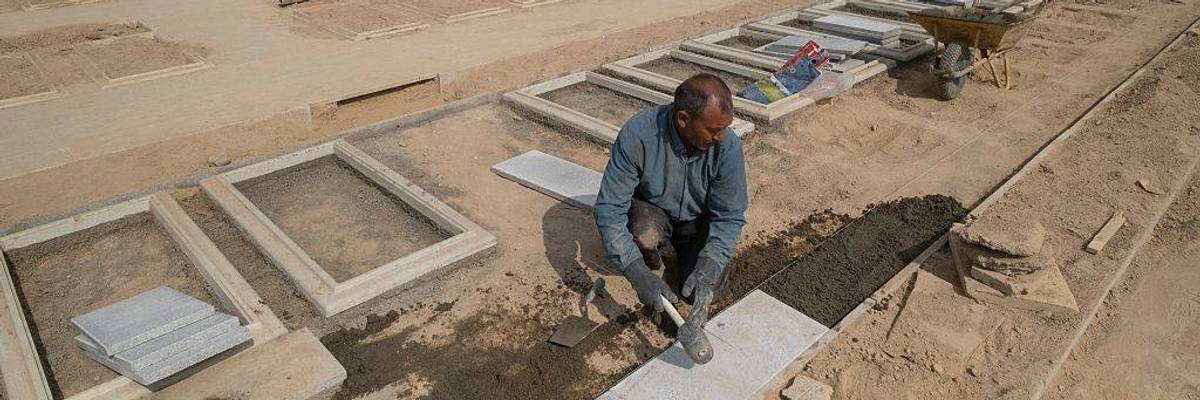
A worker works next to new graves during funerals for those killed in the US-Israeli military campaign at Behesht-e Zahra cemetery in southern Tehran, Iran, on March 9, 2026.
Trump's War of Choice in Iran Has Cost US Taxpayers Over $10 Billion in Just 10 Days
The estimated spending on the Iran war in just over a week amounts to over 1% of the 2026 US defense budget.
The cost of President Donald Trump's unprovoked and unconstitutional war with Iran has already cost US taxpayers billions of dollars, and will cost billions more if the conflict drags on.
Anadolu Ajansı on Monday published an estimate that the Iran war cost $10.35 billion over its first 10 days, or more than 1% of the entire 2026 US defense budget.
The US spent an estimated $779 million in the war's first 24 hours alone, and Anadolu noted that daily costs have gone up since then.
Specifically, Anadolu found that as "the campaign has expanded, operational spending has climbed into the billions, based on estimated flight hours, maintenance costs, and munitions expenditures derived from the US Department of Defense’s 2025 and 2026 budget requests."
In the days since Anadolu published its estimate, the estimated cost of the war has soared past $11 billion, according to a tracker that assumes the assault is costing the US $1 billion per day, based on preliminary figures from the Pentagon.
The Washington Post reported on Monday that the US Department of Defense estimated that it burned through $5.6 billion worth of munitions in the initial strikes on Iran, raising questions about whether the war has seriously eroded US military readiness.
Due to the conflict's rapidly escalating costs, the Trump administration is expected to ask US Congress for a $50 billion supplemental funding bill to keep the war going.
Bobby Kogan, senior director of federal budget policy at the Center for American Progress, and Damian Murphy, senior vice president of national security and international policy at the Center for American Progress, released a memo on Monday explaining why Congress should not agree to any White House requests for supplemental funding.
First, the memo notes that polling shows that the Iran war is unprecedentedly unpopular, being the first US war ever to have a net negative approval rating at the outset of the conflict.
"Lawmakers in Congress have the upper hand both morally and politically in opposing the war in Iran," the memo states. "The public does not want to be drawn into another forever war that threatens American lives, kills children, destabilizes the Middle East, and whose costs could easily balloon to hundreds of billions or even trillions of dollars."
The memo then argues that the massive increase in defense spending contained in the One Big Beautiful Bill Act, which was passed by Republicans in last year and signed into law by Trump, should be more than enough to cover the cost of replacing munitions.
"The 'Big Beautiful Bill' provided an additional $153 billion for defense just eight months ago," the memo explains, "on top of the annual defense budget of around $900 billion. The annual defense appropriations bill, also approved only a few months ago, grants the White House the legal authority and flexibility to move around billions of dollars within the Department of Defense to achieve their goals, known as transfer authority."
We are at a crossroads
This country and this world are at a monumental crossroads. In a few short weeks, US voters will have an opportunity to beat back the forces of fascism and confront the billionaires who are rigging the economy, our media system, and our democracy, making it increasingly impossible for ordinary people to get by. We’re not just talking about the election. We’re talking about what must be done once these fascist elements are vanquished from power. We need a bolder set of solutions than what either major party has so far been willing to offer and a working-class movement ready to fight like hell for it. Trump didn't emerge from nowhere. The conditions that fueled MAGA authoritarianism were created by decades of radical neoliberal economic policies and a corrupt political system dominated by corporate interests. They slashed taxes on the super-rich, promising that the benefits would trickle down. They said giveaways to the corporate titans would make life more affordable for the rest of us. It was all bullshit. And when a bitter, betrayed populace searches for someone to blame, right-wing demagogues have little trouble finding scapegoats. People know when they're being lied to, but you won't hear any of this from the corporate media. Only independent journalism—powered and funded by people who believe in building a better world—can deliver truly trustworthy daily news. Our Fall Campaign is underway, and we need your help. To power our newsroom through the rest of the year, we need to raise $125,000 by midnight on October 31. So if you share our vision, please contribute whatever you can to sustain our work. |
The cost of President Donald Trump's unprovoked and unconstitutional war with Iran has already cost US taxpayers billions of dollars, and will cost billions more if the conflict drags on.
Anadolu Ajansı on Monday published an estimate that the Iran war cost $10.35 billion over its first 10 days, or more than 1% of the entire 2026 US defense budget.
The US spent an estimated $779 million in the war's first 24 hours alone, and Anadolu noted that daily costs have gone up since then.
Specifically, Anadolu found that as "the campaign has expanded, operational spending has climbed into the billions, based on estimated flight hours, maintenance costs, and munitions expenditures derived from the US Department of Defense’s 2025 and 2026 budget requests."
In the days since Anadolu published its estimate, the estimated cost of the war has soared past $11 billion, according to a tracker that assumes the assault is costing the US $1 billion per day, based on preliminary figures from the Pentagon.
The Washington Post reported on Monday that the US Department of Defense estimated that it burned through $5.6 billion worth of munitions in the initial strikes on Iran, raising questions about whether the war has seriously eroded US military readiness.
Due to the conflict's rapidly escalating costs, the Trump administration is expected to ask US Congress for a $50 billion supplemental funding bill to keep the war going.
Bobby Kogan, senior director of federal budget policy at the Center for American Progress, and Damian Murphy, senior vice president of national security and international policy at the Center for American Progress, released a memo on Monday explaining why Congress should not agree to any White House requests for supplemental funding.
First, the memo notes that polling shows that the Iran war is unprecedentedly unpopular, being the first US war ever to have a net negative approval rating at the outset of the conflict.
"Lawmakers in Congress have the upper hand both morally and politically in opposing the war in Iran," the memo states. "The public does not want to be drawn into another forever war that threatens American lives, kills children, destabilizes the Middle East, and whose costs could easily balloon to hundreds of billions or even trillions of dollars."
The memo then argues that the massive increase in defense spending contained in the One Big Beautiful Bill Act, which was passed by Republicans in last year and signed into law by Trump, should be more than enough to cover the cost of replacing munitions.
"The 'Big Beautiful Bill' provided an additional $153 billion for defense just eight months ago," the memo explains, "on top of the annual defense budget of around $900 billion. The annual defense appropriations bill, also approved only a few months ago, grants the White House the legal authority and flexibility to move around billions of dollars within the Department of Defense to achieve their goals, known as transfer authority."
- While Spending Billions on Iran War, Trump Quietly Moves to Boot Millions More Off Food Aid ›
- $1 Billion Daily Cost of Trump's Iran War Could Fund Food Aid, Healthcare for Tens of Millions ›
- While Cost of Living Soars and Healthcare Taken Away, Trump Spending $1 Billion Per Day in War of Choice With Iran ›
- Opinion | The Cost of War: Iran Edition | Common Dreams ›
- 250+ Groups Have Single Message: 'Not One More Penny' for 'Foolish, Destructive' Iran War | Common Dreams ›
- Opinion | Is Trump's Iran War the US Version of the Suez Crisis? | Common Dreams ›
- Opinion | The Costs of Trump's Unnecessary, Illegal War on Iran Keep Mounting | Common Dreams ›
- $2 Billion Per Day Spent by US on Iran War Could Have Saved 87 Million Lives, Says UN Humanitarian Chief | Common Dreams ›
- Economist: Don't Listen to Hegseth, Trump's Iran War Will Cost 'Very Possibly Trillions' | Common Dreams ›
The cost of President Donald Trump's unprovoked and unconstitutional war with Iran has already cost US taxpayers billions of dollars, and will cost billions more if the conflict drags on.
Anadolu Ajansı on Monday published an estimate that the Iran war cost $10.35 billion over its first 10 days, or more than 1% of the entire 2026 US defense budget.
The US spent an estimated $779 million in the war's first 24 hours alone, and Anadolu noted that daily costs have gone up since then.
Specifically, Anadolu found that as "the campaign has expanded, operational spending has climbed into the billions, based on estimated flight hours, maintenance costs, and munitions expenditures derived from the US Department of Defense’s 2025 and 2026 budget requests."
In the days since Anadolu published its estimate, the estimated cost of the war has soared past $11 billion, according to a tracker that assumes the assault is costing the US $1 billion per day, based on preliminary figures from the Pentagon.
The Washington Post reported on Monday that the US Department of Defense estimated that it burned through $5.6 billion worth of munitions in the initial strikes on Iran, raising questions about whether the war has seriously eroded US military readiness.
Due to the conflict's rapidly escalating costs, the Trump administration is expected to ask US Congress for a $50 billion supplemental funding bill to keep the war going.
Bobby Kogan, senior director of federal budget policy at the Center for American Progress, and Damian Murphy, senior vice president of national security and international policy at the Center for American Progress, released a memo on Monday explaining why Congress should not agree to any White House requests for supplemental funding.
First, the memo notes that polling shows that the Iran war is unprecedentedly unpopular, being the first US war ever to have a net negative approval rating at the outset of the conflict.
"Lawmakers in Congress have the upper hand both morally and politically in opposing the war in Iran," the memo states. "The public does not want to be drawn into another forever war that threatens American lives, kills children, destabilizes the Middle East, and whose costs could easily balloon to hundreds of billions or even trillions of dollars."
The memo then argues that the massive increase in defense spending contained in the One Big Beautiful Bill Act, which was passed by Republicans in last year and signed into law by Trump, should be more than enough to cover the cost of replacing munitions.
"The 'Big Beautiful Bill' provided an additional $153 billion for defense just eight months ago," the memo explains, "on top of the annual defense budget of around $900 billion. The annual defense appropriations bill, also approved only a few months ago, grants the White House the legal authority and flexibility to move around billions of dollars within the Department of Defense to achieve their goals, known as transfer authority."
- While Spending Billions on Iran War, Trump Quietly Moves to Boot Millions More Off Food Aid ›
- $1 Billion Daily Cost of Trump's Iran War Could Fund Food Aid, Healthcare for Tens of Millions ›
- While Cost of Living Soars and Healthcare Taken Away, Trump Spending $1 Billion Per Day in War of Choice With Iran ›
- Opinion | The Cost of War: Iran Edition | Common Dreams ›
- 250+ Groups Have Single Message: 'Not One More Penny' for 'Foolish, Destructive' Iran War | Common Dreams ›
- Opinion | Is Trump's Iran War the US Version of the Suez Crisis? | Common Dreams ›
- Opinion | The Costs of Trump's Unnecessary, Illegal War on Iran Keep Mounting | Common Dreams ›
- $2 Billion Per Day Spent by US on Iran War Could Have Saved 87 Million Lives, Says UN Humanitarian Chief | Common Dreams ›
- Economist: Don't Listen to Hegseth, Trump's Iran War Will Cost 'Very Possibly Trillions' | Common Dreams ›