SUBSCRIBE TO OUR FREE NEWSLETTER
Daily news & progressive opinion—funded by the people, not the corporations—delivered straight to your inbox.
5
#000000
#FFFFFF
To donate by check, phone, or other method, see our More Ways to Give page.
Daily news & progressive opinion—funded by the people, not the corporations—delivered straight to your inbox.
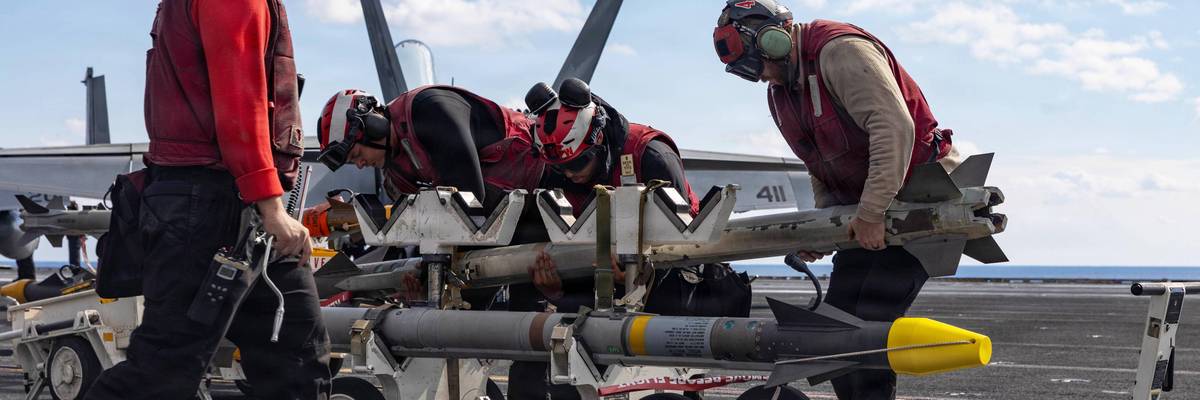
Sailors handle ordnance on the flight deck of the USS Gerald R. Ford in the eastern Mediterranean Sea in support of the US-Israeli war on Iraon on March 2, 2026.
"The interest costs alone will add billions of dollars to the total cost of this war," said Linda Bilmes. "And unlike the upfront costs, these are costs we are explicitly passing on to the next generation."
A Harvard expert who specializes in looking beyond official government estimates to calculate the true financial cost of US wars has said she is "certain" the price tag of President Donald Trump's assault on Iran will eventually reach at least $1 trillion, once benefits for troops, replenishment of munition stockpiles, borrowing costs, and other factors are fully taken into account.
“We are borrowing to finance this war at higher rates, on top of a much larger debt base,” Linda Bilmes, the Daniel Patrick Moynihan senior lecturer in public policy at the Harvard Kennedy School, said in a recent interview. "The result is that the interest costs alone will add billions of dollars to the total cost of this war. And unlike the upfront costs, these are costs we are explicitly passing on to the next generation."
Bilmes, who co-authored The Three Trillion Dollar War: The True Cost of the Iraq Conflict with Nobel laureate economist Joseph Stiglitz, estimates that the first several days of the US-Israeli assault on Iran cost American taxpayers at least $16 billion—significantly more than the Pentagon's official figure, $11.3 billion.
"The short-term costs are even higher than they appear," Bilmes emphasized. "The Pentagon reports costs based on the historical value of inventory, instead of the actual cost it takes to replace what we are using. And those replacement costs are far higher."
Bilmes also pointed to the substantial costs of "large, multi-year contracts" the Trump administration has inked with arms manufacturers such as Lockheed Martin.
Over the long-term, said Bilmes, the cost of veterans' care will be massive. "We now have roughly 55,000 US troops deployed in this conflict who have been exposed to toxins, contaminants, and environmental hazards, such as burning fuel and chemical residues that we know can cause long-term harm," she noted. "If even one-third of the 55,000 troops deployed today claim benefits, then we are committing ourselves to tens or hundreds of billions of dollars in disability and medical care costs for this cohort alone."
"I am certain we will spend $1 trillion for the Iran war," Bilmes said. "Perhaps we have already racked up that amount."
The Trump administration is expected to request that Congress approve between $80 billion and $100 billion in funding for the Iran war, according to The Washington Post. Earlier this month, the Trump White House released a budget proposal that called for $1.5 trillion in military spending next fiscal year.
Bilmes noted that if Trump's request is fully enacted, US military spending would rise "to levels about 20% higher than the peak reached during World War Two."
"This raises the baseline," Bilmes said. "Even if Congress does not agree to approve the full increase, it is highly likely that at least $100 billion per year will be added to the base defense budget that would not have been approved in the absence of this war."
"And once that increase is built into the base," she added, "it raises the baseline and compounds—so an additional $100 billion per year is $1 trillion over the next decade."
Dear Common Dreams reader, It’s been nearly 30 years since I co-founded Common Dreams with my late wife, Lina Newhouser. We had the radical notion that journalism should serve the public good, not corporate profits. It was clear to us from the outset what it would take to build such a project. No paid advertisements. No corporate sponsors. No millionaire publisher telling us what to think or do. Many people said we wouldn't last a year, but we proved those doubters wrong. Together with a tremendous team of journalists and dedicated staff, we built an independent media outlet free from the constraints of profits and corporate control. Our mission has always been simple: To inform. To inspire. To ignite change for the common good. Building Common Dreams was not easy. Our survival was never guaranteed. When you take on the most powerful forces—Wall Street greed, fossil fuel industry destruction, Big Tech lobbyists, and uber-rich oligarchs who have spent billions upon billions rigging the economy and democracy in their favor—the only bulwark you have is supporters who believe in your work. But here’s the urgent message from me today. It's never been this bad out there. And it's never been this hard to keep us going. At the very moment Common Dreams is most needed, the threats we face are intensifying. We need your support now more than ever. We don't accept corporate advertising and never will. We don't have a paywall because we don't think people should be blocked from critical news based on their ability to pay. Everything we do is funded by the donations of readers like you. When everyone does the little they can afford, we are strong. But if that support retreats or dries up, so do we. Will you donate now to make sure Common Dreams not only survives but thrives? —Craig Brown, Co-founder |
A Harvard expert who specializes in looking beyond official government estimates to calculate the true financial cost of US wars has said she is "certain" the price tag of President Donald Trump's assault on Iran will eventually reach at least $1 trillion, once benefits for troops, replenishment of munition stockpiles, borrowing costs, and other factors are fully taken into account.
“We are borrowing to finance this war at higher rates, on top of a much larger debt base,” Linda Bilmes, the Daniel Patrick Moynihan senior lecturer in public policy at the Harvard Kennedy School, said in a recent interview. "The result is that the interest costs alone will add billions of dollars to the total cost of this war. And unlike the upfront costs, these are costs we are explicitly passing on to the next generation."
Bilmes, who co-authored The Three Trillion Dollar War: The True Cost of the Iraq Conflict with Nobel laureate economist Joseph Stiglitz, estimates that the first several days of the US-Israeli assault on Iran cost American taxpayers at least $16 billion—significantly more than the Pentagon's official figure, $11.3 billion.
"The short-term costs are even higher than they appear," Bilmes emphasized. "The Pentagon reports costs based on the historical value of inventory, instead of the actual cost it takes to replace what we are using. And those replacement costs are far higher."
Bilmes also pointed to the substantial costs of "large, multi-year contracts" the Trump administration has inked with arms manufacturers such as Lockheed Martin.
Over the long-term, said Bilmes, the cost of veterans' care will be massive. "We now have roughly 55,000 US troops deployed in this conflict who have been exposed to toxins, contaminants, and environmental hazards, such as burning fuel and chemical residues that we know can cause long-term harm," she noted. "If even one-third of the 55,000 troops deployed today claim benefits, then we are committing ourselves to tens or hundreds of billions of dollars in disability and medical care costs for this cohort alone."
"I am certain we will spend $1 trillion for the Iran war," Bilmes said. "Perhaps we have already racked up that amount."
The Trump administration is expected to request that Congress approve between $80 billion and $100 billion in funding for the Iran war, according to The Washington Post. Earlier this month, the Trump White House released a budget proposal that called for $1.5 trillion in military spending next fiscal year.
Bilmes noted that if Trump's request is fully enacted, US military spending would rise "to levels about 20% higher than the peak reached during World War Two."
"This raises the baseline," Bilmes said. "Even if Congress does not agree to approve the full increase, it is highly likely that at least $100 billion per year will be added to the base defense budget that would not have been approved in the absence of this war."
"And once that increase is built into the base," she added, "it raises the baseline and compounds—so an additional $100 billion per year is $1 trillion over the next decade."
A Harvard expert who specializes in looking beyond official government estimates to calculate the true financial cost of US wars has said she is "certain" the price tag of President Donald Trump's assault on Iran will eventually reach at least $1 trillion, once benefits for troops, replenishment of munition stockpiles, borrowing costs, and other factors are fully taken into account.
“We are borrowing to finance this war at higher rates, on top of a much larger debt base,” Linda Bilmes, the Daniel Patrick Moynihan senior lecturer in public policy at the Harvard Kennedy School, said in a recent interview. "The result is that the interest costs alone will add billions of dollars to the total cost of this war. And unlike the upfront costs, these are costs we are explicitly passing on to the next generation."
Bilmes, who co-authored The Three Trillion Dollar War: The True Cost of the Iraq Conflict with Nobel laureate economist Joseph Stiglitz, estimates that the first several days of the US-Israeli assault on Iran cost American taxpayers at least $16 billion—significantly more than the Pentagon's official figure, $11.3 billion.
"The short-term costs are even higher than they appear," Bilmes emphasized. "The Pentagon reports costs based on the historical value of inventory, instead of the actual cost it takes to replace what we are using. And those replacement costs are far higher."
Bilmes also pointed to the substantial costs of "large, multi-year contracts" the Trump administration has inked with arms manufacturers such as Lockheed Martin.
Over the long-term, said Bilmes, the cost of veterans' care will be massive. "We now have roughly 55,000 US troops deployed in this conflict who have been exposed to toxins, contaminants, and environmental hazards, such as burning fuel and chemical residues that we know can cause long-term harm," she noted. "If even one-third of the 55,000 troops deployed today claim benefits, then we are committing ourselves to tens or hundreds of billions of dollars in disability and medical care costs for this cohort alone."
"I am certain we will spend $1 trillion for the Iran war," Bilmes said. "Perhaps we have already racked up that amount."
The Trump administration is expected to request that Congress approve between $80 billion and $100 billion in funding for the Iran war, according to The Washington Post. Earlier this month, the Trump White House released a budget proposal that called for $1.5 trillion in military spending next fiscal year.
Bilmes noted that if Trump's request is fully enacted, US military spending would rise "to levels about 20% higher than the peak reached during World War Two."
"This raises the baseline," Bilmes said. "Even if Congress does not agree to approve the full increase, it is highly likely that at least $100 billion per year will be added to the base defense budget that would not have been approved in the absence of this war."
"And once that increase is built into the base," she added, "it raises the baseline and compounds—so an additional $100 billion per year is $1 trillion over the next decade."