SUBSCRIBE TO OUR FREE NEWSLETTER
Daily news & progressive opinion—funded by the people, not the corporations—delivered straight to your inbox.
5
#000000
#FFFFFF
To donate by check, phone, or other method, see our More Ways to Give page.
Daily news & progressive opinion—funded by the people, not the corporations—delivered straight to your inbox.
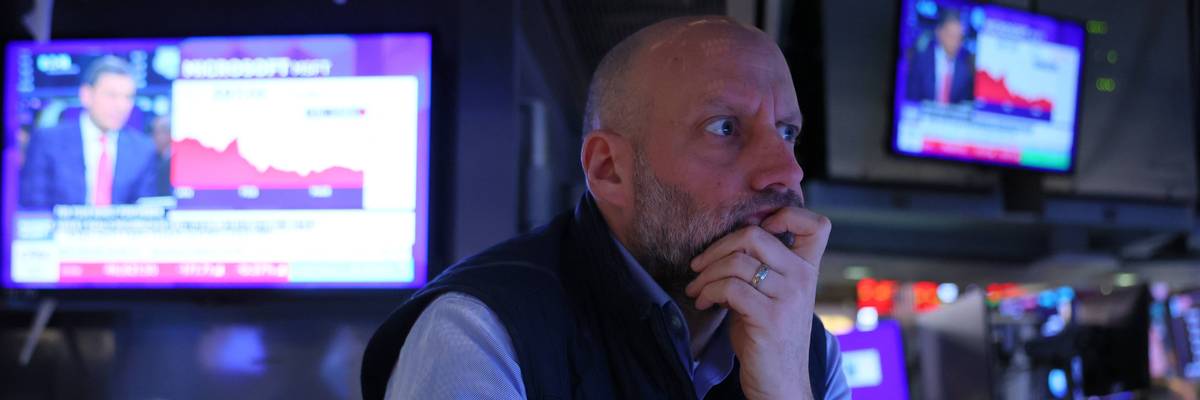
Traders work on the floor of the New York Stock Exchange during morning trading on March 18, 2026 in New York City.
It’s too late to prevent the inflation of an AI bubble or to advise against a US attack on Tehran. At this point, the most we can do is to hope for a quick end to the war and for some improvisational brilliance among the world’s leaders of government and finance.
Several commentators have remarked that the United States’ war on Iran carries echoes of 2008. I’ll argue here that a potential financial crash this year could actually be much worse.
The Global Financial Crisis (GFC) of 2008 was the biggest economic crunch since the Great Depression. Unemployment surged, topping 10% in the US. Global stocks lost trillions of dollars in value. Major brokerage houses collapsed. The US auto industry only survived thanks to enormous government bailouts. How could another crash top that?
Consider the causes. The 2008 Great Recession resulted from a confluence of three factors:
The resulting unwinding of debt and derivatives came within a hair’s breadth of turning into a massive bank run and general economic collapse. Governments (led by the US) bailed out industries and banks, lowered interest rates to zero, purchased large tranches of financial securities, and instituted enormous fiscal stimulus programs and tax cuts. Even with these rapid and maximum-scale efforts totaling hundreds of billions of dollars, the GFC led to widespread housing foreclosures, a near-40% downturn in the S&P 500, and a substantial increase in the poverty rate.
Now consider the following:
In view of the possibly catastrophic consequences of the attack on Iran, many people wonder what motives could have justified it. Logan McMillen argues in Foreign Policy in Focus that the so-called “Donroe Doctrine” intends to freeze China out of the Western Hemisphere and to deprive it of cheap energy:
The strategy is entirely zero-sum. By turning the Middle East and the Caribbean into militarized chokepoints, the United States is suffocating China’s independent oil supply lines, starving its industrial capacity while guaranteeing temporary windfall profits for Western supermajors. Concurrently, from the lithium flats of Bolivia to the ports of Peru, Washington is deploying right-wing proxies and military coercion to systematically dispossess Chinese capital in Latin America, re-colonizing the Andes to secure the supply chains of the 21st century.
Other commentators see the war as being spearheaded by members of the Christian Zionist movement, which desires a fulfillment of biblical prophecies of the battle of Armageddon and the return of Jesus.
Even if McMillen’s analysis is sound and there is an arguably rational motive behind the war, that doesn’t mean the campaign will go according to plan or that it will achieve its aims. Many analysts see it already careening off the rails.
It’s too late to prevent the inflation of an AI bubble or to advise against a US attack on Tehran. At this point, the most we can do is to hope for a quick end to the war and for some improvisational brilliance among the world’s leaders of government and finance.
Meanwhile, it would be smart to make whatever preparations you can. For folks in the Northern Hemisphere, it’s time to start planning this spring’s food garden. You might want to plant a few more rows of beans than you do most years, so you have enough to share with neighbors.
Dear Common Dreams reader, It’s been nearly 30 years since I co-founded Common Dreams with my late wife, Lina Newhouser. We had the radical notion that journalism should serve the public good, not corporate profits. It was clear to us from the outset what it would take to build such a project. No paid advertisements. No corporate sponsors. No millionaire publisher telling us what to think or do. Many people said we wouldn't last a year, but we proved those doubters wrong. Together with a tremendous team of journalists and dedicated staff, we built an independent media outlet free from the constraints of profits and corporate control. Our mission has always been simple: To inform. To inspire. To ignite change for the common good. Building Common Dreams was not easy. Our survival was never guaranteed. When you take on the most powerful forces—Wall Street greed, fossil fuel industry destruction, Big Tech lobbyists, and uber-rich oligarchs who have spent billions upon billions rigging the economy and democracy in their favor—the only bulwark you have is supporters who believe in your work. But here’s the urgent message from me today. It's never been this bad out there. And it's never been this hard to keep us going. At the very moment Common Dreams is most needed, the threats we face are intensifying. We need your support now more than ever. We don't accept corporate advertising and never will. We don't have a paywall because we don't think people should be blocked from critical news based on their ability to pay. Everything we do is funded by the donations of readers like you. When everyone does the little they can afford, we are strong. But if that support retreats or dries up, so do we. Will you donate now to make sure Common Dreams not only survives but thrives? —Craig Brown, Co-founder |
Several commentators have remarked that the United States’ war on Iran carries echoes of 2008. I’ll argue here that a potential financial crash this year could actually be much worse.
The Global Financial Crisis (GFC) of 2008 was the biggest economic crunch since the Great Depression. Unemployment surged, topping 10% in the US. Global stocks lost trillions of dollars in value. Major brokerage houses collapsed. The US auto industry only survived thanks to enormous government bailouts. How could another crash top that?
Consider the causes. The 2008 Great Recession resulted from a confluence of three factors:
The resulting unwinding of debt and derivatives came within a hair’s breadth of turning into a massive bank run and general economic collapse. Governments (led by the US) bailed out industries and banks, lowered interest rates to zero, purchased large tranches of financial securities, and instituted enormous fiscal stimulus programs and tax cuts. Even with these rapid and maximum-scale efforts totaling hundreds of billions of dollars, the GFC led to widespread housing foreclosures, a near-40% downturn in the S&P 500, and a substantial increase in the poverty rate.
Now consider the following:
In view of the possibly catastrophic consequences of the attack on Iran, many people wonder what motives could have justified it. Logan McMillen argues in Foreign Policy in Focus that the so-called “Donroe Doctrine” intends to freeze China out of the Western Hemisphere and to deprive it of cheap energy:
The strategy is entirely zero-sum. By turning the Middle East and the Caribbean into militarized chokepoints, the United States is suffocating China’s independent oil supply lines, starving its industrial capacity while guaranteeing temporary windfall profits for Western supermajors. Concurrently, from the lithium flats of Bolivia to the ports of Peru, Washington is deploying right-wing proxies and military coercion to systematically dispossess Chinese capital in Latin America, re-colonizing the Andes to secure the supply chains of the 21st century.
Other commentators see the war as being spearheaded by members of the Christian Zionist movement, which desires a fulfillment of biblical prophecies of the battle of Armageddon and the return of Jesus.
Even if McMillen’s analysis is sound and there is an arguably rational motive behind the war, that doesn’t mean the campaign will go according to plan or that it will achieve its aims. Many analysts see it already careening off the rails.
It’s too late to prevent the inflation of an AI bubble or to advise against a US attack on Tehran. At this point, the most we can do is to hope for a quick end to the war and for some improvisational brilliance among the world’s leaders of government and finance.
Meanwhile, it would be smart to make whatever preparations you can. For folks in the Northern Hemisphere, it’s time to start planning this spring’s food garden. You might want to plant a few more rows of beans than you do most years, so you have enough to share with neighbors.
Several commentators have remarked that the United States’ war on Iran carries echoes of 2008. I’ll argue here that a potential financial crash this year could actually be much worse.
The Global Financial Crisis (GFC) of 2008 was the biggest economic crunch since the Great Depression. Unemployment surged, topping 10% in the US. Global stocks lost trillions of dollars in value. Major brokerage houses collapsed. The US auto industry only survived thanks to enormous government bailouts. How could another crash top that?
Consider the causes. The 2008 Great Recession resulted from a confluence of three factors:
The resulting unwinding of debt and derivatives came within a hair’s breadth of turning into a massive bank run and general economic collapse. Governments (led by the US) bailed out industries and banks, lowered interest rates to zero, purchased large tranches of financial securities, and instituted enormous fiscal stimulus programs and tax cuts. Even with these rapid and maximum-scale efforts totaling hundreds of billions of dollars, the GFC led to widespread housing foreclosures, a near-40% downturn in the S&P 500, and a substantial increase in the poverty rate.
Now consider the following:
In view of the possibly catastrophic consequences of the attack on Iran, many people wonder what motives could have justified it. Logan McMillen argues in Foreign Policy in Focus that the so-called “Donroe Doctrine” intends to freeze China out of the Western Hemisphere and to deprive it of cheap energy:
The strategy is entirely zero-sum. By turning the Middle East and the Caribbean into militarized chokepoints, the United States is suffocating China’s independent oil supply lines, starving its industrial capacity while guaranteeing temporary windfall profits for Western supermajors. Concurrently, from the lithium flats of Bolivia to the ports of Peru, Washington is deploying right-wing proxies and military coercion to systematically dispossess Chinese capital in Latin America, re-colonizing the Andes to secure the supply chains of the 21st century.
Other commentators see the war as being spearheaded by members of the Christian Zionist movement, which desires a fulfillment of biblical prophecies of the battle of Armageddon and the return of Jesus.
Even if McMillen’s analysis is sound and there is an arguably rational motive behind the war, that doesn’t mean the campaign will go according to plan or that it will achieve its aims. Many analysts see it already careening off the rails.
It’s too late to prevent the inflation of an AI bubble or to advise against a US attack on Tehran. At this point, the most we can do is to hope for a quick end to the war and for some improvisational brilliance among the world’s leaders of government and finance.
Meanwhile, it would be smart to make whatever preparations you can. For folks in the Northern Hemisphere, it’s time to start planning this spring’s food garden. You might want to plant a few more rows of beans than you do most years, so you have enough to share with neighbors.