SUBSCRIBE TO OUR FREE NEWSLETTER
Daily news & progressive opinion—funded by the people, not the corporations—delivered straight to your inbox.
5
#000000
#FFFFFF
To donate by check, phone, or other method, see our More Ways to Give page.
Daily news & progressive opinion—funded by the people, not the corporations—delivered straight to your inbox.
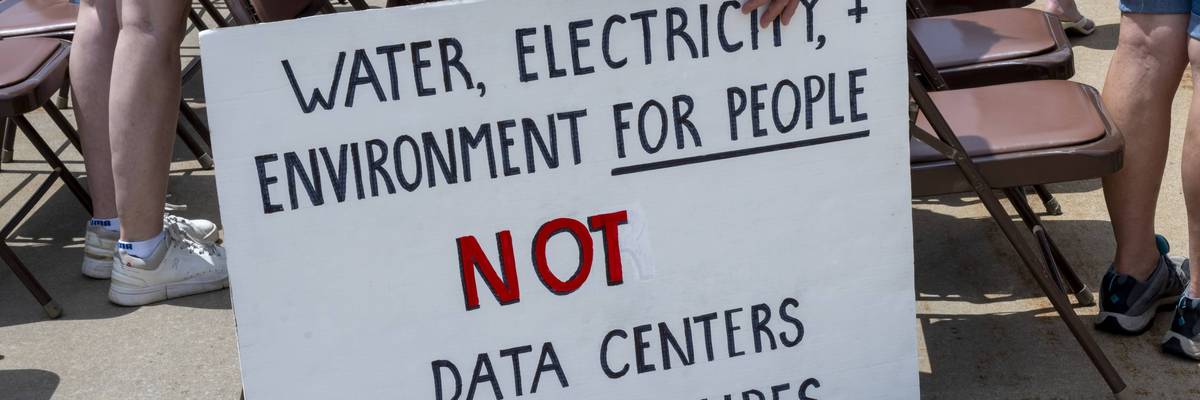
Someone carries a poster in a Mother Earth Vs Big Tech Petition rally at the capitol in Saint Paul, Minnesota.
The anti-fracking movement and the Inflation Reduction Act coalition were both built in part on early philanthropic bets on local and national organizing; data center resistance can follow the same pattern, but only if the money shows up while the moment is live.
The fastest-growing movement in the country is running on almost no institutional money, and it's effectively fighting against some of the world’s most rapacious billionaires.
It is an organic, grassroots movement to stop AI data centers.
Data centers not only raise electricity bills, they are draining water often already in short supply, drive pollution and emissions, and are routinely negotiated in secret.
Communities have figured this out faster than local governments, and with stunning success, local groups are winning their campaigns against data center projects all over the country.
Fund the organizers and trainers who can turn 833 local fights into a coherent national and international movement without flattening what makes each one local. And fund fast.
Opponents successfully blocked or delayed at least 75 projects worth roughly $130 billion in the first quarter of 2026, matching all of 2025 in three months. Active opposition groups more than doubled to 833 across 49 states. Legislators filed more than 300 data center bills in the first six weeks of the year.
None of this came from a philanthropic strategy, but rather from neighbors and unlikely allies in church basements and county planning hearings.
Movements at this stage have energy and passion. And they have potential and momentum. But what they don't have is the resources that can sustain a strategic fight. No staff to hold momentum between hearings, no legal defense when developers sue, no trainers to turn a first-time zoning meeting attendee into an organizer, and nothing linking the fight in Prince William County to the ones in Hancock County, South Jersey, Dublin, and Santiago.
The anti-fracking movement and the coalition behind the Inflation Reduction Act were both built in part on early philanthropic bets on local and national organizing. Data center resistance can follow the same pattern, but only if the money shows up while the moment is live.
As the most significant institutional funder of non-violent, disruptive climate activism, Climate Emergency Fund directs resources where grassroots energy, public concern, and campaign opportunity most clearly align. Right now, that is the AI data center resistance. So far in 2026, more than a third of our granted support has gone to groups planning campaigns around data centers and AI. Our venture philanthropy model moves early-stage funding to new groups fast, sometimes before they have a name, and stays close through what we call intensive accompaniment. The data center fight rewards exactly this approach, because the decisive moments are rezoning votes and permit hearings that will not wait for a grant cycle.
I know the objections, because I hear them from funders and civil society. Some say climate philanthropy should retreat to safer ground while nonprofits are under attack. Some, following the Gates Foundation's lead, want to pivot to affordability. Others, like Sunrise Movement, argue the fight against authoritarianism comes first. I understand all three impulses, and I think the data center fight answers all three.
This is the affordability issue: Electricity prices are, as Charles Hua of the consumer group PowerLines put it, “the new eggs,” with residential bills in Indiana up 17.5% in a year and Georgia Power customers absorbing six rate increases in two years.
This is the democracy issue: communities discovering projects negotiated in secret, behind nondisclosure agreements and shell companies, then organizing to demand consent. They understand fundamentally that the future belongs to all of us, not just seven tech billionaires and their allies.
And it is the climate issue: The International Energy Agency projects that gas and coal will meet more than 40% of new data center electricity demand through 2030, with retired coal plants at risk of coming back online.
Funders do not have to choose among their priorities here. This is the nexus.
It is also, frankly, the most defensible grant a climate or democracy funder can make. At the very least, supporting a community group that testifies or protests at a county board meeting is constitutionally protected, small-d democratic activity with bipartisan support. What a strange thing that fear of an administration touting threats against “anti-tech extremism” would cause funder retrenchment around perhaps the most politically unifying issue we’ve seen in a generation. In an era when funders worry about risk, this is what low risk and high leverage look like at the same time.
So the ask is specific. Fund general operating support, because these groups need salaries, not deliverables. Fund pooled legal defense, because litigation designed to drain and intimidate is coming. Fund the organizers and trainers who can turn 833 local fights into a coherent national and international movement without flattening what makes each one local. And fund fast.
Philanthropy likes to say it provides risk capital for social change. The people are already in the room. The only question is whether we will fund them to stay there.
Dear Common Dreams reader, It’s been nearly 30 years since I co-founded Common Dreams with my late wife, Lina Newhouser. We had the radical notion that journalism should serve the public good, not corporate profits. It was clear to us from the outset what it would take to build such a project. No paid advertisements. No corporate sponsors. No millionaire publisher telling us what to think or do. Many people said we wouldn't last a year, but we proved those doubters wrong. Together with a tremendous team of journalists and dedicated staff, we built an independent media outlet free from the constraints of profits and corporate control. Our mission has always been simple: To inform. To inspire. To ignite change for the common good. Building Common Dreams was not easy. Our survival was never guaranteed. When you take on the most powerful forces—Wall Street greed, fossil fuel industry destruction, Big Tech lobbyists, and uber-rich oligarchs who have spent billions upon billions rigging the economy and democracy in their favor—the only bulwark you have is supporters who believe in your work. But here’s the urgent message from me today. It's never been this bad out there. And it's never been this hard to keep us going. At the very moment Common Dreams is most needed, the threats we face are intensifying. We need your support now more than ever. We don't accept corporate advertising and never will. We don't have a paywall because we don't think people should be blocked from critical news based on their ability to pay. Everything we do is funded by the donations of readers like you. When everyone does the little they can afford, we are strong. But if that support retreats or dries up, so do we. Will you donate now to make sure Common Dreams not only survives but thrives? —Craig Brown, Co-founder |
The fastest-growing movement in the country is running on almost no institutional money, and it's effectively fighting against some of the world’s most rapacious billionaires.
It is an organic, grassroots movement to stop AI data centers.
Data centers not only raise electricity bills, they are draining water often already in short supply, drive pollution and emissions, and are routinely negotiated in secret.
Communities have figured this out faster than local governments, and with stunning success, local groups are winning their campaigns against data center projects all over the country.
Fund the organizers and trainers who can turn 833 local fights into a coherent national and international movement without flattening what makes each one local. And fund fast.
Opponents successfully blocked or delayed at least 75 projects worth roughly $130 billion in the first quarter of 2026, matching all of 2025 in three months. Active opposition groups more than doubled to 833 across 49 states. Legislators filed more than 300 data center bills in the first six weeks of the year.
None of this came from a philanthropic strategy, but rather from neighbors and unlikely allies in church basements and county planning hearings.
Movements at this stage have energy and passion. And they have potential and momentum. But what they don't have is the resources that can sustain a strategic fight. No staff to hold momentum between hearings, no legal defense when developers sue, no trainers to turn a first-time zoning meeting attendee into an organizer, and nothing linking the fight in Prince William County to the ones in Hancock County, South Jersey, Dublin, and Santiago.
The anti-fracking movement and the coalition behind the Inflation Reduction Act were both built in part on early philanthropic bets on local and national organizing. Data center resistance can follow the same pattern, but only if the money shows up while the moment is live.
As the most significant institutional funder of non-violent, disruptive climate activism, Climate Emergency Fund directs resources where grassroots energy, public concern, and campaign opportunity most clearly align. Right now, that is the AI data center resistance. So far in 2026, more than a third of our granted support has gone to groups planning campaigns around data centers and AI. Our venture philanthropy model moves early-stage funding to new groups fast, sometimes before they have a name, and stays close through what we call intensive accompaniment. The data center fight rewards exactly this approach, because the decisive moments are rezoning votes and permit hearings that will not wait for a grant cycle.
I know the objections, because I hear them from funders and civil society. Some say climate philanthropy should retreat to safer ground while nonprofits are under attack. Some, following the Gates Foundation's lead, want to pivot to affordability. Others, like Sunrise Movement, argue the fight against authoritarianism comes first. I understand all three impulses, and I think the data center fight answers all three.
This is the affordability issue: Electricity prices are, as Charles Hua of the consumer group PowerLines put it, “the new eggs,” with residential bills in Indiana up 17.5% in a year and Georgia Power customers absorbing six rate increases in two years.
This is the democracy issue: communities discovering projects negotiated in secret, behind nondisclosure agreements and shell companies, then organizing to demand consent. They understand fundamentally that the future belongs to all of us, not just seven tech billionaires and their allies.
And it is the climate issue: The International Energy Agency projects that gas and coal will meet more than 40% of new data center electricity demand through 2030, with retired coal plants at risk of coming back online.
Funders do not have to choose among their priorities here. This is the nexus.
It is also, frankly, the most defensible grant a climate or democracy funder can make. At the very least, supporting a community group that testifies or protests at a county board meeting is constitutionally protected, small-d democratic activity with bipartisan support. What a strange thing that fear of an administration touting threats against “anti-tech extremism” would cause funder retrenchment around perhaps the most politically unifying issue we’ve seen in a generation. In an era when funders worry about risk, this is what low risk and high leverage look like at the same time.
So the ask is specific. Fund general operating support, because these groups need salaries, not deliverables. Fund pooled legal defense, because litigation designed to drain and intimidate is coming. Fund the organizers and trainers who can turn 833 local fights into a coherent national and international movement without flattening what makes each one local. And fund fast.
Philanthropy likes to say it provides risk capital for social change. The people are already in the room. The only question is whether we will fund them to stay there.
The fastest-growing movement in the country is running on almost no institutional money, and it's effectively fighting against some of the world’s most rapacious billionaires.
It is an organic, grassroots movement to stop AI data centers.
Data centers not only raise electricity bills, they are draining water often already in short supply, drive pollution and emissions, and are routinely negotiated in secret.
Communities have figured this out faster than local governments, and with stunning success, local groups are winning their campaigns against data center projects all over the country.
Fund the organizers and trainers who can turn 833 local fights into a coherent national and international movement without flattening what makes each one local. And fund fast.
Opponents successfully blocked or delayed at least 75 projects worth roughly $130 billion in the first quarter of 2026, matching all of 2025 in three months. Active opposition groups more than doubled to 833 across 49 states. Legislators filed more than 300 data center bills in the first six weeks of the year.
None of this came from a philanthropic strategy, but rather from neighbors and unlikely allies in church basements and county planning hearings.
Movements at this stage have energy and passion. And they have potential and momentum. But what they don't have is the resources that can sustain a strategic fight. No staff to hold momentum between hearings, no legal defense when developers sue, no trainers to turn a first-time zoning meeting attendee into an organizer, and nothing linking the fight in Prince William County to the ones in Hancock County, South Jersey, Dublin, and Santiago.
The anti-fracking movement and the coalition behind the Inflation Reduction Act were both built in part on early philanthropic bets on local and national organizing. Data center resistance can follow the same pattern, but only if the money shows up while the moment is live.
As the most significant institutional funder of non-violent, disruptive climate activism, Climate Emergency Fund directs resources where grassroots energy, public concern, and campaign opportunity most clearly align. Right now, that is the AI data center resistance. So far in 2026, more than a third of our granted support has gone to groups planning campaigns around data centers and AI. Our venture philanthropy model moves early-stage funding to new groups fast, sometimes before they have a name, and stays close through what we call intensive accompaniment. The data center fight rewards exactly this approach, because the decisive moments are rezoning votes and permit hearings that will not wait for a grant cycle.
I know the objections, because I hear them from funders and civil society. Some say climate philanthropy should retreat to safer ground while nonprofits are under attack. Some, following the Gates Foundation's lead, want to pivot to affordability. Others, like Sunrise Movement, argue the fight against authoritarianism comes first. I understand all three impulses, and I think the data center fight answers all three.
This is the affordability issue: Electricity prices are, as Charles Hua of the consumer group PowerLines put it, “the new eggs,” with residential bills in Indiana up 17.5% in a year and Georgia Power customers absorbing six rate increases in two years.
This is the democracy issue: communities discovering projects negotiated in secret, behind nondisclosure agreements and shell companies, then organizing to demand consent. They understand fundamentally that the future belongs to all of us, not just seven tech billionaires and their allies.
And it is the climate issue: The International Energy Agency projects that gas and coal will meet more than 40% of new data center electricity demand through 2030, with retired coal plants at risk of coming back online.
Funders do not have to choose among their priorities here. This is the nexus.
It is also, frankly, the most defensible grant a climate or democracy funder can make. At the very least, supporting a community group that testifies or protests at a county board meeting is constitutionally protected, small-d democratic activity with bipartisan support. What a strange thing that fear of an administration touting threats against “anti-tech extremism” would cause funder retrenchment around perhaps the most politically unifying issue we’ve seen in a generation. In an era when funders worry about risk, this is what low risk and high leverage look like at the same time.
So the ask is specific. Fund general operating support, because these groups need salaries, not deliverables. Fund pooled legal defense, because litigation designed to drain and intimidate is coming. Fund the organizers and trainers who can turn 833 local fights into a coherent national and international movement without flattening what makes each one local. And fund fast.
Philanthropy likes to say it provides risk capital for social change. The people are already in the room. The only question is whether we will fund them to stay there.