SUBSCRIBE TO OUR FREE NEWSLETTER
Daily news & progressive opinion—funded by the people, not the corporations—delivered straight to your inbox.
5
#000000
#FFFFFF
To donate by check, phone, or other method, see our More Ways to Give page.
Daily news & progressive opinion—funded by the people, not the corporations—delivered straight to your inbox.
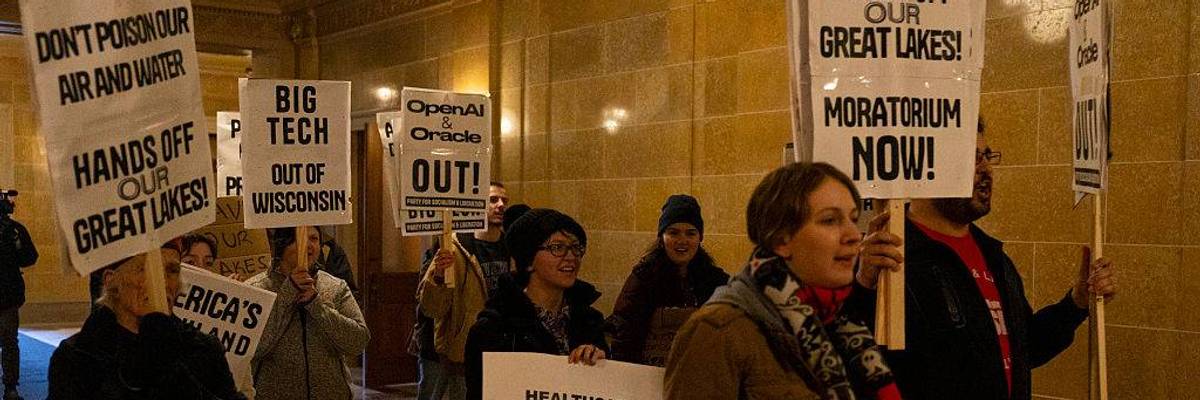
Protesters gather for a statewide data center day of action at the Wisconsin State Capitol on February 12, 2026 in Madison, Wisconsin.
“This is really setting a precedent,” said one activist. "This is something that other communities can look to."
The nationwide backlash against the artificial intelligence industry entered a new stage on Tuesday after a small Wisconsin city overwhelmingly passed a first-of-its-kind referendum limiting AI data center construction.
According to a Wednesday report in Politico, voters in the Milwaukee suburb of Port Washington, home to roughly 12,000 residents, supported the data center restrictions by a margin of around 2-to-1.
The referendus requires town officials to seek voter permission before approving or providing tax incentives for any future data centers in the community, giving residents veto power over new projects.
Port Washington is already home to a $15 billion, 1.3-gigawatt data center funded by tech giants Oracle and OpenAI, and local residents wanted to ensure that no additional facilities are green lit without their express approval.
The referendum was pushed by a grassroots community organization called Great Lakes Neighbors United, which advocates "advancing transparency, environmental stewardship, and responsible development in Wisconsin."
Christine Le Jeune, founder of Great Lakes Neighbors United, told Politico that she hopes the work done limiting AI facilities' construction can be replicated nationwide.
“This is really setting a precedent,” Le Jeune, said. "This is something that other communities can look to."
Politico noted that similar anti-data center measures are coming up for votes later this year in communities across the US, including in Monterey Park, California; Augusta Township, Michigan; and Janesville, Wisconsin.
Opposition to AI data centers has become a major political issue in recent months, as local residents have objected to the large facilities consuming massive amounts of electricity and water, while also generating significant noise pollution.
Data centers also put a major strain on the US electrical grid, causing a spike in utility bills across the country. PJM Interconnection, the largest US grid operator that serves over 65 million people across 13 states, projected earlier this year that it will be a full six gigawatts short of its reliability requirements in 2027 thanks to the demands of data centers.
Sen. Bernie Sanders (I-Vt.) and Rep. Alexandria Ocasio-Cortez (D-NY) introduced a bill in March that would impose a nationwide moratorium on AI data center construction “until strong national safeguards are in place to protect workers, consumers, and communities, defend privacy and civil rights, and ensure these technologies do not harm our environment.”
At the same time, the AI industry is planning on spending big money in 2026 to influence elections, with the goal of passing legislation setting a single set of AI regulations that will take effect throughout the US, overriding any restrictions placed on the technology by state governments.
CNN reported in February that Leading the Future—a super political action committee (PAC) backed by venture capital firm Andreessen Horowitz and Palantir co-founder Joe Lonsdale, is pledging to spend at least $100 million to ensure AI-friendly candidates get elected to Congress this year.
Dear Common Dreams reader, It’s been nearly 30 years since I co-founded Common Dreams with my late wife, Lina Newhouser. We had the radical notion that journalism should serve the public good, not corporate profits. It was clear to us from the outset what it would take to build such a project. No paid advertisements. No corporate sponsors. No millionaire publisher telling us what to think or do. Many people said we wouldn't last a year, but we proved those doubters wrong. Together with a tremendous team of journalists and dedicated staff, we built an independent media outlet free from the constraints of profits and corporate control. Our mission has always been simple: To inform. To inspire. To ignite change for the common good. Building Common Dreams was not easy. Our survival was never guaranteed. When you take on the most powerful forces—Wall Street greed, fossil fuel industry destruction, Big Tech lobbyists, and uber-rich oligarchs who have spent billions upon billions rigging the economy and democracy in their favor—the only bulwark you have is supporters who believe in your work. But here’s the urgent message from me today. It's never been this bad out there. And it's never been this hard to keep us going. At the very moment Common Dreams is most needed, the threats we face are intensifying. We need your support now more than ever. We don't accept corporate advertising and never will. We don't have a paywall because we don't think people should be blocked from critical news based on their ability to pay. Everything we do is funded by the donations of readers like you. When everyone does the little they can afford, we are strong. But if that support retreats or dries up, so do we. Will you donate now to make sure Common Dreams not only survives but thrives? —Craig Brown, Co-founder |
The nationwide backlash against the artificial intelligence industry entered a new stage on Tuesday after a small Wisconsin city overwhelmingly passed a first-of-its-kind referendum limiting AI data center construction.
According to a Wednesday report in Politico, voters in the Milwaukee suburb of Port Washington, home to roughly 12,000 residents, supported the data center restrictions by a margin of around 2-to-1.
The referendus requires town officials to seek voter permission before approving or providing tax incentives for any future data centers in the community, giving residents veto power over new projects.
Port Washington is already home to a $15 billion, 1.3-gigawatt data center funded by tech giants Oracle and OpenAI, and local residents wanted to ensure that no additional facilities are green lit without their express approval.
The referendum was pushed by a grassroots community organization called Great Lakes Neighbors United, which advocates "advancing transparency, environmental stewardship, and responsible development in Wisconsin."
Christine Le Jeune, founder of Great Lakes Neighbors United, told Politico that she hopes the work done limiting AI facilities' construction can be replicated nationwide.
“This is really setting a precedent,” Le Jeune, said. "This is something that other communities can look to."
Politico noted that similar anti-data center measures are coming up for votes later this year in communities across the US, including in Monterey Park, California; Augusta Township, Michigan; and Janesville, Wisconsin.
Opposition to AI data centers has become a major political issue in recent months, as local residents have objected to the large facilities consuming massive amounts of electricity and water, while also generating significant noise pollution.
Data centers also put a major strain on the US electrical grid, causing a spike in utility bills across the country. PJM Interconnection, the largest US grid operator that serves over 65 million people across 13 states, projected earlier this year that it will be a full six gigawatts short of its reliability requirements in 2027 thanks to the demands of data centers.
Sen. Bernie Sanders (I-Vt.) and Rep. Alexandria Ocasio-Cortez (D-NY) introduced a bill in March that would impose a nationwide moratorium on AI data center construction “until strong national safeguards are in place to protect workers, consumers, and communities, defend privacy and civil rights, and ensure these technologies do not harm our environment.”
At the same time, the AI industry is planning on spending big money in 2026 to influence elections, with the goal of passing legislation setting a single set of AI regulations that will take effect throughout the US, overriding any restrictions placed on the technology by state governments.
CNN reported in February that Leading the Future—a super political action committee (PAC) backed by venture capital firm Andreessen Horowitz and Palantir co-founder Joe Lonsdale, is pledging to spend at least $100 million to ensure AI-friendly candidates get elected to Congress this year.
The nationwide backlash against the artificial intelligence industry entered a new stage on Tuesday after a small Wisconsin city overwhelmingly passed a first-of-its-kind referendum limiting AI data center construction.
According to a Wednesday report in Politico, voters in the Milwaukee suburb of Port Washington, home to roughly 12,000 residents, supported the data center restrictions by a margin of around 2-to-1.
The referendus requires town officials to seek voter permission before approving or providing tax incentives for any future data centers in the community, giving residents veto power over new projects.
Port Washington is already home to a $15 billion, 1.3-gigawatt data center funded by tech giants Oracle and OpenAI, and local residents wanted to ensure that no additional facilities are green lit without their express approval.
The referendum was pushed by a grassroots community organization called Great Lakes Neighbors United, which advocates "advancing transparency, environmental stewardship, and responsible development in Wisconsin."
Christine Le Jeune, founder of Great Lakes Neighbors United, told Politico that she hopes the work done limiting AI facilities' construction can be replicated nationwide.
“This is really setting a precedent,” Le Jeune, said. "This is something that other communities can look to."
Politico noted that similar anti-data center measures are coming up for votes later this year in communities across the US, including in Monterey Park, California; Augusta Township, Michigan; and Janesville, Wisconsin.
Opposition to AI data centers has become a major political issue in recent months, as local residents have objected to the large facilities consuming massive amounts of electricity and water, while also generating significant noise pollution.
Data centers also put a major strain on the US electrical grid, causing a spike in utility bills across the country. PJM Interconnection, the largest US grid operator that serves over 65 million people across 13 states, projected earlier this year that it will be a full six gigawatts short of its reliability requirements in 2027 thanks to the demands of data centers.
Sen. Bernie Sanders (I-Vt.) and Rep. Alexandria Ocasio-Cortez (D-NY) introduced a bill in March that would impose a nationwide moratorium on AI data center construction “until strong national safeguards are in place to protect workers, consumers, and communities, defend privacy and civil rights, and ensure these technologies do not harm our environment.”
At the same time, the AI industry is planning on spending big money in 2026 to influence elections, with the goal of passing legislation setting a single set of AI regulations that will take effect throughout the US, overriding any restrictions placed on the technology by state governments.
CNN reported in February that Leading the Future—a super political action committee (PAC) backed by venture capital firm Andreessen Horowitz and Palantir co-founder Joe Lonsdale, is pledging to spend at least $100 million to ensure AI-friendly candidates get elected to Congress this year.