

SUBSCRIBE TO OUR FREE NEWSLETTER
Daily news & progressive opinion—funded by the people, not the corporations—delivered straight to your inbox.
5
#000000
#FFFFFF
To donate by check, phone, or other method, see our More Ways to Give page.
Daily news & progressive opinion—funded by the people, not the corporations—delivered straight to your inbox.
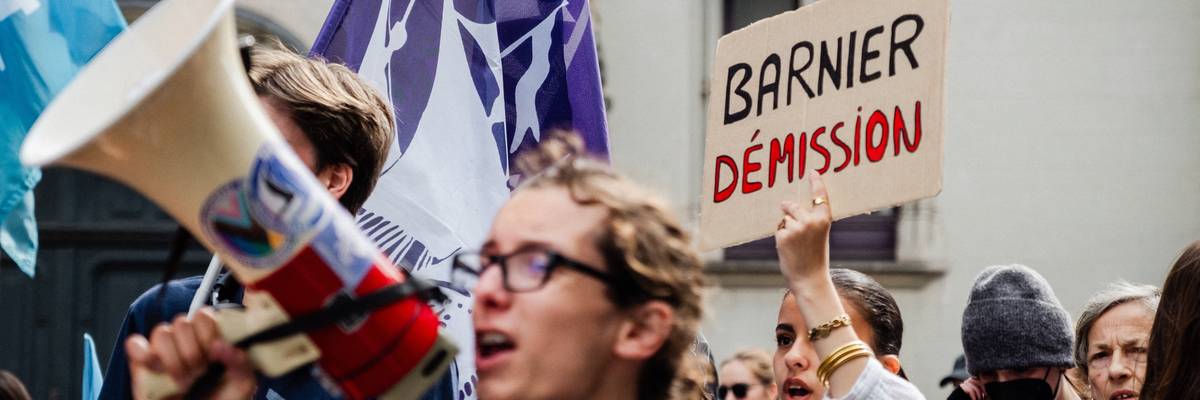
A protester carries a sign called on Michel Barnier, who was selected by French President Emmanuel Macron as the prime minister, to resign at a protest on September 7, 2024 in Nantes, France.
"Expressing one's vote will be useless as long as Macron is in power," said one demonstrator.
In cities and towns across France on Saturday, more than 100,000 people answered the call from the left-wing political party La France Insoumise for mass protests against President Emmanuel Macron's selection of a right-wing prime minister.
The demonstrations came two months after the left coalition won more seats than Macron's centrist coalition or the far-right Rassemblement National (RN) in the National Assembly and two days after the president announced that Michel Barnier, the right-wing former Brexit negotiator for the European Union, would lead the government.
The selection was made after negotiations between Macron and RN leader Marine Le Pen, leading protesters on Saturday to accuse the president of a "denial of democracy."
"Expressing one's vote will be useless as long as Macron is in power," a protester named Manon Bonijol told Al Jazeera.
A poll released on Friday by Elabe showed that 74% of French people believed Macron had disregarded the results of July's snap parliamentary elections, and 55% said the election had been "stolen."
Jean-Luc Mélenchon, the leader of La France Insoumise (LFI), or France Unbowed, also accused Macron of "stealing the election" in a speech at the demonstration in Paris on Saturday.
" Democracy is not just the art of accepting you have won but the humility to accept you have lost," Mélenchon told protesters. "I call you for what will be a long battle."
He added that "the French people are in rebellion. They have entered into revolution."
Macron's centrist coalition won about 160 assembly seats out of 577 in July, compared to the left coalition's 180. The RN won about 140.
Barnier's Les Républicains (LR) party won fewer than 50 parliamentary seats. French presidents have generally named prime ministers, who oversee domestic policy, from the party with the most seats in the National Assembly.
Barnier signaled on Friday that he would largely defend Macron's pro-business policies and could unveil stricter anti-immigration reforms. Macron has enraged French workers and the left with policies including a retirement age hike last year.
Protests also took place in cities including Nantes, Nice, Montpellier, Marseilles, and Strasbourg.
All four left-wing parties within the Nouveau Front Populaire (NFP) coalition have announced plans to vote for a motion of no confidence against Barnier.
The RN has not committed to backing Barnier's government yet and leaders have said they are waiting to see what policies he presents to the National Assembly before deciding how to proceed in a no confidence vote.
Dear Common Dreams reader, It’s been nearly 30 years since I co-founded Common Dreams with my late wife, Lina Newhouser. We had the radical notion that journalism should serve the public good, not corporate profits. It was clear to us from the outset what it would take to build such a project. No paid advertisements. No corporate sponsors. No millionaire publisher telling us what to think or do. Many people said we wouldn't last a year, but we proved those doubters wrong. Together with a tremendous team of journalists and dedicated staff, we built an independent media outlet free from the constraints of profits and corporate control. Our mission has always been simple: To inform. To inspire. To ignite change for the common good. Building Common Dreams was not easy. Our survival was never guaranteed. When you take on the most powerful forces—Wall Street greed, fossil fuel industry destruction, Big Tech lobbyists, and uber-rich oligarchs who have spent billions upon billions rigging the economy and democracy in their favor—the only bulwark you have is supporters who believe in your work. But here’s the urgent message from me today. It's never been this bad out there. And it's never been this hard to keep us going. At the very moment Common Dreams is most needed, the threats we face are intensifying. We need your support now more than ever. We don't accept corporate advertising and never will. We don't have a paywall because we don't think people should be blocked from critical news based on their ability to pay. Everything we do is funded by the donations of readers like you. When everyone does the little they can afford, we are strong. But if that support retreats or dries up, so do we. Will you donate now to make sure Common Dreams not only survives but thrives? —Craig Brown, Co-founder |
In cities and towns across France on Saturday, more than 100,000 people answered the call from the left-wing political party La France Insoumise for mass protests against President Emmanuel Macron's selection of a right-wing prime minister.
The demonstrations came two months after the left coalition won more seats than Macron's centrist coalition or the far-right Rassemblement National (RN) in the National Assembly and two days after the president announced that Michel Barnier, the right-wing former Brexit negotiator for the European Union, would lead the government.
The selection was made after negotiations between Macron and RN leader Marine Le Pen, leading protesters on Saturday to accuse the president of a "denial of democracy."
"Expressing one's vote will be useless as long as Macron is in power," a protester named Manon Bonijol told Al Jazeera.
A poll released on Friday by Elabe showed that 74% of French people believed Macron had disregarded the results of July's snap parliamentary elections, and 55% said the election had been "stolen."
Jean-Luc Mélenchon, the leader of La France Insoumise (LFI), or France Unbowed, also accused Macron of "stealing the election" in a speech at the demonstration in Paris on Saturday.
" Democracy is not just the art of accepting you have won but the humility to accept you have lost," Mélenchon told protesters. "I call you for what will be a long battle."
He added that "the French people are in rebellion. They have entered into revolution."
Macron's centrist coalition won about 160 assembly seats out of 577 in July, compared to the left coalition's 180. The RN won about 140.
Barnier's Les Républicains (LR) party won fewer than 50 parliamentary seats. French presidents have generally named prime ministers, who oversee domestic policy, from the party with the most seats in the National Assembly.
Barnier signaled on Friday that he would largely defend Macron's pro-business policies and could unveil stricter anti-immigration reforms. Macron has enraged French workers and the left with policies including a retirement age hike last year.
Protests also took place in cities including Nantes, Nice, Montpellier, Marseilles, and Strasbourg.
All four left-wing parties within the Nouveau Front Populaire (NFP) coalition have announced plans to vote for a motion of no confidence against Barnier.
The RN has not committed to backing Barnier's government yet and leaders have said they are waiting to see what policies he presents to the National Assembly before deciding how to proceed in a no confidence vote.
In cities and towns across France on Saturday, more than 100,000 people answered the call from the left-wing political party La France Insoumise for mass protests against President Emmanuel Macron's selection of a right-wing prime minister.
The demonstrations came two months after the left coalition won more seats than Macron's centrist coalition or the far-right Rassemblement National (RN) in the National Assembly and two days after the president announced that Michel Barnier, the right-wing former Brexit negotiator for the European Union, would lead the government.
The selection was made after negotiations between Macron and RN leader Marine Le Pen, leading protesters on Saturday to accuse the president of a "denial of democracy."
"Expressing one's vote will be useless as long as Macron is in power," a protester named Manon Bonijol told Al Jazeera.
A poll released on Friday by Elabe showed that 74% of French people believed Macron had disregarded the results of July's snap parliamentary elections, and 55% said the election had been "stolen."
Jean-Luc Mélenchon, the leader of La France Insoumise (LFI), or France Unbowed, also accused Macron of "stealing the election" in a speech at the demonstration in Paris on Saturday.
" Democracy is not just the art of accepting you have won but the humility to accept you have lost," Mélenchon told protesters. "I call you for what will be a long battle."
He added that "the French people are in rebellion. They have entered into revolution."
Macron's centrist coalition won about 160 assembly seats out of 577 in July, compared to the left coalition's 180. The RN won about 140.
Barnier's Les Républicains (LR) party won fewer than 50 parliamentary seats. French presidents have generally named prime ministers, who oversee domestic policy, from the party with the most seats in the National Assembly.
Barnier signaled on Friday that he would largely defend Macron's pro-business policies and could unveil stricter anti-immigration reforms. Macron has enraged French workers and the left with policies including a retirement age hike last year.
Protests also took place in cities including Nantes, Nice, Montpellier, Marseilles, and Strasbourg.
All four left-wing parties within the Nouveau Front Populaire (NFP) coalition have announced plans to vote for a motion of no confidence against Barnier.
The RN has not committed to backing Barnier's government yet and leaders have said they are waiting to see what policies he presents to the National Assembly before deciding how to proceed in a no confidence vote.

