

SUBSCRIBE TO OUR FREE NEWSLETTER
Daily news & progressive opinion—funded by the people, not the corporations—delivered straight to your inbox.
5
#000000
#FFFFFF
To donate by check, phone, or other method, see our More Ways to Give page.
Daily news & progressive opinion—funded by the people, not the corporations—delivered straight to your inbox.
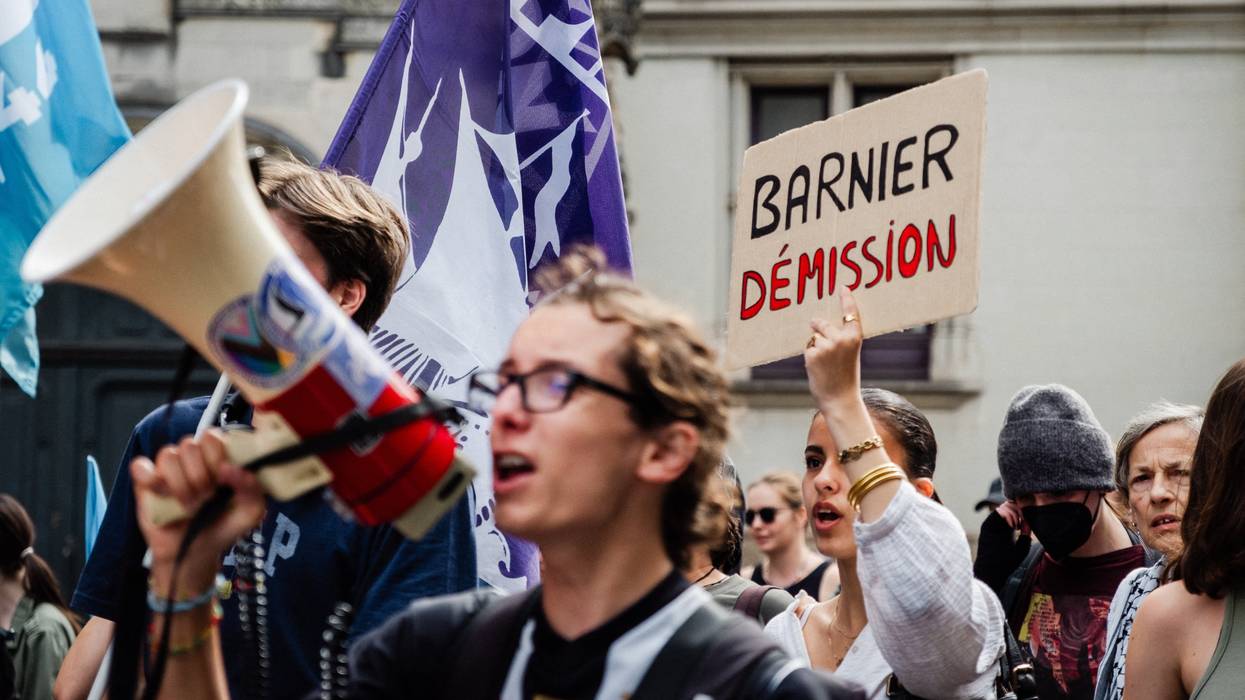
"Expressing one's vote will be useless as long as Macron is in power," said one demonstrator.
In cities and towns across France on Saturday, more than 100,000 people answered the call from the left-wing political party La France Insoumise for mass protests against President Emmanuel Macron's selection of a right-wing prime minister.
The demonstrations came two months after the left coalition won more seats than Macron's centrist coalition or the far-right Rassemblement National (RN) in the National Assembly and two days after the president announced that Michel Barnier, the right-wing former Brexit negotiator for the European Union, would lead the government.
The selection was made after negotiations between Macron and RN leader Marine Le Pen, leading protesters on Saturday to accuse the president of a "denial of democracy."
"Expressing one's vote will be useless as long as Macron is in power," a protester named Manon Bonijol told Al Jazeera.
A poll released on Friday by Elabe showed that 74% of French people believed Macron had disregarded the results of July's snap parliamentary elections, and 55% said the election had been "stolen."
Jean-Luc Mélenchon, the leader of La France Insoumise (LFI), or France Unbowed, also accused Macron of "stealing the election" in a speech at the demonstration in Paris on Saturday.
" Democracy is not just the art of accepting you have won but the humility to accept you have lost," Mélenchon told protesters. "I call you for what will be a long battle."
He added that "the French people are in rebellion. They have entered into revolution."
Macron's centrist coalition won about 160 assembly seats out of 577 in July, compared to the left coalition's 180. The RN won about 140.
Barnier's Les Républicains (LR) party won fewer than 50 parliamentary seats. French presidents have generally named prime ministers, who oversee domestic policy, from the party with the most seats in the National Assembly.
Barnier signaled on Friday that he would largely defend Macron's pro-business policies and could unveil stricter anti-immigration reforms. Macron has enraged French workers and the left with policies including a retirement age hike last year.
Protests also took place in cities including Nantes, Nice, Montpellier, Marseilles, and Strasbourg.
All four left-wing parties within the Nouveau Front Populaire (NFP) coalition have announced plans to vote for a motion of no confidence against Barnier.
The RN has not committed to backing Barnier's government yet and leaders have said they are waiting to see what policies he presents to the National Assembly before deciding how to proceed in a no confidence vote.
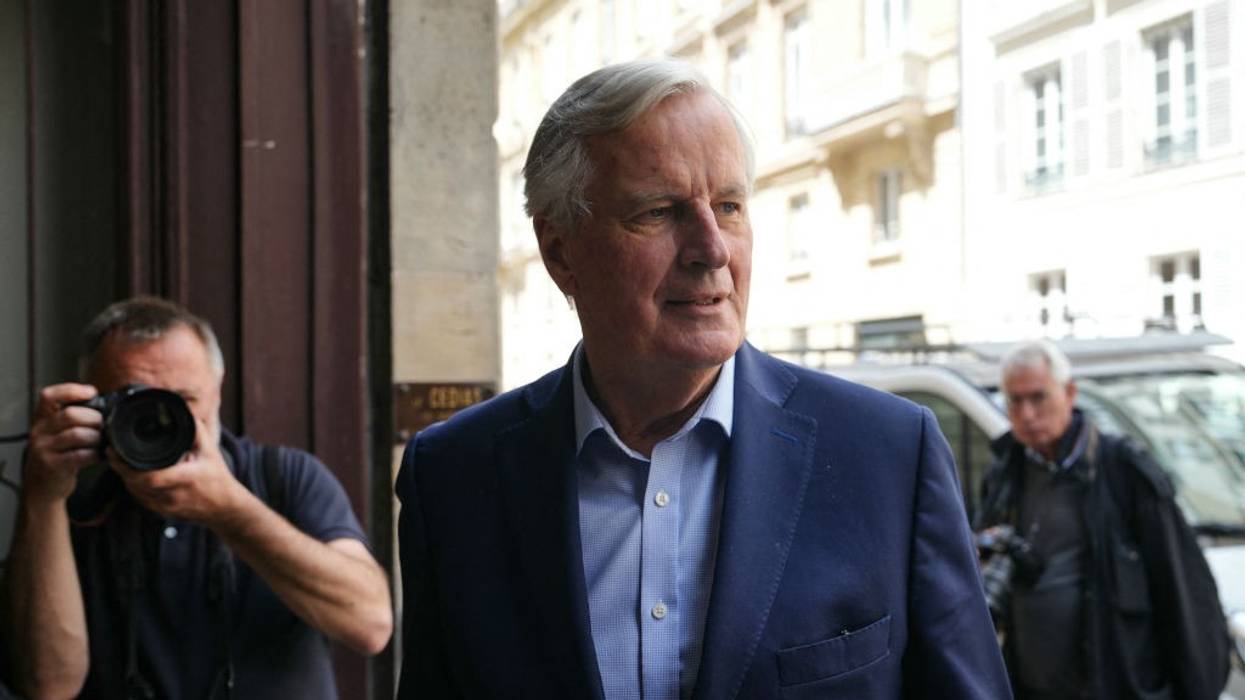
The president drew criticism for rejecting the candidate put up by the left-of-center coalition that won the most seats in parliamentary elections.
French President Emmanuel Macron on Thursday named the right-wing politician Michel Barnier as prime minister, prompting outrage from a coalition of left-of-center parties that won the most seats in recent parliamentary elections and argued that the premier should be chosen from its ranks.
The decision marks the end of an unprecedented period in which France hasn't had an active government following the final round of parliamentary elections on July 7 and the previous prime minister's resignation on July 16.
The election ended with the Nouveau Front Populaire (NFP), the left coalition, winning a plurality of seats at 32.6%, Macron's own Ensemble coalition of centrist neoliberals winning 27.9%, and the far-right Rassemblement National (RN) winning 24.6%. NFP and Ensemble coordinated their efforts in the final round, forming a "republican front" to block the RN—a successful effort that drew praise from left and centrist figures across the world.
Barnier's center-right party, Les Républicains (LR), once a powerful force in France, gained only 8.3% of the seats, yet emerged victorious in the prime ministerial sweepstakes following Macron's negotiations with RN leader Marine Le Pen, who's thought to have agreed to Barnier's appointment. Without RN's support, Barnier could be ousted by a no-confidence vote in parliament.
In late August, Macron rejected the NFP's proposed prime minister, Lucie Castets, a little-known civil servant and economist whose nomination was itself a compromise reached by the parties within the NFP, which include the center-left Parti Socialiste (PS), the left-wing La France Insoumise (LFI), and Les Écologistes, a green party.
Les Écologistes on Thursday condemned Macron's choice, saying he was "obsessed with the preservation of his neoliberal record" and he'd aligned with the far-right.
"By appointing Mr. Barnier, who did not call for a republican blockade and whose positions on immigration resonate with those of the RN, to [Hôtel Matignon, the prime minister's residence], Emmanuel Macron is turning his back on the millions of citizens who have created a historic republican blockade in France," the party said in a statement.
🔴⚡ Un accord a été trouvé entre le président de la République, LR et le RN sur la nomination de @MichelBarnier | Il ne manquait plus que l'accord de Marine Le Pen, le RN confirme ne pas censurer un gouvernement #Barnier. pic.twitter.com/rKlaeE1n1n
— Nouveau Front Populaire 🟢🔴🟡🟣🔴 (ex NUPES News) (@NupesNews) September 5, 2024
Normally, the French president names a prime minister within days of an election for the National Assembly, as the directly-elected house of Parliament is called. However, with no party gaining a majority, and Macron opposed to the NFP—the coalition had run on a platform of rolling back his anti-worker agenda—the negotiations dragged on, especially once the president announced an interlude for the Olympics.
In the French system, the president chooses the prime minister, who has power over governmental ministries, but a majority of the National Assembly must approve of the choice or the deputies, as members of parliament are known, can issue a vote of no confidence. Not since the Fifth Republic formed with constitutional reform in 1958 has the country gone so long without a prime minister.
Barnier, 73, was first elected to the National Assembly in 1978 and worked his way up, serving various key ministerial posts in the 1990s and 2000s under center-right Presidents Jacques Chirac and Nicolas Sarkozy. From 2016 until 2021, he served as the European Union's chief Brexit negotiator.
Barnier was generally regarded as a centrist conservative but moved to the right in 2021, speaking harshly about immigration as he prepared a 2022 presidential run. The effort failed: He didn't receive his party's nomination.
Le Pen emerged in recent days as the "kingmaker" in the prime minister negotiations, according to Le Monde. With the backing of Ensemble and the RN, Barnier will be able to hold on to the job, as together the two blocs have more than 50% of the seats in the National Assembly.
Le Pen indicated at least a modicum of support for Barnier on Thursday, saying that he is "someone who is respectful of the different political forces and capable of addressing the RN."
Castets, on the other hand, said she was "very worried" about Barnier's appointment and called him "reactionary."
"Michel Barnier is the continuation of Macron's policy, or even worse," Castets told Mediapart.
Jean-Luc Mélenchon, standard-bearer of the French left and leader of the LFI, the NFP party holding the most seats, also decried the choice, pointing out that Barnier's party did poorly in the election and hadn't been part of the republican front. He said the "election has been stolen."
Mélenchon has led an effort to impeach Macron for his refusal to name an NFP prime minister but experts say it has little chance of succeeding. Mélenchon's allies are holding a rally on Saturday to call for the ouster of both Macron and Barnier.
Fabien Roussel, the leader of a Communist party that's a smaller member of the NFP, called Macron's move "a middle finger to the French who aspire to change," roughly translated, in a social media post.
The PS, which includes such figures as former President François Hollande and Paris Mayor Anne Hidalgo, hasn't joined the impeachment call but was critical of Macron's process. Olivier Faure, the party's leader, called it an affront to democracy.
"Democratic denial at its peak: a Prime Minister from the party that came in 4th place and who did not even participate in the republican front," Faure said. "We're entering a crisis of regime."
The transfer of power to Barnier was set for 6 pm local time at Hôtel Matignon on Thursday.
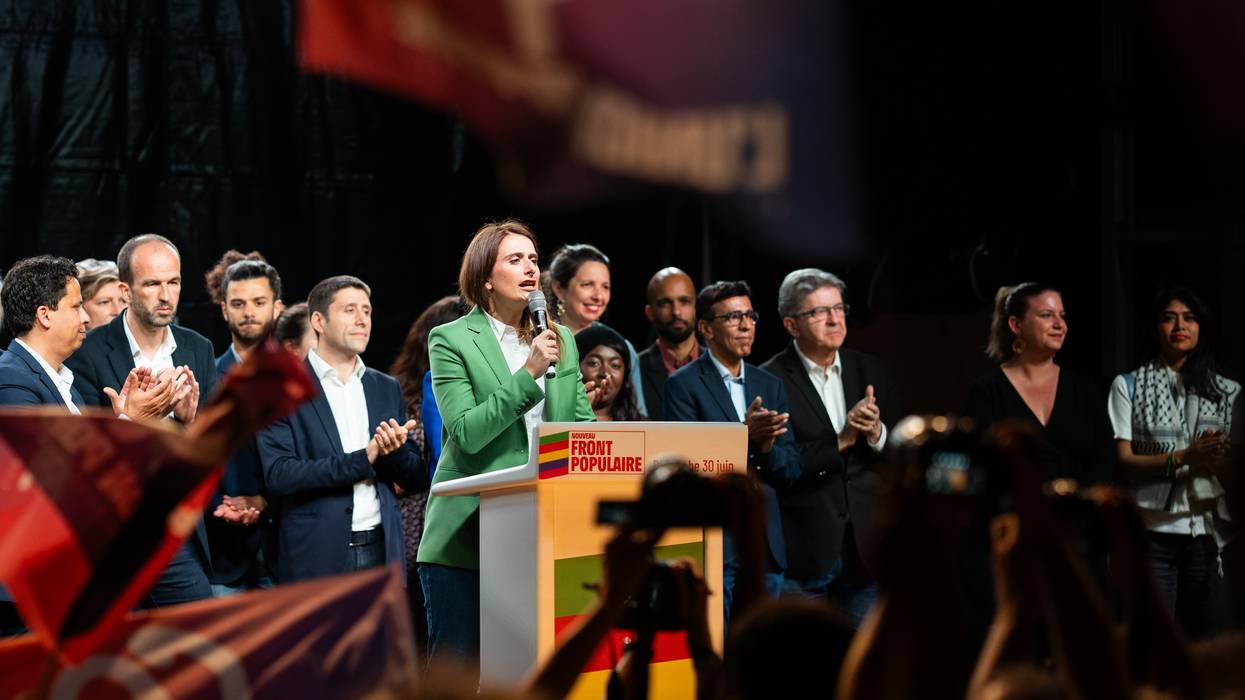
"The people must get rid of Macron for the good of democracy," said the leader of France's Green Party.
Leftist parties in France on Tuesday accused President Emmanuel Macron of election theft and announced mass protests after he rejected Nouveau Front Populaire's proposed candidate for prime minister, even though the left-wing coalition won the most seats in a snap parliamentary contest last month.
The left-wing parties that formed NFP in June to fight off the surging far-right expressed outrage at Macron's decision, with the Jean-Luc Mélenchon-led La France Insoumise (LFI) Party condemning Macron's dismissal of a leftist government as a "coup" and urging a "firm response from French society."
Backing demands from youth-led organizations, the party specifically called for "a large demonstration against Macron's coup on September 7" and expressed "hope that the political, union, and allied forces committed to the defense of democracy will join this call."
Marine Tondelier, the leader of France's Green Party, said Tuesday that "this election is being stolen from us" and declared that "the people must get rid of Macron for the good of democracy."
"He is chaos and instability," Tondelier added.
The French political system has been engulfed in chaos since Macron called snap elections in June after his party performed dreadfully in European Parliament elections in June as Marine Le Pen's far-right, xenophobic National Rally surged.
While the French left and Macron allies successfully teamed up last month to prevent the National Rally from seizing control of the nation's government, NFP's stunning victory in the snap election created a new dilemma for Macron, who has been openly hostile to the left since taking office in 2017.
"Facing a hung parliament in which each of the three almost equal groupings—the left, Macron's centrist bloc, and the far-right National Rally—have ruled out forming a coalition, the president appeared to be back to square one," Reuters reported.
Macron claimed Monday that a leftist-led government "would immediately have a majority of more than 350 MPs against it, effectively preventing it from acting."
"In view of the opinions expressed by the political leaders consulted, the institutional stability of our country means that this option should not be pursued," said Macron, ruling out the NFP's candidate for prime minister, Lucie Castets.
Protesting Macron's decision, leftist leaders boycotted a fresh round of negotiations on Tuesday, with Tondelier saying that "we're not going to continue these sham consultations with a president who doesn't listen anyway... and is obsessed with keeping control."
"He's not looking for a solution, he's trying to obstruct it," said Tondelier.
In a social media post on Monday, Mélenchon pledged to move ahead with an impeachment motion against Macron, calling for a "swift and firm" response to the French president.
"The president of the republic has just created a situation of exceptional gravity," Mélenchon wrote.

France's left-of-center parties held off a far-right advance in the country's parliamentary elections by building a progressive platform and forming strategic alliances, their supporters say.
Political figures from across the world congratulated France's left-of-center coalition following parliamentary elections on Sunday in which it gained the most seats of any group, outperforming the far-right party that many feared would take control of the National Assembly, in what The Washington Post called "one of the greatest political upsets in recent French history."
In the second and final round of voting, the Nouveau Front Populaire (NFP) won roughly 180 out of the 577 seats in the assembly, far from a majority but more than President Emmanuel Macron's centrist coalition, which won about 160, or Marine Le Pen's far-right Rassemblement National (RN), which won about 140 or 145.
Several parties including the leftist La France Insoumise (LFI), the center-left Parti Socialiste (PS), and Les Écologistes, a green party, joined forces to form the NFP after Macron announced a snap election in early June.
The parties came together out of fear of the RN, which led the polls and had the strongest showing of any party or alliance in the first round of the parliamentary elections on June 30. The NFP also opposed Macron's neoliberal agenda and supported progressive economic policies such as a lower retirement age.
Jeremy Corbyn, member of U.K. parliament and standard-bearer of the British left, said the French results provided "an urgent, valuable lesson."
"Don't concede ground to those who sow division and fear," Corbyn, who himself was reelected a few days ago, wrote on social media. "Build a bold left movement that offers an alternative of inclusion and hope. That is how you defeat the far right."
Similarly, U.S. Sen. Bernie Sanders (I-Vt.) argued that the French results offered confirmation of the popularity of progressive economic platforms like the NFP's.
"Here's a simple fact: If politicians stand with working families, working families will stand with you," Sanders wrote on social media. "As it turns out, lowering the retirement age and raising the minimum wage are very popular. Congratulations to the French left for taking on right-wing extremism and winning."
Ce soir, la justice sociale a gagné.
Ce soir, la justice environnementale a gagné.
Ce soir, le peuple a gagné.
Et ça ne fait que commencer !#VictoireNFP #ElectionsLegislatives2024 pic.twitter.com/3OwoRTdFTG
— Marine Tondelier (@marinetondelier) July 7, 2024
Several members of France's multiracial soccer team, currently competing in the UEFA European Football Championship in Germany, expressed joy and relief at the results of the election back home.
"The victory of the people," midfielder Tchouameni Aurélien wrote on social media.
Forward Marcus Thuram reacted similarly.
"Congratulations to all those who came forward in the face of the danger that hovered over our country," he wrote. "Long live diversity, long live the republic, long live France. The fight continues."
The effort to defeat the far right involved multiple levels of negotiation between left and centrist parties—not just the formation of the NFP, which prevented member parties from running candidates against one another, but also strategic cooperation between the NFP and Ensemble, Macron's own coalition, before Sunday's second round of voting.
Last week, going into the second round, more than 300 of the 577 legislative races had three or more candidates still in contention—in most cases, one NFP candidate, one Ensemble candidate, and one RN candidate. Because of a shared fear of the far right, the NFP and Ensemble negotiated to drop their third-place candidates from more than 220 races so that left and centrist votes wouldn't be split.
The strategy worked, with RN leaders, who last week had been openly speaking about obtaining a parliamentary majority of 289 seats, left with only about half of that figure or less—though even 140 seats marks a significant gain for the party, which had only 88 previously. The tallies are still being finalized, with different media outlets reporting slightly different totals.
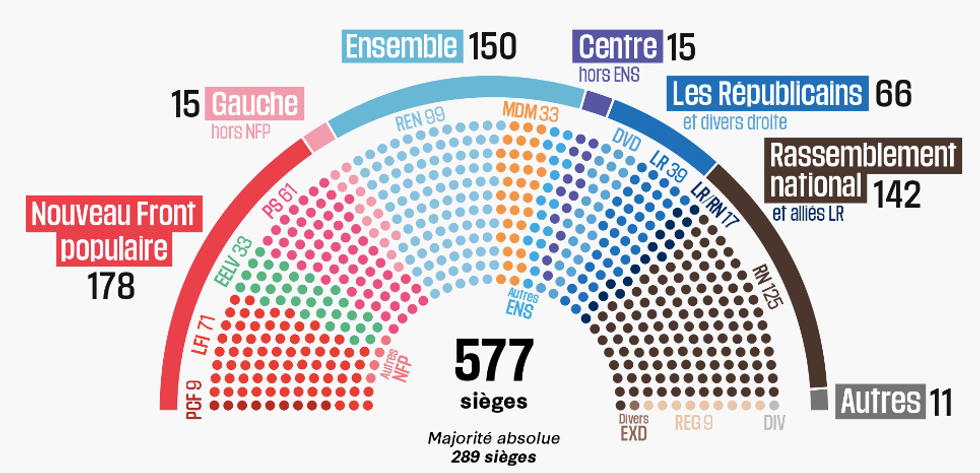 Source: La Libération, based on data from France's interior ministry
Luiz Inácio Lula da Silva, the leftist president of Brazil, praised the "maturity" of the groups that joined together to defeat the far right. Polish Prime Minister Donald Tusk, a centrist, expressed relief in light of the impact an RN victory could have had on the Ukraine war.
"In Paris enthusiasm, in Moscow disappointment, in Kyiv relief," Tusk wrote on social media. "Enough to be happy in Warsaw."
The coalition-building stands as a remarkable accomplishment given the challenges that it entailed: Just building the NFP alliance required tricky negotiation. Left-of-center parties, after decades of discord, formed an alliance for the first time in 2022, but it fell apart last year, and, though the PS was part of that alliance, it was not endorsed by prominent center-left figures such as former President François Hollande, who has backed the NFP.
The NFP parties didn't decide in advance whom they'd put forward for prime minister, and the different factions within the alliance are now jockeying for the position. Many of the more centrist NFP figures have declared that it can't be Jean-Luc Mélenchon, the LFI leader, whom they view as divisive.
In any case, Macron has the power to name the prime minister, and it's not clear if he would be willing to name Mélenchon, who ran against him for president in 2017 and 2022. Macron on Monday declined to accept the resignation of Prime Minister Gabriel Attal, an ally from his own party, explaining that he should stay on "to ensure the stability of the country."
That's likely just a temporary solution: Ensemble had a near-majority in the previous parliament but, having lost more than 80 seats, will no longer be strong enough to avoid a vote of no confidence in the prime minister and his government. Macron will have to name a prime minister that a majority of the incoming National Assembly approve of or risk triggering such votes of no confidence. The newly elected parliamentarians are scheduled to begin their first session on July 18.

Jean-Luc Mélenchon, leader of the leftist La France Insoumise party, called the election results an "immense relief for a majority of people in our country."
This is a developing story… Please check back for possible updates...
Preliminary results from France's parliamentary election on Sunday show that strategic collaboration between the left and allies of President Emmanuel Macron has succeeded in preventing Marine Le Pen's fascist National Rally from winning an absolute majority.
According to projections released shortly after polls closed, Nouveau Front Populaire (NFP)—a coalition of left-of-center parties formed ahead of the snap elections to counter the far-right—is on track to secure the largest number of seats in parliament. The Financial Times reported that NFP is expected to win "anywhere from 170 to 215 seats," while Macron's centrist alliance was "running close behind, with pollsters predicting ranges of 140 to 180 seats, a big drop from the roughly 250 they held in the outgoing National Assembly."
Le Pen's Rassemblement National (RN) is expected to finish third with between 120 and 150 seats.
Following the first round of voting last weekend, hundreds of candidates from Macron's alliance and parties within the NFP dropped out of three-way runoff races in a strategic bid to defeat RN candidates—an effort that appears to have paid off in a major way. RN won the first round of voting and, at the time, appeared to have a chance at an absolute majority.
Jean-Luc Mélenchon, leader of the leftist La France Insoumise party, called the early election results an "immense relief for a majority of people in our country" and urged Macron to resign and allow the left to govern.
"The united left saved the republic," said Mélenchon. "It can begin the ecological and social work that our people, our time, our world, [and] our Europe so badly need."
The Associated Press noted that the leftist leader's speech "is an indication of what's ahead" as coalitions prepare to jockey over who will lead the government.
"He says he will not negotiate with Macron, and Macron has refused to negotiate with him," AP added.

Leftist Jean-Luc Mélenchon said his party's third-place candidates would withdraw from three-way runoffs to help prevent the far-right from seizing power.
Leaders of France's left-of-center parties vowed Sunday to withdraw their third-place candidates from runoff races in an effort to prevent Marine Le Pen's fascist National Rally from securing an absolute majority in the country's Parliament.
But will centrist candidates follow suit?
That question became critical following the first round of voting in snap parliamentary elections called by French President Emmanuel Macron last month after his party suffered a stinging defeat in European elections. Macron's decision appears to have backfired in a major way.
Le Pen's viciously xenophobic Rassemblement National (RN) prevailed in round one on Sunday, winning 33.2% of the vote, while the Nouveau Front Populaire (NFP)—an alliance of left-of-center parties formed ahead of the snap elections to counter the far-right—came in second at 28%. Macron's centrist Ensemble coalition landed in third with 22.4% of the vote.
The decisive second round will be held on July 7, and efforts to stop Le Pen's party from seizing outright control of the National Assembly likely hinge on electoral cooperation between the center and the left. The Financial Times calculated that the first round of voting "produced more than 300 three-way runoffs... an unprecedented number, although the final figure will depend on how many candidates drop out."
In races qualifying for runoffs, according to FT, Macron's Ensemble alliance had 95 third-place candidates after round one while the left-of-center NFP had 129.
Speaking to supporters Sunday, leftist La France Insoumise (LFI) leader Jean-Luc Mélenchon said his party would withdraw candidates from races in which they placed third and the far-right NR was in the lead—a vow that the heads of other left-wing parties echoed.
"Our instructions are simple, direct, and clear: not one vote, not one more seat for the RN," said Mélenchon.
"The question that should be asked of every Macronist in the next couple days: Does this line extend to La France Insoumise or not? Right now, it's not clear."
The centrists were much less direct about their intentions.
French Prime Minister Gabriel Attal, who acknowledged the far-right is "at the gates of power," said the centrist alliance would withdraw candidates from runoffs if their presence would hinder "another candidate—who, like us—defends the values of the Republic," without specifically saying whether he includes leftist LFI candidates in that category.
"The question that should be asked of every Macronist in the next couple days: Does this line extend to La France Insoumise or not? Right now, it's not clear," France-based journalist Cole Stangler wrote Sunday.
Macron similarly urged voters to back candidates who are "clearly republican and democratic." But as The Washington Post observed, the French president "has at times portrayed the far-left as equally dangerous as the far-right," raising concerns that centrists could allow the far-right to win close races by splitting votes in three-way runoffs that include candidates from Mélenchon's LFI.
As Reuters reported, French Finance Minister Bruno Le Maire "ruled out calling on voters to choose an LFI candidate" in a radio interview—a position that one senior Greens member denounced as "cowardly and privileged."
One government minister, Roland Lescure, did explicitly urge "all voters to block the extreme right without hesitation by voting for the best-placed alternative candidate," even if it's an LFI candidate.
"The real danger for France today is an absolute majority National Rally," said Lescure. "And we must do everything to prevent it."
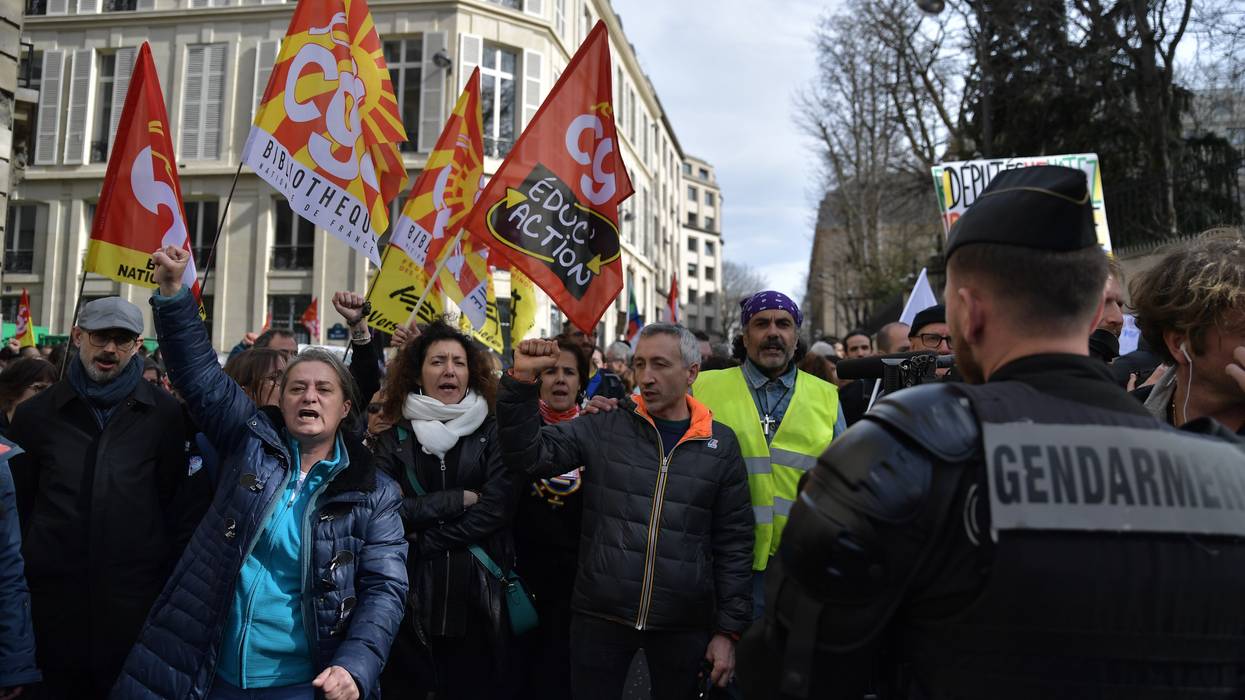
"What the government is doing makes people sick of politics. It should improve people's lives, not destroy them," said Rachel Keke, a leftist in France's National Assembly.
Amid protests against French President Emmanuel Macron's unpopular plan to overhaul the country's pension system, his government on Thursday chose the "nuclear option," opting to use a constitutional procedure to force through reforms, including raising the retirement age from 62 to 64, without a vote in the lower house of Parliament.
While the proposal passed the Senate, the upper chamber of Parliament, 193-114 Thursday morning, "reports indicated that the ruling party, which lost its overall majority in elections last year, was a handful of votes short" in the National Assembly, which led to an emergency Council of Ministers meeting about triggering Article 49.3,
Le Monde explained.
After announcing the government was invoking executive privilege, French Prime Minister Élisabeth Borne "faced scenes of anger and unrest in the National Assembly," reported Politico. "Far-left lawmakers belonging to the France Unbowed party booed and chanted the national hymn the Marseillaise as far-right National Rally MPs shouted 'Resign! Resign!'"
Using the controversial procedure to push through the plan is risky for Macron—founder of the Renaissance party—because it allows members of Parliament "to submit motions of no-confidence within 24 hours," Politico added. "While the government has survived motions of no-confidence in recent months, the stakes are much higher this time around. If a majority of MPs vote in favor of a motion, Borne's government would be forced to resign."
While multiple opposition groups in Parliament may respond with no-confidence motions, Marine Le Pen's far-right National Rally party has already pledged to do so.
"It's a total failure for the government," Le Pen told reporters of the Article 49.3 decision, calling for Borne's resignation. "From the beginning, the government fooled itself into thinking it had a majority."
Socialist Party chief Olivier Faure also criticized the approach, saying that "when a president has no majority in the country, no majority in the National Assembly, he must withdraw his bill."
Fabien Roussel, head of the French Communist Party, declared that "this government is not worthy of our Fifth Republic, of French democracy. Until the very end, Parliament has been ridiculed, humiliated."
MP Rachel Keke of the leftist party La France Insoumise stressed that "what the government is doing makes people sick of politics. It should improve people's lives, not destroy them."
Former French presidential candidate and MP Jean-Luc Mélenchon, who launched La France Insoumise, tweeted: "It is a spectacular failure and a collapse of the presidential minority. United unions call for continued action. This is what we are going to focus on."
French trade unions have led national demonstrations and strikes against the overhaul since January. While protesters were oscillating "between rage and resignation" earlier this week, they filled the streets of Paris on Thursday, and "the leader of the CFDT labor union, Laurent Berger, announced there would be new protest dates," according to Le Monde.
The General Confederation of Labor (CGT) said in a statement that "this reform is unfair, unjustified, and unjustifiable, this is what millions of people have been asserting forcefully for weeks in the demonstrations, with the strike, and in all the initiatives. These massive mobilizations are supported by a very large majority of the population and almost all workers."
"The only response from the government and employers is repression: requisitions, police interventions on workplace occupations, arrests, intimidation, questioning of the right to strike," the confederation added. "We won't let it happen! What the CGT denounced as unfair yesterday is even more so today! This can only encourage us to step up mobilizations and strikes, the fight continues!"

"It's not often that we see such a mass mobilization," said leftist leader Jean-Luc Mélenchon.
Hundreds of thousands of enraged workers across France walked off the job and hit the streets Tuesday to protest President Emmanuel Macron's unpopular plan to raise the nation's official retirement age from 62 to 64.
It marks the second time this month that French workers have mobilized against Macron's attack on the country's pension system. Nationwide strikes and marches on January 19 brought out between one million and two million people, and labor unions aimed to match or exceed those numbers on Tuesday, with roughly 250 demonstrations planned around the country.
Longtime leftist leader Jean-Luc Mélenchon predicted Tuesday morning that "a historic day" of protests would help defeat Macron's proposal once and for all, as massive crowds rallied in cities and towns outside Paris—prior to a major march that shut down the French capital on Tuesday afternoon.
“It's not often that we see such a mass mobilization," Mélenchon said from the southern city of Marseille. "It's a form of citizens' insurrection."
On the small western island of Ouessant, about 100 people gathered early in the day for a protest outside the office of Mayor Denis Palluel.
In a phone interview with The Associated Press, Palluel noted that the threat of having to work longer to qualify for a full pension dismayed mariners on the island who have grueling ocean-based jobs.
"Retiring at a reasonable age is important," he said, "because life expectancy isn't very long."
"Retiring at a reasonable age is important because life expectancy isn't very long."
Despite widespread opposition to pushing back France's retirement age—approximately three-fourths of the population is against such a move, according to recent polling—many lawmakers remain determined to fulfill Macron's election pledge to overhaul the nation's pension system.
On Monday, Macron described his effort to hike the retirement age as "essential." Prime Minister Élisabeth Borne, for her part, asserted this past weekend that raising the retirement age to 64 by 2030 is "no longer negotiable."
"Strikers and protesters intend to prove otherwise," Agence France-Presse reported Tuesday. "Labor unions and left-wing legislators fighting in parliament against Macron's plans are counting on protesters to turn out massively to strengthen their efforts to kill the bill."
As they did earlier this month, strikes on Tuesday upended multiple aspects of daily life, including electricity production, transportation, and education.
"TotalEnegies says between 75% and 100% of workers at its refineries and fuel depots are on strike, while electricity supplier EDF said they're monitoring a drop in power to the national grid equivalent to three nuclear power plants," Euronews reported.
According to AP: "Rail operator SNCF reported major disruptions, with strikes knocking out most trains in the Paris region, in all other regions, and on France’s flagship high-speed network linking cities and major towns. The Paris Metro was also hard hit by station closures and cancellations."
France's Education Ministry, meanwhile, reported that around a quarter of the nation's teachers were on strike Tuesday, down from 70% during the first round of protests.
Macron's proposed pension reform, the text of which Borne presented to the National Assembly earlier this month, faces an uphill battle.
For one thing, the New Ecological and Social People's Union (NUPES)—a coalition of four left-wing parties recently formed by Mélenchon—won 131 seats in last June's parliamentary elections, helping to prevent the neoliberal alliance Ensemble from securing the absolute majority it needed to ram through Macron's unwanted austerity agenda.
According to AFP, even the president's own allies from his ruling alliance have expressed concerns about some aspects of the legislation.
"We can feel a certain nervousness from the majority as we begin our work," Mathilde Panot, head of the left-wing France Unbowed party in the National Assembly, told the news outlet on Tuesday. "When we see this opposition growing, I understand why they are wavering."
However, journalist Marlon Ettinger, citing French Communist Party MP André Chassaigne, warned recently that "the government might try to pass the reform through a social security financing bill (known as PLFRSS), which would allow for a series of constitutional delays that would significantly limit the amount of time deputies can discuss the bill. It would also block the possibility for the opposition to present their own counterproposals."
In addition, "although Macron has no popular assent, nor a parliamentary majority for his reform, he does have constitutional tools he can use to push the package through," Ettinger explained in Jacobin. "One, known as 49.3 (after the article of the Constitution which grants the president this power), essentially lets him bypass the National Assembly. The constitution of the current Fifth Republic grants the president these authoritarian powers to hedge against any popular sentiment that might make its way into the lower house. The use of 49.3 would suspend the debate in the National Assembly, then send the bill directly to the Senate, which is controlled by Les Républicains."
Aware that such anti-democratic maneuvers are on the table, Mélenchon and other opponents of the assault on France's pension system have called on Macron to withdraw his proposal for good.

France's new left-wing coalition picked up enough votes during Sunday's legislative elections to help deny President Emmanuel Macron the absolute majority he needed to ram through his unpopular austerity agenda.
Macron's neoliberal alliance Ensemble won the most seats in the National Assembly with 245 but fell well short of the 289 needed to control parliament.
Meanwhile, the New Ecological and Social People's Union (NUPES)--the recently formed coalition led by leftist MP Jean-Luc Melenchon--won 131 seats, more than doubling the combined number of representatives that its four parties had in 2017.
NUPES, which brings together Melenchon's France Unbowed, the center-left Socialist Party, French Communist Party, and Greens, campaigned on lowering the retirement age from 62 to 60, hiking the minimum wage, and freezing prices on essential products--in sharp contrast to Macron's alliance, which is trying to raise the retirement age to 65 and has reduced the corporate tax rate, exacerbating economic inequality and insecurity.
"The rout of the presidential party is complete and no clear majority is in sight," Melenchon told a cheering crowd of supporters in Paris on Sunday night. "It is the failure of Macronism and the moral failure of those who lecture us."
Clementine Autain, one of Melenchon's top allies, said that the election results vindicate the left's strategy and reflect "a gathering of the forces for a social and ecological transformation on the basis of a profound change of society."
Although the strong showing by NUPES has made it the largest opposition force in parliament, a distinction that enables it to chair the assembly's key finance committee, the far-right National Rally picked up 89 seats and has also claimed a right to the position as the largest single opposition party.
National Rally's record showing, which its president Jordan Bardella called "a historic breakthrough," represents an eleven-fold increase in representation for the xenophobic party of presidential runner-up Marine Le Pen.
In addition to pushing a pro-corporate agenda, Macron's pursuit of anti-immigrant and anti-Muslim policies has legitimized Le Pen's reactionary ideas, progressive critics say.
Some of Macron's allies portrayed National Rally and NUPES as equally extremist. Melenchon, by contrast, instructed his supporters to "not give a single vote" to the far-right after he finished just behind Le Pen in the first round of April's presidential race, thereby helping Macron win the runoff.
The conservative Les Republicains, which picked up 61 seats, are "likely to become kingmakers," Reuters reported, as Macron's center-right majority seeks out potential allies to overcome France's first hung parliament since 1988.
If Macron is unable to form a stable alliance with Les Republicains, which has a platform "more compatible with Ensemble than other parties" and could give the president an outright majority, he will be forced to "run a minority government that will have to negotiate bills with other parties on a case-by-case basis," Reuters noted.
Les Republicains leader Christian Jacob said his party "will remain in the opposition but be 'constructive,' suggesting case-by-case deals rather than a coalition pact," the news outlet added.
Macron's government is not confining its search for possible legislative friends to the right.
According to Agence France Presse, "Senior Macron officials were on Sunday already trying to drive a wedge through the different factions of the NUPES alliance," accusing France Unbowed of being too rigidly radical and adversarial in a bid to peel off more moderate Socialists and Greens.
"There are moderates on the benches, on the right, on the left," said government spokesperson Olivia Gregoire. "There are moderate Socialists and there are people on the right who, perhaps, on legislation, will be on our side."
If legislative gridlock persists, Macron could eventually call a snap election.

Less than two weeks after France's neoliberal president, Emmanuel Macron, defeated the far-right's Marine Le Pen to win a second five-year term, the country's four major left parties have agreed in principle to form an electoral coalition that aims to deny Macron a parliamentary majority.
"No one on the left can win on their own."
France's center-left Socialist Party and Jean-Luc Melenchon's far-left France Unbowed reached a draft agreement on Wednesday following extensive negotiations. The French Communist Party and Greens had already agreed to join the alliance earlier this week.
"We want to elect MPs in a majority of constituencies to stop Emmanuel Macron from pursuing his unjust and brutal policies and beat the far-right," the Socialist Party and France Unbowed said in a joint statement, according to Agence France-Presse.
The pact was spearheaded by Melenchon, who finished just behind Le Pen in the first round of France's presidential election and therefore missed out on a chance to challenge the incumbent one-on-one.
If the deal is confirmed--it still needs to be approved by the Socialists' national committee on Thursday--all four parties "will campaign under a common program and run one joint candidate in the election for the National Assembly on June 9 and 12," Politico reported. "The agreement would reportedly allow a Socialist candidate to run unopposed in 70 constituencies."
BBC News underscored the potential significance of the coalition: "Instead of running against each other in the parliamentary elections, Socialists, Greens, Communists, and supporters of France Unbowed will share one candidate per constituency, thus greatly increasing their chances."
"After Macron's win, Melenchon immediately called on voters to 'elect him prime minister' and hand the left a National Assembly majority," AFP reported. "A united left ahead of the parliamentary poll is 'an unprecedented and important event,' political historian Gilles Candar told AFP--although he added that it remains to be seen whether it can secure power or remain coherent."
If the left-wing coalition succeeds in winning a parliamentary majority and Melenchon becomes prime minister, it could systematically block Macron's pro-corporate agenda.
Macron, a former investment banker, has reduced the corporate tax rate and is currently pushing an unpopular plan to raise the retirement age from 62 to 65. In addition to exacerbating economic inequality and insecurity, Macron's pursuit of anti-immigrant and anti-Muslim policies has legitimized Le Pen's far-right ideas, progressive critics say.
If Melenchon's proposed alliance is finalized, it would constitute "the first formal coalition for the French left since the Socialist-Green pact two decades ago," Politico noted. "If the deal goes ahead, the parties will campaign on policies including raising the minimum wage, capping prices on essential products, and lowering the retirement age to 60."
Pierre Jouvet, a negotiator for the Socialist Party, told reporters: "I believe that today we are a few hours away from a historic moment, a historic moment that has been awaited for years by the people of the left who have been ardently asking us to find a way to come together."
"No one on the left can win on their own," Communist Party leader Fabien Roussel told France Inter radio, adding that the coalition needs to harness "the immense hope among the French public, among workers, among young people who are asking us to unite."