SUBSCRIBE TO OUR FREE NEWSLETTER
Daily news & progressive opinion—funded by the people, not the corporations—delivered straight to your inbox.
5
#000000
#FFFFFF
To donate by check, phone, or other method, see our More Ways to Give page.
Daily news & progressive opinion—funded by the people, not the corporations—delivered straight to your inbox.
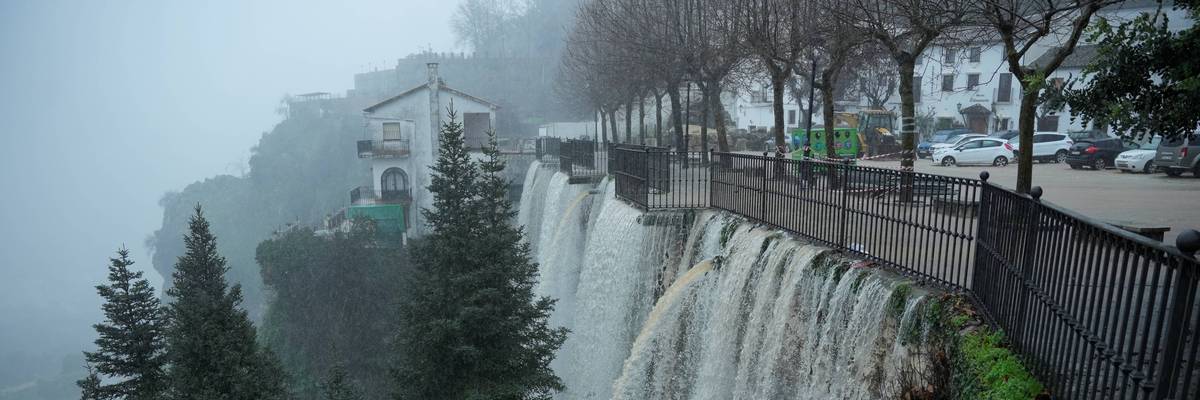
A street turned into a river in the town of Grazalema, Cadiz, Spain, after the Leonardo storm on February, 4 2026.
In many of the world's most arid and semi-arid regions, rain is no longer arriving as a blessing but as disaster; to understand why, we need to look at the ground rather than the sky.
The arrival of rain as a blessing is among the oldest human stories there is.
In Botswana, water and wealth are two names for the same blessing. Pula is the name of Botswana’s national currency, indicating the drought stricken land’s emotional relationship to water.
We see the emotional representation of rain in African American blues traditions, rainmaking rituals in West Africa, monsoon folk songs across South Asia, and Indigenous rain-dance ceremonies. Across cultures for millennia, rain has equaled relief.
But today, human-driven land degradation is rewriting that story.
What if instead of waiting for landscapes to collapse to pay the costs, we invested in the resilience of those very landscapes?
In many of the world's most arid and semi-arid regions, rain is no longer arriving as a blessing but as disaster.
To understand why, we need to look at the ground rather than the sky.
If we look at the Earth's surface now, versus 100 years ago, we'll see that most of the land has been transformed from natural ecosystems to concrete, agricultural, and productive land. This is the process of desertification.
You may think of desertification through familiar cultural images such as advancing sand dunes swallowing settlements, cracked earth stretching to the horizon, and vegetation fading into absence. But the defining characteristic of desertification is not simply a lack of water. It is the loss of a landscape's ability to hold water.
Healthy soil functions like a sponge. Built from organic matter, fungal networks, plant roots, insects, and billions of microorganisms, it can absorb and store enormous quantities of water. When rain falls, much of it infiltrates the ground, replenishing soil moisture and underground aquifers. The water moves slowly through the landscape and across layers of soil, sustaining rivers and vegetation long after the storm has passed.
However, degraded soil behaves differently.
Decades of intensive cultivation, overgrazing, vegetation loss, repeated tillage, and use of synthetic inputs reduce soil organic matter and weaken the soil food web. As soil structure deteriorates, the ground becomes compacted and hardens. Pores that once allowed water to penetrate collapse. Rain can no longer soak in. So, when a heavy rainfall arrives, the water cannot penetrate the ground and flushes all that lays on the surface.
Instead of absorbing the water, the soil lets it run downhill. Small rivulets become torrents. Topsoil is stripped away. Gullies form. Streams rise rapidly, and rivers burst their banks. The same rainfall that would once have been absorbed by the landscape becomes a destructive flood.
At Commonland, we work with communities to restore landscapes that have been identified as degraded—places where decades of ecological decline have reduced the land's ability to support communities, livelihoods, and biodiversity. We aim to provide those communities and local organizations with the means to reverse the cycle of degradation and contribute to regenerating the landscapes they live in and depend on. However, reversing the effects of decades of landscape degradation is not an easy ride.
Over the past 18 months, two of those landscapes, on opposite sides of the world in Spain and South Africa, have delivered the same warning: Without healthy ecosystems, our social, economic, and financial systems collapse.
In the Spanish town of Grazalema, where around 1,500 people are nestled in the mountains of Cádiz, the 2026 January rains shattered records. The landscape, as a result of decades of intensive land use, had lost much of its ability to absorb and regulate water. Aquifers filled rapidly. Water began emerging through the ground itself, threatening the ancient karstic system on which the village sits. Gullies opened across farmland, roads disappeared, and the entire town was evacuated for 10 days.
We have funded the degradation of the systems that protect us, while calling it productivity. The rains are now sending the invoice.
For local farmers, the damage was not only immediate but cumulative. Fields were washed out or left waterlogged, making planting impossible. Topsoil was stripped away, taking with it both fertility and future yield potential. Livestock grazing areas were damaged or cut off, feed stores were lost or became inaccessible, and seasonal cycles were disrupted beyond repair for the year.
“The economic damages for all our activities have been very high,” says Carmen Bueno, owner of the regenerative farm Tambor del Llano. Bueno is also a member of Asociación Serranías Vivas, a local association that brings together farmers, land managers, and rural stakeholders working to restore and protect the Sierra de Cádiz landscape through more sustainable land use and coordinated landscape restoration efforts.
More than 8,000 kilometers away, another landscape faced a sadly similar story.
In May 2026, catastrophic flooding tore through the Langkloof and Baviaanskloof valleys on South Africa’s Eastern Cape. After months of droughts drying up the land, the floods washed everything away: from fields, to tarmac roads, as well as wetlands. For many households, this meant more than infrastructure loss—it meant isolation. Local communities could not move out of their house, let alone the valleys; food and water supplies could not be accessed; farm produce could not reach markets; and tourism bookings collapsed overnight. Repair work, where possible, became slow and costly, held back by washed-out routes and limited resources in already stretched communities.
“These are communities that were already living on the margins,” said Justine Rudman-Koekemoer, co-director and financial manager of Living Lands, an organization working to restore landscapes and support the rural communities who depend on them. "There are no easy routes in or out, no quick fixes. Recovery will be slow and expensive, and it will not happen without outside help." Today, fundraising efforts are underway to rebuild essential damaged infrastructure from the floods.
The hit associated with these events is felt across everyone living in the landscape, from the local communities whose houses were flooded, including the farmers who lost their harvests, to the public infrastructure that needs to be repaired and rebuilt.
However, those losses also have a ripple effect across the broader financial and private sectors, which often fail to account for the climate and nature risk they are exposed to. As a result of these events, loans from banks are likely to be delayed or defaulted, insurance payouts are likely to be requested, and investments into businesses lost.
These devastating events raise an essential question: What if instead of waiting for landscapes to collapse to pay the costs, we invested in the resilience of those very landscapes?
In the financial world, risk and return are two sides of the same coin; the rate of return is determined based on the risk of losing that money.
Over the past decades, investments toward nature were often framed as opportunities for investors to make a commercial return. However this rarely holds true, and most investments continue to flow toward extractive industries, outpacing investment in nature-based solutions by more than 30 to 1: In 2022, roughly $7.4 trillion was spent on extractive activities, and only $220 billion was spent on regenerative activities.
But what if we turned the logic for investing in nature on its head and started to present landscape restoration as a risk mitigation strategy for investors. Given that all the loans, insurance, and investments are tied to enterprises and people based in landscapes, they are directly exposed to the risk related to the health of these very landscapes.
The risk landscape desertification creates isn't abstract. Over 80% of Europe's natural habitats are now in poor or bad condition, leaving the continent more vulnerable to floods, droughts, and ecological instability. Restored wetlands, regenerated soils, and resilient forests aren't symbolic gestures—they're working infrastructure that slows water, stores carbon, and absorbs shocks before those shocks become disasters for people on the ground, and financial losses for capital providers.
Those who work degraded land understand this without needing the statistics. In Grazalema, southern Spain and in the Baviaanskloof, South Africa, farmers and land stewards have watched extreme rainfall turn bare, depleted soil into disaster—fields washed away, roads severed, local economies set back years by a single storm. They know, from direct experience, that land isn't just a commodity but a living system everything else depends on.
It’s now the private and financial sectors’ turn to recognize and value those risks by investing in mitigation solutions. In practice, they can begin by estimating the costs that climate change and environmental degradation could create in the landscapes where they invest or source products. This estimate can then help determine how much investment should be directed toward preventing desertification and restoring those landscapes. Landscape restoration could then become a risk mitigation strategy with an allocated budget for implementing the restoration of those landscapes.
We have funded the degradation of the systems that protect us, while calling it productivity.
The rains are now sending the invoice.
What we are facing is not a choice between conservation and growth, but between repeatedly paying for destruction after the fact or investing in the systems that prevent it in the first place.
Restoration is not a cost to be minimized. It is the most reliable form of resilience we have and the only one that strengthens the system it protects.
Nature restoration is not a discretionary environmental cost; it is resilience infrastructure in its most fundamental form.
To recognize it as such, we need to move beyond fragmented, short-term funding and unlock access to large scale funding from the public, private, and financial sectors to the organizations and individuals on the ground that are on the frontline of landscape restoration.
Restoration is not a cost to be minimized. It is the most reliable form of resilience we have and the only one that strengthens the system it protects.
The task ahead is to ensure that we do not let degradation become the author of the story we tell about rain.
When the rains come, let us still look to the sky in relief.
Dear Common Dreams reader, It’s been nearly 30 years since I co-founded Common Dreams with my late wife, Lina Newhouser. We had the radical notion that journalism should serve the public good, not corporate profits. It was clear to us from the outset what it would take to build such a project. No paid advertisements. No corporate sponsors. No millionaire publisher telling us what to think or do. Many people said we wouldn't last a year, but we proved those doubters wrong. Together with a tremendous team of journalists and dedicated staff, we built an independent media outlet free from the constraints of profits and corporate control. Our mission has always been simple: To inform. To inspire. To ignite change for the common good. Building Common Dreams was not easy. Our survival was never guaranteed. When you take on the most powerful forces—Wall Street greed, fossil fuel industry destruction, Big Tech lobbyists, and uber-rich oligarchs who have spent billions upon billions rigging the economy and democracy in their favor—the only bulwark you have is supporters who believe in your work. But here’s the urgent message from me today. It's never been this bad out there. And it's never been this hard to keep us going. At the very moment Common Dreams is most needed, the threats we face are intensifying. We need your support now more than ever. We don't accept corporate advertising and never will. We don't have a paywall because we don't think people should be blocked from critical news based on their ability to pay. Everything we do is funded by the donations of readers like you. When everyone does the little they can afford, we are strong. But if that support retreats or dries up, so do we. Will you donate now to make sure Common Dreams not only survives but thrives? —Craig Brown, Co-founder |
The arrival of rain as a blessing is among the oldest human stories there is.
In Botswana, water and wealth are two names for the same blessing. Pula is the name of Botswana’s national currency, indicating the drought stricken land’s emotional relationship to water.
We see the emotional representation of rain in African American blues traditions, rainmaking rituals in West Africa, monsoon folk songs across South Asia, and Indigenous rain-dance ceremonies. Across cultures for millennia, rain has equaled relief.
But today, human-driven land degradation is rewriting that story.
What if instead of waiting for landscapes to collapse to pay the costs, we invested in the resilience of those very landscapes?
In many of the world's most arid and semi-arid regions, rain is no longer arriving as a blessing but as disaster.
To understand why, we need to look at the ground rather than the sky.
If we look at the Earth's surface now, versus 100 years ago, we'll see that most of the land has been transformed from natural ecosystems to concrete, agricultural, and productive land. This is the process of desertification.
You may think of desertification through familiar cultural images such as advancing sand dunes swallowing settlements, cracked earth stretching to the horizon, and vegetation fading into absence. But the defining characteristic of desertification is not simply a lack of water. It is the loss of a landscape's ability to hold water.
Healthy soil functions like a sponge. Built from organic matter, fungal networks, plant roots, insects, and billions of microorganisms, it can absorb and store enormous quantities of water. When rain falls, much of it infiltrates the ground, replenishing soil moisture and underground aquifers. The water moves slowly through the landscape and across layers of soil, sustaining rivers and vegetation long after the storm has passed.
However, degraded soil behaves differently.
Decades of intensive cultivation, overgrazing, vegetation loss, repeated tillage, and use of synthetic inputs reduce soil organic matter and weaken the soil food web. As soil structure deteriorates, the ground becomes compacted and hardens. Pores that once allowed water to penetrate collapse. Rain can no longer soak in. So, when a heavy rainfall arrives, the water cannot penetrate the ground and flushes all that lays on the surface.
Instead of absorbing the water, the soil lets it run downhill. Small rivulets become torrents. Topsoil is stripped away. Gullies form. Streams rise rapidly, and rivers burst their banks. The same rainfall that would once have been absorbed by the landscape becomes a destructive flood.
At Commonland, we work with communities to restore landscapes that have been identified as degraded—places where decades of ecological decline have reduced the land's ability to support communities, livelihoods, and biodiversity. We aim to provide those communities and local organizations with the means to reverse the cycle of degradation and contribute to regenerating the landscapes they live in and depend on. However, reversing the effects of decades of landscape degradation is not an easy ride.
Over the past 18 months, two of those landscapes, on opposite sides of the world in Spain and South Africa, have delivered the same warning: Without healthy ecosystems, our social, economic, and financial systems collapse.
In the Spanish town of Grazalema, where around 1,500 people are nestled in the mountains of Cádiz, the 2026 January rains shattered records. The landscape, as a result of decades of intensive land use, had lost much of its ability to absorb and regulate water. Aquifers filled rapidly. Water began emerging through the ground itself, threatening the ancient karstic system on which the village sits. Gullies opened across farmland, roads disappeared, and the entire town was evacuated for 10 days.
We have funded the degradation of the systems that protect us, while calling it productivity. The rains are now sending the invoice.
For local farmers, the damage was not only immediate but cumulative. Fields were washed out or left waterlogged, making planting impossible. Topsoil was stripped away, taking with it both fertility and future yield potential. Livestock grazing areas were damaged or cut off, feed stores were lost or became inaccessible, and seasonal cycles were disrupted beyond repair for the year.
“The economic damages for all our activities have been very high,” says Carmen Bueno, owner of the regenerative farm Tambor del Llano. Bueno is also a member of Asociación Serranías Vivas, a local association that brings together farmers, land managers, and rural stakeholders working to restore and protect the Sierra de Cádiz landscape through more sustainable land use and coordinated landscape restoration efforts.
More than 8,000 kilometers away, another landscape faced a sadly similar story.
In May 2026, catastrophic flooding tore through the Langkloof and Baviaanskloof valleys on South Africa’s Eastern Cape. After months of droughts drying up the land, the floods washed everything away: from fields, to tarmac roads, as well as wetlands. For many households, this meant more than infrastructure loss—it meant isolation. Local communities could not move out of their house, let alone the valleys; food and water supplies could not be accessed; farm produce could not reach markets; and tourism bookings collapsed overnight. Repair work, where possible, became slow and costly, held back by washed-out routes and limited resources in already stretched communities.
“These are communities that were already living on the margins,” said Justine Rudman-Koekemoer, co-director and financial manager of Living Lands, an organization working to restore landscapes and support the rural communities who depend on them. "There are no easy routes in or out, no quick fixes. Recovery will be slow and expensive, and it will not happen without outside help." Today, fundraising efforts are underway to rebuild essential damaged infrastructure from the floods.
The hit associated with these events is felt across everyone living in the landscape, from the local communities whose houses were flooded, including the farmers who lost their harvests, to the public infrastructure that needs to be repaired and rebuilt.
However, those losses also have a ripple effect across the broader financial and private sectors, which often fail to account for the climate and nature risk they are exposed to. As a result of these events, loans from banks are likely to be delayed or defaulted, insurance payouts are likely to be requested, and investments into businesses lost.
These devastating events raise an essential question: What if instead of waiting for landscapes to collapse to pay the costs, we invested in the resilience of those very landscapes?
In the financial world, risk and return are two sides of the same coin; the rate of return is determined based on the risk of losing that money.
Over the past decades, investments toward nature were often framed as opportunities for investors to make a commercial return. However this rarely holds true, and most investments continue to flow toward extractive industries, outpacing investment in nature-based solutions by more than 30 to 1: In 2022, roughly $7.4 trillion was spent on extractive activities, and only $220 billion was spent on regenerative activities.
But what if we turned the logic for investing in nature on its head and started to present landscape restoration as a risk mitigation strategy for investors. Given that all the loans, insurance, and investments are tied to enterprises and people based in landscapes, they are directly exposed to the risk related to the health of these very landscapes.
The risk landscape desertification creates isn't abstract. Over 80% of Europe's natural habitats are now in poor or bad condition, leaving the continent more vulnerable to floods, droughts, and ecological instability. Restored wetlands, regenerated soils, and resilient forests aren't symbolic gestures—they're working infrastructure that slows water, stores carbon, and absorbs shocks before those shocks become disasters for people on the ground, and financial losses for capital providers.
Those who work degraded land understand this without needing the statistics. In Grazalema, southern Spain and in the Baviaanskloof, South Africa, farmers and land stewards have watched extreme rainfall turn bare, depleted soil into disaster—fields washed away, roads severed, local economies set back years by a single storm. They know, from direct experience, that land isn't just a commodity but a living system everything else depends on.
It’s now the private and financial sectors’ turn to recognize and value those risks by investing in mitigation solutions. In practice, they can begin by estimating the costs that climate change and environmental degradation could create in the landscapes where they invest or source products. This estimate can then help determine how much investment should be directed toward preventing desertification and restoring those landscapes. Landscape restoration could then become a risk mitigation strategy with an allocated budget for implementing the restoration of those landscapes.
We have funded the degradation of the systems that protect us, while calling it productivity.
The rains are now sending the invoice.
What we are facing is not a choice between conservation and growth, but between repeatedly paying for destruction after the fact or investing in the systems that prevent it in the first place.
Restoration is not a cost to be minimized. It is the most reliable form of resilience we have and the only one that strengthens the system it protects.
Nature restoration is not a discretionary environmental cost; it is resilience infrastructure in its most fundamental form.
To recognize it as such, we need to move beyond fragmented, short-term funding and unlock access to large scale funding from the public, private, and financial sectors to the organizations and individuals on the ground that are on the frontline of landscape restoration.
Restoration is not a cost to be minimized. It is the most reliable form of resilience we have and the only one that strengthens the system it protects.
The task ahead is to ensure that we do not let degradation become the author of the story we tell about rain.
When the rains come, let us still look to the sky in relief.
The arrival of rain as a blessing is among the oldest human stories there is.
In Botswana, water and wealth are two names for the same blessing. Pula is the name of Botswana’s national currency, indicating the drought stricken land’s emotional relationship to water.
We see the emotional representation of rain in African American blues traditions, rainmaking rituals in West Africa, monsoon folk songs across South Asia, and Indigenous rain-dance ceremonies. Across cultures for millennia, rain has equaled relief.
But today, human-driven land degradation is rewriting that story.
What if instead of waiting for landscapes to collapse to pay the costs, we invested in the resilience of those very landscapes?
In many of the world's most arid and semi-arid regions, rain is no longer arriving as a blessing but as disaster.
To understand why, we need to look at the ground rather than the sky.
If we look at the Earth's surface now, versus 100 years ago, we'll see that most of the land has been transformed from natural ecosystems to concrete, agricultural, and productive land. This is the process of desertification.
You may think of desertification through familiar cultural images such as advancing sand dunes swallowing settlements, cracked earth stretching to the horizon, and vegetation fading into absence. But the defining characteristic of desertification is not simply a lack of water. It is the loss of a landscape's ability to hold water.
Healthy soil functions like a sponge. Built from organic matter, fungal networks, plant roots, insects, and billions of microorganisms, it can absorb and store enormous quantities of water. When rain falls, much of it infiltrates the ground, replenishing soil moisture and underground aquifers. The water moves slowly through the landscape and across layers of soil, sustaining rivers and vegetation long after the storm has passed.
However, degraded soil behaves differently.
Decades of intensive cultivation, overgrazing, vegetation loss, repeated tillage, and use of synthetic inputs reduce soil organic matter and weaken the soil food web. As soil structure deteriorates, the ground becomes compacted and hardens. Pores that once allowed water to penetrate collapse. Rain can no longer soak in. So, when a heavy rainfall arrives, the water cannot penetrate the ground and flushes all that lays on the surface.
Instead of absorbing the water, the soil lets it run downhill. Small rivulets become torrents. Topsoil is stripped away. Gullies form. Streams rise rapidly, and rivers burst their banks. The same rainfall that would once have been absorbed by the landscape becomes a destructive flood.
At Commonland, we work with communities to restore landscapes that have been identified as degraded—places where decades of ecological decline have reduced the land's ability to support communities, livelihoods, and biodiversity. We aim to provide those communities and local organizations with the means to reverse the cycle of degradation and contribute to regenerating the landscapes they live in and depend on. However, reversing the effects of decades of landscape degradation is not an easy ride.
Over the past 18 months, two of those landscapes, on opposite sides of the world in Spain and South Africa, have delivered the same warning: Without healthy ecosystems, our social, economic, and financial systems collapse.
In the Spanish town of Grazalema, where around 1,500 people are nestled in the mountains of Cádiz, the 2026 January rains shattered records. The landscape, as a result of decades of intensive land use, had lost much of its ability to absorb and regulate water. Aquifers filled rapidly. Water began emerging through the ground itself, threatening the ancient karstic system on which the village sits. Gullies opened across farmland, roads disappeared, and the entire town was evacuated for 10 days.
We have funded the degradation of the systems that protect us, while calling it productivity. The rains are now sending the invoice.
For local farmers, the damage was not only immediate but cumulative. Fields were washed out or left waterlogged, making planting impossible. Topsoil was stripped away, taking with it both fertility and future yield potential. Livestock grazing areas were damaged or cut off, feed stores were lost or became inaccessible, and seasonal cycles were disrupted beyond repair for the year.
“The economic damages for all our activities have been very high,” says Carmen Bueno, owner of the regenerative farm Tambor del Llano. Bueno is also a member of Asociación Serranías Vivas, a local association that brings together farmers, land managers, and rural stakeholders working to restore and protect the Sierra de Cádiz landscape through more sustainable land use and coordinated landscape restoration efforts.
More than 8,000 kilometers away, another landscape faced a sadly similar story.
In May 2026, catastrophic flooding tore through the Langkloof and Baviaanskloof valleys on South Africa’s Eastern Cape. After months of droughts drying up the land, the floods washed everything away: from fields, to tarmac roads, as well as wetlands. For many households, this meant more than infrastructure loss—it meant isolation. Local communities could not move out of their house, let alone the valleys; food and water supplies could not be accessed; farm produce could not reach markets; and tourism bookings collapsed overnight. Repair work, where possible, became slow and costly, held back by washed-out routes and limited resources in already stretched communities.
“These are communities that were already living on the margins,” said Justine Rudman-Koekemoer, co-director and financial manager of Living Lands, an organization working to restore landscapes and support the rural communities who depend on them. "There are no easy routes in or out, no quick fixes. Recovery will be slow and expensive, and it will not happen without outside help." Today, fundraising efforts are underway to rebuild essential damaged infrastructure from the floods.
The hit associated with these events is felt across everyone living in the landscape, from the local communities whose houses were flooded, including the farmers who lost their harvests, to the public infrastructure that needs to be repaired and rebuilt.
However, those losses also have a ripple effect across the broader financial and private sectors, which often fail to account for the climate and nature risk they are exposed to. As a result of these events, loans from banks are likely to be delayed or defaulted, insurance payouts are likely to be requested, and investments into businesses lost.
These devastating events raise an essential question: What if instead of waiting for landscapes to collapse to pay the costs, we invested in the resilience of those very landscapes?
In the financial world, risk and return are two sides of the same coin; the rate of return is determined based on the risk of losing that money.
Over the past decades, investments toward nature were often framed as opportunities for investors to make a commercial return. However this rarely holds true, and most investments continue to flow toward extractive industries, outpacing investment in nature-based solutions by more than 30 to 1: In 2022, roughly $7.4 trillion was spent on extractive activities, and only $220 billion was spent on regenerative activities.
But what if we turned the logic for investing in nature on its head and started to present landscape restoration as a risk mitigation strategy for investors. Given that all the loans, insurance, and investments are tied to enterprises and people based in landscapes, they are directly exposed to the risk related to the health of these very landscapes.
The risk landscape desertification creates isn't abstract. Over 80% of Europe's natural habitats are now in poor or bad condition, leaving the continent more vulnerable to floods, droughts, and ecological instability. Restored wetlands, regenerated soils, and resilient forests aren't symbolic gestures—they're working infrastructure that slows water, stores carbon, and absorbs shocks before those shocks become disasters for people on the ground, and financial losses for capital providers.
Those who work degraded land understand this without needing the statistics. In Grazalema, southern Spain and in the Baviaanskloof, South Africa, farmers and land stewards have watched extreme rainfall turn bare, depleted soil into disaster—fields washed away, roads severed, local economies set back years by a single storm. They know, from direct experience, that land isn't just a commodity but a living system everything else depends on.
It’s now the private and financial sectors’ turn to recognize and value those risks by investing in mitigation solutions. In practice, they can begin by estimating the costs that climate change and environmental degradation could create in the landscapes where they invest or source products. This estimate can then help determine how much investment should be directed toward preventing desertification and restoring those landscapes. Landscape restoration could then become a risk mitigation strategy with an allocated budget for implementing the restoration of those landscapes.
We have funded the degradation of the systems that protect us, while calling it productivity.
The rains are now sending the invoice.
What we are facing is not a choice between conservation and growth, but between repeatedly paying for destruction after the fact or investing in the systems that prevent it in the first place.
Restoration is not a cost to be minimized. It is the most reliable form of resilience we have and the only one that strengthens the system it protects.
Nature restoration is not a discretionary environmental cost; it is resilience infrastructure in its most fundamental form.
To recognize it as such, we need to move beyond fragmented, short-term funding and unlock access to large scale funding from the public, private, and financial sectors to the organizations and individuals on the ground that are on the frontline of landscape restoration.
Restoration is not a cost to be minimized. It is the most reliable form of resilience we have and the only one that strengthens the system it protects.
The task ahead is to ensure that we do not let degradation become the author of the story we tell about rain.
When the rains come, let us still look to the sky in relief.