5
#000000
#FFFFFF
To donate by check, phone, or other method, see our More Ways to Give page.
Daily news & progressive opinion—funded by the people, not the corporations—delivered straight to your inbox.
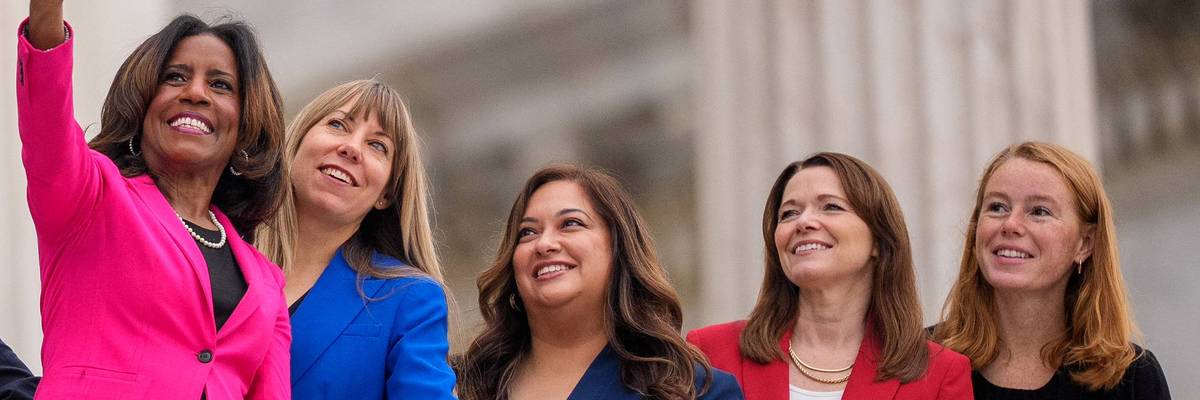
(L-R) Rep.-elects Donna Miller (D-Ill.), Sarah Trone Garriott (D-Iowa), Patty García (D-Ill.), Christina Bohannan (D-Iowa), and Rebecca Cooke (D-Wis.) take a selfie as they arrive along with other congressional freshmen of the 120th Congress for a group photograph on the steps of the House of Representatives of the US Capitol Building on November 12, 2026 in Washington, DC.
When the new Congress convenes in January, Democrats must make childcare more affordable and accessible, invest in the workers who make care possible, expand access to paid family and medical leave, and help families manage the crushing costs of caring for aging relatives.
In Iowa, three women are heading to Congress with something important in common: They understand that the high cost of caregiving—childcare, eldercare, and taking time off work to care for loved ones—is one of the biggest economic challenges facing American families.
Lindsay James knows what it's like to stretch every dollar, recalling the days when she clipped coupons and served rice and beans to make ends meet while raising a family and helping put her husband through school. Sarah Trone Garriott has spoken openly about the challenges of affording childcare for her sons and fought to expand assistance for families as a state senator. And Christina Bohannan, the daughter of a day care provider, grew up seeing firsthand the challenges facing the people who care for our children.
These women didn't just campaign on making life more affordable. They brought their own experiences as mothers, daughters, and advocates to the conversation. While I was knocking on voters’ doors, I heard again and again that life is too expensive and people need leaders who will work to bring costs down. And on Election Day, Iowans sent all three to Washington.
The new women heading to Washington from Iowa and districts across the country understand what's at stake because they've lived it. Millions of families across America have too.
At the Campaign for a Family Friendly Economy PAC, we made sure the cost of care was front and center in the races that would determine control of Congress. Across the country, we endorsed 29 candidates who committed to making caregiving more affordable. I met one-on-one with every endorsed candidate to underscore the importance of addressing care costs for voters. We brought candidates together with families and caregivers, elevated their stories to voters, and supported their campaigns through paid communications and voter outreach. We invested more than $40 million in competitive races, knocked on more than 16 million doors, and held over 757,000 conversations with voters about which candidates would actually lower costs, especially the cost of caregiving.
These efforts helped make the cost of care a central part of the broader Democratic affordability message—and helped elect a new generation of champions ready to deliver.
Their victories are part of a much bigger story. Across the country, voters rejected Republican leadership and elected Democrats who promised to tackle the affordability crisis squeezing working families. Now, with new majorities in Congress, Democrats have a mandate to deliver—and lowering the cost of caregiving must be central to that agenda.
Because the cost of care is the cost of living.
For too long, politicians have treated childcare, eldercare, and paid family leave as separate from the economy. But for millions of Americans, they determine whether families can pay their bills, whether parents can remain in the workforce, and whether adult children can afford to care for aging loved ones.
This election made clear that these pressures are top of mind for voters and they want new leaders who will take action to alleviate them.
According to early exit polling, nearly 9 in 10 voters said the cost of living was a crucial or major factor in their vote. And a September 2026 poll from the National Women’s Law Center found that 81% of adults support guaranteeing access to affordable, high-quality childcare, while 89% support affordable long-term care for older adults and people with disabilities.
The message is unmistakable: Families are struggling, and they expect their elected leaders to do something about it.
From Iowa to Maine, Ohio to Pennsylvania, our conversations with voters reinforced what families have been telling us for years: The price of groceries matters. The cost of housing matters. And so does the enormous expense of caring for the people we love.
Candidates who recognized that connection won important victories. In Maine, Senator-elect Troy Jackson made expanding access to affordable childcare, eldercare, and paid family and medical leave central to his message to working families. In Texas, Senator-elect James Talarico put childcare affordability at the heart of his agenda. Across the country, candidates demonstrated that addressing the cost of care isn't just good policy. It's good politics. And it’s what delivered the Blue Tsunami we saw on our TVs on Tuesday night.
But winning elections is only the beginning.
When the new Congress convenes in January, Democrats must turn their promises into action. That means voting to make childcare more affordable and accessible, invest in the workers who make care possible, expand access to paid family and medical leave, and help families manage the crushing costs of caring for aging relatives.
These policies aren't simply about helping families balance work and family. They're about strengthening our economy. Affordable, reliable care allows more people to work, earn higher wages, build financial security, and contribute to their communities. Supporting caregivers means supporting economic growth.
Voters didn't elect new leaders to hear more lofty speeches. Rebekah, whom I met in Des Moines, doesn't need to be told that life is expensive—she needs relief. With affordable childcare so hard to find, she's had to pass up better-paying jobs and career opportunities because she can only take positions that allow her to bring her children when school is out. She knows firsthand how hard it is to make ends meet. Voters elected leaders to do something about it.
The new women heading to Washington from Iowa and districts across the country understand what's at stake because they've lived it. Millions of families across America have too.
Democrats now have an opportunity—and an obligation—to prove that they heard them.
The cost of care helped define this election. Lowering it must help define the next Congress.
This country and this world are at a monumental crossroads. US voters have an opportunity to beat back the forces of fascism and confront the billionaires who are rigging the economy, our media system, and our democracy, making it increasingly impossible for ordinary people to get by. We’re not just talking about the election. We’re talking about what must be done once these fascist elements are vanquished from power. We need a bolder set of solutions than what either major party has so far been willing to offer and a working-class movement ready to fight like hell for it. Trump didn't emerge from nowhere. The conditions that fueled MAGA authoritarianism were created by decades of radical neoliberal economic policies and a corrupt political system dominated by corporate interests. They slashed taxes on the super-rich, promising that the benefits would trickle down. They said giveaways to the corporate titans would make life more affordable for the rest of us. It was all bullshit. And when a bitter, betrayed populace searches for someone to blame, right-wing demagogues have little trouble finding scapegoats. People know when they're being lied to, but you won't hear any of this from the corporate media. Only independent journalism—powered and funded by people who believe in building a better world—can deliver truly trustworthy daily news. If you share our vision, please contribute whatever you can to sustain our work. |
In Iowa, three women are heading to Congress with something important in common: They understand that the high cost of caregiving—childcare, eldercare, and taking time off work to care for loved ones—is one of the biggest economic challenges facing American families.
Lindsay James knows what it's like to stretch every dollar, recalling the days when she clipped coupons and served rice and beans to make ends meet while raising a family and helping put her husband through school. Sarah Trone Garriott has spoken openly about the challenges of affording childcare for her sons and fought to expand assistance for families as a state senator. And Christina Bohannan, the daughter of a day care provider, grew up seeing firsthand the challenges facing the people who care for our children.
These women didn't just campaign on making life more affordable. They brought their own experiences as mothers, daughters, and advocates to the conversation. While I was knocking on voters’ doors, I heard again and again that life is too expensive and people need leaders who will work to bring costs down. And on Election Day, Iowans sent all three to Washington.
The new women heading to Washington from Iowa and districts across the country understand what's at stake because they've lived it. Millions of families across America have too.
At the Campaign for a Family Friendly Economy PAC, we made sure the cost of care was front and center in the races that would determine control of Congress. Across the country, we endorsed 29 candidates who committed to making caregiving more affordable. I met one-on-one with every endorsed candidate to underscore the importance of addressing care costs for voters. We brought candidates together with families and caregivers, elevated their stories to voters, and supported their campaigns through paid communications and voter outreach. We invested more than $40 million in competitive races, knocked on more than 16 million doors, and held over 757,000 conversations with voters about which candidates would actually lower costs, especially the cost of caregiving.
These efforts helped make the cost of care a central part of the broader Democratic affordability message—and helped elect a new generation of champions ready to deliver.
Their victories are part of a much bigger story. Across the country, voters rejected Republican leadership and elected Democrats who promised to tackle the affordability crisis squeezing working families. Now, with new majorities in Congress, Democrats have a mandate to deliver—and lowering the cost of caregiving must be central to that agenda.
Because the cost of care is the cost of living.
For too long, politicians have treated childcare, eldercare, and paid family leave as separate from the economy. But for millions of Americans, they determine whether families can pay their bills, whether parents can remain in the workforce, and whether adult children can afford to care for aging loved ones.
This election made clear that these pressures are top of mind for voters and they want new leaders who will take action to alleviate them.
According to early exit polling, nearly 9 in 10 voters said the cost of living was a crucial or major factor in their vote. And a September 2026 poll from the National Women’s Law Center found that 81% of adults support guaranteeing access to affordable, high-quality childcare, while 89% support affordable long-term care for older adults and people with disabilities.
The message is unmistakable: Families are struggling, and they expect their elected leaders to do something about it.
From Iowa to Maine, Ohio to Pennsylvania, our conversations with voters reinforced what families have been telling us for years: The price of groceries matters. The cost of housing matters. And so does the enormous expense of caring for the people we love.
Candidates who recognized that connection won important victories. In Maine, Senator-elect Troy Jackson made expanding access to affordable childcare, eldercare, and paid family and medical leave central to his message to working families. In Texas, Senator-elect James Talarico put childcare affordability at the heart of his agenda. Across the country, candidates demonstrated that addressing the cost of care isn't just good policy. It's good politics. And it’s what delivered the Blue Tsunami we saw on our TVs on Tuesday night.
But winning elections is only the beginning.
When the new Congress convenes in January, Democrats must turn their promises into action. That means voting to make childcare more affordable and accessible, invest in the workers who make care possible, expand access to paid family and medical leave, and help families manage the crushing costs of caring for aging relatives.
These policies aren't simply about helping families balance work and family. They're about strengthening our economy. Affordable, reliable care allows more people to work, earn higher wages, build financial security, and contribute to their communities. Supporting caregivers means supporting economic growth.
Voters didn't elect new leaders to hear more lofty speeches. Rebekah, whom I met in Des Moines, doesn't need to be told that life is expensive—she needs relief. With affordable childcare so hard to find, she's had to pass up better-paying jobs and career opportunities because she can only take positions that allow her to bring her children when school is out. She knows firsthand how hard it is to make ends meet. Voters elected leaders to do something about it.
The new women heading to Washington from Iowa and districts across the country understand what's at stake because they've lived it. Millions of families across America have too.
Democrats now have an opportunity—and an obligation—to prove that they heard them.
The cost of care helped define this election. Lowering it must help define the next Congress.