SUBSCRIBE TO OUR FREE NEWSLETTER
Daily news & progressive opinion—funded by the people, not the corporations—delivered straight to your inbox.
5
#000000
#FFFFFF
To donate by check, phone, or other method, see our More Ways to Give page.
Daily news & progressive opinion—funded by the people, not the corporations—delivered straight to your inbox.
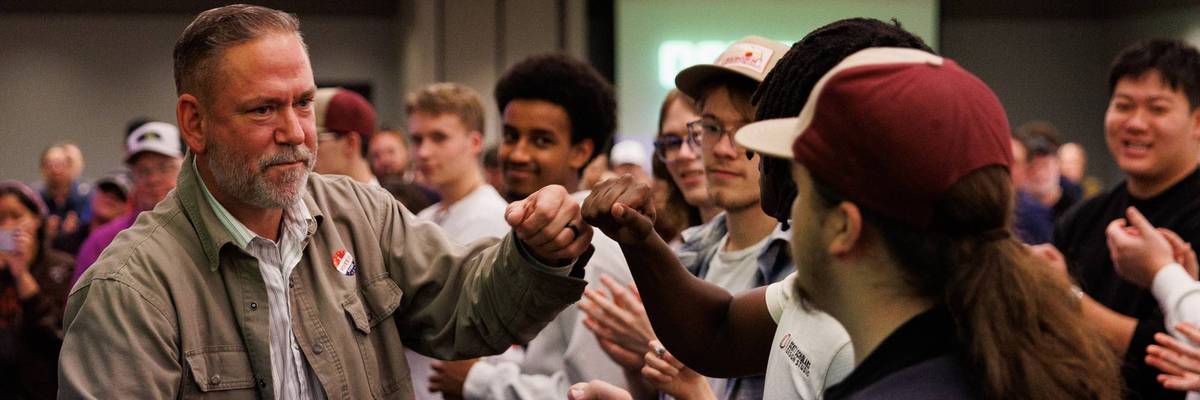
Dan Osborn, nonpartisan candidate for U.S. Senate, fist bumps supporters during an election watch party in Omaha on Tuesday, Nov. 3, 2026.
Even the strongest individual candidate cannot substitute for the patient work of building an independent political movement.
Dan Osborn, the independent candidate and former local union president, once again came within a few percentage points of winning the Nebraska US Senate seat. (He lost by 6.7% in 2024 and the same again this year.) He mounted an impressive challenge, but he couldn’t close the gap. Why? And what does his defeat tell us about the future of independent working-class politics?
Wouldn’t Osborn have done much better if he ran as a Democrat?
The anti-Trump Blue Wave created key red state Senate Democratic victories as it tore through Texas, Kansas, Iowa, Ohio, South Carolina, and maybe even Mississippi. But, it hit the shoals in North Dakota where the Democrat lost by 20.7 percent, by 18 percent in Oklahoma, and by 30.4 percent in Wyoming. The wave also didn’t reach the rest of the South and border states.
It would be prudent to lay the foundation for an independent party that would be overtly committed to take on corporate power, runaway inequality, and job insecurity.
So, it is not at all clear that a Democrat would have outperformed Osborn in Nebraska. Nevertheless, there are several lessons from Osborn’s defeat worth considering.
1. Running for the Senate is a big deal.
Anyone running for the US Senate against a Republican in a very red state is going to face a wall of money. There are only a handful of genuinely competitive Senate races every two years, and enormous sums flow into them. Osborn was up against $37 million—about $40 per voter—the most ever spent on a Senate race in Nebraska.
It would be nice to think money doesn’t matter, but when the sums are that enormous it does. Money buys advertising, organization, visibility, and an increased ability to define a candidate, as well as to define the candidate’s opponent. Overcoming those advantages is extraordinarily difficult.
2. Running for the Senate is a big jump.
I can’t think of anyone who has gone directly from serving as a local union president to being elected to the US Senate. That’s a hell of a leap, and Osborn deserves enormous credit for attempting it.
But it raises a question: Why not first run for a less demanding office, build an organization, establish a political record, and develop a broader base of support? Why not Congress or the state legislature?
We can second guess all we want, but there’s no guarantee that a smaller race would have been easier for Osborn. And sometimes political opportunities don’t wait. Especially because building political power takes time, which means the odds were stacked against Osborn from the start.
3. Was he really an independent, or a Democrat in disguise?
Everyone knows the Democratic brand is in terrible shape in Nebraska, as well as in much of red America. We did a survey that shows how much. Running as an independent, for Osborn, made considerable sense. But according to the New York Times,
“more than half of voters — 55 percent — say they see Mr. Osborn, a union leader, as more of a Democrat than anything else. Just one third of voters say they consider him to be an independent.”
And, of course, the Republicans spent millions hammering away at that perception throughout the campaign.
To make matters worse, a leaked recordings captured Osborn privately expressing views that were far more liberal from the more cautious public positions he took during the campaign on issues like the border wall, transgender people, and ICE.
Whether or not voters agreed with the positions on those issues he’d taken in public, the episode created a credibility problem. It reinforced the Republican argument that Osborn was really a Democrat hiding behind an independent label.
This points to a larger problem: An independent candidate running alone must convince voters that his independence is real if he’s going to avoid negativity of the Democratic brand in red America.
4. There is no substitute for building an independent political organization, step by step.
Osborn could be labeled—or mislabeled—a Democratic shill precisely because he was an individual candidate. He did not represent a political organization with a record of independence from the two major parties. He had no established movement behind him to demonstrate what that independence meant. As an individual, it was all on him.
Compare that with the Nonpartisan League, which prospered in North Dakota during and after World War I. It had a coherent platform, including the public ownership of grain elevators and the establishment of a publicly owned bank. (The public Bank of North Dakota still operates today.) In a few years, the League recruited tens of thousands of dues-paying members and ran candidates for local and state offices.
It was never about one person. It was a movement and a political organization. The verbal gaffes or vulnerabilities of any individual candidate could not bring down the entire effort.
Building that kind of organization takes longer than trying to produce a dramatic political breakthrough from the top down. It’s not impossible for one individual to pull it off—Osborn has come remarkably close—but relying on one candidate makes the entire effort vulnerable to that person’s mistakes, inconsistencies, or political liabilities. (Consider the Dem’s experience with Graham Platner in Maine.)
It was never about one person. It was a movement and a political organization. The verbal gaffes or vulnerabilities of any individual candidate could not bring down the entire effort.
An organization built around a clear platform is much stronger over the long run. It can explain, over several years and through many different candidates, what it means to be independent of the two major parties. Its record, membership, and collective work become the proof of its independence, and it becomes much more difficult to dismiss the entire organization as a Democratic front.
5. Osborn’s race shows why we need a long-term vision for a new working-class party. Or will the Democrats again become the party of working people?
The alternative to running as an individual is the creation of a new political organization of working people—one that is fundamentally different from the Democrats and the Republicans.
But why bother? Aren’t the Democrats now positioned to fight for powerful pro-worker policies like raising the minimum wage, facilitating labor union organizing, and putting price controls on pharmaceutical and food cartels?
Let’s hope so. But, it’s just as possible for the Democrats with narrow victories in purple districts to call for moderate policies to secure their positions and maintain the support of their wealthy donors. Although we might see a slew of investigations to uncover corruption and the Epstein files, there may be little movement on the most basic economic protections for working people.
And the Democrats still do not have the support of a majority of voters without college degrees, according to exit polls.
Therefore, it would be prudent to lay the foundation for an independent party that would be overtly committed to take on corporate power, runaway inequality, and job insecurity. It would fight for good jobs, decent wages, strong unions, and support for communities where working people can thrive.
Osborn’s campaign demonstrated that an independent working-class candidate could mount a serious challenge in a red state. His defeat should not obscure that achievement.
But it would also have to welcome working people with a range of social and cultural beliefs, including people who might not feel comfortable with the progressive left. That doesn’t mean abandoning basic principles of fairness, equality, and justice. It does mean recognizing that working people will not agree on everything, and that a successful political organization must be broad enough to unite them around their common economic interests.
Most important, it must be a party of and by working people. Its members—not wealthy donors, not political consultants, not a handful of prominent leaders—must shape its platform, choose its candidates, run its campaigns, and recruit new members. It must be an organization people actively participate in, not simply a label they vote for every few years.
Dan Osborn’s campaign demonstrated that an independent working-class candidate could mount a serious challenge in a red state. His defeat should not obscure that achievement. But it also reminds us that even the strongest individual candidate cannot substitute for the patient work of building an independent political movement.
We need to move beyond the search for the next Dan Osborn. We need to build a political organization that can produce hundreds of them.
Let’s hope Osborn’s remarkable effort helps lay the foundation for that movement.
(For more, please see A Party of Our Own.)
This country and this world are at a monumental crossroads. US voters have an opportunity to beat back the forces of fascism and confront the billionaires who are rigging the economy, our media system, and our democracy, making it increasingly impossible for ordinary people to get by. We’re not just talking about the election. We’re talking about what must be done once these fascist elements are vanquished from power. We need a bolder set of solutions than what either major party has so far been willing to offer and a working-class movement ready to fight like hell for it. Trump didn't emerge from nowhere. The conditions that fueled MAGA authoritarianism were created by decades of radical neoliberal economic policies and a corrupt political system dominated by corporate interests. They slashed taxes on the super-rich, promising that the benefits would trickle down. They said giveaways to the corporate titans would make life more affordable for the rest of us. It was all bullshit. And when a bitter, betrayed populace searches for someone to blame, right-wing demagogues have little trouble finding scapegoats. People know when they're being lied to, but you won't hear any of this from the corporate media. Only independent journalism—powered and funded by people who believe in building a better world—can deliver truly trustworthy daily news. If you share our vision, please contribute whatever you can to sustain our work. |
Les Leopold is the executive director of the Labor Institute and author of the new book, “The Billionaires Have Two Parties, We Need a Party of Our Own” (2026). His previous books include: “Wall Street’s War on Workers: How Mass Layoffs and Greed Are Destroying the Working Class and What to Do About It" (2024); "Runaway Inequality: An Activist's Guide to Economic Justice" (2015); and “The Man Who Hated Work and Loved Labor: The Life and Times of Tony Mazzocchi” (2007). Read more of his work on his substack here.
Dan Osborn, the independent candidate and former local union president, once again came within a few percentage points of winning the Nebraska US Senate seat. (He lost by 6.7% in 2024 and the same again this year.) He mounted an impressive challenge, but he couldn’t close the gap. Why? And what does his defeat tell us about the future of independent working-class politics?
Wouldn’t Osborn have done much better if he ran as a Democrat?
The anti-Trump Blue Wave created key red state Senate Democratic victories as it tore through Texas, Kansas, Iowa, Ohio, South Carolina, and maybe even Mississippi. But, it hit the shoals in North Dakota where the Democrat lost by 20.7 percent, by 18 percent in Oklahoma, and by 30.4 percent in Wyoming. The wave also didn’t reach the rest of the South and border states.
It would be prudent to lay the foundation for an independent party that would be overtly committed to take on corporate power, runaway inequality, and job insecurity.
So, it is not at all clear that a Democrat would have outperformed Osborn in Nebraska. Nevertheless, there are several lessons from Osborn’s defeat worth considering.
1. Running for the Senate is a big deal.
Anyone running for the US Senate against a Republican in a very red state is going to face a wall of money. There are only a handful of genuinely competitive Senate races every two years, and enormous sums flow into them. Osborn was up against $37 million—about $40 per voter—the most ever spent on a Senate race in Nebraska.
It would be nice to think money doesn’t matter, but when the sums are that enormous it does. Money buys advertising, organization, visibility, and an increased ability to define a candidate, as well as to define the candidate’s opponent. Overcoming those advantages is extraordinarily difficult.
2. Running for the Senate is a big jump.
I can’t think of anyone who has gone directly from serving as a local union president to being elected to the US Senate. That’s a hell of a leap, and Osborn deserves enormous credit for attempting it.
But it raises a question: Why not first run for a less demanding office, build an organization, establish a political record, and develop a broader base of support? Why not Congress or the state legislature?
We can second guess all we want, but there’s no guarantee that a smaller race would have been easier for Osborn. And sometimes political opportunities don’t wait. Especially because building political power takes time, which means the odds were stacked against Osborn from the start.
3. Was he really an independent, or a Democrat in disguise?
Everyone knows the Democratic brand is in terrible shape in Nebraska, as well as in much of red America. We did a survey that shows how much. Running as an independent, for Osborn, made considerable sense. But according to the New York Times,
“more than half of voters — 55 percent — say they see Mr. Osborn, a union leader, as more of a Democrat than anything else. Just one third of voters say they consider him to be an independent.”
And, of course, the Republicans spent millions hammering away at that perception throughout the campaign.
To make matters worse, a leaked recordings captured Osborn privately expressing views that were far more liberal from the more cautious public positions he took during the campaign on issues like the border wall, transgender people, and ICE.
Whether or not voters agreed with the positions on those issues he’d taken in public, the episode created a credibility problem. It reinforced the Republican argument that Osborn was really a Democrat hiding behind an independent label.
This points to a larger problem: An independent candidate running alone must convince voters that his independence is real if he’s going to avoid negativity of the Democratic brand in red America.
4. There is no substitute for building an independent political organization, step by step.
Osborn could be labeled—or mislabeled—a Democratic shill precisely because he was an individual candidate. He did not represent a political organization with a record of independence from the two major parties. He had no established movement behind him to demonstrate what that independence meant. As an individual, it was all on him.
Compare that with the Nonpartisan League, which prospered in North Dakota during and after World War I. It had a coherent platform, including the public ownership of grain elevators and the establishment of a publicly owned bank. (The public Bank of North Dakota still operates today.) In a few years, the League recruited tens of thousands of dues-paying members and ran candidates for local and state offices.
It was never about one person. It was a movement and a political organization. The verbal gaffes or vulnerabilities of any individual candidate could not bring down the entire effort.
Building that kind of organization takes longer than trying to produce a dramatic political breakthrough from the top down. It’s not impossible for one individual to pull it off—Osborn has come remarkably close—but relying on one candidate makes the entire effort vulnerable to that person’s mistakes, inconsistencies, or political liabilities. (Consider the Dem’s experience with Graham Platner in Maine.)
It was never about one person. It was a movement and a political organization. The verbal gaffes or vulnerabilities of any individual candidate could not bring down the entire effort.
An organization built around a clear platform is much stronger over the long run. It can explain, over several years and through many different candidates, what it means to be independent of the two major parties. Its record, membership, and collective work become the proof of its independence, and it becomes much more difficult to dismiss the entire organization as a Democratic front.
5. Osborn’s race shows why we need a long-term vision for a new working-class party. Or will the Democrats again become the party of working people?
The alternative to running as an individual is the creation of a new political organization of working people—one that is fundamentally different from the Democrats and the Republicans.
But why bother? Aren’t the Democrats now positioned to fight for powerful pro-worker policies like raising the minimum wage, facilitating labor union organizing, and putting price controls on pharmaceutical and food cartels?
Let’s hope so. But, it’s just as possible for the Democrats with narrow victories in purple districts to call for moderate policies to secure their positions and maintain the support of their wealthy donors. Although we might see a slew of investigations to uncover corruption and the Epstein files, there may be little movement on the most basic economic protections for working people.
And the Democrats still do not have the support of a majority of voters without college degrees, according to exit polls.
Therefore, it would be prudent to lay the foundation for an independent party that would be overtly committed to take on corporate power, runaway inequality, and job insecurity. It would fight for good jobs, decent wages, strong unions, and support for communities where working people can thrive.
Osborn’s campaign demonstrated that an independent working-class candidate could mount a serious challenge in a red state. His defeat should not obscure that achievement.
But it would also have to welcome working people with a range of social and cultural beliefs, including people who might not feel comfortable with the progressive left. That doesn’t mean abandoning basic principles of fairness, equality, and justice. It does mean recognizing that working people will not agree on everything, and that a successful political organization must be broad enough to unite them around their common economic interests.
Most important, it must be a party of and by working people. Its members—not wealthy donors, not political consultants, not a handful of prominent leaders—must shape its platform, choose its candidates, run its campaigns, and recruit new members. It must be an organization people actively participate in, not simply a label they vote for every few years.
Dan Osborn’s campaign demonstrated that an independent working-class candidate could mount a serious challenge in a red state. His defeat should not obscure that achievement. But it also reminds us that even the strongest individual candidate cannot substitute for the patient work of building an independent political movement.
We need to move beyond the search for the next Dan Osborn. We need to build a political organization that can produce hundreds of them.
Let’s hope Osborn’s remarkable effort helps lay the foundation for that movement.
(For more, please see A Party of Our Own.)