SUBSCRIBE TO OUR FREE NEWSLETTER
Daily news & progressive opinion—funded by the people, not the corporations—delivered straight to your inbox.
5
#000000
#FFFFFF
To donate by check, phone, or other method, see our More Ways to Give page.
Daily news & progressive opinion—funded by the people, not the corporations—delivered straight to your inbox.
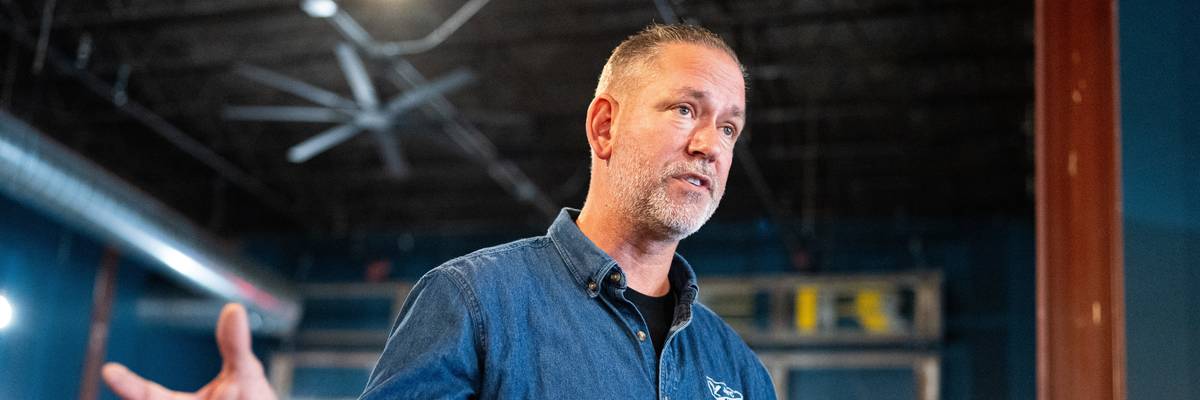
Then-Independent Senate candidate Dan Osborn of Nebraska speaks during his campaign stop at a coffeshop in O'Neill, Nebraska on October 14, 2024.
"Working-class candidate v. billionaire political race. I'm here for it," wrote one longtime progressive strategist.
Dan Osborn, an Independent U.S. Senate candidate who struck a chord with working-class voters in Nebraska and came within striking distance of unseating his Republican opponent last year, announced Thursday that he's considering another run, this time challenging GOP Sen. Pete GOP Ricketts, who is up for election in 2026.
"We could replace a billionaire with a mechanic," Osborn wrote in a thread on X on Thursday. "I'll run against Pete Ricketts—if the support is there." Osborn said that he's launching an exploratory committee and would run as Independent, as he did in 2024.
Ricketts has served as a senator since 2023, and prior to that was the governor of Nebraska from 2015-2023. By one estimate, Ricketts has a net worth of over $165 million—though the wealth of his father, brokerage founder Joe Ricketts, and family is estimated to be worth $4.1 billion, according to Forbes.
A mechanic and unionist who helped lead a strike against Kellogg's cereal company, Osborn lost to Sen. Deb Fischer (R-Neb.) by less than 7 points in November 2024 in what became an unexpectedly close race.
Although he didn't win, he overperformed the national Democratic ticket by a higher percentage than other candidates running against Republicans in competitive Senate races, according to The Nation.
"Billionaires have bought up the country and are carving it up day by day," said Osborn Thursday. "The economy they've built is good for them, bad for us. Good for huge multinationals and multibillionaires. Bad for workers. Bad for small businesses, bad for family farmers. Bad for anyone who wants Social Security to survive. Bad for your PAYCHECK."
Osborn cast the potential race as between "someone who's spent his life working for a living and will never take an order from a corporation or a party boss" and "someone who's never worked a day in his life and is entirely beholden to corporations and party."
"We could take on this illness, the billionaire class, directly," he said.
Osborn, who campaigned on issues like Right to Repair and lowering taxes on overtime payments, earned praise from Sen. Bernie Sanders (I-Vt.), who told The Nation in late November that Osborn's bid should be viewed as a "model for the future."
Osborn "took on both political parties. He took on the corporate world. He ran as a strong trade unionist. Without party support, getting heavily outspent, he got through to working-class people all over Nebraska. It was an extraordinary campaign," Sanders said.
In reaction to the news that Osborn is exploring a second run, a former Sanders campaign manager and longtime progressive Democratic strategist Faiz Shakir, wrote: "working-class candidate v. billionaire political race. I'm here for it."
This country and this world are at a monumental crossroads. US voters have an opportunity to beat back the forces of fascism and confront the billionaires who are rigging the economy, our media system, and our democracy, making it increasingly impossible for ordinary people to get by. We’re not just talking about the election. We’re talking about what must be done once these fascist elements are vanquished from power. We need a bolder set of solutions than what either major party has so far been willing to offer and a working-class movement ready to fight like hell for it. Trump didn't emerge from nowhere. The conditions that fueled MAGA authoritarianism were created by decades of radical neoliberal economic policies and a corrupt political system dominated by corporate interests. They slashed taxes on the super-rich, promising that the benefits would trickle down. They said giveaways to the corporate titans would make life more affordable for the rest of us. It was all bullshit. And when a bitter, betrayed populace searches for someone to blame, right-wing demagogues have little trouble finding scapegoats. People know when they're being lied to, but you won't hear any of this from the corporate media. Only independent journalism—powered and funded by people who believe in building a better world—can deliver truly trustworthy daily news. If you share our vision, please contribute whatever you can to sustain our work. |
Dan Osborn, an Independent U.S. Senate candidate who struck a chord with working-class voters in Nebraska and came within striking distance of unseating his Republican opponent last year, announced Thursday that he's considering another run, this time challenging GOP Sen. Pete GOP Ricketts, who is up for election in 2026.
"We could replace a billionaire with a mechanic," Osborn wrote in a thread on X on Thursday. "I'll run against Pete Ricketts—if the support is there." Osborn said that he's launching an exploratory committee and would run as Independent, as he did in 2024.
Ricketts has served as a senator since 2023, and prior to that was the governor of Nebraska from 2015-2023. By one estimate, Ricketts has a net worth of over $165 million—though the wealth of his father, brokerage founder Joe Ricketts, and family is estimated to be worth $4.1 billion, according to Forbes.
A mechanic and unionist who helped lead a strike against Kellogg's cereal company, Osborn lost to Sen. Deb Fischer (R-Neb.) by less than 7 points in November 2024 in what became an unexpectedly close race.
Although he didn't win, he overperformed the national Democratic ticket by a higher percentage than other candidates running against Republicans in competitive Senate races, according to The Nation.
"Billionaires have bought up the country and are carving it up day by day," said Osborn Thursday. "The economy they've built is good for them, bad for us. Good for huge multinationals and multibillionaires. Bad for workers. Bad for small businesses, bad for family farmers. Bad for anyone who wants Social Security to survive. Bad for your PAYCHECK."
Osborn cast the potential race as between "someone who's spent his life working for a living and will never take an order from a corporation or a party boss" and "someone who's never worked a day in his life and is entirely beholden to corporations and party."
"We could take on this illness, the billionaire class, directly," he said.
Osborn, who campaigned on issues like Right to Repair and lowering taxes on overtime payments, earned praise from Sen. Bernie Sanders (I-Vt.), who told The Nation in late November that Osborn's bid should be viewed as a "model for the future."
Osborn "took on both political parties. He took on the corporate world. He ran as a strong trade unionist. Without party support, getting heavily outspent, he got through to working-class people all over Nebraska. It was an extraordinary campaign," Sanders said.
In reaction to the news that Osborn is exploring a second run, a former Sanders campaign manager and longtime progressive Democratic strategist Faiz Shakir, wrote: "working-class candidate v. billionaire political race. I'm here for it."