SUBSCRIBE TO OUR FREE NEWSLETTER
Daily news & progressive opinion—funded by the people, not the corporations—delivered straight to your inbox.
5
#000000
#FFFFFF
To donate by check, phone, or other method, see our More Ways to Give page.
In much of the country, there is an enormous vacuum for working people seeking political representation. In 2024, 132 Republican House victories were by 25 percentage points or more.
In nine Great Plains and central states—Oklahoma, Kansas, Nebraska, Missouri, Iowa, South Dakota, North Dakota, Montana, and Idaho—Democrats did not even field candidates in approximately 40 percent of the roughly 1,400 state legislative races, according to my own rough count.
Here’s what one 2026 projection looks like:
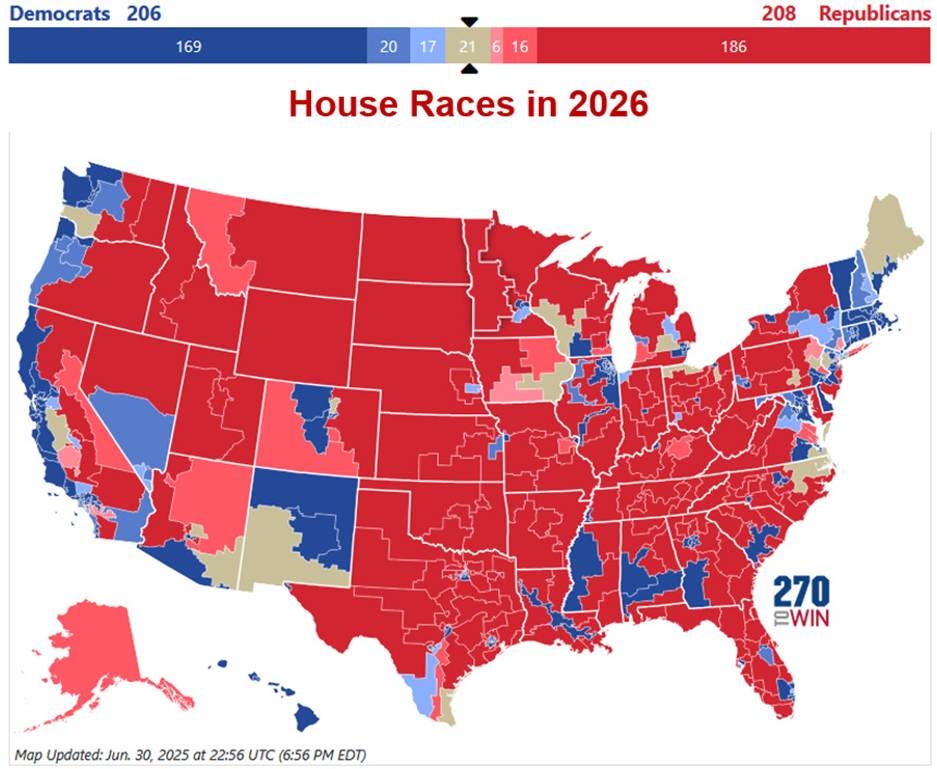
The above map shows all too clearly that in vast areas of the country working-class voters have no realistic alternative-party representation—the Republican is the only viable major-party choice, while the Democratic Party has largely abandoned many of these races.
But nature, as well as politics, abhors a vacuum, which is why we’re starting to see the emergence of progressive populist independents trying to take hold in this desert.
Here are a few worth noting:
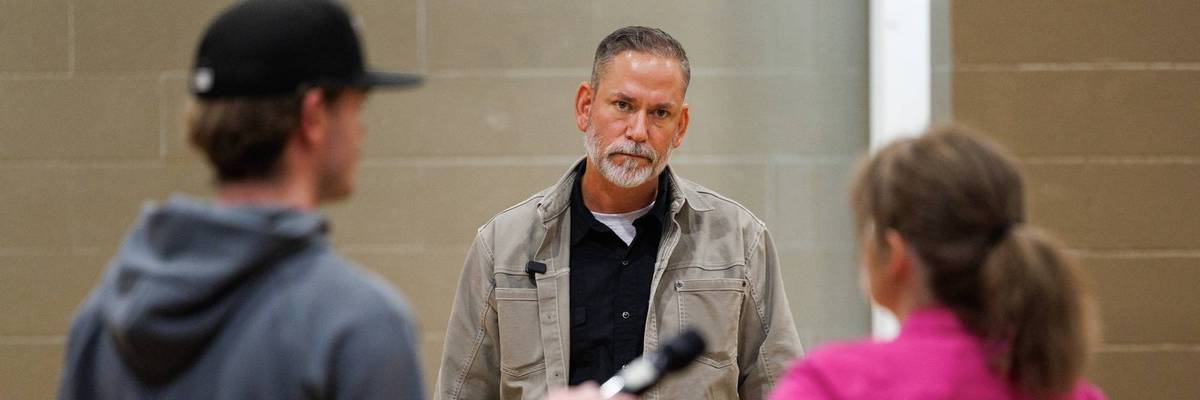
Dan Osborn, a mechanic, Navy veteran, and former labor union president, is running for US Senate in Nebraska against incumbent Republican Pete Ricketts, the former governor and son of billionaire Joe Ricketts. Osborn came within seven points of defeating Republican Sen. Deb Fischer in 2024, running 16 points ahead of Kamala Harris, and the 2026 race has again attracted national attention.
The current polling picture is close. The average of three recent Nebraska polls has Ricketts at 46.3 percent and Osborn at 44.7 percent, within the margin of error, with a substantial share of voters undecided or supporting other candidates. The latest polls that meet the New York Times criteria for worthiness show Osborn slightly ahead, a virtual toss-up pitting an incumbent Republican with deep pockets against an independent.
We can expect an inordinate amount of money to flood into the race to attack Osborn. A Republican super PAC has already put more than $3 million into advertising targeting him.
Osborn is running on his Nebraska Growth & Fairness Plan, which he says is “not a party’s platform or written by consultants. It’s written for the people who punch a clock and wonder why nobody in Washington is fighting for them.”
He explicitly disavows a connection to the Democratic Party, though the Republicans try to link the two at every turn.
If Osborn can overcome the Republican financial advantage, it would be an enormous boost to working-class candidates who have given up on the Democrats.
Unfortunately, Osborn faces the fallout from a leaked audio recording in which he made disparaging remarks about some of Trump’s voters. The recording was obtained by the Omaha World-Herald, and Osborn subsequently said that the voice “sure sounds like me” and apologized for the remarks.
He was recorded saying:
“Billy Bob in f—— Red Cloud, Nebraska, who lives next to the f—— Trump store as you pull into town and is waving the flag, all he knows is that he’s on the winning team. (Trump has) been so effective at taking Billy Bob and his wife Mary Jane or Mary Jo and telling them … you’re on the winning team. And that’s all they care about, because their lives probably suck so f—— bad.”
November will tell us whether his campaign against the two parties can overcome both the Republican financial advantage and the political damage from his choice of words.
Todd Achilles is running as an independent for US Senate in Idaho. He says:
“The two-party system has failed America. Both parties increase the national debt, keep us in endless wars, and favor big corporations, harming our families in the process…I reject the left-right divide because the challenge ahead of us is those at the top versus those at the bottom — those in power against the people. I will fight for all Idahoans, not billionaires or extremists.”
Achilles, a former Democratic member of the Idaho House of Representatives, is not a traditional working-class candidate. He is an Army veteran and technology executive who is running on a populist, anti-corporate platform.
The polling picture in Idaho is complicated. Recent surveys have produced very different results depending on the sample and whether voters are shown a two-candidate or multi-candidate race. One recent rather optimistic average of polls shows Achilles trailing by about 3 to 5 percent.
Whatever the polling, Idaho remains an overwhelmingly Republican state: Donald Trump defeated Kamala Harris there by 36.5 percentage points in 2024, winning 66.9 percent to Harris’s 30.4 percent.
Brian Bengs, a US Navy and Air Force veteran, former JAG officer, and lawyer, is running as an independent for the US Senate from South Dakota. In 2022, he ran for Senate as a Democrat and lost by more than 40 points. He’s running as a member of the Independent Veterans of America.
He is attacking the billionaire class:
“who buy politicians to rig the system so they can pay a lower tax rate than their secretaries & condition us to see only through red or blue-colored glasses disguising how they pick our pockets.”
His campaign’s current platform indeed emphasizes getting big money out of politics, eliminating corruption, banning congressional stock trading, unrigging the tax code, and reducing the national debt.
Like Achilles, Bengs faces a formidable Republican political environment. Trump carried South Dakota by 29.2 percentage points in 2024.
Bill Hill, a commercial fisherman, construction worker, teacher, principal, and former superintendent, is running as an independent for Alaska’s sole congressional seat. He spent more than two decades in education and was named Alaska Superintendent of the Year in 2023.
Hill is calling for:
“a total ban on congressional stock trading. Billionaires and corporations need to pay their share like the rest of us. And we need to get big money out of our elections…I’m a lifelong independent running to do what’s right by Alaskans, not what’s right by billionaires, corporations, or party bosses in DC.”
Political analysts repeatedly warn that third-party candidates can serve as spoilers, potentially helping the candidate they least support. But Alaska’s ranked-choice voting system makes the situation more complicated.
The Democrat, Eric Hafner, remains on the November ballot, along with Republican incumbent Nick Begich, Hill, and Libertarian Jim McDermott. In the latest New York Times/Siena poll, the first-choice results were Begich 47 percent, Hill 35 percent, Hafner 8 percent, and McDermott 5 percent. After ranked-choice tabulation, Begich led Hill 53 percent to 47 percent.
So, in Alaska, the spoiler question is not simply a matter of who finishes ahead in the first round. The ranked-choice system makes the ultimate effect of Hafner’s candidacy dependent on how his supporters’ second choices are distributed.
Candidates Without a Party?
Currently, there is no unified effort to build a party of independents to run in deep-red America. Instead, the effort is largely driven by the candidates themselves. It’s unclear if this will be the best long-term approach.
The word “independent” does fit nicely with the idea of independent candidates, free from any broader party or political organization. But independence has its downside in terms of accumulating and sharing campaign expertise, funding, and building a unified platform.
To find out more about the viability of independent candidates, we will be conducting a new survey of 5,000 voters in red America. One question we will ask respondents is whether a new organization of independents should be formed and what to call it.
Will a New Political Formation Emerge?
The political logic of the Democratic Party’s abandonment of its working class roots, which led to the very red map of America, and the Republican Party’s failure to support workers and their issues while having control of the government, suggests strongly that something new could emerge. There are just too many working people with no political home. But it remains to be seen how this vacuum will be filled—and by whom.
There is some chance that the Democrats, responding to the independents, will address the void by running many more working-class and progressive populist candidates. But the Democratic brand is extremely tarnished.
As John Tester, the former Democratic Montana US Senator, put it in a leaked text attributed to him:
“Every race I ran as Montana Senator and US Senator it was about distancing myself from the Democratic Party…. During my last two races the Democratic Party was poison in my attempts to get re-elected.”
For those of us who want to end MAGA’s grip on national politics this November, let’s hope that an enormous blue (and independent) wave will serve, for now, as the antidote.
For more information, see A Party of Our Own.
In much of the country, there is an enormous vacuum for working people seeking political representation. In 2024, 132 Republican House victories were by 25 percentage points or more.
In nine Great Plains and central states—Oklahoma, Kansas, Nebraska, Missouri, Iowa, South Dakota, North Dakota, Montana, and Idaho—Democrats did not even field candidates in approximately 40 percent of the roughly 1,400 state legislative races, according to my own rough count.
Here’s what one 2026 projection looks like:
The above map shows all too clearly that in vast areas of the country working-class voters have no realistic alternative-party representation—the Republican is the only viable major-party choice, while the Democratic Party has largely abandoned many of these races.
But nature, as well as politics, abhors a vacuum, which is why we’re starting to see the emergence of progressive populist independents trying to take hold in this desert.
Here are a few worth noting:
Dan Osborn, a mechanic, Navy veteran, and former labor union president, is running for US Senate in Nebraska against incumbent Republican Pete Ricketts, the former governor and son of billionaire Joe Ricketts. Osborn came within seven points of defeating Republican Sen. Deb Fischer in 2024, running 16 points ahead of Kamala Harris, and the 2026 race has again attracted national attention.
The current polling picture is close. The average of three recent Nebraska polls has Ricketts at 46.3 percent and Osborn at 44.7 percent, within the margin of error, with a substantial share of voters undecided or supporting other candidates. The latest polls that meet the New York Times criteria for worthiness show Osborn slightly ahead, a virtual toss-up pitting an incumbent Republican with deep pockets against an independent.
We can expect an inordinate amount of money to flood into the race to attack Osborn. A Republican super PAC has already put more than $3 million into advertising targeting him.
Osborn is running on his Nebraska Growth & Fairness Plan, which he says is “not a party’s platform or written by consultants. It’s written for the people who punch a clock and wonder why nobody in Washington is fighting for them.”
He explicitly disavows a connection to the Democratic Party, though the Republicans try to link the two at every turn.
If Osborn can overcome the Republican financial advantage, it would be an enormous boost to working-class candidates who have given up on the Democrats.
Unfortunately, Osborn faces the fallout from a leaked audio recording in which he made disparaging remarks about some of Trump’s voters. The recording was obtained by the Omaha World-Herald, and Osborn subsequently said that the voice “sure sounds like me” and apologized for the remarks.
He was recorded saying:
“Billy Bob in f—— Red Cloud, Nebraska, who lives next to the f—— Trump store as you pull into town and is waving the flag, all he knows is that he’s on the winning team. (Trump has) been so effective at taking Billy Bob and his wife Mary Jane or Mary Jo and telling them … you’re on the winning team. And that’s all they care about, because their lives probably suck so f—— bad.”
November will tell us whether his campaign against the two parties can overcome both the Republican financial advantage and the political damage from his choice of words.
Todd Achilles is running as an independent for US Senate in Idaho. He says:
“The two-party system has failed America. Both parties increase the national debt, keep us in endless wars, and favor big corporations, harming our families in the process…I reject the left-right divide because the challenge ahead of us is those at the top versus those at the bottom — those in power against the people. I will fight for all Idahoans, not billionaires or extremists.”
Achilles, a former Democratic member of the Idaho House of Representatives, is not a traditional working-class candidate. He is an Army veteran and technology executive who is running on a populist, anti-corporate platform.
The polling picture in Idaho is complicated. Recent surveys have produced very different results depending on the sample and whether voters are shown a two-candidate or multi-candidate race. One recent rather optimistic average of polls shows Achilles trailing by about 3 to 5 percent.
Whatever the polling, Idaho remains an overwhelmingly Republican state: Donald Trump defeated Kamala Harris there by 36.5 percentage points in 2024, winning 66.9 percent to Harris’s 30.4 percent.
Brian Bengs, a US Navy and Air Force veteran, former JAG officer, and lawyer, is running as an independent for the US Senate from South Dakota. In 2022, he ran for Senate as a Democrat and lost by more than 40 points. He’s running as a member of the Independent Veterans of America.
He is attacking the billionaire class:
“who buy politicians to rig the system so they can pay a lower tax rate than their secretaries & condition us to see only through red or blue-colored glasses disguising how they pick our pockets.”
His campaign’s current platform indeed emphasizes getting big money out of politics, eliminating corruption, banning congressional stock trading, unrigging the tax code, and reducing the national debt.
Like Achilles, Bengs faces a formidable Republican political environment. Trump carried South Dakota by 29.2 percentage points in 2024.
Bill Hill, a commercial fisherman, construction worker, teacher, principal, and former superintendent, is running as an independent for Alaska’s sole congressional seat. He spent more than two decades in education and was named Alaska Superintendent of the Year in 2023.
Hill is calling for:
“a total ban on congressional stock trading. Billionaires and corporations need to pay their share like the rest of us. And we need to get big money out of our elections…I’m a lifelong independent running to do what’s right by Alaskans, not what’s right by billionaires, corporations, or party bosses in DC.”
Political analysts repeatedly warn that third-party candidates can serve as spoilers, potentially helping the candidate they least support. But Alaska’s ranked-choice voting system makes the situation more complicated.
The Democrat, Eric Hafner, remains on the November ballot, along with Republican incumbent Nick Begich, Hill, and Libertarian Jim McDermott. In the latest New York Times/Siena poll, the first-choice results were Begich 47 percent, Hill 35 percent, Hafner 8 percent, and McDermott 5 percent. After ranked-choice tabulation, Begich led Hill 53 percent to 47 percent.
So, in Alaska, the spoiler question is not simply a matter of who finishes ahead in the first round. The ranked-choice system makes the ultimate effect of Hafner’s candidacy dependent on how his supporters’ second choices are distributed.
Candidates Without a Party?
Currently, there is no unified effort to build a party of independents to run in deep-red America. Instead, the effort is largely driven by the candidates themselves. It’s unclear if this will be the best long-term approach.
The word “independent” does fit nicely with the idea of independent candidates, free from any broader party or political organization. But independence has its downside in terms of accumulating and sharing campaign expertise, funding, and building a unified platform.
To find out more about the viability of independent candidates, we will be conducting a new survey of 5,000 voters in red America. One question we will ask respondents is whether a new organization of independents should be formed and what to call it.
Will a New Political Formation Emerge?
The political logic of the Democratic Party’s abandonment of its working class roots, which led to the very red map of America, and the Republican Party’s failure to support workers and their issues while having control of the government, suggests strongly that something new could emerge. There are just too many working people with no political home. But it remains to be seen how this vacuum will be filled—and by whom.
There is some chance that the Democrats, responding to the independents, will address the void by running many more working-class and progressive populist candidates. But the Democratic brand is extremely tarnished.
As John Tester, the former Democratic Montana US Senator, put it in a leaked text attributed to him:
“Every race I ran as Montana Senator and US Senator it was about distancing myself from the Democratic Party…. During my last two races the Democratic Party was poison in my attempts to get re-elected.”
For those of us who want to end MAGA’s grip on national politics this November, let’s hope that an enormous blue (and independent) wave will serve, for now, as the antidote.
For more information, see A Party of Our Own.
In much of the country, there is an enormous vacuum for working people seeking political representation. In 2024, 132 Republican House victories were by 25 percentage points or more.
In nine Great Plains and central states—Oklahoma, Kansas, Nebraska, Missouri, Iowa, South Dakota, North Dakota, Montana, and Idaho—Democrats did not even field candidates in approximately 40 percent of the roughly 1,400 state legislative races, according to my own rough count.
Here’s what one 2026 projection looks like:
The above map shows all too clearly that in vast areas of the country working-class voters have no realistic alternative-party representation—the Republican is the only viable major-party choice, while the Democratic Party has largely abandoned many of these races.
But nature, as well as politics, abhors a vacuum, which is why we’re starting to see the emergence of progressive populist independents trying to take hold in this desert.
Here are a few worth noting:
Dan Osborn, a mechanic, Navy veteran, and former labor union president, is running for US Senate in Nebraska against incumbent Republican Pete Ricketts, the former governor and son of billionaire Joe Ricketts. Osborn came within seven points of defeating Republican Sen. Deb Fischer in 2024, running 16 points ahead of Kamala Harris, and the 2026 race has again attracted national attention.
The current polling picture is close. The average of three recent Nebraska polls has Ricketts at 46.3 percent and Osborn at 44.7 percent, within the margin of error, with a substantial share of voters undecided or supporting other candidates. The latest polls that meet the New York Times criteria for worthiness show Osborn slightly ahead, a virtual toss-up pitting an incumbent Republican with deep pockets against an independent.
We can expect an inordinate amount of money to flood into the race to attack Osborn. A Republican super PAC has already put more than $3 million into advertising targeting him.
Osborn is running on his Nebraska Growth & Fairness Plan, which he says is “not a party’s platform or written by consultants. It’s written for the people who punch a clock and wonder why nobody in Washington is fighting for them.”
He explicitly disavows a connection to the Democratic Party, though the Republicans try to link the two at every turn.
If Osborn can overcome the Republican financial advantage, it would be an enormous boost to working-class candidates who have given up on the Democrats.
Unfortunately, Osborn faces the fallout from a leaked audio recording in which he made disparaging remarks about some of Trump’s voters. The recording was obtained by the Omaha World-Herald, and Osborn subsequently said that the voice “sure sounds like me” and apologized for the remarks.
He was recorded saying:
“Billy Bob in f—— Red Cloud, Nebraska, who lives next to the f—— Trump store as you pull into town and is waving the flag, all he knows is that he’s on the winning team. (Trump has) been so effective at taking Billy Bob and his wife Mary Jane or Mary Jo and telling them … you’re on the winning team. And that’s all they care about, because their lives probably suck so f—— bad.”
November will tell us whether his campaign against the two parties can overcome both the Republican financial advantage and the political damage from his choice of words.
Todd Achilles is running as an independent for US Senate in Idaho. He says:
“The two-party system has failed America. Both parties increase the national debt, keep us in endless wars, and favor big corporations, harming our families in the process…I reject the left-right divide because the challenge ahead of us is those at the top versus those at the bottom — those in power against the people. I will fight for all Idahoans, not billionaires or extremists.”
Achilles, a former Democratic member of the Idaho House of Representatives, is not a traditional working-class candidate. He is an Army veteran and technology executive who is running on a populist, anti-corporate platform.
The polling picture in Idaho is complicated. Recent surveys have produced very different results depending on the sample and whether voters are shown a two-candidate or multi-candidate race. One recent rather optimistic average of polls shows Achilles trailing by about 3 to 5 percent.
Whatever the polling, Idaho remains an overwhelmingly Republican state: Donald Trump defeated Kamala Harris there by 36.5 percentage points in 2024, winning 66.9 percent to Harris’s 30.4 percent.
Brian Bengs, a US Navy and Air Force veteran, former JAG officer, and lawyer, is running as an independent for the US Senate from South Dakota. In 2022, he ran for Senate as a Democrat and lost by more than 40 points. He’s running as a member of the Independent Veterans of America.
He is attacking the billionaire class:
“who buy politicians to rig the system so they can pay a lower tax rate than their secretaries & condition us to see only through red or blue-colored glasses disguising how they pick our pockets.”
His campaign’s current platform indeed emphasizes getting big money out of politics, eliminating corruption, banning congressional stock trading, unrigging the tax code, and reducing the national debt.
Like Achilles, Bengs faces a formidable Republican political environment. Trump carried South Dakota by 29.2 percentage points in 2024.
Bill Hill, a commercial fisherman, construction worker, teacher, principal, and former superintendent, is running as an independent for Alaska’s sole congressional seat. He spent more than two decades in education and was named Alaska Superintendent of the Year in 2023.
Hill is calling for:
“a total ban on congressional stock trading. Billionaires and corporations need to pay their share like the rest of us. And we need to get big money out of our elections…I’m a lifelong independent running to do what’s right by Alaskans, not what’s right by billionaires, corporations, or party bosses in DC.”
Political analysts repeatedly warn that third-party candidates can serve as spoilers, potentially helping the candidate they least support. But Alaska’s ranked-choice voting system makes the situation more complicated.
The Democrat, Eric Hafner, remains on the November ballot, along with Republican incumbent Nick Begich, Hill, and Libertarian Jim McDermott. In the latest New York Times/Siena poll, the first-choice results were Begich 47 percent, Hill 35 percent, Hafner 8 percent, and McDermott 5 percent. After ranked-choice tabulation, Begich led Hill 53 percent to 47 percent.
So, in Alaska, the spoiler question is not simply a matter of who finishes ahead in the first round. The ranked-choice system makes the ultimate effect of Hafner’s candidacy dependent on how his supporters’ second choices are distributed.
Candidates Without a Party?
Currently, there is no unified effort to build a party of independents to run in deep-red America. Instead, the effort is largely driven by the candidates themselves. It’s unclear if this will be the best long-term approach.
The word “independent” does fit nicely with the idea of independent candidates, free from any broader party or political organization. But independence has its downside in terms of accumulating and sharing campaign expertise, funding, and building a unified platform.
To find out more about the viability of independent candidates, we will be conducting a new survey of 5,000 voters in red America. One question we will ask respondents is whether a new organization of independents should be formed and what to call it.
Will a New Political Formation Emerge?
The political logic of the Democratic Party’s abandonment of its working class roots, which led to the very red map of America, and the Republican Party’s failure to support workers and their issues while having control of the government, suggests strongly that something new could emerge. There are just too many working people with no political home. But it remains to be seen how this vacuum will be filled—and by whom.
There is some chance that the Democrats, responding to the independents, will address the void by running many more working-class and progressive populist candidates. But the Democratic brand is extremely tarnished.
As John Tester, the former Democratic Montana US Senator, put it in a leaked text attributed to him:
“Every race I ran as Montana Senator and US Senator it was about distancing myself from the Democratic Party…. During my last two races the Democratic Party was poison in my attempts to get re-elected.”
For those of us who want to end MAGA’s grip on national politics this November, let’s hope that an enormous blue (and independent) wave will serve, for now, as the antidote.
For more information, see A Party of Our Own.