SUBSCRIBE TO OUR FREE NEWSLETTER
Daily news & progressive opinion—funded by the people, not the corporations—delivered straight to your inbox.
5
#000000
#FFFFFF
To donate by check, phone, or other method, see our More Ways to Give page.
Daily news & progressive opinion—funded by the people, not the corporations—delivered straight to your inbox.
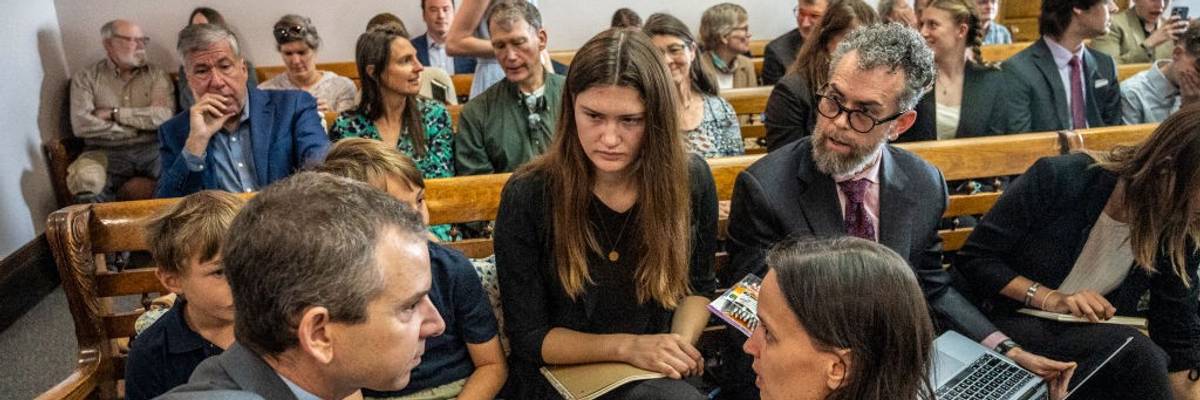
A growing number of young people, states, and cities are suing Big Oil and governments for failing to act on the crisis.
Across the globe, people are turning to the courts to combat the worsening climate emergency. Since 2015, cases around the world have doubled to over 2,000, according to a recent United Nations report.
They are also on the rise in the United States.
In a landmark trial in Montana, a judge ruled this summer that the state had violated the young plaintiffs’ “right to a clean and healthful environment”—a fundamental right enshrined in the Montana Constitution.
Litigation alone won’t solve the climate emergency. The environmental justice movement will need to keep sustained pressure on our elected officials.
The case, Held v. Montana, is the first constitutional climate suit in U.S. history to make it to trial. The nonprofit law firm Our Children’s Trust brought the legal challenge on behalf of 16 young people, ranging in age from five to 22, against the state’s pro-fossil fuel policies.
They argued that Montana’s energy policy had harmed Montana’s environment and failed to protect their rights, citing a law that prevented state agencies from considering climate impacts when approving projects. The court sided with the plaintiffs and held that this restriction violated the state’s constitution.
Throughout the trial, experts testified to the public health threats from climate change. And the plaintiffs, many of them children, provided impactful testimonies on how Montana’s changing climate had hurt them both physically and mentally.
Some described experiencing severe allergies and respiratory illnesses due to increased air pollution and wildfire smoke. Others had witnessed their homes damaged by floods, suffered isolation from not being able to safely recreate outside, and expressed anguish over their futures knowing that glaciers are melting in the state they call home.
The Montana court set an important precedent by recognizing that a safe and stable climate is integral to the enjoyment of all other rights. This decision can inform other cases seeking to hold governments—along with fossil fuel companies—accountable for harms caused by climate change.
Young people are also pursuing constitutional climate cases in Hawaii, Virginia, and Utah.
Other states like Massachusetts and Rhode Island, along with cities like Boulder, Colorado, and Baltimore, Maryland, are suing for damages from Big Oil for allegedly concealing or misrepresenting the dangers of burning fossil fuels.
California filed suit this September against five of the largest oil and gas companies in the world for engaging in a “decades-long campaign of deception” about climate change. California is the largest oil-producing state and economy to take such legal action against Big Oil.
The lawsuit alleges that Exxon Mobil, Shell, Chevron, BP, ConocoPhillips, and their trade association, the American Petroleum Institute, have all known for more than 50 years that burning fossil fuels would lead to global warming.
Yet rather than warn the public, the complaint details how the companies chose to publicly downplay and deny the dangers to the environment while aggressively promoting their products in California.
Through this lawsuit, California Attorney General Rob Bonta seeks to hold the fossil fuel companies financially responsible for contributing to climate-related damages in the state, create a fund to finance climate mitigation, and prevent these companies from further misleading the public. This approach is similar to that used against the tobacco industry.
Climate-related lawsuits face complex legal obstacles, like proving causality between fossil fuel industry practices and resulting harms. But if successful, they can make Big Oil pay for its well-documented role in the climate disaster—and ultimately transform how these companies do business.
Litigation alone won’t solve the climate emergency. The environmental justice movement will need to keep sustained pressure on our elected officials, many of whom have either enabled this crisis or been far too reluctant to act on it.
Together, this combination of litigation and grassroots advocacy sends a powerful message to policymakers that, in the words of Montana plaintiff Rikki Held, “We can’t keep passing on the climate crisis to future generations.”
Dear Common Dreams reader, It’s been nearly 30 years since I co-founded Common Dreams with my late wife, Lina Newhouser. We had the radical notion that journalism should serve the public good, not corporate profits. It was clear to us from the outset what it would take to build such a project. No paid advertisements. No corporate sponsors. No millionaire publisher telling us what to think or do. Many people said we wouldn't last a year, but we proved those doubters wrong. Together with a tremendous team of journalists and dedicated staff, we built an independent media outlet free from the constraints of profits and corporate control. Our mission has always been simple: To inform. To inspire. To ignite change for the common good. Building Common Dreams was not easy. Our survival was never guaranteed. When you take on the most powerful forces—Wall Street greed, fossil fuel industry destruction, Big Tech lobbyists, and uber-rich oligarchs who have spent billions upon billions rigging the economy and democracy in their favor—the only bulwark you have is supporters who believe in your work. But here’s the urgent message from me today. It's never been this bad out there. And it's never been this hard to keep us going. At the very moment Common Dreams is most needed, the threats we face are intensifying. We need your support now more than ever. We don't accept corporate advertising and never will. We don't have a paywall because we don't think people should be blocked from critical news based on their ability to pay. Everything we do is funded by the donations of readers like you. When everyone does the little they can afford, we are strong. But if that support retreats or dries up, so do we. Will you donate now to make sure Common Dreams not only survives but thrives? —Craig Brown, Co-founder |
Across the globe, people are turning to the courts to combat the worsening climate emergency. Since 2015, cases around the world have doubled to over 2,000, according to a recent United Nations report.
They are also on the rise in the United States.
In a landmark trial in Montana, a judge ruled this summer that the state had violated the young plaintiffs’ “right to a clean and healthful environment”—a fundamental right enshrined in the Montana Constitution.
Litigation alone won’t solve the climate emergency. The environmental justice movement will need to keep sustained pressure on our elected officials.
The case, Held v. Montana, is the first constitutional climate suit in U.S. history to make it to trial. The nonprofit law firm Our Children’s Trust brought the legal challenge on behalf of 16 young people, ranging in age from five to 22, against the state’s pro-fossil fuel policies.
They argued that Montana’s energy policy had harmed Montana’s environment and failed to protect their rights, citing a law that prevented state agencies from considering climate impacts when approving projects. The court sided with the plaintiffs and held that this restriction violated the state’s constitution.
Throughout the trial, experts testified to the public health threats from climate change. And the plaintiffs, many of them children, provided impactful testimonies on how Montana’s changing climate had hurt them both physically and mentally.
Some described experiencing severe allergies and respiratory illnesses due to increased air pollution and wildfire smoke. Others had witnessed their homes damaged by floods, suffered isolation from not being able to safely recreate outside, and expressed anguish over their futures knowing that glaciers are melting in the state they call home.
The Montana court set an important precedent by recognizing that a safe and stable climate is integral to the enjoyment of all other rights. This decision can inform other cases seeking to hold governments—along with fossil fuel companies—accountable for harms caused by climate change.
Young people are also pursuing constitutional climate cases in Hawaii, Virginia, and Utah.
Other states like Massachusetts and Rhode Island, along with cities like Boulder, Colorado, and Baltimore, Maryland, are suing for damages from Big Oil for allegedly concealing or misrepresenting the dangers of burning fossil fuels.
California filed suit this September against five of the largest oil and gas companies in the world for engaging in a “decades-long campaign of deception” about climate change. California is the largest oil-producing state and economy to take such legal action against Big Oil.
The lawsuit alleges that Exxon Mobil, Shell, Chevron, BP, ConocoPhillips, and their trade association, the American Petroleum Institute, have all known for more than 50 years that burning fossil fuels would lead to global warming.
Yet rather than warn the public, the complaint details how the companies chose to publicly downplay and deny the dangers to the environment while aggressively promoting their products in California.
Through this lawsuit, California Attorney General Rob Bonta seeks to hold the fossil fuel companies financially responsible for contributing to climate-related damages in the state, create a fund to finance climate mitigation, and prevent these companies from further misleading the public. This approach is similar to that used against the tobacco industry.
Climate-related lawsuits face complex legal obstacles, like proving causality between fossil fuel industry practices and resulting harms. But if successful, they can make Big Oil pay for its well-documented role in the climate disaster—and ultimately transform how these companies do business.
Litigation alone won’t solve the climate emergency. The environmental justice movement will need to keep sustained pressure on our elected officials, many of whom have either enabled this crisis or been far too reluctant to act on it.
Together, this combination of litigation and grassroots advocacy sends a powerful message to policymakers that, in the words of Montana plaintiff Rikki Held, “We can’t keep passing on the climate crisis to future generations.”
Across the globe, people are turning to the courts to combat the worsening climate emergency. Since 2015, cases around the world have doubled to over 2,000, according to a recent United Nations report.
They are also on the rise in the United States.
In a landmark trial in Montana, a judge ruled this summer that the state had violated the young plaintiffs’ “right to a clean and healthful environment”—a fundamental right enshrined in the Montana Constitution.
Litigation alone won’t solve the climate emergency. The environmental justice movement will need to keep sustained pressure on our elected officials.
The case, Held v. Montana, is the first constitutional climate suit in U.S. history to make it to trial. The nonprofit law firm Our Children’s Trust brought the legal challenge on behalf of 16 young people, ranging in age from five to 22, against the state’s pro-fossil fuel policies.
They argued that Montana’s energy policy had harmed Montana’s environment and failed to protect their rights, citing a law that prevented state agencies from considering climate impacts when approving projects. The court sided with the plaintiffs and held that this restriction violated the state’s constitution.
Throughout the trial, experts testified to the public health threats from climate change. And the plaintiffs, many of them children, provided impactful testimonies on how Montana’s changing climate had hurt them both physically and mentally.
Some described experiencing severe allergies and respiratory illnesses due to increased air pollution and wildfire smoke. Others had witnessed their homes damaged by floods, suffered isolation from not being able to safely recreate outside, and expressed anguish over their futures knowing that glaciers are melting in the state they call home.
The Montana court set an important precedent by recognizing that a safe and stable climate is integral to the enjoyment of all other rights. This decision can inform other cases seeking to hold governments—along with fossil fuel companies—accountable for harms caused by climate change.
Young people are also pursuing constitutional climate cases in Hawaii, Virginia, and Utah.
Other states like Massachusetts and Rhode Island, along with cities like Boulder, Colorado, and Baltimore, Maryland, are suing for damages from Big Oil for allegedly concealing or misrepresenting the dangers of burning fossil fuels.
California filed suit this September against five of the largest oil and gas companies in the world for engaging in a “decades-long campaign of deception” about climate change. California is the largest oil-producing state and economy to take such legal action against Big Oil.
The lawsuit alleges that Exxon Mobil, Shell, Chevron, BP, ConocoPhillips, and their trade association, the American Petroleum Institute, have all known for more than 50 years that burning fossil fuels would lead to global warming.
Yet rather than warn the public, the complaint details how the companies chose to publicly downplay and deny the dangers to the environment while aggressively promoting their products in California.
Through this lawsuit, California Attorney General Rob Bonta seeks to hold the fossil fuel companies financially responsible for contributing to climate-related damages in the state, create a fund to finance climate mitigation, and prevent these companies from further misleading the public. This approach is similar to that used against the tobacco industry.
Climate-related lawsuits face complex legal obstacles, like proving causality between fossil fuel industry practices and resulting harms. But if successful, they can make Big Oil pay for its well-documented role in the climate disaster—and ultimately transform how these companies do business.
Litigation alone won’t solve the climate emergency. The environmental justice movement will need to keep sustained pressure on our elected officials, many of whom have either enabled this crisis or been far too reluctant to act on it.
Together, this combination of litigation and grassroots advocacy sends a powerful message to policymakers that, in the words of Montana plaintiff Rikki Held, “We can’t keep passing on the climate crisis to future generations.”