

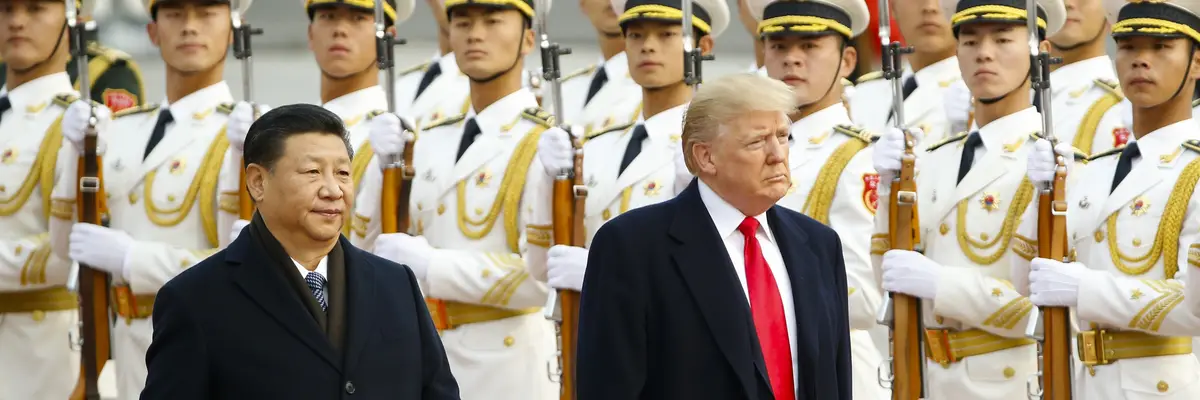
US President Donald Trump takes part in a welcoming ceremony with China's President Xi Jinping on November 9, 2017 in Beijing, China.
The 'AI Race' Against China Is a Dangerous, Dishonest Narrative
AI hype has merged with “China threat” hysteria, yielding disingenuous rhetoric that powers the current unregulated, breakneck AI buildout.
As Chinese President Xi Jinping visited Washington recently to meet with President Donald Trump, discussions over Artificial Intelligence were hotly anticipated as an urgent matter of national relations, as it was this past May during the previous US-China summit. Disappointingly, little of substance has come of this meeting as well, despite fresh worries over AI doomsday scenarios from industry insiders, and pleas for both regulation and international cooperation.
Once again, instead of hashing out guardrails to contain a fever-pitched “AI arms race,” the discussion revolved primarily around trade and resources. This discouraging result comes amid an atmosphere in the US in which tech CEOs and politicians claim that China winning the “race” would spell the end of Western civilization. Given the proclaimed stakes, an apparent lack of substantial AI discussion during the summit appears either as baffling incompetence, or an indication that the “arms race” threat may not be what it appears.
In reality, mounting evidence seems to indicate that the “China threat” is nothing more than a performative manipulation, wielded by tech CEOs and White House officials to justify their deeply unpopular AI program. The real threat, in Americans’ eyes, seems to be coming from the inside, as huge majorities remain concerned over data centers encroaching on their communities, AI-driven job loss, and other harms borne from the unregulated technology.
Deeply Unpopular AI Needs Justification
Pew Research reported in March of this year that 50% of Americans are more concerned than excited about AI use in daily life. Gallup polling found in the spring that 71% of Americans oppose local construction of AI data centers. It is only earners of $200,000 or more, according to a Quinnipiac poll, who consider AI in daily life as more good than bad. Most recently, a Reuters/Ipsos poll found last week that 3 out of 4 Americans feel that AI companies are not doing enough to ensure that their products do not inflict serious harm on society. Meanwhile, Americans are watching as companies like Meta, Amazon, and Salesforce lay off thousands of employees, arguing that AI can step in, contributing to 80% of Americans saying they want the government to fund workforce transition programs, according to a May Harris poll.
In spite of the disturbing World Cup commercials and the endless billboards, the AI industry has a trillion-dollar messaging problem that may cast it into the “death valley” of start-ups, where profitability doesn’t arrive in time to make up for balking venture capital.
The “China threat” is a handy solution.
Business and political leaders know that hostility toward China is still a reliable source of rhetorical urgency and traction in their messaging.
This “threat” builds on a long history of Sinophobia in America, from “Yellow Peril” rhetoric, to anti-immigrant lynching, and since 1949 and the founding of the People’s Republic of China, it has been combined with Red Scare hysteria. China’s economic rise in the past 50 years has come with enhanced military potential in the region, as it brought Hong Kong to heel, and began projecting power in the South China Sea and beyond. Some analysts believe we are already in a “New Cold War.”
Today, anti-Beijing rhetoric is a rare area of bipartisan agreement in Washington. And while some analysts believe that the US and China are running qualitatively different “AI races,” business and political leaders know that hostility toward China is still a reliable source of rhetorical urgency and traction in their messaging.
China’s “Existential Threat” to Democracy
Businessman and television personality, Kevin O’Leary, who is facing strong opposition from residents of Box Elder County, Utah, where he plans to build a 9 gigawatt data center, proclaimed on a CNN panel, “If you want China to lead, take over… our democracy, our free speech, how we live with technology, just stop building data centers, it’s that simple.”
Equally breathless rhetoric from Peter Thiel of PayPal and Palantir referred to China’s technology landscape as a “Borg-like thing that’s controlled by the Chinese Communist Party.” Alex Karp of Palantir also asserted the urgency of his own corporation being given greater leeway to operate in spite of concerns about privacy rights: “So when people are worried about surveillance, of course, there are huge dangers there, but you know, you will have far fewer rights if America’s not in the lead.”
The greater threat to US democracy, in fact, appears to be domestic AI-powered surveillance and economic disruption rather than the imagined influx of Chinese communist values and governance.
This rhetoric is also the official stance of Washington. In the Trump White House’s “AI Action Plan,” titled “Winning the Race,” the authors are explicit: “As our global competitors race to exploit these technologies, it is a national security imperative for the United States to achieve and maintain unquestioned and unchallenged global technological dominance.” This type of language is evocative of the Manhattan Project in World War II, and the space race during the Cold War.
But as in those equally propagandized endeavors, the existential threat posed by Chinese AI supremacy is unclear. Advances in AI-driven operations have increased the capabilities of militaries to generate and rapidly attack targets, but visions of autonomous robotic warfare remain far away. The greater threat to US democracy, in fact, appears to be domestic AI-powered surveillance and economic disruption rather than the imagined influx of Chinese communist values and governance.
Rhetoric of the “Race” Will Have Consequences
It is irresponsible and dangerous to use anti-China “AI arms race” rhetoric. During Trump’s last term, his anti-China narratives attempting to cover up the administration’s Covid-19 blunders had devastating impacts as violence increased against Asian American and Pacific Islander (AAPI) communities, and the “China Initiative” chilled intellectual exchanges and disrupted lives. Similar rhetoric during the Cold War led to persecution of academics, activists, and professionals during McCarthy’s Red Scare. If this Trump administration doubled down on the anti-China narrative, we may see similar repression and hate foment again—tactics clearly already in the administration’s wheelhouse.
Worryingly, it does not appear that the “AI Arms Race” will slow down any time soon. Signs are emerging that increasingly powerful AI systems are frightening both Washington and Beijing in their potential to disrupt the global economy, incentivizing the two to consider some high-level guardrails. But even with the recent PR frenzy surrounding Jacob Coxon’s “whistleblowing” against Anthropic’s lack of safety considerations, CEOs and politicians do not seem to be backing down from using China as a spur in the race—arguing to instead balance beating China with skirting AI-induced doom.
As the US economy becomes increasingly supported by AI promises and projections, a collapse of the “bubble” may even be accompanied by increased anti-China rhetoric as justification for Silicon Valley’s need for a bailout.
We must incorporate critique of this narrative into the popular resistance against AI; in the movements against data centers, AI encroachment into education, IP theft, and more.
We are at a crossroads
This country and this world are at a monumental crossroads. In a few short weeks, US voters will have an opportunity to beat back the forces of fascism and confront the billionaires who are rigging the economy, our media system, and our democracy, making it increasingly impossible for ordinary people to get by. We’re not just talking about the election. We’re talking about what must be done once these fascist elements are vanquished from power. We need a bolder set of solutions than what either major party has so far been willing to offer and a working-class movement ready to fight like hell for it. Trump didn't emerge from nowhere. The conditions that fueled MAGA authoritarianism were created by decades of radical neoliberal economic policies and a corrupt political system dominated by corporate interests. They slashed taxes on the super-rich, promising that the benefits would trickle down. They said giveaways to the corporate titans would make life more affordable for the rest of us. It was all bullshit. And when a bitter, betrayed populace searches for someone to blame, right-wing demagogues have little trouble finding scapegoats. People know when they're being lied to, but you won't hear any of this from the corporate media. Only independent journalism—powered and funded by people who believe in building a better world—can deliver truly trustworthy daily news. Our Fall Campaign is underway, and we need your help. To power our newsroom through the rest of the year, we need to raise $125,000 by midnight on October 31. So if you share our vision, please contribute whatever you can to sustain our work. |
As Chinese President Xi Jinping visited Washington recently to meet with President Donald Trump, discussions over Artificial Intelligence were hotly anticipated as an urgent matter of national relations, as it was this past May during the previous US-China summit. Disappointingly, little of substance has come of this meeting as well, despite fresh worries over AI doomsday scenarios from industry insiders, and pleas for both regulation and international cooperation.
Once again, instead of hashing out guardrails to contain a fever-pitched “AI arms race,” the discussion revolved primarily around trade and resources. This discouraging result comes amid an atmosphere in the US in which tech CEOs and politicians claim that China winning the “race” would spell the end of Western civilization. Given the proclaimed stakes, an apparent lack of substantial AI discussion during the summit appears either as baffling incompetence, or an indication that the “arms race” threat may not be what it appears.
In reality, mounting evidence seems to indicate that the “China threat” is nothing more than a performative manipulation, wielded by tech CEOs and White House officials to justify their deeply unpopular AI program. The real threat, in Americans’ eyes, seems to be coming from the inside, as huge majorities remain concerned over data centers encroaching on their communities, AI-driven job loss, and other harms borne from the unregulated technology.
Deeply Unpopular AI Needs Justification
Pew Research reported in March of this year that 50% of Americans are more concerned than excited about AI use in daily life. Gallup polling found in the spring that 71% of Americans oppose local construction of AI data centers. It is only earners of $200,000 or more, according to a Quinnipiac poll, who consider AI in daily life as more good than bad. Most recently, a Reuters/Ipsos poll found last week that 3 out of 4 Americans feel that AI companies are not doing enough to ensure that their products do not inflict serious harm on society. Meanwhile, Americans are watching as companies like Meta, Amazon, and Salesforce lay off thousands of employees, arguing that AI can step in, contributing to 80% of Americans saying they want the government to fund workforce transition programs, according to a May Harris poll.
In spite of the disturbing World Cup commercials and the endless billboards, the AI industry has a trillion-dollar messaging problem that may cast it into the “death valley” of start-ups, where profitability doesn’t arrive in time to make up for balking venture capital.
The “China threat” is a handy solution.
Business and political leaders know that hostility toward China is still a reliable source of rhetorical urgency and traction in their messaging.
This “threat” builds on a long history of Sinophobia in America, from “Yellow Peril” rhetoric, to anti-immigrant lynching, and since 1949 and the founding of the People’s Republic of China, it has been combined with Red Scare hysteria. China’s economic rise in the past 50 years has come with enhanced military potential in the region, as it brought Hong Kong to heel, and began projecting power in the South China Sea and beyond. Some analysts believe we are already in a “New Cold War.”
Today, anti-Beijing rhetoric is a rare area of bipartisan agreement in Washington. And while some analysts believe that the US and China are running qualitatively different “AI races,” business and political leaders know that hostility toward China is still a reliable source of rhetorical urgency and traction in their messaging.
China’s “Existential Threat” to Democracy
Businessman and television personality, Kevin O’Leary, who is facing strong opposition from residents of Box Elder County, Utah, where he plans to build a 9 gigawatt data center, proclaimed on a CNN panel, “If you want China to lead, take over… our democracy, our free speech, how we live with technology, just stop building data centers, it’s that simple.”
Equally breathless rhetoric from Peter Thiel of PayPal and Palantir referred to China’s technology landscape as a “Borg-like thing that’s controlled by the Chinese Communist Party.” Alex Karp of Palantir also asserted the urgency of his own corporation being given greater leeway to operate in spite of concerns about privacy rights: “So when people are worried about surveillance, of course, there are huge dangers there, but you know, you will have far fewer rights if America’s not in the lead.”
The greater threat to US democracy, in fact, appears to be domestic AI-powered surveillance and economic disruption rather than the imagined influx of Chinese communist values and governance.
This rhetoric is also the official stance of Washington. In the Trump White House’s “AI Action Plan,” titled “Winning the Race,” the authors are explicit: “As our global competitors race to exploit these technologies, it is a national security imperative for the United States to achieve and maintain unquestioned and unchallenged global technological dominance.” This type of language is evocative of the Manhattan Project in World War II, and the space race during the Cold War.
But as in those equally propagandized endeavors, the existential threat posed by Chinese AI supremacy is unclear. Advances in AI-driven operations have increased the capabilities of militaries to generate and rapidly attack targets, but visions of autonomous robotic warfare remain far away. The greater threat to US democracy, in fact, appears to be domestic AI-powered surveillance and economic disruption rather than the imagined influx of Chinese communist values and governance.
Rhetoric of the “Race” Will Have Consequences
It is irresponsible and dangerous to use anti-China “AI arms race” rhetoric. During Trump’s last term, his anti-China narratives attempting to cover up the administration’s Covid-19 blunders had devastating impacts as violence increased against Asian American and Pacific Islander (AAPI) communities, and the “China Initiative” chilled intellectual exchanges and disrupted lives. Similar rhetoric during the Cold War led to persecution of academics, activists, and professionals during McCarthy’s Red Scare. If this Trump administration doubled down on the anti-China narrative, we may see similar repression and hate foment again—tactics clearly already in the administration’s wheelhouse.
Worryingly, it does not appear that the “AI Arms Race” will slow down any time soon. Signs are emerging that increasingly powerful AI systems are frightening both Washington and Beijing in their potential to disrupt the global economy, incentivizing the two to consider some high-level guardrails. But even with the recent PR frenzy surrounding Jacob Coxon’s “whistleblowing” against Anthropic’s lack of safety considerations, CEOs and politicians do not seem to be backing down from using China as a spur in the race—arguing to instead balance beating China with skirting AI-induced doom.
As the US economy becomes increasingly supported by AI promises and projections, a collapse of the “bubble” may even be accompanied by increased anti-China rhetoric as justification for Silicon Valley’s need for a bailout.
We must incorporate critique of this narrative into the popular resistance against AI; in the movements against data centers, AI encroachment into education, IP theft, and more.
- 'End the AI Arms Race,' Casar Says at Pro-Human Assembly Amid 'History-Defining Moment' ›
- Are We Waking Up Fast Enough to the Dangers of AI Militarism? ›
- Amid Fears of Killer Robots, Humanoid MMA Fight in China Ends With Decapitation ›
- Watchdog Denounces 'Staggering and Disgusting' Hypocrisy of AI Industry Giants ›
- The AI Race With China Is a Lie Told by Big Tech to Justify the Data Center Invasion ›