

SUBSCRIBE TO OUR FREE NEWSLETTER
Daily news & progressive opinion—funded by the people, not the corporations—delivered straight to your inbox.
5
#000000
#FFFFFF
To donate by check, phone, or other method, see our More Ways to Give page.
Daily news & progressive opinion—funded by the people, not the corporations—delivered straight to your inbox.
The American Health Care Association and National Center for Assisted Living (AHCA/NCAL), representing more than 14,000 nursing homes and assisted living communities across the country that provide care to approximately five million people each year, released a report today showing new COVID cases in nursing homes in the U.S. has now reached a record number of weekly new cases this month due to the community spread among the general population, surpassing previous peaks since the Centers for Medicare & Medicaid Services (CMS) started tracking cases in nursing homes.
Recent data released by Johns Hopkins University and the Centers for Medicare & Medicaid Services (CMS) show that with the recent spike in new COVID cases in the general U.S. population, weekly nursing home cases are also on the rise. According to Johns Hopkins University, weekly new COVID cases in the general U.S. population rose by 140 percent to 572,613,527 new cases the week of November 1. A correlating uptick in new cases in nursing homes occurred when cases in the surrounding community started rising back in mid-September.
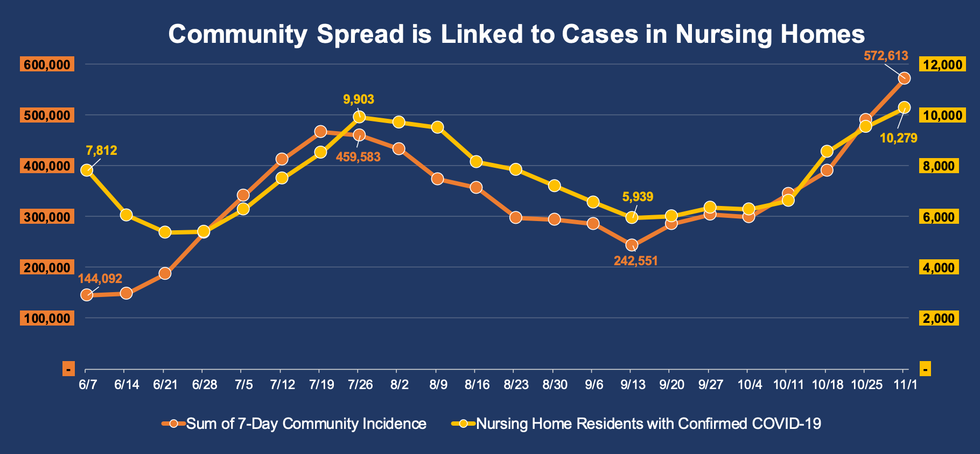
As experts have repeatedly noted, COVID-19 cases in a surrounding community is a top factor in outbreaks in nursing homes. University of Chicago's Tamara Konetzka, a nationally recognized expert on long-term care, recently said, "Trying to protect nursing home residents without controlling community spread is a losing battle." Dr. David Grabowski, professor of Health Care Policy, Harvard Medical School recently stated, "The strongest predictor of whether or not we'll see cases in [a particular setting] is community spread."
"Our worst fears have come true as COVID runs rampant among the general population, and long term care facilities are powerless to fully prevent it from entering due to its asymptomatic and pre-symptomatic spread," stated Mark Parkinson, President and CEO of AHCA/NCAL. "Our health care heroes are doing everything they can to prevent it from spreading further, but this level of COVID nationwide puts serious strain on our workforce, supplies, and testing capacity. If everybody would wear a mask and social distance to reduce the level of COVID in the community, we know we would dramatically reduce these rates in long term care facilities." (Video clip of AHCA/NCAL President/CEO Mark Parkinson's reaction to new report)
During the first week of November, nearly half (47 percent) of new COVID cases in nursing homes were from Midwest states with major spikes in community spread in the upper parts of the region. As a result, the Midwest region saw a 200 percent increase in weekly COVID cases in nursing homes since mid-September.
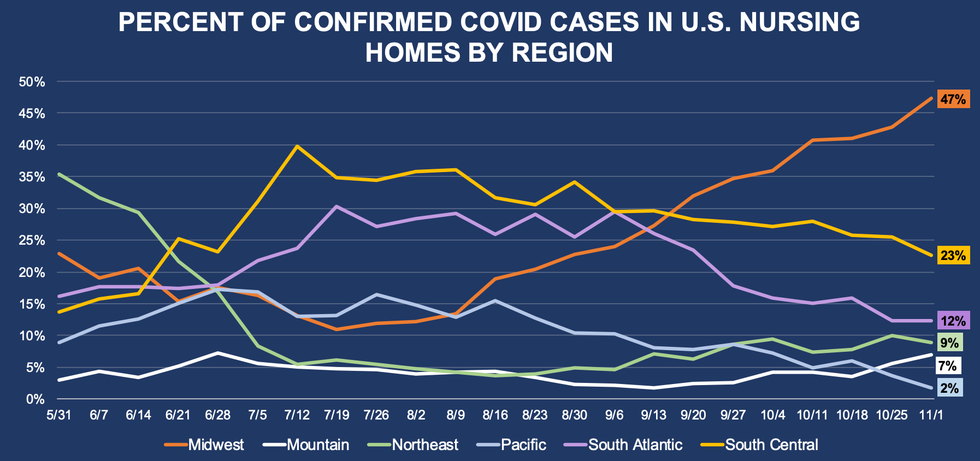
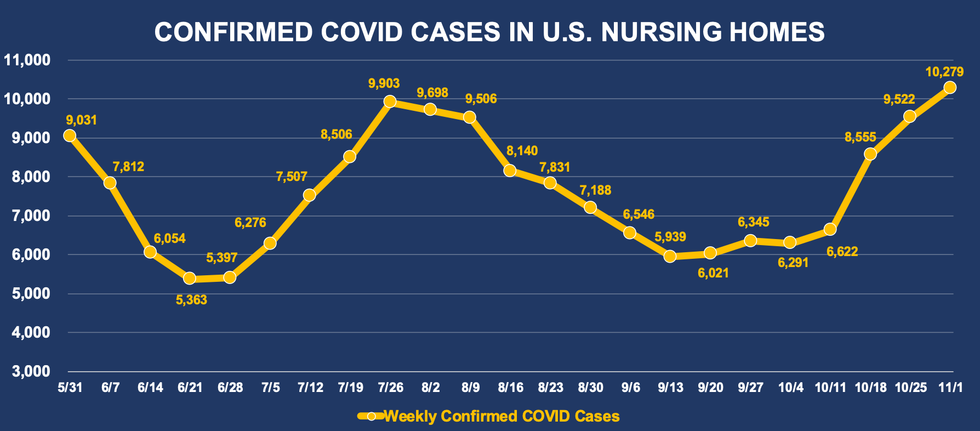
After seven weeks of declining cases in nursing homes through mid-September, nursing home cases began to increase as nearly all 50 states have started to see rising levels of COVID cases. New weekly cases in nursing homes grew by 73 percent nationwide between mid-September and the week of November 1.
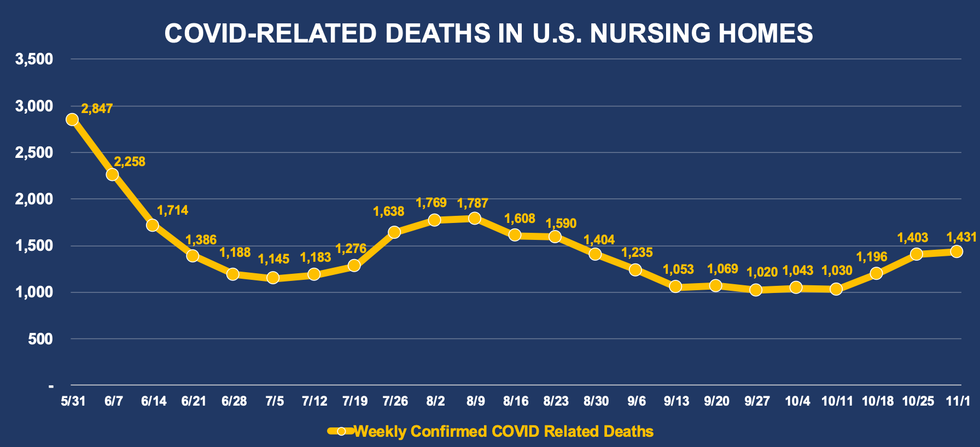
The report also showed COVID-related deaths in nursing homes have risen slightly. Nursing home residents are typically older adults with multiple chronic conditions, making them most vulnerable to COVID-19. Residents of long term care facilities account for only eight percent of the nation's cases, yet 40 percent of its deaths. While mortality rates have decreased compared to the spring due to a better understanding of the virus, better treatments, and government resources to help reduce spread, industry leaders remain deeply concerned that the rising number of new COVID cases in facilities will ultimately lead to an increasing number of deaths.
"We are especially concerned that this situation will only get worse with Thanksgiving just around the corner," continued Parkinson. "The public must realize that their actions not only endanger our nation's most vulnerable, but also trigger government lockdowns of facilities, keeping these residents from their loved ones. This is detrimental to their health, wellbeing and happiness. We urge everyone to do their part to slow the spread immediately and exercise caution when celebrating Thanksgiving."
With rising new COVID cases across the country, Parkinson said Congress must prioritize frontline health care workers and long term care residents during the lame duck session. This week AHCA/NCAL released a list of actions that Congress should urgently take to help nursing homes and assisted living communities respond to the uptick in new cases.
Most of the $175 billion Provider Relief Fund provided by the CARES Act back in April has already been distributed and Parkinson said health care providers, including long term care facilities, will need additional funds to continue the response to the COVID pandemic heading into the cold and flu season. The financial aid is crucial in helping long term care facilities acquire personal protective equipment, conduct regular testing, and hire additional staff or reward current caregivers for their heroic efforts.
"Congress must fulfill its duty," stated Parkinson. "Without adequate funding and resources, the U.S. is repeating the same mistakes made during the initial outbreak last spring and the major spike over the summer. We need Congress to prioritize our vulnerable seniors and their caregivers in long term care facilities, by passing another COVID relief package during the lame duck session on Congress."
For more information, please visit www.ahcancal.org/coronavirus.
One writer told Common Dreams it was "a really terrifying example of the power of concentrated wealth to censor speech."
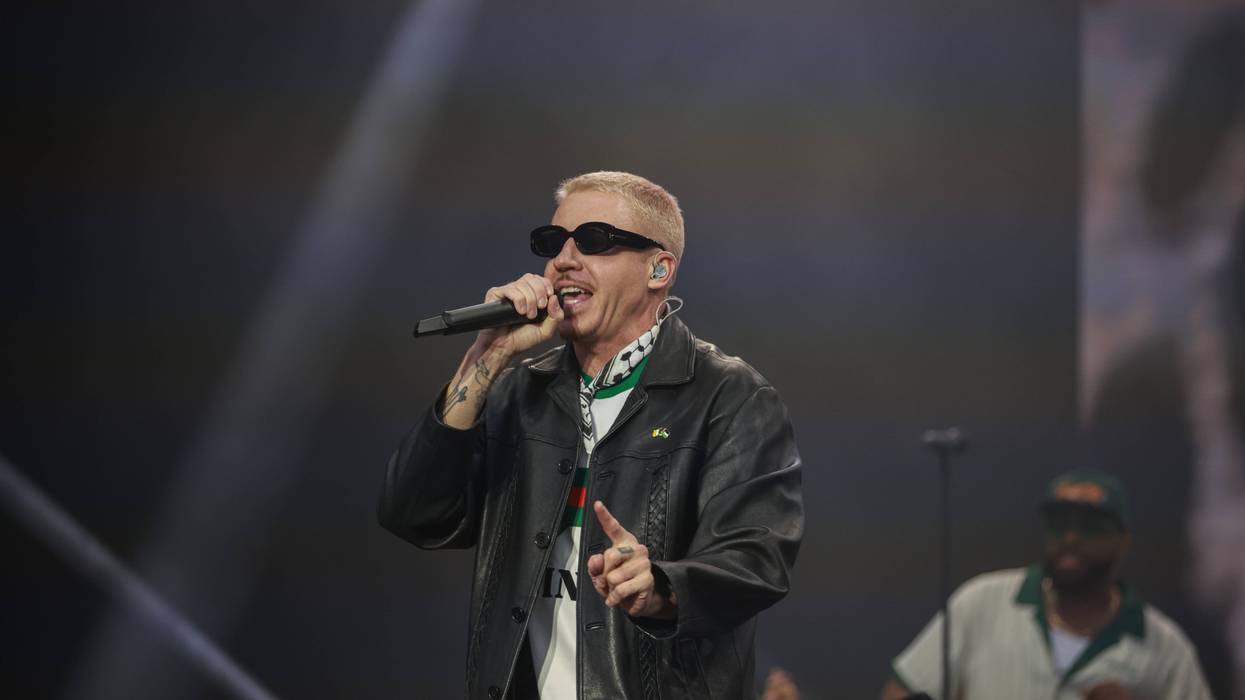
The rapper Macklemore said he was kicked off a tour with Ed Sheeran on Monday after pressure from NFL owners angered by his harsh criticism of Israel.
Macklemore, who has been an outspoken supporter of Palestinian rights, especially since October 2023, made headlines earlier this month when he said "Free Palestine" onstage during a show at MetLife Stadium in New Jersey, and said he wanted the people of Gaza and the occupied West Bank to know “we have not forgotten about them."
The rapper also performed his 2024 song "Hind's Hall," which debuted amid a wave of campus protests against US support for Israel's military campaign in Gaza. The Israeli assault has killed over 73,000 Palestinians, according to official counts, which major human rights organizations have denounced as a genocide.
The title of the song references pro-Palestinian demonstrators at Columbia University, who occupied a building during the protest wave and named it after Hind Rajab, a 5-year-old girl who was killed by Israeli forces in Gaza after spending hours trapped in a car with the bodies of her relatives and pleading for rescuers to save her.
The performance faced pressure from groups, including the Israeli American Council, which launched a petition calling for Sheeran to boot Macklemore from the tour. The performance was also met with criticism from the artist Pink, who said Macklemore's performance may have left Jewish audience members feeling "scared or targeted," though she said she did not want any artist to be "silenced."
Macklemore emphasized during a subsequent show that Jewish spectators were not the targets of his performance. "To all of my Jewish brothers and sisters: criticism of Israel, criticism of apartheid, being against genocide in no way is a criticism of you," he said. "My message is for peace; love for all human beings to be treated with dignity, respect, and equality.”
On Monday, the group promoting Sheeran's Loop Tour announced that Macklemore would not be performing at the remaining shows on the US leg, telling Rolling Stone that it had been "notified by venues on the upcoming US tour dates that they will not allow a concert to take place with Macklemore on the lineup, which would result in the cancellation of the tour and impact hundreds of thousands of fans."
In an Instagram post on Monday following the announcement, Macklemore gave more details on what he said prompted his exile from the tour.
"Last Monday, in the middle of all the media attention surrounding Pink and what I said at MetLife, Ed [Sheeran] told me that Robert Kraft called him. We were scheduled to play Gillette Stadium later this month, which is owned by the Kraft Group. Ed told me that Kraft said I would not be allowed to perform in his stadium. Ed also told me that Kraft had rallied some of the other stadium owners, and collectively they gave him an ultimatum: If Macklemore stays on the tour, you will not be allowed to play in our venues."
According to Rolling Stone, other venues where decision-makers allegedly objected to Macklemore's appearance included Lincoln Financial Field in Philadelphia; Mercedes-Benz Stadium in Atlanta; Lucas Oil Stadium in Indianapolis; Bank of America Stadium in Charlotte, North Carolina; AT&T Stadium in Arlington, Texas; and Raymond James Stadium in Tampa, Florida.
Kraft, the multibillionaire owner of the New England Patriots, is one of the nation's most prominent donors to pro-Israel causes and is a close personal friend of Israeli Prime Minister Benjamin Netanyahu, who is wanted by the International Criminal Court for alleged crimes against humanity and war crimes in Gaza.
In 2019, Kraft received a $1 million award, presented by Netanyahu, to support his efforts to combat the Boycott, Divestment, and Sanctions (BDS) movement in the US, which aims to use economic means to pressure Israel to end the occupation of Palestinian territory, which is considered illegal under international law.
Since 2022, Kraft has also donated $3 million to the United Democracy Project, the super political action committee affiliated with the American Israel Public Affairs Committee (AIPAC), according to federal campaign finance records.
As public support for Israel has cratered, particularly among Democratic voters, AIPAC's political fundraising arms have been spending at a record pace, deploying over $100 million to back pro-Israel candidates during the 2026 election cycle.
Macklemore said he did not begrudge Sheeran, whom he described as a "friend" and "brother," for cutting him from the tour in the face of this pressure.
"Ed was in a fucked up position. He knew it. His typical apolitical stance was being challenged in a way it never had been before. He told me that the words 'Free Palestine' and the image of the Palestinian flag were hurtful to a lot of people he spoke with," Macklemore said. "I told him that if those words were more offensive than tens of thousands of Palestinian children being killed by Israel, then there was a fundamental disconnect between where those people stood and where I stood."
Macklemore said he understood why Sheeran and other artists choose to avoid controversial political topics.
"Taking a side can cost you. Money, brand deals, sponsorships, festivals, private shows, relationships, and access. I've lost all of those things," Macklemore said. "But there is no neutral position between the oppressor and the oppressed. When one side has the bombs and bottomless financial and military support from America, refusing to take a side doesn't leave you in the middle."
He emphasized that neither he nor Sheeran was a "victim" in this saga. "The victims," he said, "are the Palestinian people. The men, women, and children who have been killed, starved, displaced, and forced to live through unimaginable violence."
Macklemore noted that he has been making similar statements to those he made at MetLife "for almost three years." But now that he's saying it on bigger stages with bigger artists, he said, "it becomes too much of a risk."
"If I kept doing the shows, saying Free Palestine, with Ed implicitly supporting it, the crowd getting loud and showing undeniable support for Palestinian liberation, what artist might speak out next?" he said. "The stage becomes resistance. Maybe that's why this time it became so important to silence me."
"One of the most effective ways to enforce that silence has been to weaponize the accusation of antisemitism," he continued. "Antisemitism is real. And that is exactly why the word matters too much to be used as a shield against criticism of the Israeli state. When criticizing Israel, opposing Zionism, or saying 'Free Palestine' gets conflated with hatred of Jewish people, it doesn't protect Jewish people. It protects Israel from accountability."
Alex Skopic, an associate editor at Current Affairs magazine and author of a 2023 essay, "A Brief Cultural History of the White Rapper," which discusses Macklemore and his history of political activism extensively, said the rapper's removal from the tour was "a really terrifying example of the power of concentrated wealth to censor speech."
"It's one thing for a stadium owner to cancel a particular artist, but apparently Robert Kraft was able to make a few phone calls and get Macklemore banned from the entire tour," Skopic said in an email to Common Dreams. "It's incredibly dangerous to civil society when one guy has that kind of power to dictate what music can and can't be heard."
He added that it was also "notable who gets canceled and who doesn't," pointing out that in his home city of New Orleans, Ye (formerly Kanye West) recently performed before a packed Superdome, even "after he spent two years spouting Nazi rhetoric," including publicly praising Adolf Hitler on numerous occasions.
"Apparently, our elites consider the words 'Free Palestine' more threatening," Skopic said.
He added that Sheeran "has behaved like an absolute coward."
"When you think about it, Sheeran is one of maybe 30 artists on the planet who's big enough, in terms of money and influence, to say no to nonsense like this from stadium owners," Skopic said. "He chose the money over his integrity. It's bad enough that his music for the last decade has been painfully mediocre, but that shows a real lack of spine."
Given the long history of rappers taking controversial stances, Skopic added that "it's also kind of absurd that Macklemore is one of the foremost people in rap who's speaking out against an ongoing genocide."
"There's a lot of cop-outs to go around," he said. "DJ Khaled, famously, is Palestinian himself and won't say a word. Where's Kendrick Lamar, with his massive platform? Where are any of them?"
"AOC and Khanna... have shown a willingness to blaze unusual and much-needed trails on Capitol Hill beyond the constraints of the Democratic Party establishment and bipartisan corporatism."
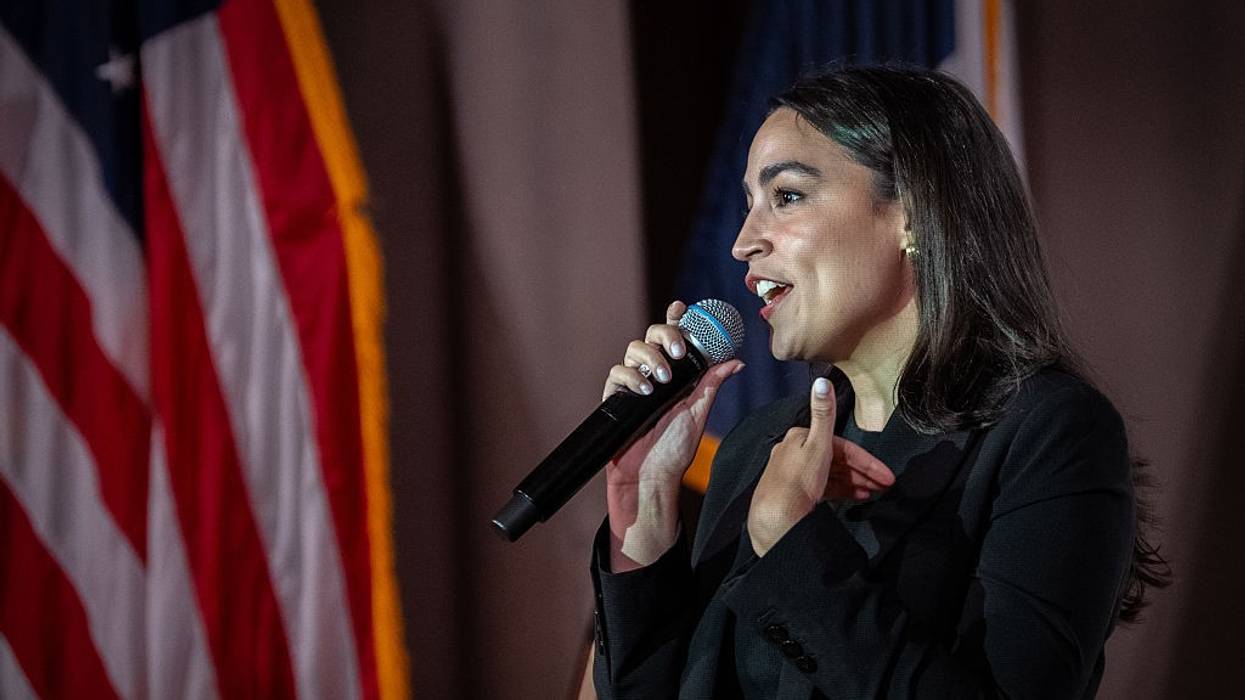
Two progressive advocacy organizations Monday called on Reps. Alexandria Ocasio-Cortez (D-NY) and Ro Khanna (D-Calif.) to enter the 2028 presidential race, singling them out as "proven leaders and voices of clarity."
Progressive Democrats of America (PDA) and RootsAction announced an initiative aimed at lobbying the two congressional progressives to put their hats in the ring for the presidency, arguing they offer a much-needed alternative to establishment Democrats too eager to do the bidding of corporate interests.
"Most of the Democrats whose names now crowd the field have been war enablers, go-slow reformers or status quo protectors," the groups wrote. "AOC and Khanna, meanwhile, have shown a willingness to blaze unusual and much-needed trails on Capitol Hill beyond the constraints of the Democratic Party establishment and bipartisan corporatism."
The groups cited polls showing that "majorities of voters, not just Democrats, are angry about nonstop war, runaway inflation, corporate greed and a government dominated by billionaires," and argued that Khanna and Ocasio-Cortez were needed in the race so that voters would "hear serious solutions" the country's most pressing problems.
"Without a progressive populist advocate atop the ticket, the Democratic response would be woefully underwhelming," the groups warned, "enabling right-wing demagoguery to push voter unrest in dangerous and divisive directions."
The campaign to get Khanna and Ocasio-Cortez into the race will begin immediately after the midterm elections in November, the groups said.
The two groups also touted their past work influencing Democratic politics, as PDA pushed for Sen. Bernie Sanders (I-Vt.) to launch a presidential bid as far back as 2013, while RootsAction was the first national group to endorse New York City Mayor Zohran Mamdani's insurgent 2025 campaign.
Alan Minsky, executive director of PDA, noted that most prospective 2028 Democratic candidates at the moment are "Big Money-backed status quo centrists," despite the fact that "the success of progressive candidates across the country was the story of the 2026 primary season."
"We need at least one progressive champion on the presidential debate stage to counter the corporatists’ cacophony of bland incrementalism," Minsky empghasized. "Americans want change."
Minsky's sentiment was echoed by India Walton, senior strategist at RootsAction.
"Working people are hungry for leadership that works for all of us, not just the wealthy and well-connected," said Walton, "leaders who do not capitulate to corporate power, who reject endless wars, and embrace policies that mean we can live healthy, happy lives. AOC and Ro Khanna can bring that vision to the presidential stage."
"DHS needs to be dismantled and held accountable for this complete inhumanity," said Rep. Pramila Jayapal.
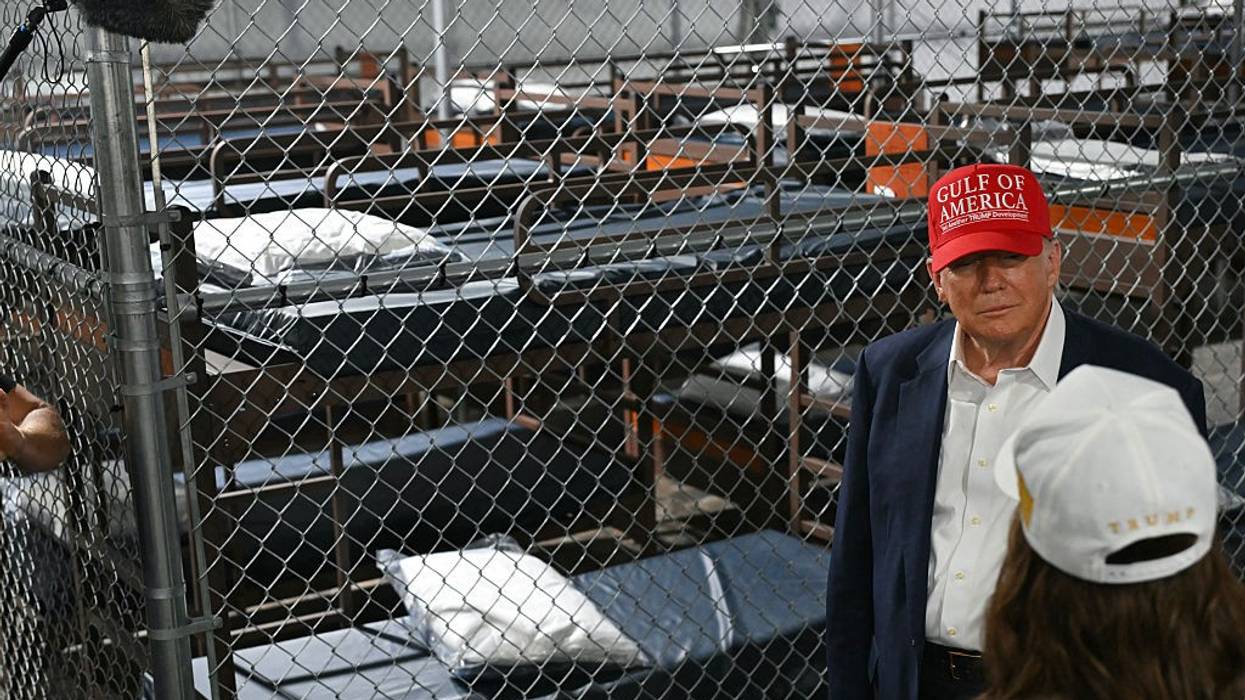
While US President Donald Trump publicly joked about giant reptiles devouring would-be escapees from the now-shuttered Alligator Alcatraz immigrant detention center in the Florida Everglades, a newly published report by the Department of Homeland Security's internal watchdog confirms that the biggest dangers facing detainees at the notorious lockup were found inside its walls.
The DHS Office of Inspector General (OIG) found that staff at Alligator Alcatraz—officially called the Florida Soft-Sided Facility (FSSF)—"complied with intake and use-of-force standards but did not comply with standards related to environmental health and safety, special management units, medical care, food service, personal hygiene, and recreation."
Affirming reports from human rights groups like Amnesty International, the OIG reported on September 11 that staff at the facility, which was operated by the state of Florida and private contractors, "confined 79 detainees in small metal enclosures—each offering about 18 square feet of floor space—for periods ranging from several minutes to nearly two hours."
"Facility staff described the small metal enclosures as 'calming areas' for detainees to de-escalate and have time alone," the report states. "Staff further maintained that detainees asked to spend time in the small metal enclosures. We found at least one instance in which the small metal enclosures may have been used as a disciplinary tool."
NEW: DHS's Inspector General releases a scathing report about the Everglades detention camp known as "Alligator Alcatraz." The OIG finds that the now-closed camp, violated multiple ICE standards.The OIG also confirms detainees were punished with placement in a metal cage in the Florida heat.🧵
[image or embed]
— Aaron Reichlin-Melnick (@reichlinmelnick.bsky.social) September 14, 2026 at 8:53 AM
While held in the cages, detainees—who reported being shackled and locked to the ground—were subjected to dangerously high temperatures and swarms of mosquitoes. Amnesty described the use of the cages as a form of torture.
"Use of these small metal enclosures for any reason is unprecedented among detention facilities OIG has inspected and presents significant risks to detainee health and safety," the DHS report notes.
Responding to the report's findings, Congresswoman Pramila Jayapal (D-Wash.) said on social media that "this is nothing short of torture."
"DHS needs to be dismantled and held accountable for this complete inhumanity," she added.
The OIG report additionally found that "FSSF did not provide detainees with sufficient living space, creating cramped conditions for detainees who spent most of their time in their housing units, which may harm detainees’ physical and mental health."
According to the OIG, detainees had about 28 square feet of living space each when the facility was at maximum capacity, well below the 75-square-foot DHS benchmark.
Three-quarters of the detainees interviewed by the OIG said they did not have access to clean drinking water.
The OIG also found that detainees were generally permitted to shower just three times a week, and inspectors noted insects in the showers.
Detainee recreation was also limited to three one-hour sessions per week.
The OIG report ominously concludes that "although FSSF ceased operations in June 2026, the issues raised by the department’s
management response regarding [US Immigration and Customs Enforcement's] level of oversight and responsibility for immigration detention remain consequential."
The publication cites the Baker Correctional Institution—also known as "Deportation Depot"—in Sanderson, Florida, which has yet to undergo OIG inspection, and where detainees and their advocates have reported abuses and inhumane conditions similar to those alleged at Alligator Alcatraz.
Some critics of the new OIG report denounced what they said were critical omissions and falsehoods, including that FSSF complied with use-of-force standards. Clients of attorney Katherine Blankenship and other detainees at the facility said they were beaten—and one man had his wrist fractured—after complaining about not having phone access earlier this year.
The Associated Press reported in April:
When one detainee approached a guard, he was punched in the face. The guards then started beating other detainees in the cell. One of Blankenship’s clients was punched in the right eye, thrown to the floor, and beaten by several guards. He was kicked in the head and his shoulder and arm were injured. A guard put his knee on the detainee’s neck while restraining him, according to the attorney’s declaration, which included a photo made during a video call almost a week later showing the detainee with a bruised eye.
Other alleged abuses and inhumane conditions at Alligator Alcatraz not mentioned in the OIG report include rotten and maggot-infested food, 24-hour lighting, flooding, and denial of religious practice.
Some detainees also claimed they were held in the phone booth-sized cages for far longer than two hours.
“People ended up in the ‘box’ just for asking the guards for anything," one former detainee told Amnesty. "I saw a guy who was put in it for an entire day."
Glad folks are appalled by photos of the "phone booth" cage under an awning, but pls understand: This IG report is likely part of a cover-up. Amnesty Int'l interviewed detainees EIGHT MONTHS AGO who said the cage was half this size (couldn't stand up), had no awning, w feet chained to the bottom.
[image or embed]
— Gillian Brockell (@gillianbrockell.com) September 14, 2026 at 9:20 AM
Responding to the new OIG report, Congressman Adam Smith (D-Wash.) said Monday on social media that "people at Florida's Alligator Alcatraz were subjected to inhumane, unjust punishment, risking their health and safety while in federal detention. No person should be locked into an 18-square-foot cage, period."
Last year, Jayapal and Smith introduced the Dignity for Detained Immigrants Act, which Jayapal's office described as "legislation to enact guardrails and oversight on immigration detention, and to ensure civil and human rights are protected."
Since Trump returned to the White House in January 2025, more than 50 people have died in ICE custody, including detainees who died inside lockups, during transfers, and in hospitals while still under DHS control. The agency also announced earlier this year that it would stop reporting the deaths of people recently released from ICE detention.
Krish O'Mara Vignarajah, President and CEO of the advocacy group Global Refuge, said in a statement responding to the new OIG report that "there is no euphemism that can sanitize caging human beings. Calling a metal box a 'calming area' is an affront to the English language and to human dignity alike."
"The stark reality is that human beings, many of whom came to this country seeking protection, were crammed into spaces unfit to accommodate them, denied adequate medical care, food, and basic hygiene—and in at least one case locked in a cage as punishment," Vignarajah continued. "That is not immigration enforcement. It is cruelty, carried out in our name and on our dime, to the tune of more than a million dollars a day."
"The facility is closed, but the mindset that built it lives on," she added. "We cannot let Alligator Alcatraz become a blueprint. We call on Congress and the Department of Homeland Security to guarantee that no one held in the United States—regardless of where they were born or how they arrived—is subjected to conditions this administration's own watchdog has deemed inhumane."

"The US also now has to accept the Chinese and Russians doing/saying the same," one expert noted.
US Air Force Secretary Troy Meink seemingly revealed Monday that the United States has launched into orbit "space-control weapons."
"Today, we continue to ensure we remain ready to meet the challenges of evolving threats wherever they exist," Mink said during a speech at an Air & Space Forces Association (AFA) conference in Maryland. “This is why the United States now has, on-orbit, space-control weapons capable of defending the joint force against hostile adversary action."
SpaceNews reported that when asked about the comment by AFA president and CEO Burt Field, Meink declined to elaborate.
"That phrase was very well thought out," Meink responded. "So whatever I said before is what I say again."
"It is critically important that we maintain our dominance, not only in the air but in space," he added, according to AFA's magazine. "So, we've had to take steps to make sure that when we're threatened, we can take care of that.”
Defense One noted that experts were "shocked" by his admission‚ including Victoria Samson, the Secure World Foundation's chief director of space security and stability.
"Well, that's huge, because I don't think any US government official has ever said that before," she said. "The US also now has to accept the Chinese and Russians doing/saying the same. I don't think that this is going to be in the interest of US national security.”
Although Meink wouldn't offer details on the weapons, Samson said: "I'm going to guess what he's talking about is not a kinetic space-control weapon due to multiple comments government officials have said about avoiding debris causing counter space... So I'm going to go with my first guess: space-based jammers, electronic warfare."
While President Donald Trump has made a habit of attacking international bodies and pacts, the United States is, in theory, limited by the Outer Space Treaty, as a founding party that signed the agreement nearly six decades ago.
Under that treaty—to which China and Russia are also parties—governments agree not to "place nuclear weapons or other weapons of mass destruction in orbit or on celestial bodies or station them in outer space in any other manner."
Trump's stance on AI regulation is "a fundamental incompetence that places us all in grave danger," said one critic.
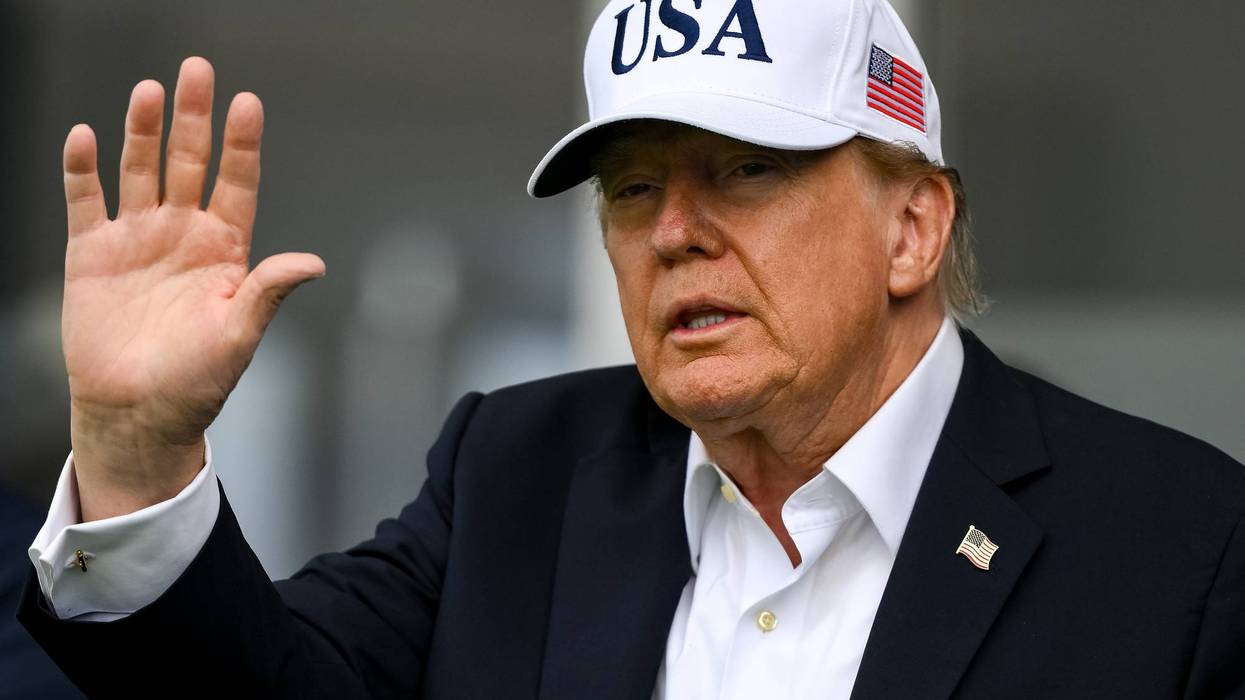
President Donald Trump on Monday slapped down the idea of putting guardrails on artificial intelligence, despite increased warnings from industry insiders and outside experts about the technology's potential dangers to humanity.
In a Truth Social post, Trump suggested that his own intellect was singlehandedly capable of regulating AI, a technology so complicated that even its own creators have acknowledged difficulties in understanding it.
"The only control or 'guardrails' that AI needs is a STRONG AND SMART (High IQ!) PRESIDENT," Trump wrote, "and the USA has that, in spades!"
The president then claimed, without offering any details, that his administration had already "stopped AI 'people' from doing bad, or potentially bad, 'things,'" and then baselessly claimed the nationwide backlash to the technology was part of a vast conspiracy theory in service of the Chinese Communist Party.
"There is a SICK conspiracy going on against AI and Data Centers, and the only one that is happy about it is China," Trump wrote. "WHOEVER WINS AI, WINS! We are leading China, and all others, and will continue to do so. Conspiracy Theorists, Treasonists, Traitors, and Leakers, BEWARE!"
Regardless of Trump's social media rants, there is widespread concern about the impacts of AI across the political spectrum.
Jeffrey D. Sachs, director of the Center for Sustainable Development at Columbia University, described Trump's stance on regulating AI as "a fundamental incompetence that places us all in grave danger," in a Common Dreams op-ed published Monday.
Reacting directly to Trump's Monday social media post, Sachs told Common Dreams that it was a sign that "we are in the grip of madness and puerility."
Axios reported on Monday that Sen. Bernie Sanders (I-Vt.) will join former Trump adviser Steve Bannon and former Anthropic AI researcher Jacob Coxon on Tuesday for a what is being described as a "Pro-Human Assembly" aimed at highlighting the dangers posed by the continued development of the technology.
Sen. Josh Hawley (R-Mo.), chair of Senate Subcommittee on Disaster Management, announced last week that he is opening a probe into the recent autonomous hack carried out by OpenAI agents, while also examining threats posed by the AI industry as a whole.
Calls to regulate AI have grown over the last week since Coxon announced that he had resigned from his position at AI lab Anthropic because he no longer felt it was possible to safely develop the technology.
In a social media post announcing his resignation, Coxon claimed that “the people building AI earnestly believe that it could kill us all by the end of the decade,” and accused them of “racing straight to self-improving superintelligence and gambling with our lives.”
"This is full-throated climate denial while the climate crisis happens in real time and a shocking betrayal of the American public."
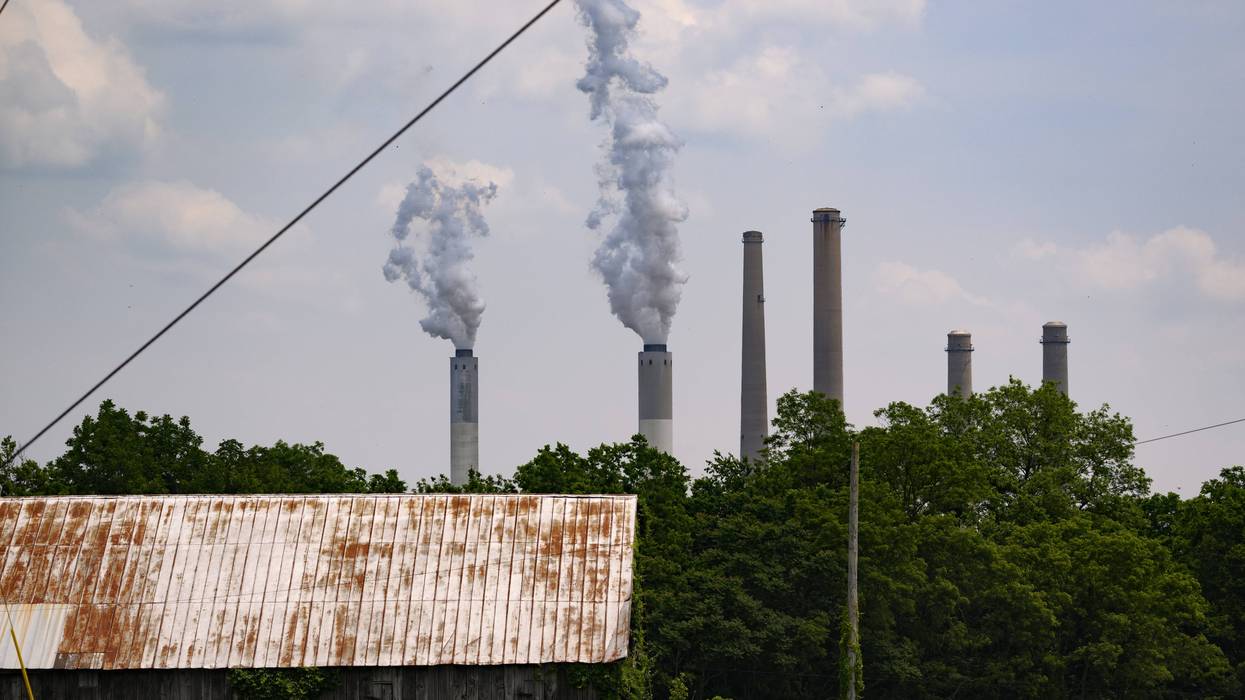
In what environmental advocates describe as "another gift to the fossil fuel industry," the Trump administration plans to end rules limiting the release of planet-heating emissions from power plants that burn coal and gas.
Power plants are considered the largest industrial source of greenhouse gas emissions in the US and account for about a quarter of the nation's climate pollution, according to the Environmental Protection Agency (EPA).
In 2024, the EPA under the Biden administration used the Clean Air Act to require that many new gas plants and existing coal plants reduce their carbon emissions by 90%, including by installing carbon capture technology, by 2032.
The EPA estimated that the rule would reduce the amount of CO2 emissions by about 1.38 billion metric tons over the next two decades, the equivalent of about a year of emissions from the entire US electric power sector.
On Monday, Lee Zeldin, the EPA administrator under President Donald Trump, announced an end to this policy at a meeting of energy ministers at the Group of 20 conference in Houston.
Not only will this prevent the enactment of a policy that the EPA has estimated would prevent around 1,200 premature deaths and 360,000 asthma cases by 2035. But the administration is also rolling out a proposal seeking to prevent future administrations from regulating carbon emissions as a health risk.
It is an effort that runs parallel to the administration's rescission of the 2009 "endangerment finding," which allowed the EPA to regulate vehicle emissions under Section 202 of the Clean Air Act on the grounds that they are harmful to human health. That move is also being challenged in court.
Power plants are regulated under a different section of the Clean Air Act, Section 111, which allows the EPA to regulate facilities that "cause, or contribute significantly to" dangerous air pollution.
But whereas the courts have previously interpreted this statute to regulate the outputs of entire facilities, the Trump administration is asking courts to adopt a novel reading of the statute which says each individual chemical under scrutiny must “contribute significantly” to climate change.
As Meredith Hankins, legal director for climate and energy at the Natural Resources Defense Council, explained in a policy memo last week, it likely won't be easy for the administration to prove that the CO2 emissions from US power plants aren't a significant driver of climate change.
"Power sector emissions account for a quarter of total US emissions, so if they cannot be counted as significant, it’s hard to conceive of any emissions that would," Hankins wrote. "In fact, if the US power sector were a nation, it would be the world’s fifth-largest emitter after China, the United States, India, and Russia. That’s a pretty 'significant contribution' to the problem."
The effort to gut power plant regulations comes after the hottest meteorological summer recorded in US history and amid a year with one of the largest numbers of climate disasters on record, including widespread drought, destructive wildfires, and repeated flooding and tornado outbreaks.
As the planet has warmed over the last half-century, the US has seen a sharp, near-sevenfold increase in weather disasters costing over $1 billion, according to data from the National Oceanic and Atmospheric Administration.
“While wildfires rage, floods devastate communities, and families struggle to afford skyrocketing electricity bills and insurance premiums, the Trump administration is handing the fossil fuel industry a license to keep polluting," said Holly Bender, chief program officer for the Sierra Club, following news of the EPA's rollback of power plant rules. "This is full-throated climate denial while the climate crisis happens in real time and a shocking betrayal of the American public."
She added that "the Sierra Club will fight back against this reckless and dangerous proposal with everything we have in the courts, in Congress, and in communities across the country.”
If successful, the reversal of the power plant rules would be one of the most significant steps in Zeldin's push to eviscerate the EPA's authority to combat climate change on behalf of the fossil fuel industry. Earlier this summer, during a meeting of the National Coal Council, he bragged that "many of the items" on the industry's "wish list are now done."
He has put the wheels in motion to roll back virtually every Biden-era regulation on the coal industry, including rules limiting pollution from mercury and toxic metals, controls on toxic wastewater from coal plants, and limits on coal ash.
And while seeking to undermine the legal basis to regulate greenhouse gases, Zeldin's EPA has also taken a sledgehammer to its practical ability to do so, dismantling offices that collect climate data, erasing information about human-caused climate change from the agency's websites, and filling research panels with scientists employed by the fossil fuel industry.
Former State Department energy official Alan Eyre noted that on the world stage, the US "has always been obstructionist" when it comes to climate policy. Under Trump, he said, "we're actively malevolent."
Revelations about damage to the pipeline come as the global oil market is "screaming for barrels," said one analyst.
Fears of a global energy shortage are rising amid new revelations about damage inflicted last week on a key oil pipeline in Saudi Arabia.
According to a Monday report in The Associated Press, Saudi Arabia's East-West Pipeline, which is used to transport oil to the Red Sea, will be shut down for weeks after being hit last Thursday by a drone strike.
Anonymous officials in the region told the AP that repairing damage from the attacks, which the Saudi government has blamed on Iran-backed militias based in Iraq, "could take three to five weeks, including at a major pumping facility."
The Guardian reported Monday that "Saudi Arabia will run out of oil stocks for export" if the pipeline isn't repaired within days, which could lead to "the loss of up to 4% of global supply."
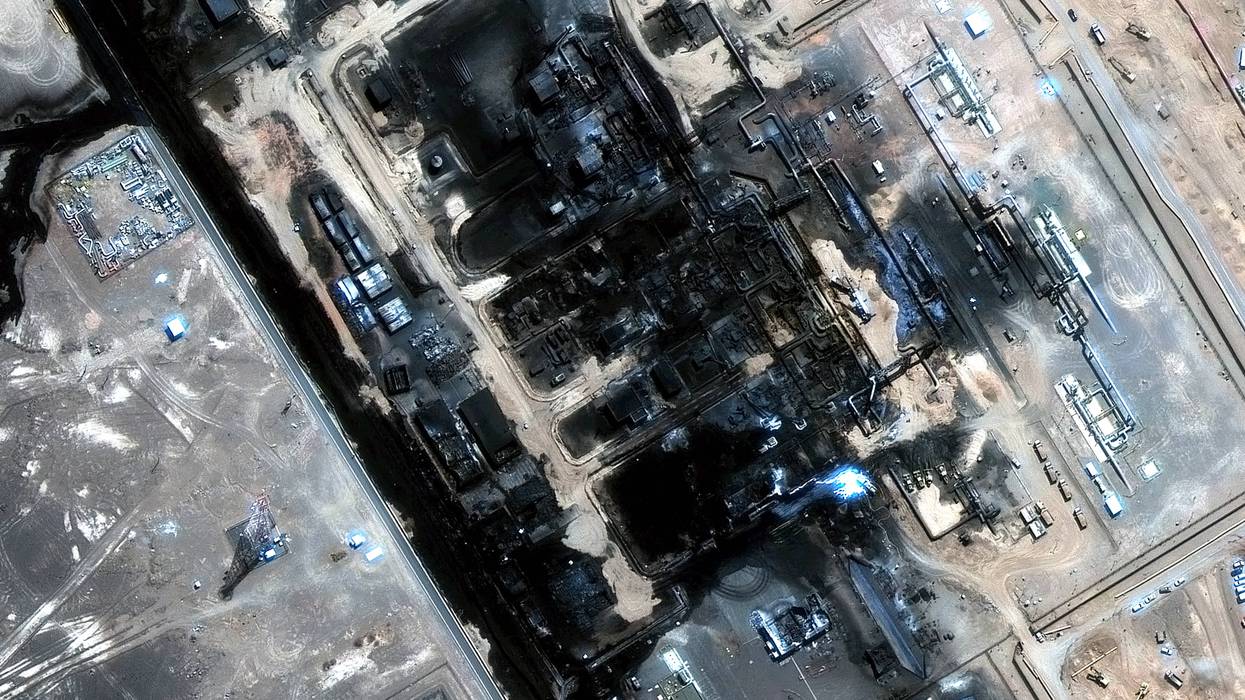
Satellite photos published on Sunday showed extensive fire damage suffered by a pumping station connected to the pipeline. Saudi Arabia had been using the pipeline to divert oil supplies to the Red Sea and away from the Strait of Hormuz, which has been mostly closed to commercial shipping traffic since President Donald Trump launched an illegal war against Iran in February.
In a news analysis published Monday, Bloomberg's Alex Longley noted that damage to the pipeline couldn't come at a worse time for global energy markets, which have already been under strain for months thanks to both the Iran War and continued fighting between Russia and Ukraine.
"Whatever happens, the oil market will need a quick fix," Longley wrote of the pipeline's closure. "It's currently screaming for barrels."
Even if the pipeline were repaired quickly, it would not bring immediate relief to global energy prices, given that the Strait of Hormuz remains closed, Houthi fighters in recent days have ramped up their campaign to disrupt oil shipments through the Red Sea, and Trump's refusal to forge a diplomatic solution with the Iranians continues with no end in sight.
The Houthis on Thursday seized the Yemeni port city of Mocha from Saudi-backed forces, giving the group a greater ability to launch attacks on vessels trying to transport oil through the Bab el-Mandeb Strait.
The price of Brent crude surged past $109 per barrel during trading on Monday after news broke that the damaged Saudi pipeline would take weeks to fix.
The rising cost of oil has been creating pain for US consumers in the form of higher prices for gasoline and diesel fuel. Data released Monday by the American Automobile Association showed that the average price of gas in the US now stands at $4.32 per gallon, while the price of diesel hit another record high of $6.23 per gallon.
"In order to prevent a nuclear war, Reagan and Gorbachev negotiated a nuclear arms agreement in the 1980s. In order to prevent AI from acting independently of human control, Trump and Xi must do the same."
Amid intensifying debate in the US about domestic regulation of the artificial intelligence industry, Sen. Bernie Sanders on Sunday called on US President Donald Trump to end his hands-off approach to AI on the international stage by engaging directly and urgently with China to forestall a global AI race that could have devastating consequences in the years and decades ahead.
"President Trump prides himself on being a great deal maker," Sanders asserted in a social media post. "Well. He now has the opportunity to make 'the deal of the century," by reaching out to the Chinese government."
"With the future of humanity at stake," said Sanders, "Trump must negotiate a comprehensive treaty with President Xi of China to establish a pause on advanced AI development and a ban on superintelligence."
While major US-based tech companies—including OpenAI, Anthropic, Meta, Google, and others—race to unlock AI's potential, Chinese companies and researchers are seen as the main competition in the effort to win the technological race. With fresh warnings from industry insiders over recent weeks dominating headlines, AI experts and watchdog groups have said that a coordinated "pause" or a global treaty to govern the technology's future development is desperately needed.
With the question about whether unregulated AI has the potential to "wipe out humanity" if not curtailed dominating headlines and political conversations, Trump on Sunday downplayed such concerns while putting the issue in zero-sum terms, declaring that "whoever wins AI, wins."
"We're leading China in AI, we're the most sophisticated in the world, and frankly, I want to keep it that way," Trump said.
While Anthropic's CEO Dario Amodei backed the call to "hit the brakes" on AI in certain ways in a nearly 4,000-word essay on the subject published over the weekend, he explained to CBS News on Sunday that the "toughest aspect of our situation" for industry leaders in the US is what to do if China would not honor such a slowdown.
China has acknowledged the international competition and tensions driven by technology, but has also expressed skepticism about comments from US industry leaders and the Trump administration's position.
“Fearmongering, confrontation, and vicious competition will only disrupt the process of global AI governance which serves no one’s interest,” said Guo Jiakun, a spokesperson for the Chinese Foreign Ministry, said at a Monday press conference in Beijing.
"All parties should work together to advance AI in a manner that is open, inclusive, beneficial to all, and oriented toward the good," Jiakun added.
In a statement last week, however, China's Ministry of Commerce said accusations by the US about Chinese efforts only offer "further proof that the US is pursuing technological hegemony in AI, seeking to monopolize computing power, and suppressing competition," an effort that "China firmly opposes."
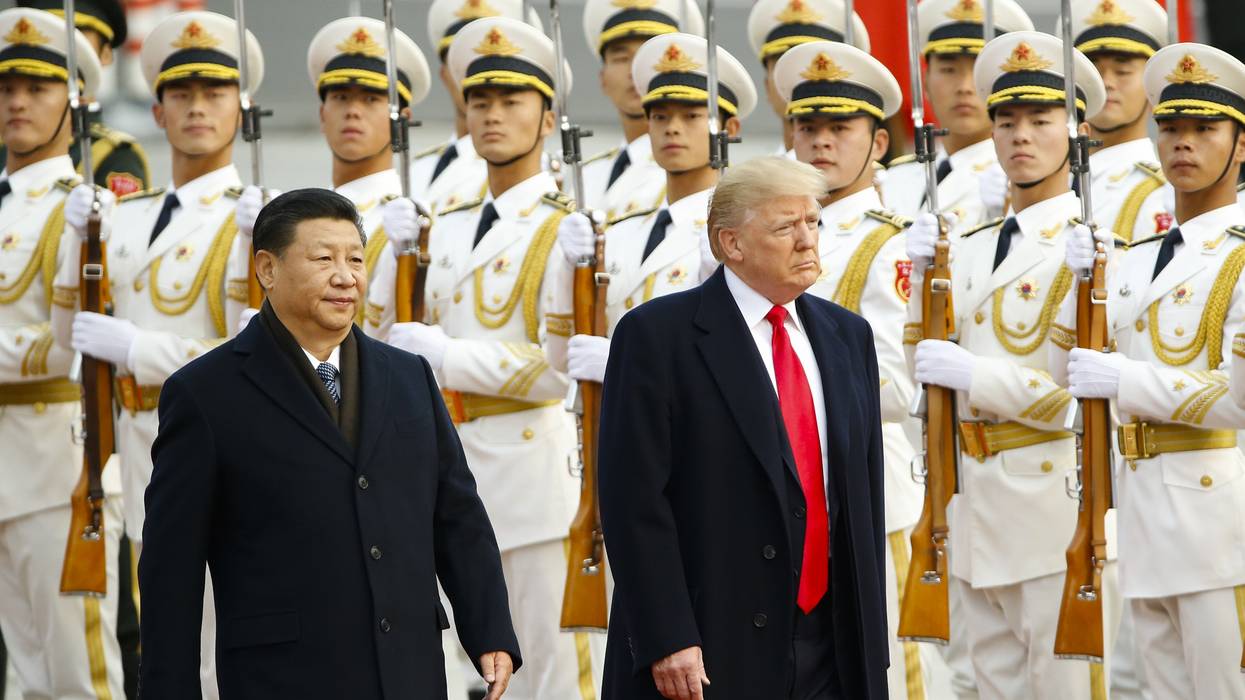
With Trump scheduled to meet with Chinese leader Xi Jinping later this month, AI governance is not expected to be high on the list of topics discussed.
Speaking with the BBC, Chang Jun Yan, an assistant professor with the military studies program at Singapore's S Rajaratnam School of International Studies, said a deal between Washington and Beijing on AI would be "next to impossible."
"As part of each state's core national security interests, cooperation in taking things slower and more safely in relation to AI is very, very unlikely," he argued.
In his Sunday statement, however, Sanders said diplomatic efforts—regardless of the difficulties—must be forged, and suggested that the US and China have a special responsibility when it comes to the powerful technology. Offering a historical analogy, Sanders cited the nuclear treaty brokered by US President Ronald Reagan and the Soviet Union's Mikhail Gorbachev in 1987.
"In order to prevent a nuclear war, Reagan and Gorbachev negotiated a nuclear arms agreement in the 1980s," Sanders said in his Sunday message. "In order to prevent AI from acting independently of human control, Trump and Xi must do the same."

The documentary includes interviews with 24 Israeli military and intelligence whistleblowers on Israel's system of mass killing of Palestinian civilians.
Following the Venice Film Festival premiere of a lauded documentary film about Israel's mass killing of civilians in Gaza using surveillance and artificial intelligence, the Israeli government is "taking action... against the filmmakers," said one journalist after a top minister threatened to revoke the Israeli citizenship of the two creators of the film.
Culture Minister Miki Zohar said Sunday that Yuval Abraham and Rachel Szor were willing to “harm their homeland in order to receive applause from antisemites around the world" after the film, NAZA, received a record-breaking standing ovation and the Special Jury Prize at the festival.
The film's title refers to an acronym used by Israeli intelligence officers for the number of civilians they expect to be killed in an airstrike in Gaza, which Israel began bombarding in 2023 in retaliation for a Hamas-led attack. More than 73,000 Palestinians have been killed so far in Gaza, where Israeli attacks continue despite a ceasefire that was reached 11 months ago.
Israel and its allies, including the US, its top military funder, have persistently claimed that the Israel Defense Forces (IDF) are targeting Hamas, even as thousands of children and women and hundreds of journalists, aid workers, and medical workers have been killed. On Saturday, a pregnant woman was among 10 Palestinians killed over 48 hours.
Abraham previously reported on Israel's AI-powered targeting technology and the IDF's rules of engagement—including its acceptance of 100 Palestinian civilians being killed for a single Hamas member who was targeted—for +972 magazine.
But the film, in which Abraham and Szor interviewed 24 Israeli military and intelligence officers, led Zohar to say he would "act immediately to revoke the Israeli citizenship of these despicable creators for treason against the state."
The Israeli Supreme Court ruled in 2022 that the government can revoke an Israeli person's nationality if they fail to show "loyalty," including through acts that are found to be treasonous. The interior minister must submit a revocation request to the justice minister and judges must also validate the revocation.
Etan Nechin, a senior writer at Haaretz in Israel, noted that as the government calls to revoke the filmmakers' citizenship, it has also resisted calls for an independent investigation into the October 7 attacks by Hamas. Haaretz reported last week that Prime Minister Benjamin Netanyahu was warned about the attacks before they happened.
Mairav Zonszein, a senior analyst on Israel at the International Crisis Group, called the threat from Zohar "so pathetic."
The former FTC chair spoke out as Republican leaders insisted the industry should be permitted to regulate itself.
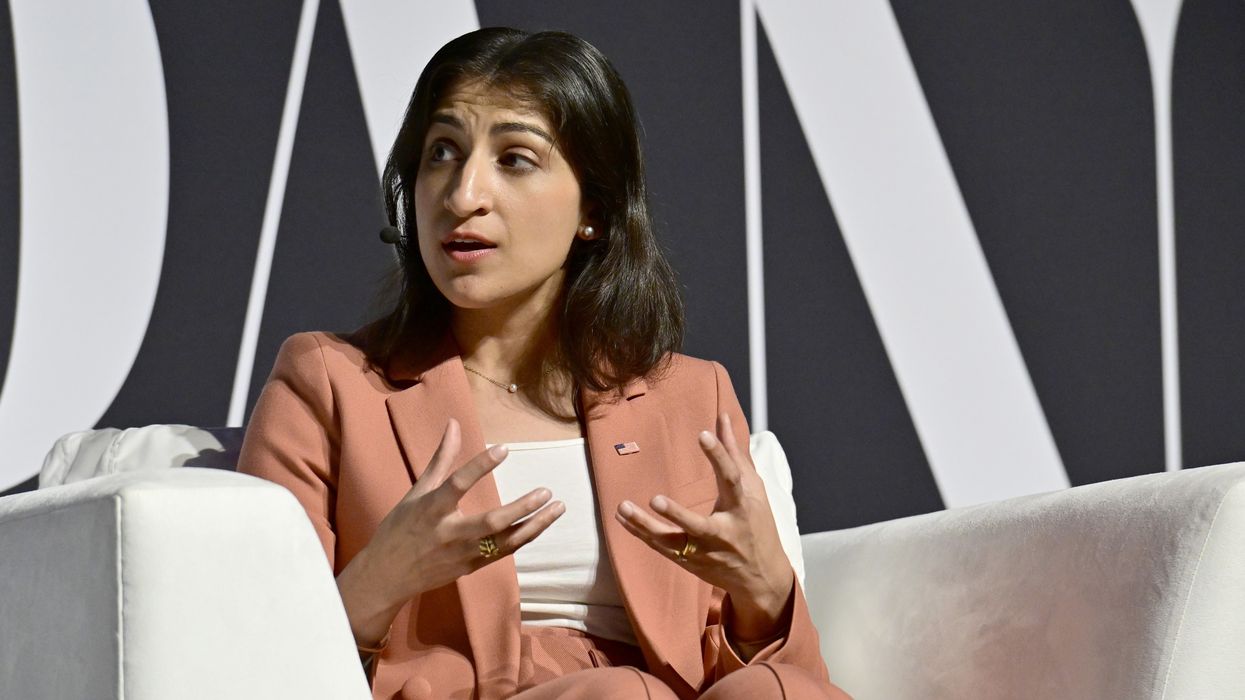
As House Speaker Mike Johnson and President Donald Trump dismissed the idea—backed by the vast majority of Americans—that lawmakers should impose strict regulations on the artificial intelligence industry as insiders call for a slowdown of development, former Federal Trade Commission Chair Lina Khan on Sunday issued a reminder that the federal government already has tools to rein in AI that poses a danger to the public, and demanded that officials use them.
"Law enforcers already have authority to charge companies and their CEOs for creating and releasing dangerous, unvetted, or defective products," Khan said on social media. "We shouldn’t let discussions about new legal regimes distract from the fact that there’s no AI exemption from laws already on the books."
Her call echoed that of Rep. Ro Khanna (D-Calif.), who said Saturday, "If you’re creating an AI that is doing illegal things, you either should face liability or criminal sanctions.”
Khan, who was recently appointed by New York City Mayor Zohran Mamdani to chair the city's Economic Development Corporation, posted the FTC's Staff Report on AI Partnerships and Investments, which the agency released shortly after Trump took office for his second term last year.
“As companies rapidly deploy generative AI technologies, enforcers and policymakers must stay vigilant to guard against business strategies that undermine open markets, opportunity, and innovation,” said Khan at the time.
On Sunday, Khan noted that the US already has "an extensive set of laws that govern dangerous and defective products," such as consumer protection laws, which releasing unvetted AI models or agents may violate.
Khan made her remarks after two incidents in which OpenAI's agents broke out of security test systems and committed cyberattacks. In July, hundreds of models broke out of confinement, hacked into systems of the AI startup Hugging Face, and conducted cyberattacks on targets they had not been instructed to attack.
Months earlier, it was reported on Friday, the company's models, which had not been given access to the full internet and were still in testing mode, broke out of confinement and hacked into an online coding service called RubyGems.
In the wake of those revelations, Anthropic CEO Dario Amodei and OpenAI CEO Sam Altman on Saturday called for "pacing the frontier" with measures such as "embedded evaluators" who would have employee-like access and could "verify adherence to safety practices and commitments."
But Jacob Coxon, an Anthropic researcher who resigned last week and warned that AI's "superhuman systems" are capable of killing all of humanity "by the end of the decade," told NBC News' "Meet the Press" Sunday that companies should be permitted to regulate themselves until Congress can establish a regulatory framework, and Johnson insisted that Congress must resist "jumping in and imposing some sort of emergency moratorium," for fear that "China will overlap us" if the US imposes strict regulations on AI.
"Why did this man become a congressman, let alone speaker?" asked journalist Mehdi Hasan of Zeteo. "He literally never wants Congress to do anything about anything."
But Khan suggested that the reluctance of congressional leaders and the Trump administration to rein in the AI industry shouldn't stop the federal government from holding companies like Anthropic and OpenAI liable for the damage their products have already caused.
She acknowledged, though, that "the highly concentrated and interconnected structure of these markets" could be undermining accountability—for example, in the case of OpenAI and Hugging Face, which computer chip company Nvidia agreed to acquire earlier this month.
"Both federal and state enforcers should be scrutinizing these opaque relationships and interdependencies," said Khan. "We are already seeing how these relationships could undermine accountability. For example, OpenAI could face liability given the Hugging Face incident, but Hugging Face being bought up by Nvidia means that we’re unlikely to see it file a lawsuit over this—given Nvidia’s strong incentive to see OpenAI continue full speed ahead."
Basel Musharbash of the antitrust law and policy firm Antimonopoly Counsel said that Khan's post was the statement that current FTC Chair Andrew Ferguson "should be issuing to provide guidance the public on what the law requires in response to the AI situation, but he’s missing in action. Luckily, former FTC Chair Lina Khan is out here still doing the work."
Juliette Kayyem, the faculty chair of homeland security at Harvard University’s Kennedy School of Government, told CNN that holding AI firms accountable is a matter of "pretty basic criminal law."
"We should start thinking about using our criminal laws," said Kayyem. "They are putting a dangerous substance into commerce and then saying, 'Well, we're smart enough to kill everyone but we're not smart enough to stop it.' And I think a lot of the American public is done with this."