SUBSCRIBE TO OUR FREE NEWSLETTER
Daily news & progressive opinion—funded by the people, not the corporations—delivered straight to your inbox.
5
#000000
#FFFFFF
To donate by check, phone, or other method, see our More Ways to Give page.
Daily news & progressive opinion—funded by the people, not the corporations—delivered straight to your inbox.
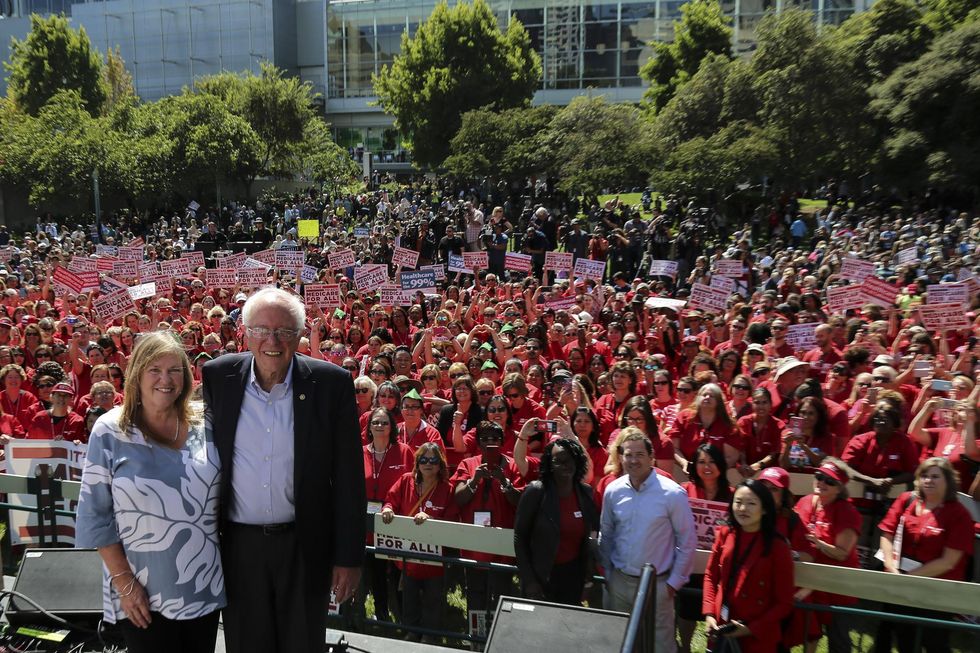
In a convention highlighted by Sen. Bernie Sanders and California Lt. Governor Gavin Newsom promoting single payer legislation federally and in California, some 500 California Nurses Association/National Nurses Organizing Committee delegates unanimously reaffirmed their commitment to work to implement an improved and expanded Medicare for all Saturday.
Meeting in San Francisco, convention delegates also endorsed resolutions to protect and defend nursing practice and patient advocacy in an era of corporate medicine, the right to collective action at a time of growing attacks on unions and workers' rights, environmental and climate justice, comprehensive immigration reform and a #PeoplesPlatform for social, economic, racial, and political justice.

Jane Sanders, Sen. Bernie Sanders at CNA/NNOC Convention, September 22
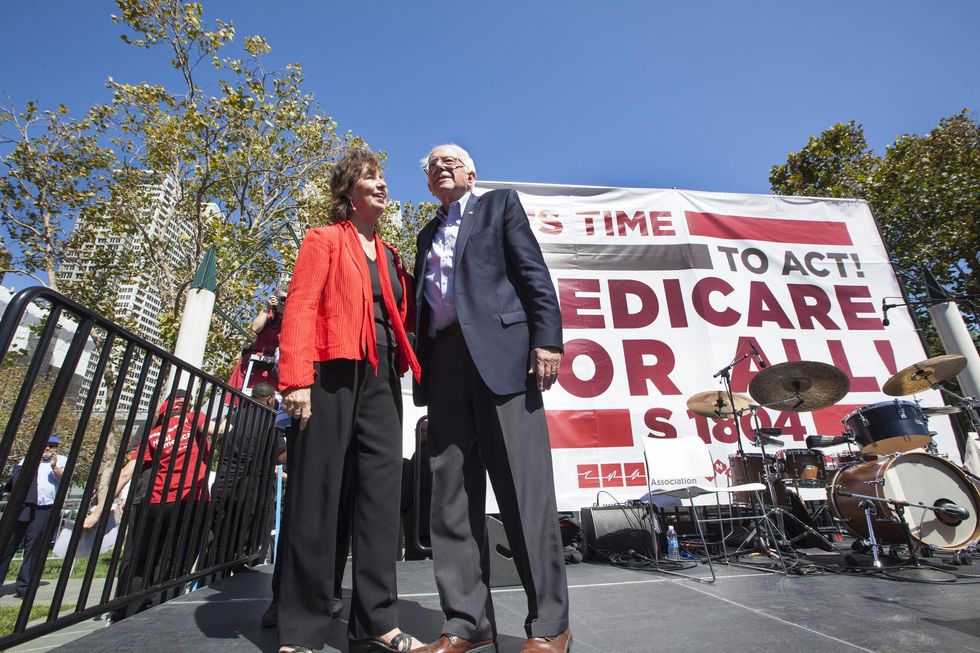
In a speech that drew widespread California and national coverage, Sen. Sanders, author of the Medicare for all bill, S. 1804, Friday stepped up the call to defeat the Graham-Cassidy Amendment, adding, "we have to understand that maintaining the status quo is just not good enough.
RoseAnn DeMoro, Sen. Bernie Sanders at CNA/NNOC Convention, September 22
Lt. Gov. Newsom praised CNA members for pushing to enact the CNA-sponsored California state single payer bill SB 562 currently blocked in the California Assembly by Speaker Anthony Rendon after passing the State Senate in June. "There is no reason to wait around on universal health care. It's time to dust off 562, its time to move 562 along, it's time to get it out of committee. Its time to move it along the legislative track. It's time to do that now.
"It's a question now of leadership, it's a question of commitment, it's question of resolve,' said Newsom, the leading candidate for California Governor in 2018. "My resolve to you, if we can't get it done next year, you have my firm and absolute commitment as your next governor, I will lead the effort to get it done. We absolutely will get it done."
An Improved Medicare for All Resolution
On Saturday, convention delegates re-iterated support for both bills in a resolution that called for eliminating the role of insurance companies in healthcare "and the human suffering they cause," and pledged that CNA/NNOC would only endorse candidates who support single payer.
Resolution on Nursing Practice and Patient Advocacy
Delegates vowed to "vigorously oppose" technology that is used to "replace, override or undermine" the professional practice of RNs and their ability to protect patients, and harassment and retaliation by nurse executives, managers and consultants of nurses who advocate for patients or challenge market-based healthcare restructuring schemes.
"This is a fight to protect our profession," said a California RN, and "challenge those who want to deregulate healthcare in pursuit of profit."
Resolution on Collective Action
The resolution warns of national "right to work" legislation that erodes conditions not just for unions but for all working people, as well as the new management-dominated National Labor Relations Board. It pledges CNA/NNOC members to work to protect worker and union rights.
Delegates resolved to "work with our allies inside and outside the labor movement" to challenge "right-to-work" legislation "and similar legislative assaults on working people proposed by ALEC (the American Legislative Exchange Council)" and politicians aligned with them.
"We must expose the expansion of 'right-to-work' laws that make the nursing profession weaker," said a Texas RN.
Resolution on Environmental and Climate Justice
Delegates agreed to work with local communities and activists to "resist fossil fuel interests" and projects such as new pipelines, deep-sea drilling, fracking, oil trains, export terminals for coal, petroleum coke, and refinery expansions, as many CNA/NNOC members have long done. They also endorsed returning the U.S. "back into the community of nations seeking to address climate disruption," and supporting a "just transition" for workers in fossil fuel related jobs.
A California Central Valley RN described how nurses see the rise in childhood asthma rates from environmental pollution. "We are a science based profession, we have to take a stand for the future of our world, and I stand here for my grandchildren."
Resolution on Immigration
Delegates said they will work with labor, immigrant rights and human and civil rights organizations to "safeguard the civil rights and liberties of all immigrants" including the right to due process, and opposing the profiling of people based on race, ethnicity or immigration status. They also called for comprehensive federal legislation with a patient to citizenship and an end to arbitrary raids, roundups, and deportations.
Numerous delegates described their own background as immigrants or the child of immigrants. An Illinois RN cited examples of undocumented patients "afraid to show up for care" because of fear of immigration agents. A Florida RN warned "we are creating an environment of fear among immigrants who make an important contribution to this country."
Resolution in Support of a #PeoplesPlatform
Delegates endorsed a Peoples Platform statement for a national grassroots movement rooted in such issues as workplace democracy, the right to healthcare, education, housing, water, and jobs, ending racism and establishing equality, climate justice, and economic democracy.
"Let's put our nurses' values to work," said a California RN.
The convention concluded with the formal seating of new national officers and a national board of directors.

National Nurses United, with close to 185,000 members in every state, is the largest union and professional association of registered nurses in US history.
(240) 235-2000"First Trump ordered 2,500 more American ground troops to the Middle East. Then it was doubled to 5,000," wrote one analyst. "Now Trump may literally double down again."
The Trump administration is reportedly considering sending 10,000 additional US troops to the Middle East amid mounting fears of an invasion of Iran, which is mobilizing its forces ahead of a possible ground assault.
The Wall Street Journal reported that the new US troop deployment "would likely include infantry and armored vehicles" and "would be added to the roughly 5,000 Marines and the thousands of paratroopers from the 82nd Airborne Division who have already been ordered to the region." The US Central Command has said roughly 50,000 American troops are currently stationed in the Middle East.
Lawmakers in the US have not authorized any attack on Iran, but legislative efforts to withdraw American forces from the war have thus far failed to pass either chamber of Congress. House Democratic leaders opted to punt a vote on a new Iran war powers resolution until mid-April despite apparently having enough support for passage, and the Senate isn't planning to hold its first public hearing on the war until after lawmakers return from spring recess.
"Sure am glad the US Congress thoroughly debated the merits of this war and the American public had a chance to weigh in regarding this expenditure of blood and treasure before the legislative branch ultimately decided it was worthwhile and voted to authorize it," Brian Finucane, senior adviser to the US Program at the International Crisis Group, wrote sardonically in response to reports of the new troop deployment plans.
Dylan Williams, vice president for government affairs at the Center for International Policy, warned that the rapidly expanding troop deployments are "like a mathematically simplified escalation trap hypothetical come to life."
"First Trump ordered 2,500 more American ground troops to the Middle East. Then it was doubled to 5,000," wrote Williams. "Now Trump may literally double down again by deploying an additional 10,000 ground troops."
The Times of Israel reported Thursday that an unnamed official "from one of the countries mediating between the US and Iran" believes President Donald Trump "appears to be leaning toward ordering a US ground operation against Iran." Israeli Prime Minister Benjamin Netanyahu has said publicly that a "ground component" is necessary in Iran, and Saudi Crown Prince Mohammed bin Salman has reportedly pushed Trump behind the scenes to launch a ground assault.
According to The Times of Israel, "the official intimately familiar with the mediation efforts says the US privately recognizes that Iran is not likely to agree to the concessions presented in Washington’s 15-point plan and has dispatched thousands of troops to the region in order to capture Tehran’s Kharg Island on Trump’s orders."
Kharg Island is Iran’s primary oil export hub. Among those urging Trump to seize the island is former Israeli Defense Minister Yoav Gallant, who wrote Thursday that "on the strategic chessboard of this war, Kharg Island is the next piece."
"Yes, there are risks," wrote Gallant, who is wanted by the International Criminal Court for war crimes and crimes against humanity in Gaza. "Any operation to seize Kharg would require thousands of troops, sustained air and naval support, and detailed intelligence, and it would carry a real and expected cost in human life."
"President Trump has set up the US for this option. By signaling willingness to explore a diplomatic agreement with Iran, he has shown both the American people and the international community that he is prepared to compromise if Iran meets core demands," Gallant added. "In giving Iran days, not months, to meet these conditions, he buys time for US forces and their allies to prepare and finalize operational plans."
"The president has actively harmed the well-being of seniors and broken his promises... to stop inflation, not touch Social Security, and leave Medicaid alone."
US Sen. Kirsten Gillbrand on Wednesday unveiled a report detailing how President Donald Trump's attacks on Social Security, Medicaid, nutrition assistance, and other programs are harming the very senior citizens whose strong support was so instrumental in his reelection.
The report—which was authored by the minority staff of the United States Senate Special Committee on Aging at the direction of Gillibrand (D-NY), its ranking member—states that Trump "was tasked with leading a nation that is rapidly aging and facing critical decisions about the policies and resources needed to support a sizable demographic change."
"The United States must decide how to ensure the independence of its seniors, how to support caregivers, and how to assist entire aging communities," the publication continues. "After one year in office, President Trump has failed at his obligations to America’s seniors. In fact, the president has actively harmed the well-being of seniors and broken his promises to them—such as his promises to stop inflation, not touch Social Security, and leave Medicaid alone."
Trump has FAILED at his obligations to America’s #seniors. The president has actively broken his promises to stop inflation, not to touch #SocialSecurity, and to "leave #Medicaid alone." READ the minority report of the Senate Committee on Aging HERE::: www.gillibrand.senate.gov/wp-content/u...
[image or embed]
— NCPSSM (@ncpssm.bsky.social) March 26, 2026 at 9:56 AM
Gillibrand said in a statement introducing the report that it "shows that instead of fighting for seniors, the president has attacked the very programs that help them stay afloat."
Republicans' so-called One Big Beautiful Bill Act, which Trump signed into law last July, ushered in the biggest cuts to Medicaid and Supplemental Nutrition Assistance Program in US history.
Gillibrand's report "focuses on eight harms that represent the Trump administration’s failure to support seniors during his first year in office."
According to the publication, Trump:
Other Democratic members of Congress including Sens. Patty Murray (Wash.) and Tammy Duckworth (Ill.) and Reps. Melanie Stansbury (NM) and John Larson (NJ) pointed out how Trump administration policies—including those mentioned in this piece and others like the billion-dollar-per-day war on Iran—are harming seniors by spending money that could have been allocated for their benefit or, in the case of Stansbury, by noting GOP attacks on mail-in voting, upon which many seniors rely.
"Seniors today are having a very hard time getting their benefits.Why?Social Security has pushed out 7,700 workers since Trump took office."
[image or embed]
— Social Security Works (@socialsecurityworks.org) March 26, 2026 at 9:03 AM
"'America first' was bullshit," Duckworth said on Bluesky. "With the $200 billion Trump wants for Iran, we could fund a decade of free, universal preschool; provide seniors with Medicare dental, vision, and hearing coverage for three years; build 2 million+ affordable homes. He promised to end wars."
The US president faces pressure to fully retract his "deeply irresponsible threats of acts that would unleash catastrophic harm on millions of civilians."
President Donald Trump on Thursday further delayed any potential US strikes on Iranian power plants to April 6, after nearly a week of critics calling him a "maniacal tyrant" for threatening to commit even more war crimes while attacking Iran with Israel.
"As per Iranian Government request, please let this statement serve to represent that I am pausing the period of Energy Plant destruction by 10 Days to Monday, April 6, 2026, at 8 P.M., Eastern Time. Talks are ongoing and, despite erroneous statements to the contrary by the Fake News Media, and others, they are going very well," Trump wrote on his Truth Social platform.
Trump initially said on the platform last Saturday night that "if Iran doesn't FULLY OPEN, WITHOUT THREAT, the Strait of Hormuz, within 48 HOURS from this exact point in time, the United States of America will hit and obliterate their various POWER PLANTS, STARTING WITH THE BIGGEST ONE FIRST!"
Jan Vande Putte, a senior nuclear and radiation protection expert with Greenpeace International, said in a Monday statement that "bombing civilian electricity infrastructure is illegal under international law. The electricity grid is essential for hospitals, clean water, desalination, and the operation of nuclear facilities. Cutting it off puts millions of lives at risk."
"A blackout could force the Bushehr nuclear facility into depending completely on backup diesel generators, causing a heightened risk of overheating, which can lead to a Fukushima-like disaster," Vande Putte warned, pointing to the 2011 accident in Japan. "If Trump carries through with this reckless threat to knock out critical infrastructure, it could lead to cascading failures, from blackouts to nuclear danger far beyond national borders, with the potential to escalate into a wider regional crisis."
Amid mounting outrage on Monday, Trump instructed the Pentagon to "postpone any and all military strikes against Iranian power plants and energy infrastructure for a five-day period, subject to the success of the ongoing meetings and discussions."
Critics continued to sound the alarm. In a Tuesday statement, Erika Guevara-Rosas, Amnesty International's senior director of research, advocacy, policy, and campaigns, called on Trump to retract his "dangerous" and "deeply irresponsible threats of acts that would unleash catastrophic harm on millions of civilians."
"By threatening such strikes, the USA is effectively indicating its willingness to plunge an entire country into darkness, and to potentially deprive its people of their human rights to life, water, food, healthcare, and adequate standard of living, and to subject them to severe pain and suffering," she warned.
"The decision to not proceed with such attacks must be based on the USA’s obligations under international humanitarian law to avoid civilian harm—not the outcome of political negotiations," the campaigner argued. "Going through with such attacks would cause devastating long-term consequences and severely undermine the international legal framework designed to protect civilians in wartime."
Guevara-Rosas also called on Iran to retract its threats to retaliate by striking power plants used by the US and Israel in Gulf states, as well as end all unlawful attacks on commercial vessels in the Strait of Hormuz and against energy infrastructure and desalination facilities in the region.
"Intentionally attacking civilian infrastructure such as power plants is generally prohibited," she stressed. "Even in the limited cases that they qualify as military targets, a party still cannot attack power plants if this may cause disproportionate harm to civilians. Given that such power plants are essential for meeting the basic needs and livelihoods of tens of millions of civilians, attacking them would be disproportionate and thus unlawful under international humanitarian law, and could amount to a war crime."
As for the Trump administration's negotiations with Iran, the president's special envoy, Steve Witkoff, confirmed Thursday that Pakistani mediators sent the United States' 15-point framework to the Iranian government—which has not fallen over nearly a month of war, despite frequent assassinations.
Citing an Iranian senior political-security official, state-run Press TV reported Wednesday that Iran had rejected Trump's 15-point plan and had a list of five conditions for ending the conflict: a halt to assassinations, concrete mechanisms to ensure that the war is not reimposed, reparations for damages, an end to the war across all fronts and for all resistance groups involved throughout the region, and recognition of Iran sovereignty over the Strait of Hormuz.
As The Associated Press reported Thursday:
Iran's Foreign Minister Abbas Araghchi said in an interview on state TV that his government has not engaged in talks to end the war and does not plan to. He said the US had tried to send messages to Iran through other nations, "but that is not a conversation nor a negotiation."
Egypt is also acting as a go-between, according to Egyptian Foreign Minister Badr Abdelatty, who said Thursday that his country sees a desire from both sides "for calm, for the exploration of negotiations."
Throughout the week, fears of Trump pursuing a ground invasion of Iran have also mounted, intenstifying pressure on congressional Democrats to force another vote on a war powers resolution intended to end the president's unauthorized Operation Epic Fury before the upcoming two-week recess.
"This may be the last opportunity for Congress to slam on the brakes before Trump launches a disastrous ground invasion of Iran," Jamal Abdi, president of the National Iranian American Council, said on social media Thursday evening. "If Democratic leadership fails to force a vote and leaves town for two weeks, they will be complicit in any catastrophic escalation."