SUBSCRIBE TO OUR FREE NEWSLETTER
Daily news & progressive opinion—funded by the people, not the corporations—delivered straight to your inbox.
5
#000000
#FFFFFF
To donate by check, phone, or other method, see our More Ways to Give page.


Daily news & progressive opinion—funded by the people, not the corporations—delivered straight to your inbox.

Jordan Libowitz
202-408-5565 | jlibowitz@citizensforethics.org
Citizens for Responsibility and Ethics in Washington (CREW) is bringing a federal lawsuit to stop President Trump from violating the Constitution by illegally receiving payments from foreign governments. The lawsuit will be filed in the Southern District of New York when the court opens at 9 AM on Monday.
The foreign emoluments clause of the Constitution prohibits Trump from receiving anything of value from foreign governments, including foreign government-owned businesses, without the approval of Congress.
"We did not want to get to this point. It was our hope that President Trump would take the necessary steps to avoid violating the Constitution before he took office," CREW Executive Director Noah Bookbinder said. "He did not. His constitutional violations are immediate and serious, so we were forced to take legal action."
Since Trump refused to divest from his businesses, he is now getting cash and favors from foreign governments, through guests and events at his hotels, leases in his buildings, and valuable real estate deals abroad. Trump does business with countries like China, India, Indonesia and the Philippines, and now that he is President, his company's acceptance of any benefits from the governments of those countries violates the Constitution. When Trump the president sits down to negotiate trade deals with these countries, the American people will have no way of knowing whether he will also be thinking about the profits of Trump the businessman.
"President Trump has made his slogan 'America First,'" said Bookbinder. "So you would think he would want to strictly follow the Constitution's foreign emoluments clause, since it was written to ensure our government officials are thinking of Americans first, and not foreign governments."
CREW is represented in the case by an all-star team of top constitutional scholars, ethics experts and litigators who have combined to argue 45 cases before the Supreme Court. The lawyers on the case include CREW's board chair and vice-chair Norman Eisen and Richard Painter, the top ethics lawyers for the last two presidents, Constitutional law scholars Erwin Chemerinsky, Laurence H. Tribe and Zephyr Teachout, and Deepak Gupta of Gupta Wessler PLLC.
Citizens for Responsibility and Ethics in Washington (CREW) is a nonprofit 501(c)(3) organization dedicated to promoting ethics and accountability in government and public life by targeting government officials -- regardless of party affiliation -- who sacrifice the common good to special interests. CREW advances its mission using a combination of research, litigation and media outreach.
Trump's comments served as an admission, said one observer, that "the uranium was a false justification for war."
President Donald Trump and his top advisers have spent months insisting that extracting and confiscating highly enriched uranium from Iran was the top objective of the unprovoked war he and Israeli Prime Minister Benjamin Netanyahu began in February—but on Tuesday at the Group of Seven summit in France, he shrugged off the need to rapidly obtain the nuclear reactor component.
There is "no rush" to retrieve uranium from nuclear sites the US bombed in June 2025, Trump said, adding that taking the highly enriched uranium is something the US wants "psychologically," but not enough to prioritize extracting it right away.
One could make the argument, he said, that it wasn't worth the effort to take the material at all.
"Frankly, to go get it—we're going to go get it—but to go get it is a big deal, because they say only China and us have the equipment," said the president. "You could make the case, 'Why do you even bother?' because it's not very valuable, you know. It's probably half a million dollars worth, it's not very valuable stuff."
Trump is backing away from getting Iran's enriched material: "You could make the case, why even bother? It's not very valuable stuff." pic.twitter.com/CgNgnZCaMQ
— Aaron Rupar (@atrupar) June 16, 2026
Trump's comments came a day after he and the Iranian government announced they had reached a memorandum of understanding (MOU) to end the war. The president told The New York Times that the agreement includes a requirement that Iran will be limited to enriching uranium only to levels that "could never be used by the military."
White House officials, though, told The Washington Post that details of Iran's nuclear program will be subject to negotiations over the next two months. The question of whether talks on the nuclear program could be held separately, after a deal to end the war was reached, had been a major sticking point for the US leading up to the MOU.
Trump brushed off suggestions that the deal to end the war, in which Iran demonstrated its economic might by effectively closing the Strait of Hormuz and sending energy prices skyrocketing—obtained no guarantees on Iran's nuclear program that hadn't already been secured in 2015 in the Joint Comprehensive Plan of Action, which was brokered by the Obama administration and which limited Iran's nuclear program in exchange for sanctions relief. Trump exited the JCPOA during his first term.
Iran will only be able to enrich uranium “for nonmilitary purposes. Forever," said Trump on Monday.
On Fox News on Monday, former National Security Council chief of staff Alex Gray insisted the president had secured a deal that, for the first time, would stop Iran from developing a nuclear weapon. Before the US and Israel began attacking Iran in February, the Middle Eastern country maintained that its nuclear power program was not for military purposes.
While Trump's supporters insisted the war and the MOU had made clear Trump had drawn a hard line on Iran's nuclear capacity, his comments on Tuesday were taken by foreign policy analyst Logan McMillen as an admission that "the uranium was a false justification for war."
"The real purpose was to punish Iran for the crime of being an independent economic power that refused to participate in America’s petro economy," said McMillen.
At CNN, Aaron Blake noted that Trump has spent weeks sending inconsistent messages about his demand that Iran end its nuclear program.
Late last month, the president said on social media that Iran's uranium "will be unearthed by the United States... in close coordination and conjunction with the Islamic Republic of Iran, plus the International Atomic Energy Agency, and DESTROYED.”
But in April, Trump told Reuters that US strikes last year had left Iran's uranium "so far underground, I don’t care about that."
Two weeks later, he again said that the US had "to take that nuclear dust," before telling Fox News last month that destroying the uranium was not "necessary except from a public relations standpoint."
A group of Democratic lawmakers pushed President Donald Trump on whether he would veto legislation that cuts Social Security.
A group of Democratic US senators warned Monday that congressional Republicans and President Donald Trump could be gearing up for a push for raise the retirement age as part of a broader—and deeply unpopular—effort to slash Social Security benefits after the 2026 midterm elections.
Sens. Elizabeth Warren (D-Mass.), Tammy Duckworth (D-Ill.), and Richard Blumenthal (D-Conn.) wrote in a letter to Trump that they have "renewed concerns" that his administration is "considering raising the retirement age, cutting the earned benefits of millions of Americans," despite the president's repeated vows to shield the program.
"Republicans have a history of attempting to increase the retirement age, privatize Social Security, or otherwise cut Social Security benefits, and some congressional Republicans have called to raise the retirement age or means-test benefits," the lawmakers wrote, emphasizing that GOP lawmakers "are not alone."
"In an interview this past fall, [Social Security Administration] Commissioner Frank Bisignano said—and later attempted to retract after public outcry—that your administration was considering this idea," the Democratic senators wrote of raising the retirement age, which would cut Social Security benefits across the board.
The nonpartisan Congressional Budget Office analysis of a 2024 Republican proposal to raise Social Security's full retirement age found that doing so would cut benefits by an average of 13% for people born after 1971.
The Democratic senators sent their letter to Trump days after Social Security's trustees said in their annual report that the program will be unable to pay out full benefits by the end of 2032—a quarter earlier than projected last year—unless Congress takes action. The finding was seen as evidence of the damage inflicted by Trump's policies, including his tariffs and tax cuts for the rich.
Ahead of the trustees report's release, House Speaker Mike Johnson declared that Social Security needs to be "adjusted and fixed" and said Republicans would release their plan "next year," without specifying what the proposal would entail.
Mike Johnson admits Republicans will cut Medicaid, Medicare, and Social Security next year pic.twitter.com/bgyAb4ppyw
— FactPost (@factpostnews) June 8, 2026
In their letter to Trump on Monday, the trio of Democratic senators demanded to know if the president is aware of "Republican plans to cut Medicare, Medicaid, or Social Security benefits" and whether he would veto GOP legislation that slashes those programs.
"Raising the retirement age—or otherwise cutting benefits—only worsens the looming retirement income crisis," the lawmakers wrote. "Doing so hurts older Americans, cutting monthly benefits and forcing millions into poverty."
"It is time to break decisively with the perverse logic in which retirees, the poor, or immigrants are expected to balance the budget, while the rich are to be allowed to live tax-free in their own parallel society. "
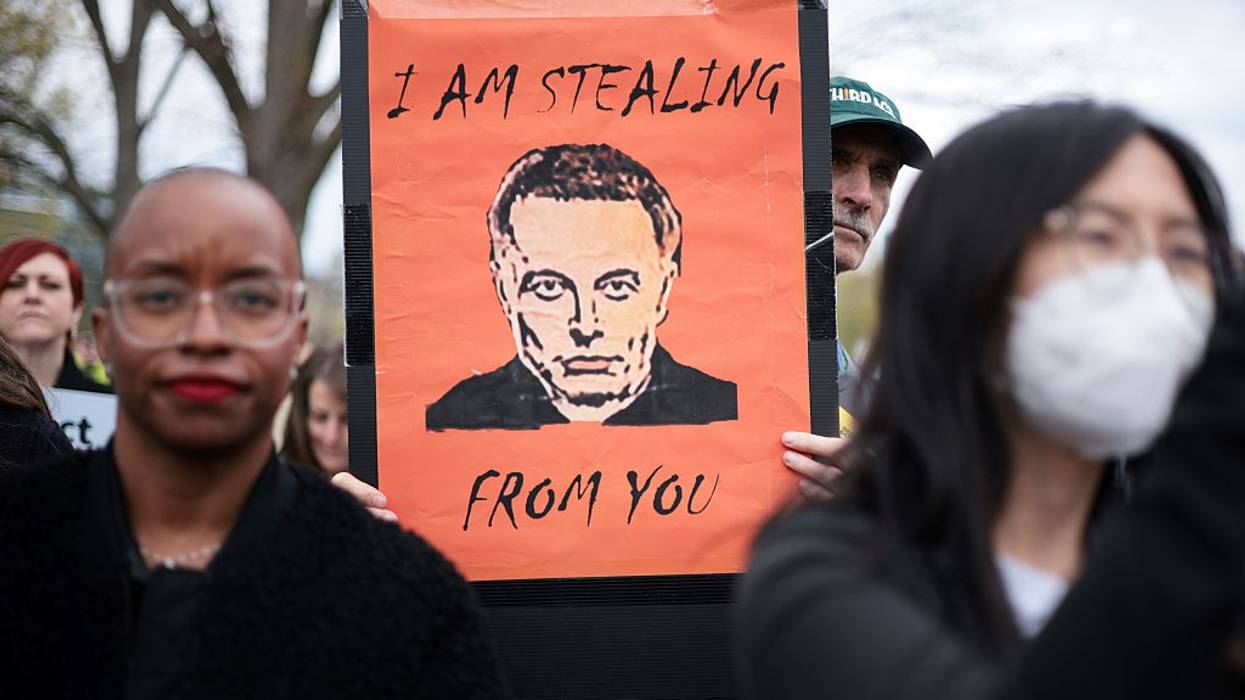
SpaceX CEO Elon Musk became the world's first trillionaire last week, and now a prominent economist is warning that his unprecedented wealth poses a grave threat to human freedom in the US and across the globe.
In a column published by The Guardian on Tuesday, Paris School of Economics professor Gabriel Zucman argued that Musk's enormous fortune is fundamentally at odds with a democratic system of governance because it gives him "the power to stifle competition, the power to shape public discourse, the power to influence policymaking, the power to buy elections, the power to stall social progress," and much else.
Zucman noted that wealth concentration is even greater now than it was during the original Gilded Age, as the top 0.00001% now have fortunes large enough to "buy 14% of everything produced in a given year in the US."
The economist added that while Musk—whose infamous destruction of the US Agency for International Development is projected to kill millions of people in the coming years—makes a particularly compelling villain, trillionaires would be a major problem for democracy even if they were of a more benevolent variety.
"No one should want to live in a society where one single individual can be worth $1 trillion, no matter their personal virtues," Zucman emphasized. "Such levels invariably skew power, distort markets, and sap our democratic ideals."
The best solution to this crisis, Zucman said, is to "create an unavoidable minimum tax on their wealth" that will "make it impossible for the super-rich to pay less tax than middle-class workers—a matter of basic equality before the law."
"It is time to break decisively with the perverse logic in which retirees, the poor, or immigrants are expected to balance the budget," Zucman concluded, "while the rich are to be allowed to live tax-free in their own parallel society. There cannot be a law more lenient for the rich and powerful than for the rest of us. If ever there was a time to act, it is now."
Zucman's thoughts on extreme wealth and democracy were echoed by Nobel Prize-winning economist Paul Krugman, who on Tuesday published an essay on his Substack page where he likened President Donald Trump's White House cage-fighting matches to the kinds of spectacles put on by Roman emperors before noting ominous similarities between the US today and the Roman Empire.
"While the causes of the decline of republican government and Rome’s eventual transition to one-man rule were doubtless complex," Krugman wrote, "there is broad consensus among historians that a key factor was the emergence of extreme inequality. A handful of men became incredibly wealthy from the spoils of Rome’s eastern conquests, and their wealth and power eventually became too great for the rules of constitutional, republican government to contain. Sound uncomfortably familiar?"
Gautam Mukunda, a professor at the Yale School of Management, similarly warned that Musk's newly minted trillionaire status was bad news for American self-governance.
In a Monday column published by Bloomberg, Mukunda pointed to the vast sums of money being spent by billionaires in US elections, which he noted "dwarf what candidates can raise themselves."
And like Krugman, Mukunda saw disturbing parallels between the US today and Ancient Rome.
"Marcus Crassus was the richest man in ancient Rome," he explained. "So rich that, by Plutarch’s account, he thought no man truly wealthy unless he could pay an army from his own purse. He spent that fortune bankrolling Julius Caesar and building the triumvirate that sidelined the Senate and, in fact if not in name, overthrew the republic."