SUBSCRIBE TO OUR FREE NEWSLETTER
Daily news & progressive opinion—funded by the people, not the corporations—delivered straight to your inbox.
5
#000000
#FFFFFF
To donate by check, phone, or other method, see our More Ways to Give page.
Daily news & progressive opinion—funded by the people, not the corporations—delivered straight to your inbox.
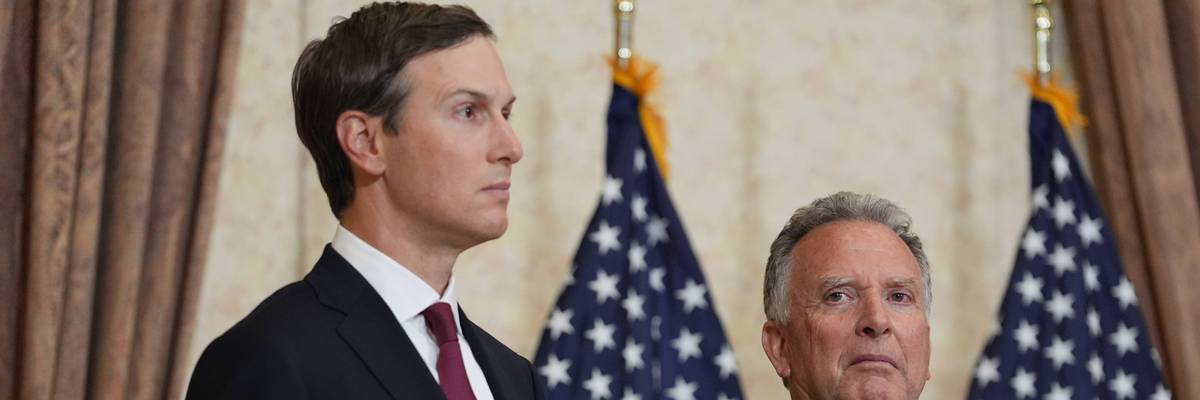
US special envoys Jared Kushner and Steve Witkoff appeared at a news conference on April 12, 2026 in Islamabad, Pakistan.
US President Donald Trump complained that his envoys' planned trip to Pakistan's capital would be "too much work."
US President Donald Trump on Saturday abruptly canceled a planned visit by two of his administration's negotiators to the Pakistani capital for diplomatic talks to end his illegal war on Iran, complaining that the trip would be "too much work."
The president announced his decision after Iranian Foreign Minister Abbas Araghchi left Islamabad on Saturday, writing in a social media post that he relayed to Pakistani officials "Iran's position concerning a workable framework to permanently end the war on Iran." Araghchi added that he has "yet to see if the US is truly serious about diplomacy."
Iranian officials said repeatedly in recent days that they had no intention of engaging in direct talks with the Trump administration this weekend as long as the US naval blockade remained in effect. Despite clear statements from Iran's leadership, the Trump White House insisted that special envoys Jared Kushner and Steve Witkoff would be holding another round of direct negotiations with Iranian officials in Islamabad after earlier talks ended without a deal.
"This has happened repeatedly: Trump claims the Iranians are begging for talks, Iran says it is false," observed Drop Site's Jeremy Scahill. "The US says Iran is lying, and then it becomes clear Iran meant what it said."
In an assessment published before Trump canceled his envoys' trip, Scahill wrote that "there is no question it is the US that is seeking direct talks right now, not Iran."
"Iran still believes it is likely the US and Israel will resume the war and has indicated it has prepared new forms of retaliatory strikes and other actions, including in the Strait of Hormuz," Scahill added. "Its military commanders have said that while the US has moved more military assets into the region during the 'ceasefire,' Tehran has also taken this period to prepare its own weapons systems for more fighting."
Trump insisted Saturday that his administration—whose deeply unpopular and deadly war of choice has sparked a global economic disaster—holds "all the cards" and that Iranian leadership is in turmoil. But Sina Toossi, a senior fellow at the Center for International Policy, wrote that "Trump can’t hide exuding desperation for a deal."
"So he invents 'fractures' in Tehran to explain being repeatedly stood up," Toossi added. "Iran’s line is unchanged: demanding the blockade be lifted and holding on to its core red lines. They’re playing hardball. He’s spinning."
Trump's cancellation of the Kushner-Witkoff trip came hours after NBC News reported that "American military bases and other equipment in the Persian Gulf region suffered extensive damage from Iranian strikes that is far worse than publicly acknowledged and is expected to cost billions of dollars to repair."
"The Iran war was a tactical and strategic disaster," said Toossi. "Despite heavy efforts to control the narrative, it’s becoming clear just how much US bases and equipment in the region were damaged or destroyed. The war backfired and inflicted far more damage than its proponents want to admit."
Dear Common Dreams reader, It’s been nearly 30 years since I co-founded Common Dreams with my late wife, Lina Newhouser. We had the radical notion that journalism should serve the public good, not corporate profits. It was clear to us from the outset what it would take to build such a project. No paid advertisements. No corporate sponsors. No millionaire publisher telling us what to think or do. Many people said we wouldn't last a year, but we proved those doubters wrong. Together with a tremendous team of journalists and dedicated staff, we built an independent media outlet free from the constraints of profits and corporate control. Our mission has always been simple: To inform. To inspire. To ignite change for the common good. Building Common Dreams was not easy. Our survival was never guaranteed. When you take on the most powerful forces—Wall Street greed, fossil fuel industry destruction, Big Tech lobbyists, and uber-rich oligarchs who have spent billions upon billions rigging the economy and democracy in their favor—the only bulwark you have is supporters who believe in your work. But here’s the urgent message from me today. It's never been this bad out there. And it's never been this hard to keep us going. At the very moment Common Dreams is most needed, the threats we face are intensifying. We need your support now more than ever. We don't accept corporate advertising and never will. We don't have a paywall because we don't think people should be blocked from critical news based on their ability to pay. Everything we do is funded by the donations of readers like you. When everyone does the little they can afford, we are strong. But if that support retreats or dries up, so do we. Will you donate now to make sure Common Dreams not only survives but thrives? —Craig Brown, Co-founder |
US President Donald Trump on Saturday abruptly canceled a planned visit by two of his administration's negotiators to the Pakistani capital for diplomatic talks to end his illegal war on Iran, complaining that the trip would be "too much work."
The president announced his decision after Iranian Foreign Minister Abbas Araghchi left Islamabad on Saturday, writing in a social media post that he relayed to Pakistani officials "Iran's position concerning a workable framework to permanently end the war on Iran." Araghchi added that he has "yet to see if the US is truly serious about diplomacy."
Iranian officials said repeatedly in recent days that they had no intention of engaging in direct talks with the Trump administration this weekend as long as the US naval blockade remained in effect. Despite clear statements from Iran's leadership, the Trump White House insisted that special envoys Jared Kushner and Steve Witkoff would be holding another round of direct negotiations with Iranian officials in Islamabad after earlier talks ended without a deal.
"This has happened repeatedly: Trump claims the Iranians are begging for talks, Iran says it is false," observed Drop Site's Jeremy Scahill. "The US says Iran is lying, and then it becomes clear Iran meant what it said."
In an assessment published before Trump canceled his envoys' trip, Scahill wrote that "there is no question it is the US that is seeking direct talks right now, not Iran."
"Iran still believes it is likely the US and Israel will resume the war and has indicated it has prepared new forms of retaliatory strikes and other actions, including in the Strait of Hormuz," Scahill added. "Its military commanders have said that while the US has moved more military assets into the region during the 'ceasefire,' Tehran has also taken this period to prepare its own weapons systems for more fighting."
Trump insisted Saturday that his administration—whose deeply unpopular and deadly war of choice has sparked a global economic disaster—holds "all the cards" and that Iranian leadership is in turmoil. But Sina Toossi, a senior fellow at the Center for International Policy, wrote that "Trump can’t hide exuding desperation for a deal."
"So he invents 'fractures' in Tehran to explain being repeatedly stood up," Toossi added. "Iran’s line is unchanged: demanding the blockade be lifted and holding on to its core red lines. They’re playing hardball. He’s spinning."
Trump's cancellation of the Kushner-Witkoff trip came hours after NBC News reported that "American military bases and other equipment in the Persian Gulf region suffered extensive damage from Iranian strikes that is far worse than publicly acknowledged and is expected to cost billions of dollars to repair."
"The Iran war was a tactical and strategic disaster," said Toossi. "Despite heavy efforts to control the narrative, it’s becoming clear just how much US bases and equipment in the region were damaged or destroyed. The war backfired and inflicted far more damage than its proponents want to admit."
US President Donald Trump on Saturday abruptly canceled a planned visit by two of his administration's negotiators to the Pakistani capital for diplomatic talks to end his illegal war on Iran, complaining that the trip would be "too much work."
The president announced his decision after Iranian Foreign Minister Abbas Araghchi left Islamabad on Saturday, writing in a social media post that he relayed to Pakistani officials "Iran's position concerning a workable framework to permanently end the war on Iran." Araghchi added that he has "yet to see if the US is truly serious about diplomacy."
Iranian officials said repeatedly in recent days that they had no intention of engaging in direct talks with the Trump administration this weekend as long as the US naval blockade remained in effect. Despite clear statements from Iran's leadership, the Trump White House insisted that special envoys Jared Kushner and Steve Witkoff would be holding another round of direct negotiations with Iranian officials in Islamabad after earlier talks ended without a deal.
"This has happened repeatedly: Trump claims the Iranians are begging for talks, Iran says it is false," observed Drop Site's Jeremy Scahill. "The US says Iran is lying, and then it becomes clear Iran meant what it said."
In an assessment published before Trump canceled his envoys' trip, Scahill wrote that "there is no question it is the US that is seeking direct talks right now, not Iran."
"Iran still believes it is likely the US and Israel will resume the war and has indicated it has prepared new forms of retaliatory strikes and other actions, including in the Strait of Hormuz," Scahill added. "Its military commanders have said that while the US has moved more military assets into the region during the 'ceasefire,' Tehran has also taken this period to prepare its own weapons systems for more fighting."
Trump insisted Saturday that his administration—whose deeply unpopular and deadly war of choice has sparked a global economic disaster—holds "all the cards" and that Iranian leadership is in turmoil. But Sina Toossi, a senior fellow at the Center for International Policy, wrote that "Trump can’t hide exuding desperation for a deal."
"So he invents 'fractures' in Tehran to explain being repeatedly stood up," Toossi added. "Iran’s line is unchanged: demanding the blockade be lifted and holding on to its core red lines. They’re playing hardball. He’s spinning."
Trump's cancellation of the Kushner-Witkoff trip came hours after NBC News reported that "American military bases and other equipment in the Persian Gulf region suffered extensive damage from Iranian strikes that is far worse than publicly acknowledged and is expected to cost billions of dollars to repair."
"The Iran war was a tactical and strategic disaster," said Toossi. "Despite heavy efforts to control the narrative, it’s becoming clear just how much US bases and equipment in the region were damaged or destroyed. The war backfired and inflicted far more damage than its proponents want to admit."