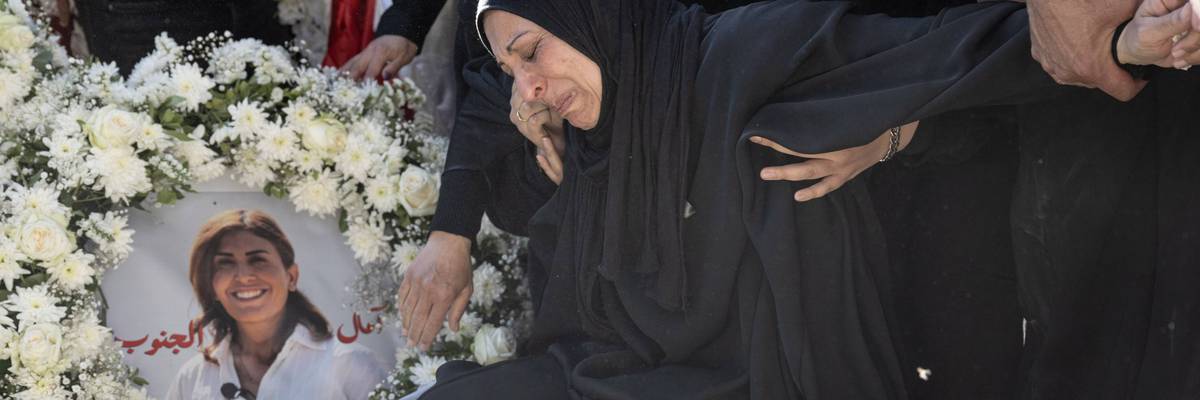
People attend a funeral ceremony for journalist Amal Khalil, who was killed in an Israeli strike in southern Lebanon on April 23, 2026.
Press Freedom Groups Demand International Probe Into Israel's Killing of Journalist Amal Khalil
"Responsibility for these crimes also lies with Israel’s allies, who continue to allow the Netanyahu government to commit them with impunity."
Global press freedom organizations are demanding an immediate international probe into the Israeli military's apparently targeted killing of Lebanese journalist Amal Khalil, who died trapped under the rubble of a home bombed by Israeli forces earlier this week.
The calls for an urgent independent investigation came as the details surrounding Khalil's killing in southern Lebanon continued to emerge. Khalil's body was recovered by the Lebanese army and Red Cross rescue workers around six hours after the Israeli military bombed the house in which she took cover with fellow journalist Zeinab Faraj—who was badly injured in the attack—following an Israeli strike near their car. Israeli forces obstructed rescue operations by continuing to attack the area.
Reporters Without Borders, known internationally as Reporters Sans Frontières (RSF), published an in-depth timeline of events, making the case that the Israeli military intentionally targeted Khalil and interfered with rescue efforts:
- At around 14:30 [Paris time]: a first Israeli strike targets a car near the vehicle carrying Amal Khalil and Zeinab Faraj. The two journalists survive the attack and manage to exit their vehicle.
- 14:52: Amal Khalil is contacted by Al Jazeera’s correspondent in southern Lebanon, Carmen Joukhadar. The call lasts nine seconds. “I could clearly hear that she was running and out of breath while speaking to me, but she told me she was fine,” he told RSF.
- Between 15:00 and 16:00: rescuers await authorization from the diplomatic committee—known as the “mechanism”—which, among other roles, serves as guarantor and mediator for the ceasefire between Lebanon and Israel, in order to access the site. The committee, established in November 2024 under the auspices of France and the United States, also includes the United Nations Interim Force in Lebanon (UNIFIL).
- Around 16:00: a second strike targets the journalists’ car. Hiding nearby, Amal Khalil calls her colleagues to inform them of the attack, then takes refuge, with Zeinab Faraj, in a three-story house located nearby.
- 16:22: last contact with Amal Khalil. According to her sister, who was on the phone with her at the time, Amal Khalil was unharmed. After this call, the journalist’s phone went dead.
- 16:27: a third Israeli strike targets the house. According to RSF, the strike was carried out by a military aircraft, not a drone. Smoke was captured in a photograph taken by Carmen Joukhadar from the neighboring village of Khiam.
- Around 16:40: Lebanese army and nearby rescue teams are unable to reach the location of the two journalists due to ongoing strikes.
- Around 18:00: the Red Cross finally manages to evacuate Zeinab Faraj, who was suffering from fractures. According to the Lebanese TV channel LBCI, a flash grenade fired by Israeli forces forced the ambulance to retreat without being able to save Amal Khalil. Zeinab Faraj was taken to the local hospital in the nearby village of Tibnin.
- Around 19:20: the Lebanese army decides to accompany the Red Cross despite lacking authorization from the “mechanism” given the urgency of the situation.
- Around 20:20: the Red Cross returns to the scene, accompanied by the Lebanese army and bulldozers begin rescue operations.
- 23:10: the army and the Red Cross publicly announce that they have found Amal Khalil’s lifeless body on the ground floor of the building. The exact time of her death is yet to be determined.
Jonathan Dagher, head of RSF's Middle East desk, said in a statement that "so long as impunity prevails, crimes will continue to be committed."
"The Israeli army has very likely committed two more war crimes on 22 April, by targeting journalists who were identified as such, obstructing rescue operations, and continuing strikes that killed one journalist and injured another," said Dagher. "Responsibility for these crimes also lies with Israel’s allies, who continue to allow the Netanyahu government to commit them with impunity."
"We call on the international community to take firm measures to ensure that the Israeli government brings its massacre of journalists in Lebanon and Palestine to an end," Dagher added. "We also call on the Lebanese government to investigate this crime, which took place on Lebanese territory, and will continue to work to ensure that justice is served for Amal Khalil and every single other journalist killed in Lebanon and the wider region."
I urge everyone to watch this report by Channel 4 News about Israel’s killing of Lebanese journalist Amal Khalil.
“Under international humanitarian law, journalists are afforded the same protection as civilians… If that journalist has a particular sympathy with a particular… pic.twitter.com/uzxCENNUqi
— Hamza Yusuf (@Hamza_a96) April 24, 2026
The Committee to Protect Journalists (CPJ) also demanded an independent investigation into Khalil's killing, which the group described as a possible war crime.
CPJ noted that Khalil "received numerous threats prior to her killing, including a reported death threat in September 2024, and public incitement against her by an Israeli military official days before her killing, leading to widespread accusations that she was deliberately targeted. The reported obstruction of rescue operations, claimed by Lebanese government officials, constitute an additional grave violation of international humanitarian law."
Jodie Ginsberg, CPJ's chief executive, said in a statement that "this is not the first time that Israel has prevented emergency services from reaching journalists injured in their strikes."
"Journalists are civilians and protected under international law," said Ginsberg. "Israel’s blatant disregard for such norms—and the international community’s failure to hold them accountable—is abhorrent."
A spokesperson for the United Nations High Commissioner for Human Rights told reporters on Friday that "deliberately targeting" journalists or rescue workers "would amount to a war crime," pointing specifically to Israel's killing of Amal Khalil and obstruction of emergency teams.
"UN High Commissioner for Human Rights Volker Türk calls for prompt, thorough, independent, and impartial investigations into all incidents involving allegations of violations of international humanitarian law," said the commissioner's spokesperson. "Findings must be disclosed, and those responsible held to account."
We are at a crossroads
This country and this world are at a monumental crossroads. In a few short weeks, US voters will have an opportunity to beat back the forces of fascism and confront the billionaires who are rigging the economy, our media system, and our democracy, making it increasingly impossible for ordinary people to get by. We’re not just talking about the election. We’re talking about what must be done once these fascist elements are vanquished from power. We need a bolder set of solutions than what either major party has so far been willing to offer and a working-class movement ready to fight like hell for it. Trump didn't emerge from nowhere. The conditions that fueled MAGA authoritarianism were created by decades of radical neoliberal economic policies and a corrupt political system dominated by corporate interests. They slashed taxes on the super-rich, promising that the benefits would trickle down. They said giveaways to the corporate titans would make life more affordable for the rest of us. It was all bullshit. And when a bitter, betrayed populace searches for someone to blame, right-wing demagogues have little trouble finding scapegoats. People know when they're being lied to, but you won't hear any of this from the corporate media. Only independent journalism—powered and funded by people who believe in building a better world—can deliver truly trustworthy daily news. Our Fall Campaign is underway, and we need your help. To power our newsroom through the rest of the year, we need to raise $125,000 by midnight on October 31. So if you share our vision, please contribute whatever you can to sustain our work. |
Global press freedom organizations are demanding an immediate international probe into the Israeli military's apparently targeted killing of Lebanese journalist Amal Khalil, who died trapped under the rubble of a home bombed by Israeli forces earlier this week.
The calls for an urgent independent investigation came as the details surrounding Khalil's killing in southern Lebanon continued to emerge. Khalil's body was recovered by the Lebanese army and Red Cross rescue workers around six hours after the Israeli military bombed the house in which she took cover with fellow journalist Zeinab Faraj—who was badly injured in the attack—following an Israeli strike near their car. Israeli forces obstructed rescue operations by continuing to attack the area.
Reporters Without Borders, known internationally as Reporters Sans Frontières (RSF), published an in-depth timeline of events, making the case that the Israeli military intentionally targeted Khalil and interfered with rescue efforts:
- At around 14:30 [Paris time]: a first Israeli strike targets a car near the vehicle carrying Amal Khalil and Zeinab Faraj. The two journalists survive the attack and manage to exit their vehicle.
- 14:52: Amal Khalil is contacted by Al Jazeera’s correspondent in southern Lebanon, Carmen Joukhadar. The call lasts nine seconds. “I could clearly hear that she was running and out of breath while speaking to me, but she told me she was fine,” he told RSF.
- Between 15:00 and 16:00: rescuers await authorization from the diplomatic committee—known as the “mechanism”—which, among other roles, serves as guarantor and mediator for the ceasefire between Lebanon and Israel, in order to access the site. The committee, established in November 2024 under the auspices of France and the United States, also includes the United Nations Interim Force in Lebanon (UNIFIL).
- Around 16:00: a second strike targets the journalists’ car. Hiding nearby, Amal Khalil calls her colleagues to inform them of the attack, then takes refuge, with Zeinab Faraj, in a three-story house located nearby.
- 16:22: last contact with Amal Khalil. According to her sister, who was on the phone with her at the time, Amal Khalil was unharmed. After this call, the journalist’s phone went dead.
- 16:27: a third Israeli strike targets the house. According to RSF, the strike was carried out by a military aircraft, not a drone. Smoke was captured in a photograph taken by Carmen Joukhadar from the neighboring village of Khiam.
- Around 16:40: Lebanese army and nearby rescue teams are unable to reach the location of the two journalists due to ongoing strikes.
- Around 18:00: the Red Cross finally manages to evacuate Zeinab Faraj, who was suffering from fractures. According to the Lebanese TV channel LBCI, a flash grenade fired by Israeli forces forced the ambulance to retreat without being able to save Amal Khalil. Zeinab Faraj was taken to the local hospital in the nearby village of Tibnin.
- Around 19:20: the Lebanese army decides to accompany the Red Cross despite lacking authorization from the “mechanism” given the urgency of the situation.
- Around 20:20: the Red Cross returns to the scene, accompanied by the Lebanese army and bulldozers begin rescue operations.
- 23:10: the army and the Red Cross publicly announce that they have found Amal Khalil’s lifeless body on the ground floor of the building. The exact time of her death is yet to be determined.
Jonathan Dagher, head of RSF's Middle East desk, said in a statement that "so long as impunity prevails, crimes will continue to be committed."
"The Israeli army has very likely committed two more war crimes on 22 April, by targeting journalists who were identified as such, obstructing rescue operations, and continuing strikes that killed one journalist and injured another," said Dagher. "Responsibility for these crimes also lies with Israel’s allies, who continue to allow the Netanyahu government to commit them with impunity."
"We call on the international community to take firm measures to ensure that the Israeli government brings its massacre of journalists in Lebanon and Palestine to an end," Dagher added. "We also call on the Lebanese government to investigate this crime, which took place on Lebanese territory, and will continue to work to ensure that justice is served for Amal Khalil and every single other journalist killed in Lebanon and the wider region."
I urge everyone to watch this report by Channel 4 News about Israel’s killing of Lebanese journalist Amal Khalil.
“Under international humanitarian law, journalists are afforded the same protection as civilians… If that journalist has a particular sympathy with a particular… pic.twitter.com/uzxCENNUqi
— Hamza Yusuf (@Hamza_a96) April 24, 2026
The Committee to Protect Journalists (CPJ) also demanded an independent investigation into Khalil's killing, which the group described as a possible war crime.
CPJ noted that Khalil "received numerous threats prior to her killing, including a reported death threat in September 2024, and public incitement against her by an Israeli military official days before her killing, leading to widespread accusations that she was deliberately targeted. The reported obstruction of rescue operations, claimed by Lebanese government officials, constitute an additional grave violation of international humanitarian law."
Jodie Ginsberg, CPJ's chief executive, said in a statement that "this is not the first time that Israel has prevented emergency services from reaching journalists injured in their strikes."
"Journalists are civilians and protected under international law," said Ginsberg. "Israel’s blatant disregard for such norms—and the international community’s failure to hold them accountable—is abhorrent."
A spokesperson for the United Nations High Commissioner for Human Rights told reporters on Friday that "deliberately targeting" journalists or rescue workers "would amount to a war crime," pointing specifically to Israel's killing of Amal Khalil and obstruction of emergency teams.
"UN High Commissioner for Human Rights Volker Türk calls for prompt, thorough, independent, and impartial investigations into all incidents involving allegations of violations of international humanitarian law," said the commissioner's spokesperson. "Findings must be disclosed, and those responsible held to account."
Global press freedom organizations are demanding an immediate international probe into the Israeli military's apparently targeted killing of Lebanese journalist Amal Khalil, who died trapped under the rubble of a home bombed by Israeli forces earlier this week.
The calls for an urgent independent investigation came as the details surrounding Khalil's killing in southern Lebanon continued to emerge. Khalil's body was recovered by the Lebanese army and Red Cross rescue workers around six hours after the Israeli military bombed the house in which she took cover with fellow journalist Zeinab Faraj—who was badly injured in the attack—following an Israeli strike near their car. Israeli forces obstructed rescue operations by continuing to attack the area.
Reporters Without Borders, known internationally as Reporters Sans Frontières (RSF), published an in-depth timeline of events, making the case that the Israeli military intentionally targeted Khalil and interfered with rescue efforts:
- At around 14:30 [Paris time]: a first Israeli strike targets a car near the vehicle carrying Amal Khalil and Zeinab Faraj. The two journalists survive the attack and manage to exit their vehicle.
- 14:52: Amal Khalil is contacted by Al Jazeera’s correspondent in southern Lebanon, Carmen Joukhadar. The call lasts nine seconds. “I could clearly hear that she was running and out of breath while speaking to me, but she told me she was fine,” he told RSF.
- Between 15:00 and 16:00: rescuers await authorization from the diplomatic committee—known as the “mechanism”—which, among other roles, serves as guarantor and mediator for the ceasefire between Lebanon and Israel, in order to access the site. The committee, established in November 2024 under the auspices of France and the United States, also includes the United Nations Interim Force in Lebanon (UNIFIL).
- Around 16:00: a second strike targets the journalists’ car. Hiding nearby, Amal Khalil calls her colleagues to inform them of the attack, then takes refuge, with Zeinab Faraj, in a three-story house located nearby.
- 16:22: last contact with Amal Khalil. According to her sister, who was on the phone with her at the time, Amal Khalil was unharmed. After this call, the journalist’s phone went dead.
- 16:27: a third Israeli strike targets the house. According to RSF, the strike was carried out by a military aircraft, not a drone. Smoke was captured in a photograph taken by Carmen Joukhadar from the neighboring village of Khiam.
- Around 16:40: Lebanese army and nearby rescue teams are unable to reach the location of the two journalists due to ongoing strikes.
- Around 18:00: the Red Cross finally manages to evacuate Zeinab Faraj, who was suffering from fractures. According to the Lebanese TV channel LBCI, a flash grenade fired by Israeli forces forced the ambulance to retreat without being able to save Amal Khalil. Zeinab Faraj was taken to the local hospital in the nearby village of Tibnin.
- Around 19:20: the Lebanese army decides to accompany the Red Cross despite lacking authorization from the “mechanism” given the urgency of the situation.
- Around 20:20: the Red Cross returns to the scene, accompanied by the Lebanese army and bulldozers begin rescue operations.
- 23:10: the army and the Red Cross publicly announce that they have found Amal Khalil’s lifeless body on the ground floor of the building. The exact time of her death is yet to be determined.
Jonathan Dagher, head of RSF's Middle East desk, said in a statement that "so long as impunity prevails, crimes will continue to be committed."
"The Israeli army has very likely committed two more war crimes on 22 April, by targeting journalists who were identified as such, obstructing rescue operations, and continuing strikes that killed one journalist and injured another," said Dagher. "Responsibility for these crimes also lies with Israel’s allies, who continue to allow the Netanyahu government to commit them with impunity."
"We call on the international community to take firm measures to ensure that the Israeli government brings its massacre of journalists in Lebanon and Palestine to an end," Dagher added. "We also call on the Lebanese government to investigate this crime, which took place on Lebanese territory, and will continue to work to ensure that justice is served for Amal Khalil and every single other journalist killed in Lebanon and the wider region."
I urge everyone to watch this report by Channel 4 News about Israel’s killing of Lebanese journalist Amal Khalil.
“Under international humanitarian law, journalists are afforded the same protection as civilians… If that journalist has a particular sympathy with a particular… pic.twitter.com/uzxCENNUqi
— Hamza Yusuf (@Hamza_a96) April 24, 2026
The Committee to Protect Journalists (CPJ) also demanded an independent investigation into Khalil's killing, which the group described as a possible war crime.
CPJ noted that Khalil "received numerous threats prior to her killing, including a reported death threat in September 2024, and public incitement against her by an Israeli military official days before her killing, leading to widespread accusations that she was deliberately targeted. The reported obstruction of rescue operations, claimed by Lebanese government officials, constitute an additional grave violation of international humanitarian law."
Jodie Ginsberg, CPJ's chief executive, said in a statement that "this is not the first time that Israel has prevented emergency services from reaching journalists injured in their strikes."
"Journalists are civilians and protected under international law," said Ginsberg. "Israel’s blatant disregard for such norms—and the international community’s failure to hold them accountable—is abhorrent."
A spokesperson for the United Nations High Commissioner for Human Rights told reporters on Friday that "deliberately targeting" journalists or rescue workers "would amount to a war crime," pointing specifically to Israel's killing of Amal Khalil and obstruction of emergency teams.
"UN High Commissioner for Human Rights Volker Türk calls for prompt, thorough, independent, and impartial investigations into all incidents involving allegations of violations of international humanitarian law," said the commissioner's spokesperson. "Findings must be disclosed, and those responsible held to account."