SUBSCRIBE TO OUR FREE NEWSLETTER
Daily news & progressive opinion—funded by the people, not the corporations—delivered straight to your inbox.
5
#000000
#FFFFFF
To donate by check, phone, or other method, see our More Ways to Give page.
Daily news & progressive opinion—funded by the people, not the corporations—delivered straight to your inbox.

Nan Wishner, California Environmental Health Initiative – 530-467-3069, nan@cal-ehi.org
Debbie Friedman, MOMS Advocating Sustainability - 415-608-8317, debbie@greenwavestrategies.com
Caroline Cox, Center for Environmental Health - 510.655.3900 x308, caroline@ceh.org
Erin Tobin, Earthjustice, 510-550-6700, etobin@earthjustice.org
A coalition of groups, including moms, water protection advocates, teens, cities, and health and environmental organizations today challenged the State of California's current planning process to control and eradicate pests. The state's programs often include spraying harmful pesticides, some of which drift onto homes and people.
The group's letter, prepared by the public interest law firm Earthjustice, was sent to the California Department of Food and Agriculture (CDFA) today. It points to flaws in the agency's proposal to prepare a Programmatic Environmental Impact Report (PEIR) for its pest programs throughout California. The PEIR covers "an undisclosed number of plant pest prevention and management programs and activities implemented by CDFA throughout California."
The groups contend that the state's current "one size fits all" approach to fighting agricultural and other pests does not prioritize least toxic methods that avoid use of harmful pesticides, nor does it account the heightened risks these chemical pose to vulnerable populations, such as children. The groups argue that the state must evaluate the risks posed by pests based on sound science and consider the actual environmental impacts of pest management activities, which are likely to be highly dependent on site-specific environmental variables, such as geography and climatic conditions.
In addition, the letter raises concern that the agency's proposal would restrict the public from having a voice in pest control and eradication programs carried out in communities far into the future.
"It is puzzling that the state is proceeding with a multi-million-dollar EIR for a pest management approach that is outdated, costly, and ineffective. If they modernize their program first, it would likely have far fewer environmental impacts, so the scope of environmental review could be much less sweeping and costly - and the process would be much less likely to lead to litigation," said Nan Wishner of the California Environmental Health Initiative, one of the groups represented by the letter.
"The state's proposal raises serious questions about when and where pest eradication projects will occur, how will the public be informed, and what will be the impacts to public health and the environment," said Earthjustice attorney Erin Tobin. "If the state intends to cut the public out of future pesticide projects, this PEIR will be vulnerable to legal challenge."
The groups demand that the state change its pest eradication planning to include:
* evaluation of the scientific bases for CDFA's current "quarantine and spray" approach
* the costs of CDFA's pest programs as well as their effectiveness at actually controlling or eradicating pests
* the impacts of the state's practices on the growers whose products and livelihoods pest management programs are intended to protect
* the criteria (if any) CDFA uses to determine whether pests are a serious environmental risk
* the impact of global warming on the arrival and spread of pests in California
* CDFA's current practice of declaring "emergencies" for pest eradication projects instead of following CEQA's procedures for preparing EIRs prior to taking action.
"It is critical that the PEIR rigorously evaluate how the state decides whether a pest poses an environmental risk and should be eradicated, as well as how effective its current practices are in actually controlling or eradicating pests," said Caroline Cox, Research Director for Center for Environmental Health. "As we recently saw with the light brown apple moth, the state's determination that the moth posed a serious threat was inaccurate. The apple moth has done no damage in the three years since CDFA declared it an emergency. When decisions about pest threats become justification for spraying in communities and on food, those decisions must be transparent and based on sound science."
The group called for an alternative planning process led by an independent body that would bring stakeholders together to create a less toxic, less costly, and more effective pest control plan that would be easier for farmers to comply with. This call has been ignored by the state agency leading to the letter sent today.
"The state's project description says that one objective of the PEIR is to minimize human health impacts of pest treatments; however, nothing else in the document addresses health impacts. CDFA's past history, from aerial spraying for the medfly 30 years ago to aerial spraying for the apple moth 3 years ago, makes clear that the agency's approach does not prioritize protecting human health and is sorely in need of updating. But, unfortunately, the PEIR project description indicates that the PEIR will focus on CDFA's business-as-usual approach," said Debbie Friedman, Chairperson of MOMS Advocating Sustainability (MAS), another of the groups on whose behalf the letter was prepared.
"One ostensible purpose of the PEIR is to avoid the repeated emergency declarations for pests that have been the agency's pattern. How can a PEIR address emergencies when, under CEQA's definition, they are unexpected occurrences? The real question the agency must ask is whether it is justified to treat pests as emergencies. Lack of time to complete legally required environmental review does not constitute an emergency," said Jason Flanders, Staff Attorney at San Francisco Baykeeper, one of the groups joining in the Earthjustice comments.
The state says it will consider how to minimize damaging peoples' health when it sprays pesticides to eradicates pests but it should instead be insisting on avoiding health threats to people altogether," said Mayor Farid Javandel of the City of Albany, which endorsed the Earthjustice letter. "Given a choice between public health and economic impacts to agricultural interests, public health must be held paramount."
Earthjustice is a non-profit public interest law firm dedicated to protecting the magnificent places, natural resources, and wildlife of this earth, and to defending the right of all people to a healthy environment. We bring about far-reaching change by enforcing and strengthening environmental laws on behalf of hundreds of organizations, coalitions and communities.
800-584-6460In San Francisco, thousands of anti-Trump activists gathered on a local beach to form a human sign that read, "Trump must go now! No ICE, no wars, no lies, no kings."
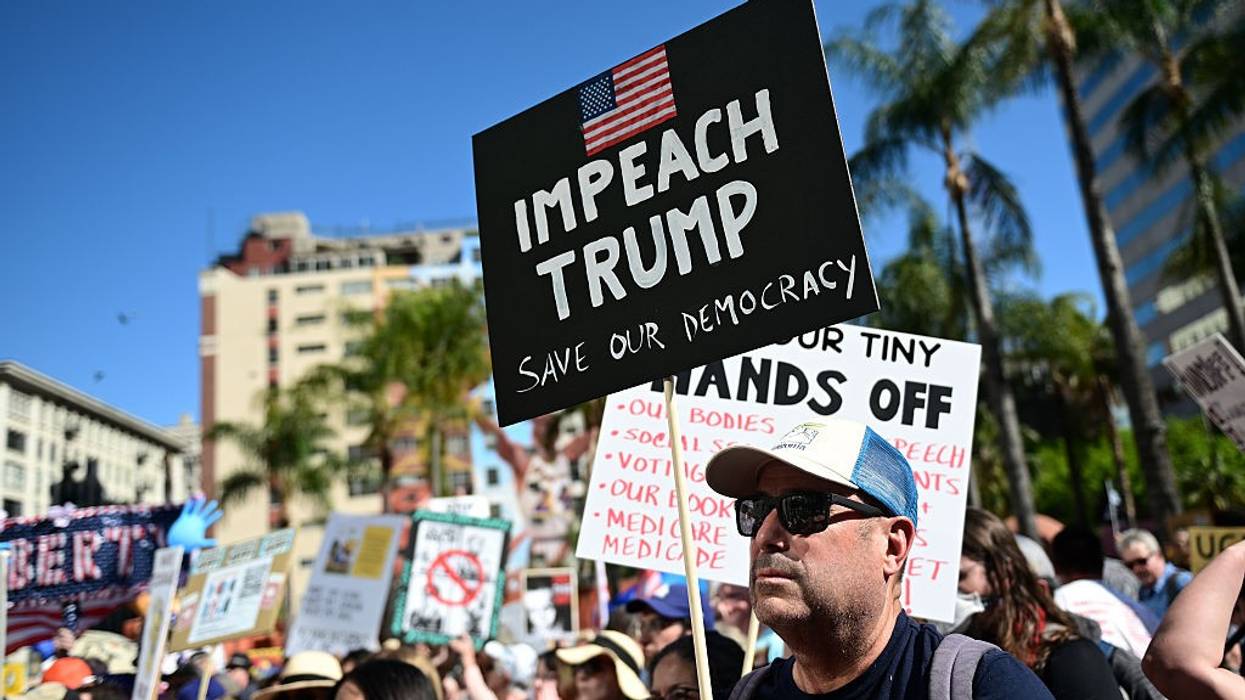
Millions of American across all 50 states on Saturday rallied against President Donald Trump and his authoritarian agenda during nationwide No Kings protests.
The flagship No Kings rally in Minneapolis, which organizers Indivisible estimated drew over 200,000 demonstrators, featured speeches from Minnesota Gov. Tim Walz and US Sen. Bernie Sanders (I-Vt.), Rep. Ilhan Omar (D-Minn.), and actress Jane Fonda, as well as a special performance from rock icon Bruce Springsteen, who performed "Streets of Minneapolis," a song he wrote in tribute of slain protesters Renee Good and Alex Pretti.
Organizers called it "the largest single-day nationwide demonstrations in US history," with an estimate 8 million people coming out for events in communities and cities nationwide.
From major cities to rural towns that have never seen mobilizations like this before, protesters made clear that in America, we don’t do kings," the No Kings coalition said in a statement.
"This is what it looks like when a movement grows—not just in size, but in reach, in courage, and in more people who see themselves as part of this movement," the organizers said. "The American people are fed up with this administration’s power grabs, an illegal war that Congress and the public haven’t approved, and the continued attempts to stifle our freedoms. We’re not waiting for change; we’re making it."
The rally in Minneapolis was one of more than 3,300 No Kings events across the US and internationally, and aerial video footage showed massive crowds gathered for demonstrations in cities including Washington, DC, New York City, Boston, Philadelphia, Chicago, and San Diego.
Congratulations to all Americans who dared to take to the streets today and publicly expressed their stance and disagreement with the actions and policies of their president. #WeSayNoKings 👍👍👍 pic.twitter.com/f3UDpmsj3m
— Dominik Hasek (@hasek_dominik) March 28, 2026
In San Francisco, thousands of anti-Trump activists gathered on a local beach to form a human sign that read, "Trump must go now! No ICE, no wars, no lies, no kings."
WOW! Protesters in San Francisco, CA formed a MASSIVE human sign on Ocean Beach reading “Trump Must Go Now!” for No Kings Day (Video: Ryan Curry / S.F. Chronicle) pic.twitter.com/ItF7c7gvke
— Marco Foster (@MarcoFoster_) March 28, 2026
However, No Kings rallies weren't just held in major US cities. In a series of social media posts, Indivisible co-founder Leah Greenberg collected photos and videos of No Kings events in communities including Arvada, Colorado, Madison, New Jersey, and St. Augustine, Florida, as well as international No Kings events held in London and Madrid.
Attendance estimates for Saturday's No Kings protests were not available as of this writing. Polling analyst G. Elliott Morris estimated that the previous No Kings event, held in October, drew at least 5 million people nationwide, making it likely “the largest single-day political protest ever.”
"No work, no school, no shopping. We're going to show up and say we're putting workers over billionaires and kings."
Ezra Levin, co-founder of Indivisible, said on Saturday that a nationwide general strike is being planned for May 1 that will be modeled on the day of action residents of Minnesota organized in January against the brutality carried out by federal immigration enforcement officials.
Appearing at the flagship No Kings rally in Minneapolis, Levin praised the strength shown by the Minnesota protesters in the face of the US Immigration and Customs Enforcement (ICE) siege of their city this year, and said his organization wanted to replicate it across the country.
"The next major national action of this movement is not just going to be another protest," Levin said. "It is a tactical escalation... It is an economic show of force, inspired by Minnesota's own day of truth and action."
Levin then outlined what the event would entail.
"On May 1, on May Day, we are saying, 'No business as usual,'" he said. "No work, no school, no shopping. We're going to show up and say we're putting workers over billionaires and kings."
Levin: This is the largest protest in Minnesota history… The next major national action of this movement is not just gonna be another protest. On May 1st, across the country, we are saying no business as usual. No work, no school, no shopping. We're gonna show up and say we're… pic.twitter.com/bRPR7K5DuP
— Acyn (@Acyn) March 28, 2026
Levin added that "we are going to build on that courage, that sacrifice" that Minnesota residents showed during their day of action in January, and vowed "to demonstrate that regular people are the greatest threat to fascism in this country."
In an interview with Payday Report published Saturday, Indivisible co-founder Leah Greenberg said that the goal of the nationwide strike action would be to send "a clear message: we demand a government that invests in our communities, not one that enriches billionaires, fuels endless war, or deploys masked agents to intimidate our neighbors.”
The No Kings protests against President Donald Trump's authoritarian government, which Indivisible has been central in organizing, have brought millions of Americans into the streets.
Polling analyst G. Elliott Morris estimated that the previous No Kings event, held in October, drew at least 5 million people nationwide, making it likely "the largest single-day political protest ever."
"You thought it was bad when Iran throttled the Strait of Hormuz?... The Houthis have already proven they can keep the Red Sea closed despite a year of US Navy skirmishing," said one journalist.
The Houthis on Saturday took credit for launching a ballistic missile at Israel, opening a new front in the war US President Donald Trump illegally started with Iran nearly one month ago.
As reported by Axios, the attack by the Houthis signals that the Yemen-based militia is joining the conflict to aide Iran, which has been under aerial assault from the US and Israel for the past four weeks.
Although the Houthi missile was intercepted by Israeli defenses, it is likely just the opening salvo in an expanding conflict throughout the Middle East.
Axios noted that while the Houthis entered the war by launching an attack on Israel, they could inflict the most damage on the US and its allies in the region by shutting down the strait of Bab al-Mandeb in the Red Sea.
"Doing that," Axios explained, "would dramatically increase the global economic crisis that has been created due to the war with Iran" and its closure of the Strait of Hormuz, which has sent global energy prices skyrocketing.
Sky News international correspondent John Sparks reported on Saturday that the Houthis' entrance into the war shows that "this crisis is expanding, it is escalating."
'This crisis is expanding and escalating.'
Houthi rebels in Yemen have confirmed they launched a missile at Israel, marking the Iran-backed group's first involvement in the war.
@sparkomat reports live from Jerusalem
https://t.co/Leuc4SnGfG
📺 Sky 501 and YouTube pic.twitter.com/TmlyFHkCZN
— Sky News (@SkyNews) March 28, 2026
Sparks argued that the Houthis' decision to fire a missile at Israel signals that "the geographical spread of this conflict is expanding," adding that "the Houthis have shown the ability to attack shipping in the Red Sea and the waters around the Arabian Peninsula."
Sparks said that even though Trump and Secretary of State Marco Rubio "have been projecting confidence" about having the war under control, "it's not playing out that way... on the ground."
Danny Citrinowicz, senior researcher at the Institute for National Security Studies, argued that the Houthis' main value to Iran isn't launching strikes on Israel, but their ability to increase economic pressure on the US.
Citrinowicz also outlined ways the Houthis could further drive up the global price of energy.
"This raises a key question: whether the Houthis will escalate further by targeting Saudi infrastructure and shipping lanes more directly, or whether they will preserve this capability as an additional lever of pressure as the conflict evolves," he wrote. "With each passing day of the conflict, particularly in light of its expanding scope against Iran, the likelihood of this scenario materializing continues to grow. It is increasingly not a question of if, but when."
Journalist Spencer Ackerman similarly pointed to the Houthis' ability to cause economic havoc as the biggest concern about their entrance into the conflict.
"You thought it was bad when Iran throttled the Strait of Hormuz?" he asked rhetorically. "The Houthis have already proven they can keep the Red Sea closed despite a year of US Navy skirmishing."