SUBSCRIBE TO OUR FREE NEWSLETTER
Daily news & progressive opinion—funded by the people, not the corporations—delivered straight to your inbox.
5
#000000
#FFFFFF
To donate by check, phone, or other method, see our More Ways to Give page.
Daily news & progressive opinion—funded by the people, not the corporations—delivered straight to your inbox.
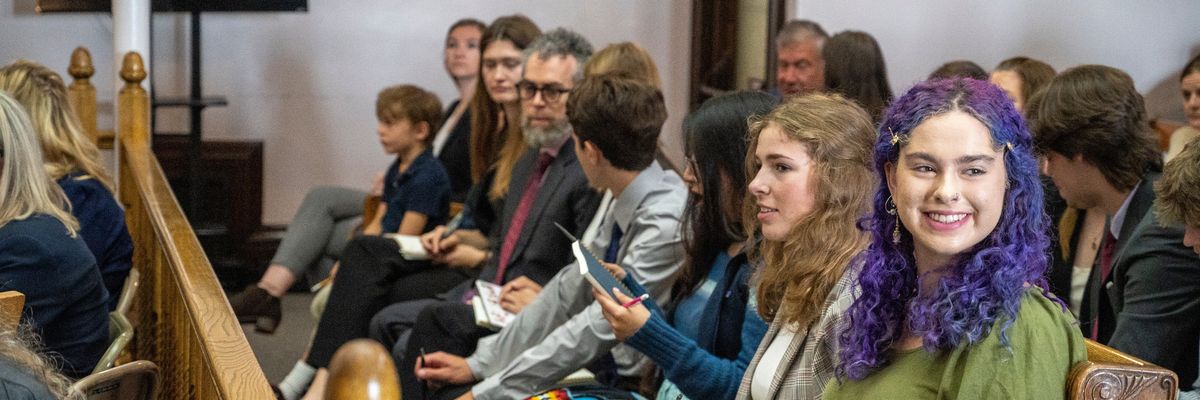
Plaintiffs await the start of the nation's first youth climate change trial at Montana's First Judicial District Court on June 12, 2023 in Helena.
The court, said one attorney, "has affirmed the constitutional rights of youth to a safe and livable climate, confirming that the future of our children cannot be sacrificed for fossil fuel interests."
Youth plaintiffs celebrated on Wednesday after the Montana Supreme Courtupheld a judge's August 2023 decision that the state government's promotion of climate-wrecking fossil fuels violates the young residents' state constitutional rights.
"This ruling is a victory not just for us, but for every young person whose future is threatened by climate change," said Rikki Held, the named plaintiff for Held v. State of Montana, in a statement. "We have been heard, and today the Montana Supreme Court has affirmed that our rights to a safe and healthy climate cannot be ignored."
Highlighting that "this will forever be in the court record, despite any continued rhetoric of denial coming from people in power in the state," Grace, another plaintiff, said, "I am thrilled that the Montana Supreme Court has sided with Montana citizens to protect the people and the places we love."
Another plaintiff, Olivia, welcomed the ruling as "a monumental win" and "a call to action for all Montanans."
Plaintiff Georgi similarly asserted that "this is a time for Montana to embrace the future—clean energy offers economic benefits and new jobs," and added that "we look forward to working with the state to implement this transition and ensure that Montana leads the way in tackling the climate crisis."
Plaintiff Kian pointed to other ongoing cases across the globe, declaring that "this ruling is not just a win for Montana—it's a signal to the world that youth-led climate action is powerful and effective."
"We hope this decision inspires others across the country and beyond to stand up for their rights to a livable climate," Kian continued. Just as the youth plaintiffs in Navahine v. Hawaii Department of Transportation secured historic climate justice through a settlement this past June, the eyes of the world are now on us, seeing how youth-driven legal action can create real change."
In Montana, the state government appealed District Court Judge Kathy Seeley's historic ruling in favor of the 16 young plaintiffs to the state's highest court, which heard arguments in July. Wednesday's 6-1 decision—only Justice Jim Rice dissented—is the first of its kind for a state supreme court.
The majority's 70-page opinion discusses the drafters of the Montana Constitution, which says in part that "the state and each person shall maintain and improve a clean and healthful environment in Montana for present and future generations," and "the Legislature shall provide for the administration and enforcement of this duty."
Chief Justice Mike McGrath wrote that the court's majority rejects "the argument that the delegates—intending the strongest, all-encompassing environmental protections in the nation, both anticipatory and preventative, for present and future generations—would grant the state a free pass to pollute the Montana environment just because the rest of the world insisted on doing so."
"The district court's conclusion of law is affirmed: Montana's right to a clean and healthful environment and environmental life support system includes a stable climate system, which is clearly within the object and true principles of the framers' inclusion of the right to a clean and healthful environment," the chief justice added.
Attorneys for the plaintiffs joined the young Montanans in applauding the opinion. Nate Bellinger of Our Children's Trust said that "this is a monumental moment for Montana, our youth, and the future of our planet."
"Today, the Montana Supreme Court has affirmed the constitutional rights of youth to a safe and livable climate, confirming that the future of our children cannot be sacrificed for fossil fuel interests," he added. "This is a victory for young people and for generations to come. The court said loud and clear: Montana's Constitution does not grant the state a free pass to ignore climate change because others fail to act—this landmark decision underscores the state's affirmative duty to lead by example."
Melissa Hornbein, senior attorney with the Western Environmental Law Center, noted that "the Montana Supreme Court's decision compels the state to carefully assess the greenhouse gas emissions and climate impacts of all future fossil fuel permits."
"Specifically, Montana's regulatory agencies must now evaluate the potential harm to the environment and the health and safety of the state's children from any new fossil fuel projects, and determine whether the project can be justified in light of the ongoing unconstitutional degradation of Montana's environment, natural resources, and climate," she explained. "This ruling clarifies that the constitution sets a clear directive for Montana to reduce its greenhouse gas emissions, which are among the highest in the nation on a per capita basis, and to transition to a clean, renewable energy future."
Whether the state government will comply with the decision remains to be seen. In a statement to The Hill, a spokesperson for Republican Montana Attorney General Austin Knudsen's office called the ruling "disappointing, but not surprising" and claimed that the court majority "yet again ruled in favor of their ideologically aligned allies and ignored the fact that Montana has no power to impact the climate."
Separately, Knudsen on Tuesday filed his 59th lawsuit against the Biden administration, challenging its plan to halt federal coal production in the Powder River Basin, which the attorney general said would "effectively kill Montana's coal industry."
This country and this world are at a monumental crossroads. US voters have an opportunity to beat back the forces of fascism and confront the billionaires who are rigging the economy, our media system, and our democracy, making it increasingly impossible for ordinary people to get by. We’re not just talking about the election. We’re talking about what must be done once these fascist elements are vanquished from power. We need a bolder set of solutions than what either major party has so far been willing to offer and a working-class movement ready to fight like hell for it. Trump didn't emerge from nowhere. The conditions that fueled MAGA authoritarianism were created by decades of radical neoliberal economic policies and a corrupt political system dominated by corporate interests. They slashed taxes on the super-rich, promising that the benefits would trickle down. They said giveaways to the corporate titans would make life more affordable for the rest of us. It was all bullshit. And when a bitter, betrayed populace searches for someone to blame, right-wing demagogues have little trouble finding scapegoats. People know when they're being lied to, but you won't hear any of this from the corporate media. Only independent journalism—powered and funded by people who believe in building a better world—can deliver truly trustworthy daily news. If you share our vision, please contribute whatever you can to sustain our work. |
Youth plaintiffs celebrated on Wednesday after the Montana Supreme Courtupheld a judge's August 2023 decision that the state government's promotion of climate-wrecking fossil fuels violates the young residents' state constitutional rights.
"This ruling is a victory not just for us, but for every young person whose future is threatened by climate change," said Rikki Held, the named plaintiff for Held v. State of Montana, in a statement. "We have been heard, and today the Montana Supreme Court has affirmed that our rights to a safe and healthy climate cannot be ignored."
Highlighting that "this will forever be in the court record, despite any continued rhetoric of denial coming from people in power in the state," Grace, another plaintiff, said, "I am thrilled that the Montana Supreme Court has sided with Montana citizens to protect the people and the places we love."
Another plaintiff, Olivia, welcomed the ruling as "a monumental win" and "a call to action for all Montanans."
Plaintiff Georgi similarly asserted that "this is a time for Montana to embrace the future—clean energy offers economic benefits and new jobs," and added that "we look forward to working with the state to implement this transition and ensure that Montana leads the way in tackling the climate crisis."
Plaintiff Kian pointed to other ongoing cases across the globe, declaring that "this ruling is not just a win for Montana—it's a signal to the world that youth-led climate action is powerful and effective."
"We hope this decision inspires others across the country and beyond to stand up for their rights to a livable climate," Kian continued. Just as the youth plaintiffs in Navahine v. Hawaii Department of Transportation secured historic climate justice through a settlement this past June, the eyes of the world are now on us, seeing how youth-driven legal action can create real change."
In Montana, the state government appealed District Court Judge Kathy Seeley's historic ruling in favor of the 16 young plaintiffs to the state's highest court, which heard arguments in July. Wednesday's 6-1 decision—only Justice Jim Rice dissented—is the first of its kind for a state supreme court.
The majority's 70-page opinion discusses the drafters of the Montana Constitution, which says in part that "the state and each person shall maintain and improve a clean and healthful environment in Montana for present and future generations," and "the Legislature shall provide for the administration and enforcement of this duty."
Chief Justice Mike McGrath wrote that the court's majority rejects "the argument that the delegates—intending the strongest, all-encompassing environmental protections in the nation, both anticipatory and preventative, for present and future generations—would grant the state a free pass to pollute the Montana environment just because the rest of the world insisted on doing so."
"The district court's conclusion of law is affirmed: Montana's right to a clean and healthful environment and environmental life support system includes a stable climate system, which is clearly within the object and true principles of the framers' inclusion of the right to a clean and healthful environment," the chief justice added.
Attorneys for the plaintiffs joined the young Montanans in applauding the opinion. Nate Bellinger of Our Children's Trust said that "this is a monumental moment for Montana, our youth, and the future of our planet."
"Today, the Montana Supreme Court has affirmed the constitutional rights of youth to a safe and livable climate, confirming that the future of our children cannot be sacrificed for fossil fuel interests," he added. "This is a victory for young people and for generations to come. The court said loud and clear: Montana's Constitution does not grant the state a free pass to ignore climate change because others fail to act—this landmark decision underscores the state's affirmative duty to lead by example."
Melissa Hornbein, senior attorney with the Western Environmental Law Center, noted that "the Montana Supreme Court's decision compels the state to carefully assess the greenhouse gas emissions and climate impacts of all future fossil fuel permits."
"Specifically, Montana's regulatory agencies must now evaluate the potential harm to the environment and the health and safety of the state's children from any new fossil fuel projects, and determine whether the project can be justified in light of the ongoing unconstitutional degradation of Montana's environment, natural resources, and climate," she explained. "This ruling clarifies that the constitution sets a clear directive for Montana to reduce its greenhouse gas emissions, which are among the highest in the nation on a per capita basis, and to transition to a clean, renewable energy future."
Whether the state government will comply with the decision remains to be seen. In a statement to The Hill, a spokesperson for Republican Montana Attorney General Austin Knudsen's office called the ruling "disappointing, but not surprising" and claimed that the court majority "yet again ruled in favor of their ideologically aligned allies and ignored the fact that Montana has no power to impact the climate."
Separately, Knudsen on Tuesday filed his 59th lawsuit against the Biden administration, challenging its plan to halt federal coal production in the Powder River Basin, which the attorney general said would "effectively kill Montana's coal industry."