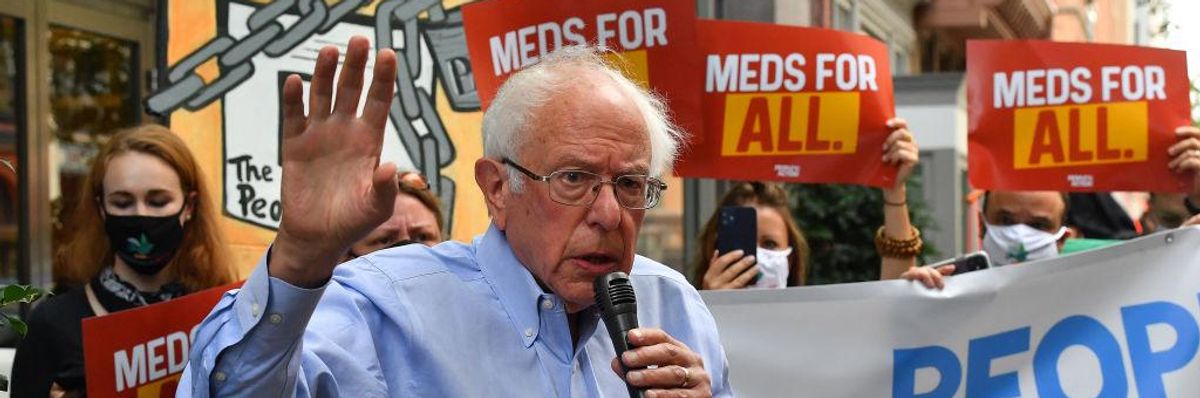
Sen. Bernie Sanders (I-Vt.) speaks during a People's Action rally against Big Pharma greed on September 21, 2021 in Washington, D.C
'We Need Medicare for All': Record Number in US Postponed Healthcare in 2022
"After health insurance companies raised prices 24% last year and made nearly $12 billion in profits last quarter, 38% of Americans now report they or a family member put off needed medical care because it was too expensive," said Sen. Bernie Sanders. "We must end this corporate greed."
Nearly 40% of people in the United States said they or a family member delayed medical care last year due to the prohibitively high cost of treatment under the nation's for-profit healthcare model, according to a Gallup survey published Tuesday.
As U.S. residents faced soaring prices for private insurance, the percentage of them forgoing medical services as a result of the costs climbed 12 points in one year, from 26% in 2021 to 38% in 2022. Of those who reported postponing treatment last year, 27% said they or a family member did so "for a very or somewhat serious condition," up nine points from the previous year.
"After health insurance companies raised prices 24% last year and made nearly $12 billion in profits last quarter, 38% of Americans now report they or a family member put off needed medical care because it was too expensive," Sen. Bernie Sanders (I-Vt.) tweeted in response to the new findings. "We must end this corporate greed. We need Medicare for All."
Gallup has been collecting self-reported data on this issue since 2001. The firm's latest annual healthcare poll, conducted from November 9 to December 2, found the highest level of cost-related delays in seeking medical care on record, topping the previous high of 33% (2019 and 2014) by five points and marking the sharpest annual increase to date. The proportion of people who said they or a family member postponed treatment for a serious condition in 2022 (27%) also surpassed the previous all-time high of 25% (2019).
Lower-income households, young adults, and women in the U.S. are especially likely to have postponed medical care due to high costs.
According to Gallup:
In 2022, Americans with an annual household income under $40,000 were nearly twice as likely as those with an income of $100,000 or more to say someone in their family delayed medical care for a serious condition (34% vs. 18%, respectively). Those with an income between $40,000 and less than $100,000 were similar to those in the lowest income group when it comes to postponing care, with 29% doing so.
Reports of putting off care for a serious condition are up 12 points among lower-income U.S. adults, up 11 points among those in the middle-income group, and up seven points among those with a higher income. The latest readings for the middle- and upper-income groups are the highest on record or tied with the highest.
Another recent survey found that just 12% of Americans think healthcare in the U.S. is handled "extremely" or "very" well. Such data provides further evidence of the unpopularity of a profit-maximizing system that has left 43 million people inadequately insured, kicked millions off of their employer-based plans when the coronavirus caused a spike in unemployment, and contributed to the country's startling decline in life expectancy.
Last week, prior to the publication of Gallup's poll, Rep. Ro Khanna (D-Calif.) wrote on social media: "If you don’t believe corporate greed has deadly consequences, take a look at the decline in American life expectancy. We need Medicare for All, and we must raise the minimum wage."
While the current, profit-driven U.S. healthcare system—which forces millions to skip treatments to avoid financial ruin and allows the pharmaceutical and insurance industries to rake in massive profits—is deeply inefficient and unpopular, polling has consistently shown that voters want the federal government to play a more active role in healthcare provision, with a majority expressing support for a publicly run insurance plan.
Recent research shows that a single-payer system of the kind proposed in Medicare for All legislation introduced by Sanders and Rep. Pramila Jayapal (D-Wash.) could have prevented hundreds of thousands of Covid-19 deaths in the U.S. over the past two and a half years.
Not only would a single-payer insurance program guarantee coverage for every person in the country, but it would also reduce overall healthcare spending nationwide by an estimated $650 billion per year.
"Millions of Americans across this country are avoiding seeking lifesaving medical care because they're afraid it will bankrupt them," Khanna, a universal healthcare advocate, tweeted last week. "In many cases, their fears are well-founded. We need Medicare for All."
We are at a crossroads
This country and this world are at a monumental crossroads. In a few short weeks, US voters will have an opportunity to beat back the forces of fascism and confront the billionaires who are rigging the economy, our media system, and our democracy, making it increasingly impossible for ordinary people to get by. We’re not just talking about the election. We’re talking about what must be done once these fascist elements are vanquished from power. We need a bolder set of solutions than what either major party has so far been willing to offer and a working-class movement ready to fight like hell for it. Trump didn't emerge from nowhere. The conditions that fueled MAGA authoritarianism were created by decades of radical neoliberal economic policies and a corrupt political system dominated by corporate interests. They slashed taxes on the super-rich, promising that the benefits would trickle down. They said giveaways to the corporate titans would make life more affordable for the rest of us. It was all bullshit. And when a bitter, betrayed populace searches for someone to blame, right-wing demagogues have little trouble finding scapegoats. People know when they're being lied to, but you won't hear any of this from the corporate media. Only independent journalism—powered and funded by people who believe in building a better world—can deliver truly trustworthy daily news. Our Fall Campaign is underway, and we need your help. To power our newsroom through the rest of the year, we need to raise $125,000 by midnight on October 31. So if you share our vision, please contribute whatever you can to sustain our work. |
Nearly 40% of people in the United States said they or a family member delayed medical care last year due to the prohibitively high cost of treatment under the nation's for-profit healthcare model, according to a Gallup survey published Tuesday.
As U.S. residents faced soaring prices for private insurance, the percentage of them forgoing medical services as a result of the costs climbed 12 points in one year, from 26% in 2021 to 38% in 2022. Of those who reported postponing treatment last year, 27% said they or a family member did so "for a very or somewhat serious condition," up nine points from the previous year.
"After health insurance companies raised prices 24% last year and made nearly $12 billion in profits last quarter, 38% of Americans now report they or a family member put off needed medical care because it was too expensive," Sen. Bernie Sanders (I-Vt.) tweeted in response to the new findings. "We must end this corporate greed. We need Medicare for All."
Gallup has been collecting self-reported data on this issue since 2001. The firm's latest annual healthcare poll, conducted from November 9 to December 2, found the highest level of cost-related delays in seeking medical care on record, topping the previous high of 33% (2019 and 2014) by five points and marking the sharpest annual increase to date. The proportion of people who said they or a family member postponed treatment for a serious condition in 2022 (27%) also surpassed the previous all-time high of 25% (2019).
Lower-income households, young adults, and women in the U.S. are especially likely to have postponed medical care due to high costs.
According to Gallup:
In 2022, Americans with an annual household income under $40,000 were nearly twice as likely as those with an income of $100,000 or more to say someone in their family delayed medical care for a serious condition (34% vs. 18%, respectively). Those with an income between $40,000 and less than $100,000 were similar to those in the lowest income group when it comes to postponing care, with 29% doing so.
Reports of putting off care for a serious condition are up 12 points among lower-income U.S. adults, up 11 points among those in the middle-income group, and up seven points among those with a higher income. The latest readings for the middle- and upper-income groups are the highest on record or tied with the highest.
Another recent survey found that just 12% of Americans think healthcare in the U.S. is handled "extremely" or "very" well. Such data provides further evidence of the unpopularity of a profit-maximizing system that has left 43 million people inadequately insured, kicked millions off of their employer-based plans when the coronavirus caused a spike in unemployment, and contributed to the country's startling decline in life expectancy.
Last week, prior to the publication of Gallup's poll, Rep. Ro Khanna (D-Calif.) wrote on social media: "If you don’t believe corporate greed has deadly consequences, take a look at the decline in American life expectancy. We need Medicare for All, and we must raise the minimum wage."
While the current, profit-driven U.S. healthcare system—which forces millions to skip treatments to avoid financial ruin and allows the pharmaceutical and insurance industries to rake in massive profits—is deeply inefficient and unpopular, polling has consistently shown that voters want the federal government to play a more active role in healthcare provision, with a majority expressing support for a publicly run insurance plan.
Recent research shows that a single-payer system of the kind proposed in Medicare for All legislation introduced by Sanders and Rep. Pramila Jayapal (D-Wash.) could have prevented hundreds of thousands of Covid-19 deaths in the U.S. over the past two and a half years.
Not only would a single-payer insurance program guarantee coverage for every person in the country, but it would also reduce overall healthcare spending nationwide by an estimated $650 billion per year.
"Millions of Americans across this country are avoiding seeking lifesaving medical care because they're afraid it will bankrupt them," Khanna, a universal healthcare advocate, tweeted last week. "In many cases, their fears are well-founded. We need Medicare for All."
- 98 Million in US Skipped Treatment or Cut Back on Essentials to Pay for Healthcare This Year ›
- Opinion | Regardless of For-Profit Coverage, Americans Still Want—and Need—Medicare for All | Common Dreams ›
- Sanders, Jayapal Plan Town Hall on Healthcare as Human Right to Promote Medicare for All Bill ›
- Medicare for All Reintroduced to Save $650 Billion and 68,000 Lives Per Year ›
- Opinion | The US Is Quite Literally in a Neoliberal Death Spiral. We Need Medicare for All | Common Dreams ›
- Sanders Report Exposes How Nonprofit Hospitals Exploit Tax Breaks, Fail Poor Patients ›
- Opinion | Don't Bust Up Medicare and Turn It Over to the States! | Common Dreams ›
- Opinion | Corporate Greed Threatens the Health of Our Minds, Our Bodies, and Our Republic | Common Dreams ›