SUBSCRIBE TO OUR FREE NEWSLETTER
Daily news & progressive opinion—funded by the people, not the corporations—delivered straight to your inbox.
5
#000000
#FFFFFF
To donate by check, phone, or other method, see our More Ways to Give page.
Daily news & progressive opinion—funded by the people, not the corporations—delivered straight to your inbox.
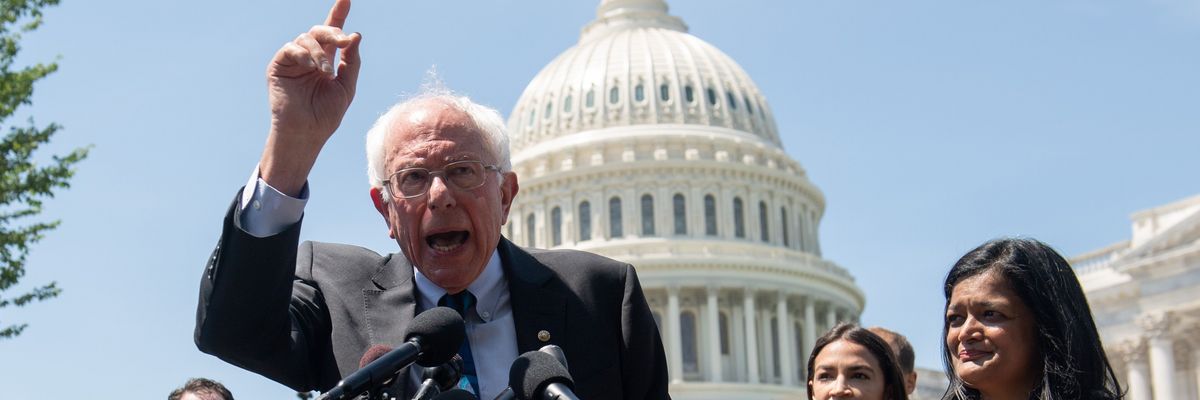
U.S. Sen. Bernie Sanders (I-Vt.) holds a press conference with Reps. Pramila Jayapal (D-Wash.) [far right], Alexandria Ocasio-Cortez (D-N.Y.) [second from right], and others in Washington, D.C. on June 24, 2019.
"There are millions of people who would like to go to a doctor but cannot afford to do so," said Sanders. "This is an outrage. In America, your health and your longevity should not be dependent on your wealth."
As Sen. Bernie Sanders and Rep. Pramila Jayapal prepare to reintroduce legislation to establish a national health program expanding Medicare to all Americans, the two lawmakers announced on Friday their plans to hold a town hall at the U.S. Capitol on May 16 regarding the need for Medicare for All.
As many health policy experts have since the coronavirus pandemic began in 2020, Sanders on Friday pointed to the public health crisis as an event that made the need for universal healthcare clearer "than it has ever been before."
"The American people understand, as I do, that healthcare is a human right, not a privilege," said the Vermont Independent senator, who chairs the Senate Health, Education, Labor, and Pensions Committee. "It is not acceptable to me, nor to the American people, that over 85 million people today are either uninsured or underinsured. As we speak, there are millions of people who would like to go to a doctor but cannot afford to do so. This is an outrage. In America, your health and your longevity should not be dependent on your wealth."
The deaths of at least one-third of the 1.1 million people in the U.S. who died of Covid-19 were linked to a lack of health insurance, said the senator, who has advocated for Medicare for All for decades—and has been dismissed by corporate Democrats and Republicans who have claimed the proposal is unpopular, too expensive, and "unrealistic," despite the fact that other wealthy countries have government-run health programs, lower health costs, and better health outcomes than the United States.
A poll by Morning Consult in 2021 showed that 55% of Americans support a Medicare for All program, and in January Gallup released a survey showing that 57% of respondents believe the federal government should ensure everyone has healthcare.
"We live in a country where millions of people ration lifesaving medication or skip necessary trips to the doctor because of cost," said Jayapal (D-Wash.). "Sadly, the number of people struggling to afford care continues to skyrocket as 15 million people lose their current health insurance as pandemic-era programs end. Breaking a bone or getting sick shouldn't be a reason that people in the richest country in the world go broke."
"There is a solution to this health crisis—a popular one that guarantees healthcare to every person as a human right and finally puts people over profits and care over corporations," she added. "That solution is Medicare for All—everyone in, nobody out. I'm so proud to fight for this legislation to finally ensure that all people can get the care they need and the care they deserve."
The lawmakers are introducing the legislation as 44% of adults in the U.S. struggle to pay for their medical care and 68,000 people die each year due to the cost of healthcare.
Amid those devastating health outcomes, Sanders said on Twitter Friday, private health insurers have spent $141 billion on stock buybacks since 2007 while healthcare costs for the average household have skyrocketed.
"It is long past time to end the international embarrassment of the United States being the only major country on Earth that does not guarantee healthcare to all of its citizens," said Sanders.
On Tuesday the lawmakers will be joined by doctors, nurses, and patients who will speak about how their lives and work have been affected by the healthcare crisis.
The event will be livestreamed on Sanders' social media pages.
Dear Common Dreams reader, It’s been nearly 30 years since I co-founded Common Dreams with my late wife, Lina Newhouser. We had the radical notion that journalism should serve the public good, not corporate profits. It was clear to us from the outset what it would take to build such a project. No paid advertisements. No corporate sponsors. No millionaire publisher telling us what to think or do. Many people said we wouldn't last a year, but we proved those doubters wrong. Together with a tremendous team of journalists and dedicated staff, we built an independent media outlet free from the constraints of profits and corporate control. Our mission has always been simple: To inform. To inspire. To ignite change for the common good. Building Common Dreams was not easy. Our survival was never guaranteed. When you take on the most powerful forces—Wall Street greed, fossil fuel industry destruction, Big Tech lobbyists, and uber-rich oligarchs who have spent billions upon billions rigging the economy and democracy in their favor—the only bulwark you have is supporters who believe in your work. But here’s the urgent message from me today. It's never been this bad out there. And it's never been this hard to keep us going. At the very moment Common Dreams is most needed, the threats we face are intensifying. We need your support now more than ever. We don't accept corporate advertising and never will. We don't have a paywall because we don't think people should be blocked from critical news based on their ability to pay. Everything we do is funded by the donations of readers like you. When everyone does the little they can afford, we are strong. But if that support retreats or dries up, so do we. Will you donate now to make sure Common Dreams not only survives but thrives? —Craig Brown, Co-founder |
As Sen. Bernie Sanders and Rep. Pramila Jayapal prepare to reintroduce legislation to establish a national health program expanding Medicare to all Americans, the two lawmakers announced on Friday their plans to hold a town hall at the U.S. Capitol on May 16 regarding the need for Medicare for All.
As many health policy experts have since the coronavirus pandemic began in 2020, Sanders on Friday pointed to the public health crisis as an event that made the need for universal healthcare clearer "than it has ever been before."
"The American people understand, as I do, that healthcare is a human right, not a privilege," said the Vermont Independent senator, who chairs the Senate Health, Education, Labor, and Pensions Committee. "It is not acceptable to me, nor to the American people, that over 85 million people today are either uninsured or underinsured. As we speak, there are millions of people who would like to go to a doctor but cannot afford to do so. This is an outrage. In America, your health and your longevity should not be dependent on your wealth."
The deaths of at least one-third of the 1.1 million people in the U.S. who died of Covid-19 were linked to a lack of health insurance, said the senator, who has advocated for Medicare for All for decades—and has been dismissed by corporate Democrats and Republicans who have claimed the proposal is unpopular, too expensive, and "unrealistic," despite the fact that other wealthy countries have government-run health programs, lower health costs, and better health outcomes than the United States.
A poll by Morning Consult in 2021 showed that 55% of Americans support a Medicare for All program, and in January Gallup released a survey showing that 57% of respondents believe the federal government should ensure everyone has healthcare.
"We live in a country where millions of people ration lifesaving medication or skip necessary trips to the doctor because of cost," said Jayapal (D-Wash.). "Sadly, the number of people struggling to afford care continues to skyrocket as 15 million people lose their current health insurance as pandemic-era programs end. Breaking a bone or getting sick shouldn't be a reason that people in the richest country in the world go broke."
"There is a solution to this health crisis—a popular one that guarantees healthcare to every person as a human right and finally puts people over profits and care over corporations," she added. "That solution is Medicare for All—everyone in, nobody out. I'm so proud to fight for this legislation to finally ensure that all people can get the care they need and the care they deserve."
The lawmakers are introducing the legislation as 44% of adults in the U.S. struggle to pay for their medical care and 68,000 people die each year due to the cost of healthcare.
Amid those devastating health outcomes, Sanders said on Twitter Friday, private health insurers have spent $141 billion on stock buybacks since 2007 while healthcare costs for the average household have skyrocketed.
"It is long past time to end the international embarrassment of the United States being the only major country on Earth that does not guarantee healthcare to all of its citizens," said Sanders.
On Tuesday the lawmakers will be joined by doctors, nurses, and patients who will speak about how their lives and work have been affected by the healthcare crisis.
The event will be livestreamed on Sanders' social media pages.
As Sen. Bernie Sanders and Rep. Pramila Jayapal prepare to reintroduce legislation to establish a national health program expanding Medicare to all Americans, the two lawmakers announced on Friday their plans to hold a town hall at the U.S. Capitol on May 16 regarding the need for Medicare for All.
As many health policy experts have since the coronavirus pandemic began in 2020, Sanders on Friday pointed to the public health crisis as an event that made the need for universal healthcare clearer "than it has ever been before."
"The American people understand, as I do, that healthcare is a human right, not a privilege," said the Vermont Independent senator, who chairs the Senate Health, Education, Labor, and Pensions Committee. "It is not acceptable to me, nor to the American people, that over 85 million people today are either uninsured or underinsured. As we speak, there are millions of people who would like to go to a doctor but cannot afford to do so. This is an outrage. In America, your health and your longevity should not be dependent on your wealth."
The deaths of at least one-third of the 1.1 million people in the U.S. who died of Covid-19 were linked to a lack of health insurance, said the senator, who has advocated for Medicare for All for decades—and has been dismissed by corporate Democrats and Republicans who have claimed the proposal is unpopular, too expensive, and "unrealistic," despite the fact that other wealthy countries have government-run health programs, lower health costs, and better health outcomes than the United States.
A poll by Morning Consult in 2021 showed that 55% of Americans support a Medicare for All program, and in January Gallup released a survey showing that 57% of respondents believe the federal government should ensure everyone has healthcare.
"We live in a country where millions of people ration lifesaving medication or skip necessary trips to the doctor because of cost," said Jayapal (D-Wash.). "Sadly, the number of people struggling to afford care continues to skyrocket as 15 million people lose their current health insurance as pandemic-era programs end. Breaking a bone or getting sick shouldn't be a reason that people in the richest country in the world go broke."
"There is a solution to this health crisis—a popular one that guarantees healthcare to every person as a human right and finally puts people over profits and care over corporations," she added. "That solution is Medicare for All—everyone in, nobody out. I'm so proud to fight for this legislation to finally ensure that all people can get the care they need and the care they deserve."
The lawmakers are introducing the legislation as 44% of adults in the U.S. struggle to pay for their medical care and 68,000 people die each year due to the cost of healthcare.
Amid those devastating health outcomes, Sanders said on Twitter Friday, private health insurers have spent $141 billion on stock buybacks since 2007 while healthcare costs for the average household have skyrocketed.
"It is long past time to end the international embarrassment of the United States being the only major country on Earth that does not guarantee healthcare to all of its citizens," said Sanders.
On Tuesday the lawmakers will be joined by doctors, nurses, and patients who will speak about how their lives and work have been affected by the healthcare crisis.
The event will be livestreamed on Sanders' social media pages.