SUBSCRIBE TO OUR FREE NEWSLETTER
Daily news & progressive opinion—funded by the people, not the corporations—delivered straight to your inbox.
5
#000000
#FFFFFF
To donate by check, phone, or other method, see our More Ways to Give page.
Daily news & progressive opinion—funded by the people, not the corporations—delivered straight to your inbox.
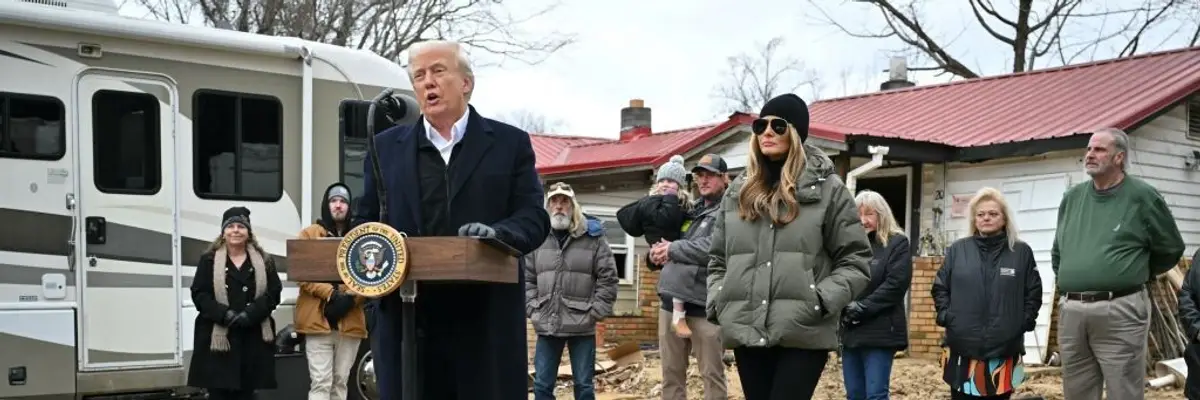
U.S. President Donald Trump speaks while visiting a neighborhood affected by Hurricane Helene in Swannanoa, North Carolina, on January 24, 2025.
"If we abolish federal funding for disaster assistance, municipalities and states wouldn't be able to cover these types of catastrophic emergencies and people would be left to fend on their own," one expert warned.
With trips to North Carolina and California on Friday, Republican U.S. President Donald Trump renewed his threat to the federal disaster assistance agency, drawing swift rebukes from climate campaigners, experts, and members of Congress.
Trump was sworn in on Monday and took aim at the Federal Emergency Management Agency (FEMA) during a Wednesday interview with Fox News' Sean Hannity. He echoed those comments on Friday after landing at Asheville Regional Airport in North Carolina, to visit a region devastated by Hurricane Helene in September.
During his first trip since Inauguration Day, Trump declared that he will "be signing an executive order to begin the process of fundamentally reforming and overhauling FEMA or maybe getting rid of FEMA."
"I think, frankly, FEMA's not good," he said. "I think when you have a problem like this, I think you want to go, and whether it's a Democrat or Republican governor, you want to use your state to fix it and not waste time calling FEMA."
"FEMA's turned out to be a disaster," the president added. "I think we're gonna recommend that FEMA go away and we pay directly, we pay a percentage to the state, but the state should fix this."
While attempting to kill FEMA could be legally complicated due to a federal law passed after Hurricane Katrina, Trump's comments sparked concern and criticism. According to CNN:
Officials with FEMA scrambled to understand his comments in North Carolina Friday, with personnel nationwide calling and texting one another, trying to figure out what his statements meant for the agency's future and work on the ground, according to a source familiar.
Trump's desire to eliminate or curtail FEMA could have chilling effects on emergency response even at state levels, former FEMA Chief Deanne Criswell told CNN.
"We need to take him at his word, and I think state emergency management directors should be concerned about what this means for spring tornado season" and the coming hurricane season, said Criswell, who served under former President Joe Biden. "Do they have the resources to protect their residents?"
Responding to Trump's remarks on social media, the think tank Carolina Forward said that "if you were upset at how FEMA responds to natural disasters, just wait until they don't exist at all. (Trump obviously won't do this—he can't, after all—but he'll very likely make a lot of noise about it and then not actually do anything, as usual)."
Congresswoman Deborah Ross (D-N.C.) also weighed in on X, saying that "FEMA has been a crucial partner in our fight to recover from Hurricane Helene. I appreciate President Trump's concern about Western N.C., but eliminating FEMA would be a disaster for our state."
Matt Sedlar, climate analyst at the Center for Economic and Policy Research (CEPR), noted in a Friday statement that "before he took office, some wondered whether Trump would actually deny federal disaster aid to states he considered politically unfriendly. The unpleasant truth is that in theory he could—and right now he appears willing to test that idea in reality."
"Trump is already setting the stage for a significant reduction in federal disaster aid and mitigation funding," warned Sedlar, who also published an article on CEPR's website that highlights how Trump's attacks on the agency relate to the Heritage Foundation-led Project 2025. "He has made repeated demands that would tie California's aid to specific policy changes he would like to see, and has even begun discussing the possibility of overhauling FEMA—if not eliminating it entirely."
"States cannot absorb the costs of these disasters, and they don't have the money to prevent them either," he stressed. "The federal government agencies that aim to make the U.S. climate resilient are already chronically underfunded as it is. If Trump truly wanted to make America great again, he would prioritize funding for aid and mitigation. Instead, he is making incoherent political demands and setting Americans up for four years of uncertainty and suffering."
Shana Udvardy, senior climate resilience policy analyst at the Union of Concerned Scientists, released a similar statement on Friday.
"The president is suggesting eliminating FEMA. My question is: Should we also ban hospitals? Both are a means to recovery," Udvardy said. "This latest comment stretches the boundaries of reality. If we abolish federal funding for disaster assistance, municipalities and states wouldn't be able to cover these types of catastrophic emergencies and people would be left to fend on their own."
After visiting North Carolina on Friday, Trump took off for the Los Angeles area, which has been ravaged by recent wildfires. As of press time, the Hughes Fire was only 56% contained, according to the California Department of Forestry and Fire Protection.
Sharing a video of Trump's Friday remarks on social media, Congresswoman Sydney Kamlager-Dove (D-Calif.) said that "as someone who's actually been on the ground in LA, people are grateful for FEMA and want more help—not less."
Margie Alt, director of the Climate Action Campaign, said in a Friday statement that "the people of Los Angeles are suffering. They need and deserve help. Wildfires fueled by high winds and climate change-fueled drought have destroyed 12,000 homes and killed 27 people in the area so far."
"Rather than playing the traditional presidential role of 'comforter in chief,' Donald Trump's visit to the area is performative, using the tragedy to advance his personal agenda: changing state water management policy to help his Los Angeles private golf club," Alt suggested. "Trump's threat to withhold disaster aid to benefit his golf club seems, unfortunately, to be par for the course when it comes to his presidency. But the people of Los Angeles deserve better, and quickly."
"Wildfires like these will only get worse and more frequent if we don't address the climate crisis that is intensifying these disasters and other extreme weather including flooding, extreme heat, drought, and more that we are experiencing across the U.S. and the world," she added. "It is unconscionable to threaten to withdraw federal support to Americans suffering the effects of this crisis because of where they live or whom they may have voted for. The climate crisis won't spare anyone."
Alt argued that "the only acceptable course of action for Trump and the Republican majority in Congress is to stop playing politics with people's lives. They must ensure that FEMA has the resources it needs, and need to stop cutting programs designed to help mitigate climate pollution and pushing for more of the fossil fuels responsible for making this crisis worse."
U.S. Sen. Sheldon Whitehouse (D-R.I.), ranking member of the U.S. Senate Environment and Public Works Committee, said in a Friday statement that "if Donald Trump cared even one bit about the communities being ravaged by climate change, he wouldn't hold disaster aid hostage to his political whims, dismiss the climate crisis as a hoax, or pander to his Big Oil donors."
"Instead, he'd tackle the carbon pollution driving these catastrophes and support U.S. clean energy dominance to lower energy costs for families," he added. "But from day one, Trump's priority has been rewarding his corrupt fossil fuel donors and sabotaging America's clean energy future. Now, he's exploiting the suffering caused by extreme weather to peddle his political agenda—proving once again he's all in for polluters and all out for the American people."
This isn't the first time Trump—who was previously president from 2017-21—has come under fire related to disaster response. As
The Associated Press reported Friday:
The last time Trump was president, he visited numerous disaster zones, including the aftermath of hurricanes and tornadoes. He sometimes sparked criticism, like when he tossed paper towels to survivors of Hurricane Maria in Puerto Rico.
Trump tapped Cameron Hamilton, a former Navy SEAL with limited experience managing natural disasters, as FEMA's acting director.
Reporting on Hamilton's position,
The New York Times noted Wednesday that "since Hurricane Katrina, when the federal response was severely criticized, FEMA has been led by disaster management professionals who have run state or local emergency management agencies, or were regional administrators at FEMA."
Dear Common Dreams reader, It’s been nearly 30 years since I co-founded Common Dreams with my late wife, Lina Newhouser. We had the radical notion that journalism should serve the public good, not corporate profits. It was clear to us from the outset what it would take to build such a project. No paid advertisements. No corporate sponsors. No millionaire publisher telling us what to think or do. Many people said we wouldn't last a year, but we proved those doubters wrong. Together with a tremendous team of journalists and dedicated staff, we built an independent media outlet free from the constraints of profits and corporate control. Our mission has always been simple: To inform. To inspire. To ignite change for the common good. Building Common Dreams was not easy. Our survival was never guaranteed. When you take on the most powerful forces—Wall Street greed, fossil fuel industry destruction, Big Tech lobbyists, and uber-rich oligarchs who have spent billions upon billions rigging the economy and democracy in their favor—the only bulwark you have is supporters who believe in your work. But here’s the urgent message from me today. It's never been this bad out there. And it's never been this hard to keep us going. At the very moment Common Dreams is most needed, the threats we face are intensifying. We need your support now more than ever. We don't accept corporate advertising and never will. We don't have a paywall because we don't think people should be blocked from critical news based on their ability to pay. Everything we do is funded by the donations of readers like you. When everyone does the little they can afford, we are strong. But if that support retreats or dries up, so do we. Will you donate now to make sure Common Dreams not only survives but thrives? —Craig Brown, Co-founder |
With trips to North Carolina and California on Friday, Republican U.S. President Donald Trump renewed his threat to the federal disaster assistance agency, drawing swift rebukes from climate campaigners, experts, and members of Congress.
Trump was sworn in on Monday and took aim at the Federal Emergency Management Agency (FEMA) during a Wednesday interview with Fox News' Sean Hannity. He echoed those comments on Friday after landing at Asheville Regional Airport in North Carolina, to visit a region devastated by Hurricane Helene in September.
During his first trip since Inauguration Day, Trump declared that he will "be signing an executive order to begin the process of fundamentally reforming and overhauling FEMA or maybe getting rid of FEMA."
"I think, frankly, FEMA's not good," he said. "I think when you have a problem like this, I think you want to go, and whether it's a Democrat or Republican governor, you want to use your state to fix it and not waste time calling FEMA."
"FEMA's turned out to be a disaster," the president added. "I think we're gonna recommend that FEMA go away and we pay directly, we pay a percentage to the state, but the state should fix this."
While attempting to kill FEMA could be legally complicated due to a federal law passed after Hurricane Katrina, Trump's comments sparked concern and criticism. According to CNN:
Officials with FEMA scrambled to understand his comments in North Carolina Friday, with personnel nationwide calling and texting one another, trying to figure out what his statements meant for the agency's future and work on the ground, according to a source familiar.
Trump's desire to eliminate or curtail FEMA could have chilling effects on emergency response even at state levels, former FEMA Chief Deanne Criswell told CNN.
"We need to take him at his word, and I think state emergency management directors should be concerned about what this means for spring tornado season" and the coming hurricane season, said Criswell, who served under former President Joe Biden. "Do they have the resources to protect their residents?"
Responding to Trump's remarks on social media, the think tank Carolina Forward said that "if you were upset at how FEMA responds to natural disasters, just wait until they don't exist at all. (Trump obviously won't do this—he can't, after all—but he'll very likely make a lot of noise about it and then not actually do anything, as usual)."
Congresswoman Deborah Ross (D-N.C.) also weighed in on X, saying that "FEMA has been a crucial partner in our fight to recover from Hurricane Helene. I appreciate President Trump's concern about Western N.C., but eliminating FEMA would be a disaster for our state."
Matt Sedlar, climate analyst at the Center for Economic and Policy Research (CEPR), noted in a Friday statement that "before he took office, some wondered whether Trump would actually deny federal disaster aid to states he considered politically unfriendly. The unpleasant truth is that in theory he could—and right now he appears willing to test that idea in reality."
"Trump is already setting the stage for a significant reduction in federal disaster aid and mitigation funding," warned Sedlar, who also published an article on CEPR's website that highlights how Trump's attacks on the agency relate to the Heritage Foundation-led Project 2025. "He has made repeated demands that would tie California's aid to specific policy changes he would like to see, and has even begun discussing the possibility of overhauling FEMA—if not eliminating it entirely."
"States cannot absorb the costs of these disasters, and they don't have the money to prevent them either," he stressed. "The federal government agencies that aim to make the U.S. climate resilient are already chronically underfunded as it is. If Trump truly wanted to make America great again, he would prioritize funding for aid and mitigation. Instead, he is making incoherent political demands and setting Americans up for four years of uncertainty and suffering."
Shana Udvardy, senior climate resilience policy analyst at the Union of Concerned Scientists, released a similar statement on Friday.
"The president is suggesting eliminating FEMA. My question is: Should we also ban hospitals? Both are a means to recovery," Udvardy said. "This latest comment stretches the boundaries of reality. If we abolish federal funding for disaster assistance, municipalities and states wouldn't be able to cover these types of catastrophic emergencies and people would be left to fend on their own."
After visiting North Carolina on Friday, Trump took off for the Los Angeles area, which has been ravaged by recent wildfires. As of press time, the Hughes Fire was only 56% contained, according to the California Department of Forestry and Fire Protection.
Sharing a video of Trump's Friday remarks on social media, Congresswoman Sydney Kamlager-Dove (D-Calif.) said that "as someone who's actually been on the ground in LA, people are grateful for FEMA and want more help—not less."
Margie Alt, director of the Climate Action Campaign, said in a Friday statement that "the people of Los Angeles are suffering. They need and deserve help. Wildfires fueled by high winds and climate change-fueled drought have destroyed 12,000 homes and killed 27 people in the area so far."
"Rather than playing the traditional presidential role of 'comforter in chief,' Donald Trump's visit to the area is performative, using the tragedy to advance his personal agenda: changing state water management policy to help his Los Angeles private golf club," Alt suggested. "Trump's threat to withhold disaster aid to benefit his golf club seems, unfortunately, to be par for the course when it comes to his presidency. But the people of Los Angeles deserve better, and quickly."
"Wildfires like these will only get worse and more frequent if we don't address the climate crisis that is intensifying these disasters and other extreme weather including flooding, extreme heat, drought, and more that we are experiencing across the U.S. and the world," she added. "It is unconscionable to threaten to withdraw federal support to Americans suffering the effects of this crisis because of where they live or whom they may have voted for. The climate crisis won't spare anyone."
Alt argued that "the only acceptable course of action for Trump and the Republican majority in Congress is to stop playing politics with people's lives. They must ensure that FEMA has the resources it needs, and need to stop cutting programs designed to help mitigate climate pollution and pushing for more of the fossil fuels responsible for making this crisis worse."
U.S. Sen. Sheldon Whitehouse (D-R.I.), ranking member of the U.S. Senate Environment and Public Works Committee, said in a Friday statement that "if Donald Trump cared even one bit about the communities being ravaged by climate change, he wouldn't hold disaster aid hostage to his political whims, dismiss the climate crisis as a hoax, or pander to his Big Oil donors."
"Instead, he'd tackle the carbon pollution driving these catastrophes and support U.S. clean energy dominance to lower energy costs for families," he added. "But from day one, Trump's priority has been rewarding his corrupt fossil fuel donors and sabotaging America's clean energy future. Now, he's exploiting the suffering caused by extreme weather to peddle his political agenda—proving once again he's all in for polluters and all out for the American people."
This isn't the first time Trump—who was previously president from 2017-21—has come under fire related to disaster response. As
The Associated Press reported Friday:
The last time Trump was president, he visited numerous disaster zones, including the aftermath of hurricanes and tornadoes. He sometimes sparked criticism, like when he tossed paper towels to survivors of Hurricane Maria in Puerto Rico.
Trump tapped Cameron Hamilton, a former Navy SEAL with limited experience managing natural disasters, as FEMA's acting director.
Reporting on Hamilton's position,
The New York Times noted Wednesday that "since Hurricane Katrina, when the federal response was severely criticized, FEMA has been led by disaster management professionals who have run state or local emergency management agencies, or were regional administrators at FEMA."
With trips to North Carolina and California on Friday, Republican U.S. President Donald Trump renewed his threat to the federal disaster assistance agency, drawing swift rebukes from climate campaigners, experts, and members of Congress.
Trump was sworn in on Monday and took aim at the Federal Emergency Management Agency (FEMA) during a Wednesday interview with Fox News' Sean Hannity. He echoed those comments on Friday after landing at Asheville Regional Airport in North Carolina, to visit a region devastated by Hurricane Helene in September.
During his first trip since Inauguration Day, Trump declared that he will "be signing an executive order to begin the process of fundamentally reforming and overhauling FEMA or maybe getting rid of FEMA."
"I think, frankly, FEMA's not good," he said. "I think when you have a problem like this, I think you want to go, and whether it's a Democrat or Republican governor, you want to use your state to fix it and not waste time calling FEMA."
"FEMA's turned out to be a disaster," the president added. "I think we're gonna recommend that FEMA go away and we pay directly, we pay a percentage to the state, but the state should fix this."
While attempting to kill FEMA could be legally complicated due to a federal law passed after Hurricane Katrina, Trump's comments sparked concern and criticism. According to CNN:
Officials with FEMA scrambled to understand his comments in North Carolina Friday, with personnel nationwide calling and texting one another, trying to figure out what his statements meant for the agency's future and work on the ground, according to a source familiar.
Trump's desire to eliminate or curtail FEMA could have chilling effects on emergency response even at state levels, former FEMA Chief Deanne Criswell told CNN.
"We need to take him at his word, and I think state emergency management directors should be concerned about what this means for spring tornado season" and the coming hurricane season, said Criswell, who served under former President Joe Biden. "Do they have the resources to protect their residents?"
Responding to Trump's remarks on social media, the think tank Carolina Forward said that "if you were upset at how FEMA responds to natural disasters, just wait until they don't exist at all. (Trump obviously won't do this—he can't, after all—but he'll very likely make a lot of noise about it and then not actually do anything, as usual)."
Congresswoman Deborah Ross (D-N.C.) also weighed in on X, saying that "FEMA has been a crucial partner in our fight to recover from Hurricane Helene. I appreciate President Trump's concern about Western N.C., but eliminating FEMA would be a disaster for our state."
Matt Sedlar, climate analyst at the Center for Economic and Policy Research (CEPR), noted in a Friday statement that "before he took office, some wondered whether Trump would actually deny federal disaster aid to states he considered politically unfriendly. The unpleasant truth is that in theory he could—and right now he appears willing to test that idea in reality."
"Trump is already setting the stage for a significant reduction in federal disaster aid and mitigation funding," warned Sedlar, who also published an article on CEPR's website that highlights how Trump's attacks on the agency relate to the Heritage Foundation-led Project 2025. "He has made repeated demands that would tie California's aid to specific policy changes he would like to see, and has even begun discussing the possibility of overhauling FEMA—if not eliminating it entirely."
"States cannot absorb the costs of these disasters, and they don't have the money to prevent them either," he stressed. "The federal government agencies that aim to make the U.S. climate resilient are already chronically underfunded as it is. If Trump truly wanted to make America great again, he would prioritize funding for aid and mitigation. Instead, he is making incoherent political demands and setting Americans up for four years of uncertainty and suffering."
Shana Udvardy, senior climate resilience policy analyst at the Union of Concerned Scientists, released a similar statement on Friday.
"The president is suggesting eliminating FEMA. My question is: Should we also ban hospitals? Both are a means to recovery," Udvardy said. "This latest comment stretches the boundaries of reality. If we abolish federal funding for disaster assistance, municipalities and states wouldn't be able to cover these types of catastrophic emergencies and people would be left to fend on their own."
After visiting North Carolina on Friday, Trump took off for the Los Angeles area, which has been ravaged by recent wildfires. As of press time, the Hughes Fire was only 56% contained, according to the California Department of Forestry and Fire Protection.
Sharing a video of Trump's Friday remarks on social media, Congresswoman Sydney Kamlager-Dove (D-Calif.) said that "as someone who's actually been on the ground in LA, people are grateful for FEMA and want more help—not less."
Margie Alt, director of the Climate Action Campaign, said in a Friday statement that "the people of Los Angeles are suffering. They need and deserve help. Wildfires fueled by high winds and climate change-fueled drought have destroyed 12,000 homes and killed 27 people in the area so far."
"Rather than playing the traditional presidential role of 'comforter in chief,' Donald Trump's visit to the area is performative, using the tragedy to advance his personal agenda: changing state water management policy to help his Los Angeles private golf club," Alt suggested. "Trump's threat to withhold disaster aid to benefit his golf club seems, unfortunately, to be par for the course when it comes to his presidency. But the people of Los Angeles deserve better, and quickly."
"Wildfires like these will only get worse and more frequent if we don't address the climate crisis that is intensifying these disasters and other extreme weather including flooding, extreme heat, drought, and more that we are experiencing across the U.S. and the world," she added. "It is unconscionable to threaten to withdraw federal support to Americans suffering the effects of this crisis because of where they live or whom they may have voted for. The climate crisis won't spare anyone."
Alt argued that "the only acceptable course of action for Trump and the Republican majority in Congress is to stop playing politics with people's lives. They must ensure that FEMA has the resources it needs, and need to stop cutting programs designed to help mitigate climate pollution and pushing for more of the fossil fuels responsible for making this crisis worse."
U.S. Sen. Sheldon Whitehouse (D-R.I.), ranking member of the U.S. Senate Environment and Public Works Committee, said in a Friday statement that "if Donald Trump cared even one bit about the communities being ravaged by climate change, he wouldn't hold disaster aid hostage to his political whims, dismiss the climate crisis as a hoax, or pander to his Big Oil donors."
"Instead, he'd tackle the carbon pollution driving these catastrophes and support U.S. clean energy dominance to lower energy costs for families," he added. "But from day one, Trump's priority has been rewarding his corrupt fossil fuel donors and sabotaging America's clean energy future. Now, he's exploiting the suffering caused by extreme weather to peddle his political agenda—proving once again he's all in for polluters and all out for the American people."
This isn't the first time Trump—who was previously president from 2017-21—has come under fire related to disaster response. As
The Associated Press reported Friday:
The last time Trump was president, he visited numerous disaster zones, including the aftermath of hurricanes and tornadoes. He sometimes sparked criticism, like when he tossed paper towels to survivors of Hurricane Maria in Puerto Rico.
Trump tapped Cameron Hamilton, a former Navy SEAL with limited experience managing natural disasters, as FEMA's acting director.
Reporting on Hamilton's position,
The New York Times noted Wednesday that "since Hurricane Katrina, when the federal response was severely criticized, FEMA has been led by disaster management professionals who have run state or local emergency management agencies, or were regional administrators at FEMA."