SUBSCRIBE TO OUR FREE NEWSLETTER
Daily news & progressive opinion—funded by the people, not the corporations—delivered straight to your inbox.
5
#000000
#FFFFFF
To donate by check, phone, or other method, see our More Ways to Give page.
Daily news & progressive opinion—funded by the people, not the corporations—delivered straight to your inbox.
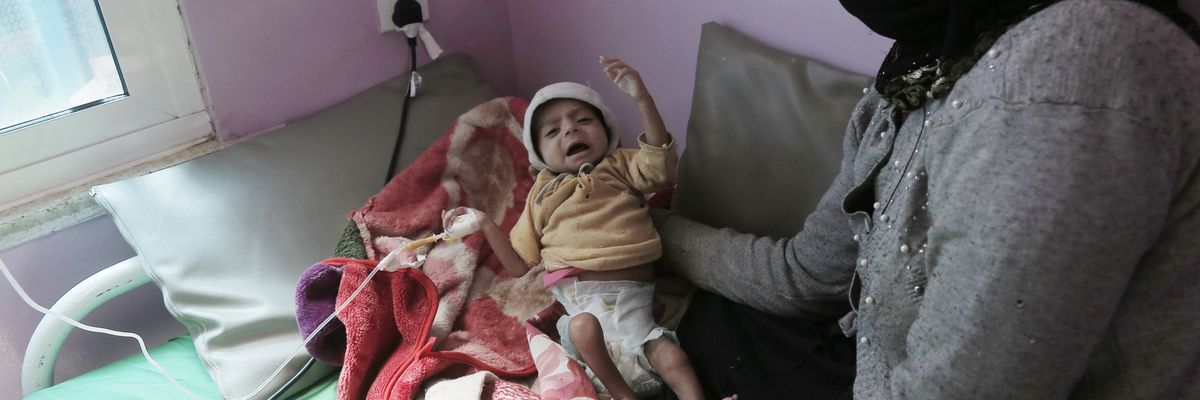
A mother tends to her child suffering from acute malnutrition while getting treatment at a health facility on December 14, 2024, in Sana'a, Yemen.
The Trump administration cut $1.3 billion in foreign assistance over the weekend—slashing lifesaving programs that Secretary of State Marco Rubio had previously said would be preserved.
The World Food Program (WFP) at the United Nations warned Monday that the Trump administration's new cuts to lifesaving U.S. foreign aid programs "could amount to a death sentence for millions of people facing extreme hunger and starvation."
The programs had previously been protected from sweeping cuts made by the President Donald Trump-created Department of Government Efficiency (DOGE), led by tech billionaire Elon Musk, with Secretary of State Marco Rubio granting waivers for the funding after 83% of the US Agency for International Development's provisions had been slashed.
Rubio claimed in March that DOGE's weekslong purge of USAID was "officially ending"—only for the State Department and USAID to spend this past weekend cutting more nutrition, healthcare, education, and financial stability programs in at least 14 countries.
On Monday, it became clear that the administration was not actually finished slashing programs aimed at promoting nutrition, education, and financial stability around the world, after the and the U.S. Agency for International Development (USAID) spent the weekend terminating aid programs, putting vulnerable people in some of the poorest nations on earth at risk of starvation or death.
The grassroots advocacy group Stand Up for Aid told Reuters that a total of $1.3 billion had been cut over the weekend, including $562 million for Afghanistan, $107 million for Yemen, $170 million for Somalia, $237 million for Syria, and $12 million for Gaza.
"Every remaining USAID award for Afghanistan was terminated," one source told Reuters.
The cuts targeted a $24 million grant for Afghanistan and a $17 million grant for Syria that were provided to the U.N. Population Fund (UNFPA), a sexual and reproductive health aid agency. Both grants had previously been terminated by DOGE but then reinstated—before the State Department, which took control of all remaining USAID programs last month, decided to again pull back the funding.
The administration is also ending a program that sends Afghan girls overseas to study, which they are prohibited from doing under restrictions imposed by the Taliban government, and terminating $169.8 million for WFP food assistance and malnutrition support for babies and children in Somalia and $111 million in WFP assistance in Syria.
In Yemen, 19 million of the war-torn country's 35 million people are in need of humanitarian assistance. According to a letter from USAID to an aid contractor in Yemen, the decision to end its contract was made by Jeremy Lewin, a DOGE operative now serving as an acting USAID assistant administrator.
"The decision to terminate this individual award is pursuant to a review and determination that the award is inconsistent with the administration's priorities," the letter read, according to Reuters.
Cindy McCain, executive director of the WFP, warned that the new cuts to the agency's emergency operations "will deepen hunger, fuel instability, and make the world far less safe."
U.S. Sen. Jeanne Shaheen (D-N.H.), ranking member of the Senate Foreign Relations Committee, noted in a statement that the Trump administration had previously provided to Congress "continued assurances that lifesaving programs would be protected during the Trump administration's 'review' of foreign assistance."
Shaheen said she looked forward to speaking with Rubio about the "devastating consequences" the cuts would have around the world.
She added on social media that women and girls will be "disproportionately" impacted by the State Department's decision to gut foreign assistance.
"It will increase maternal deaths and increase poverty, eliminate support for family planning programs in developing countries, [and] cut off 50 million women from access to contraception," said the senator.
U.S. officials who are involved in humanitarian aid and spoke on condition of anonymity told Reuters that in Afghanistan, the cuts could worsen economic stability and other conditions that have propelled people to join extremist groups like ISIS-K.
In Gaza, where Israel is again blocking humanitarian aid after breaking a brief cease-fire earlier this year, the cuts came days after the WFP warned it was distributing its final food packages to Palestinians.
All of the U.N. agency's bakeries in the besieged enclave are inoperable due to a lack of supplies, and the WFP said last week that it had enough provisions to make hot meals for another two weeks.
While the cease-fire "offered a short respite," said the heads of several U.N. agencies in a joint statement on Monday, "assertions that there is now enough food to feed all Palestinians in Gaza are far from the reality on the ground, and commodities are running extremely low."
Dear Common Dreams reader, It’s been nearly 30 years since I co-founded Common Dreams with my late wife, Lina Newhouser. We had the radical notion that journalism should serve the public good, not corporate profits. It was clear to us from the outset what it would take to build such a project. No paid advertisements. No corporate sponsors. No millionaire publisher telling us what to think or do. Many people said we wouldn't last a year, but we proved those doubters wrong. Together with a tremendous team of journalists and dedicated staff, we built an independent media outlet free from the constraints of profits and corporate control. Our mission has always been simple: To inform. To inspire. To ignite change for the common good. Building Common Dreams was not easy. Our survival was never guaranteed. When you take on the most powerful forces—Wall Street greed, fossil fuel industry destruction, Big Tech lobbyists, and uber-rich oligarchs who have spent billions upon billions rigging the economy and democracy in their favor—the only bulwark you have is supporters who believe in your work. But here’s the urgent message from me today. It's never been this bad out there. And it's never been this hard to keep us going. At the very moment Common Dreams is most needed, the threats we face are intensifying. We need your support now more than ever. We don't accept corporate advertising and never will. We don't have a paywall because we don't think people should be blocked from critical news based on their ability to pay. Everything we do is funded by the donations of readers like you. When everyone does the little they can afford, we are strong. But if that support retreats or dries up, so do we. Will you donate now to make sure Common Dreams not only survives but thrives? —Craig Brown, Co-founder |
The World Food Program (WFP) at the United Nations warned Monday that the Trump administration's new cuts to lifesaving U.S. foreign aid programs "could amount to a death sentence for millions of people facing extreme hunger and starvation."
The programs had previously been protected from sweeping cuts made by the President Donald Trump-created Department of Government Efficiency (DOGE), led by tech billionaire Elon Musk, with Secretary of State Marco Rubio granting waivers for the funding after 83% of the US Agency for International Development's provisions had been slashed.
Rubio claimed in March that DOGE's weekslong purge of USAID was "officially ending"—only for the State Department and USAID to spend this past weekend cutting more nutrition, healthcare, education, and financial stability programs in at least 14 countries.
On Monday, it became clear that the administration was not actually finished slashing programs aimed at promoting nutrition, education, and financial stability around the world, after the and the U.S. Agency for International Development (USAID) spent the weekend terminating aid programs, putting vulnerable people in some of the poorest nations on earth at risk of starvation or death.
The grassroots advocacy group Stand Up for Aid told Reuters that a total of $1.3 billion had been cut over the weekend, including $562 million for Afghanistan, $107 million for Yemen, $170 million for Somalia, $237 million for Syria, and $12 million for Gaza.
"Every remaining USAID award for Afghanistan was terminated," one source told Reuters.
The cuts targeted a $24 million grant for Afghanistan and a $17 million grant for Syria that were provided to the U.N. Population Fund (UNFPA), a sexual and reproductive health aid agency. Both grants had previously been terminated by DOGE but then reinstated—before the State Department, which took control of all remaining USAID programs last month, decided to again pull back the funding.
The administration is also ending a program that sends Afghan girls overseas to study, which they are prohibited from doing under restrictions imposed by the Taliban government, and terminating $169.8 million for WFP food assistance and malnutrition support for babies and children in Somalia and $111 million in WFP assistance in Syria.
In Yemen, 19 million of the war-torn country's 35 million people are in need of humanitarian assistance. According to a letter from USAID to an aid contractor in Yemen, the decision to end its contract was made by Jeremy Lewin, a DOGE operative now serving as an acting USAID assistant administrator.
"The decision to terminate this individual award is pursuant to a review and determination that the award is inconsistent with the administration's priorities," the letter read, according to Reuters.
Cindy McCain, executive director of the WFP, warned that the new cuts to the agency's emergency operations "will deepen hunger, fuel instability, and make the world far less safe."
U.S. Sen. Jeanne Shaheen (D-N.H.), ranking member of the Senate Foreign Relations Committee, noted in a statement that the Trump administration had previously provided to Congress "continued assurances that lifesaving programs would be protected during the Trump administration's 'review' of foreign assistance."
Shaheen said she looked forward to speaking with Rubio about the "devastating consequences" the cuts would have around the world.
She added on social media that women and girls will be "disproportionately" impacted by the State Department's decision to gut foreign assistance.
"It will increase maternal deaths and increase poverty, eliminate support for family planning programs in developing countries, [and] cut off 50 million women from access to contraception," said the senator.
U.S. officials who are involved in humanitarian aid and spoke on condition of anonymity told Reuters that in Afghanistan, the cuts could worsen economic stability and other conditions that have propelled people to join extremist groups like ISIS-K.
In Gaza, where Israel is again blocking humanitarian aid after breaking a brief cease-fire earlier this year, the cuts came days after the WFP warned it was distributing its final food packages to Palestinians.
All of the U.N. agency's bakeries in the besieged enclave are inoperable due to a lack of supplies, and the WFP said last week that it had enough provisions to make hot meals for another two weeks.
While the cease-fire "offered a short respite," said the heads of several U.N. agencies in a joint statement on Monday, "assertions that there is now enough food to feed all Palestinians in Gaza are far from the reality on the ground, and commodities are running extremely low."
The World Food Program (WFP) at the United Nations warned Monday that the Trump administration's new cuts to lifesaving U.S. foreign aid programs "could amount to a death sentence for millions of people facing extreme hunger and starvation."
The programs had previously been protected from sweeping cuts made by the President Donald Trump-created Department of Government Efficiency (DOGE), led by tech billionaire Elon Musk, with Secretary of State Marco Rubio granting waivers for the funding after 83% of the US Agency for International Development's provisions had been slashed.
Rubio claimed in March that DOGE's weekslong purge of USAID was "officially ending"—only for the State Department and USAID to spend this past weekend cutting more nutrition, healthcare, education, and financial stability programs in at least 14 countries.
On Monday, it became clear that the administration was not actually finished slashing programs aimed at promoting nutrition, education, and financial stability around the world, after the and the U.S. Agency for International Development (USAID) spent the weekend terminating aid programs, putting vulnerable people in some of the poorest nations on earth at risk of starvation or death.
The grassroots advocacy group Stand Up for Aid told Reuters that a total of $1.3 billion had been cut over the weekend, including $562 million for Afghanistan, $107 million for Yemen, $170 million for Somalia, $237 million for Syria, and $12 million for Gaza.
"Every remaining USAID award for Afghanistan was terminated," one source told Reuters.
The cuts targeted a $24 million grant for Afghanistan and a $17 million grant for Syria that were provided to the U.N. Population Fund (UNFPA), a sexual and reproductive health aid agency. Both grants had previously been terminated by DOGE but then reinstated—before the State Department, which took control of all remaining USAID programs last month, decided to again pull back the funding.
The administration is also ending a program that sends Afghan girls overseas to study, which they are prohibited from doing under restrictions imposed by the Taliban government, and terminating $169.8 million for WFP food assistance and malnutrition support for babies and children in Somalia and $111 million in WFP assistance in Syria.
In Yemen, 19 million of the war-torn country's 35 million people are in need of humanitarian assistance. According to a letter from USAID to an aid contractor in Yemen, the decision to end its contract was made by Jeremy Lewin, a DOGE operative now serving as an acting USAID assistant administrator.
"The decision to terminate this individual award is pursuant to a review and determination that the award is inconsistent with the administration's priorities," the letter read, according to Reuters.
Cindy McCain, executive director of the WFP, warned that the new cuts to the agency's emergency operations "will deepen hunger, fuel instability, and make the world far less safe."
U.S. Sen. Jeanne Shaheen (D-N.H.), ranking member of the Senate Foreign Relations Committee, noted in a statement that the Trump administration had previously provided to Congress "continued assurances that lifesaving programs would be protected during the Trump administration's 'review' of foreign assistance."
Shaheen said she looked forward to speaking with Rubio about the "devastating consequences" the cuts would have around the world.
She added on social media that women and girls will be "disproportionately" impacted by the State Department's decision to gut foreign assistance.
"It will increase maternal deaths and increase poverty, eliminate support for family planning programs in developing countries, [and] cut off 50 million women from access to contraception," said the senator.
U.S. officials who are involved in humanitarian aid and spoke on condition of anonymity told Reuters that in Afghanistan, the cuts could worsen economic stability and other conditions that have propelled people to join extremist groups like ISIS-K.
In Gaza, where Israel is again blocking humanitarian aid after breaking a brief cease-fire earlier this year, the cuts came days after the WFP warned it was distributing its final food packages to Palestinians.
All of the U.N. agency's bakeries in the besieged enclave are inoperable due to a lack of supplies, and the WFP said last week that it had enough provisions to make hot meals for another two weeks.
While the cease-fire "offered a short respite," said the heads of several U.N. agencies in a joint statement on Monday, "assertions that there is now enough food to feed all Palestinians in Gaza are far from the reality on the ground, and commodities are running extremely low."