5
#000000
#FFFFFF
To donate by check, phone, or other method, see our More Ways to Give page.
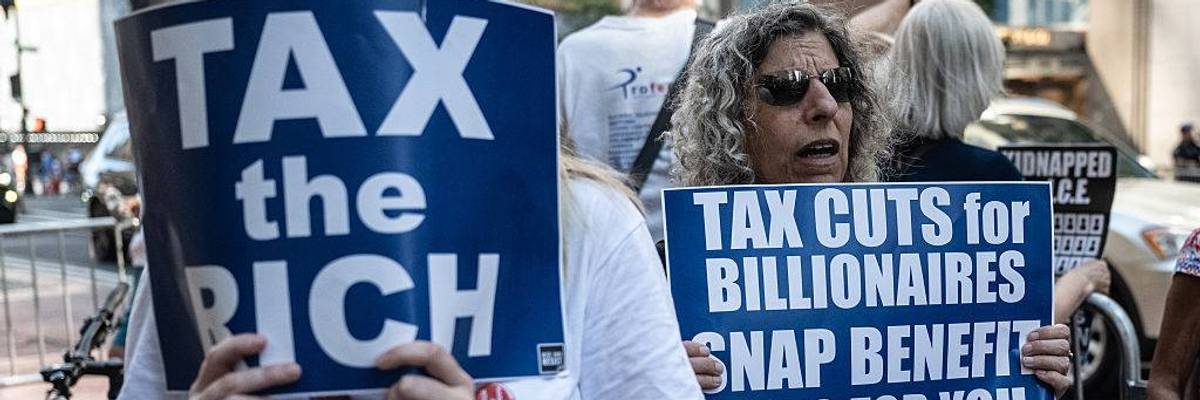
Just over a week away from Tax Day in the United States, a think tank on Monday released an analysis highlighting how most Americans will see their taxes go up this year, while the wealthy will see substantial cuts, thanks to "a mix of legislative action and illegal executive actions" from the Republican-controlled Congress and President Donald Trump.
"The president, in concert with Congress, has dramatically increased tariff taxes, enacted large tax cuts that primarily benefit the well-off and corporations, dramatically curtailed IRS enforcement, and issued legally problematic regulations," states the Institute on Taxation and Economic Policy (ITEP) report, referring to the Internal Revenue Service.
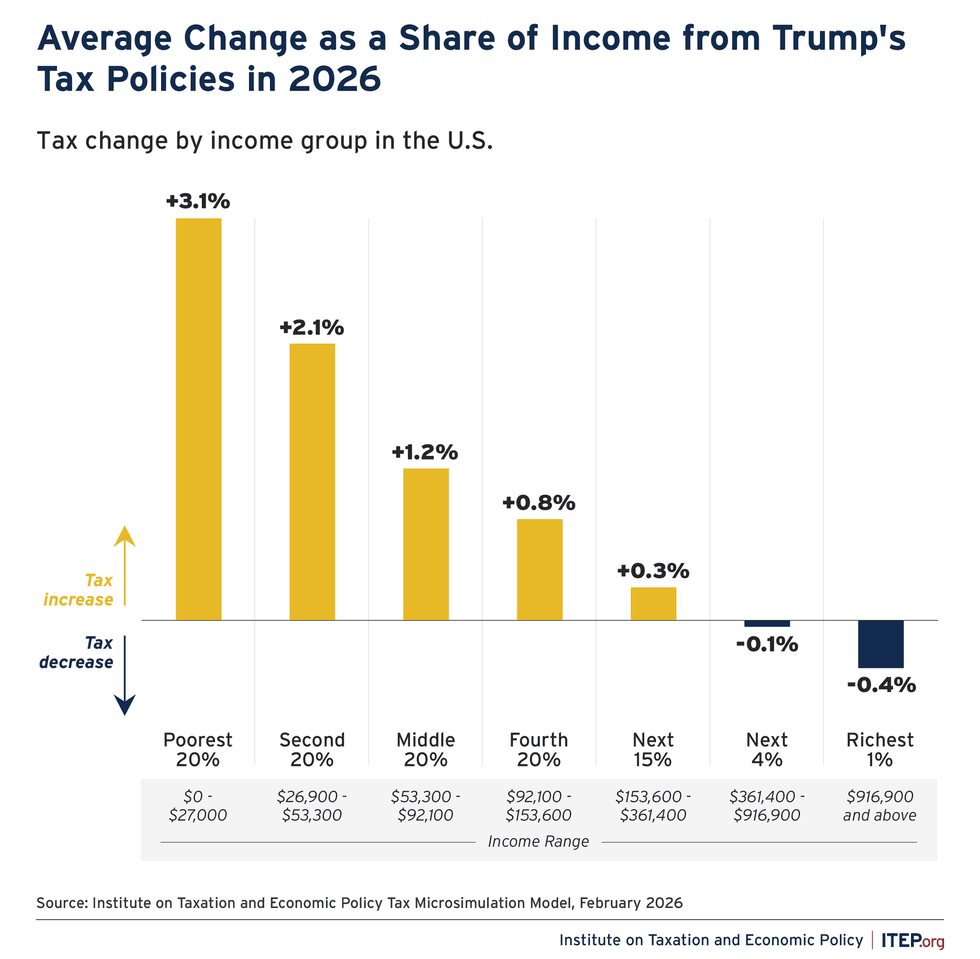
The bottom 95% of Americans will generally see higher taxes, according to report author Michael Ettlinger, a senior fellow at ITEP and the University of New Hampshire's Carsey School of Public Policy. The middle 60% will see an average increase of $900—though that estimate tops $1,000 for taxpayers in Alaska, Florida, Georgia, Idaho, Nebraska, North Carolina, South Dakota, Texas, Utah, Vermont, and Wyoming.
The primary drivers of tax hikes for working people are Trump's tariffs—which his administration continues to pursue despite a major setback at the US Supreme Court—and the so-called One Big Beautiful Bill Act (OBBBA), the budget reconciliation package that congressional Republicans passed and the president signed last summer.
The OBBBA slashed programs for the working class, including food assistance and Medicaid, and failed to extend Affordable Care Act premium tax credits that helped people afford health insurance. The Republican package is also expected to give the wealthiest 1% of Americans $1 trillion in tax cuts while adding $4.6 trillion to the federal deficit over the next decade.
This year alone, "the highest-income 20% get a $380 billion tax cut, with $117 billion going to the richest 1% alone," Ettlinger detailed. "To put the $117 billion going to the top 1% in 2026 in perspective, it is more than the federal government will spend in 2026 on the combined budgets of the Department of Education, Department of Transportation, Department of Justice, the State Department, the National Aeronautics and Space Administration, the Environmental Protection Agency, the National Endowment for the Humanities, and the National Endowment for the Arts."
"Or, put in another context, that $117 billion could buy every Major League Baseball team (all of them together) or pay for the combined cost of every wedding in the country for a year, as we described in July, along with other comparisons," he added.
 (Image by Institute on Taxation and Economic Policy)
Ettlinger pointed out that "the wealthiest have also saved many billions with the elimination of more than $40 billion over 10 years in IRS tax enforcement funding that was aimed specifically at cracking down on tax evasion by the wealthy. The Trump administration has also, administratively, strangled IRS enforcement initiatives targeted at high-wealth tax sheltering."
The expert also noted that the "OBBBA included large tax cuts for corporations, and the administration has added on to the benefits of these tax cuts with legally doubtful regulatory changes." For example, some major companies had an effective federal income tax rate of 0% in 2025, including Chenier Energy, LiveNation, Peter Thiel's Palantir, Elon Musk's Tesla, and Yum! Brands, whose subsidiaries include the fast food chains KFC, Pizza Hut, and Taco Bell.
Jeff Bezos' Amazon had an effective tax rate of 1.4%. For Meta, the parent company of Facebook, Instagram, and WhatsApp, it was 3.6%. Alphabet, the company behind Google, had an 8% rate. Ettlinger stressed that "these companies' ultralow tax bills are just the tip of the iceberg of what has been done to business taxes in the first year of President Trump's second term. From OBBBA alone, corporations and other businesses will pay $234 billion less in 2026 and $1.7 trillion less over 10 years."
It's not just rich Americans who are benefiting from Trump and his party's policies. As Ettlinger explained: "A total of $32 billion in tax savings from OBBBA will go offshore in 2026. Many foreign shareholders are likely to end up paying zero US corporate tax despite benefiting from the US economy and the role of the government in sustaining it."
The report concludes with a warning: "Unfortunately, it could get worse. The administration is being heavily lobbied to add to its unlawful regulatory record by indexing capital gains for inflation—which would be a benefit hugely skewed to the wealthy. In addition, the congressional Republican Study Committee has a tax plan that would, likewise, be of substantial benefit to those with the highest income and wealth."
Early last month, Sens. Ted Cruz (R-Texas) and Tim Scott (R-SC) sent a letter urging Treasury Secretary Scott Bessent to make the change to federal tax on capital gains, or the profits from selling investments, including bonds, real estate, and stocks.
"Ted Cruz is asking the Treasury Department to break the law to give another round of tax breaks to the ultrarich," Senate Finance Committee Ranking Member Ron Wyden (D-Ore.) responded at the time. "These guys can’t help themselves."
Just over a week away from Tax Day in the United States, a think tank on Monday released an analysis highlighting how most Americans will see their taxes go up this year, while the wealthy will see substantial cuts, thanks to "a mix of legislative action and illegal executive actions" from the Republican-controlled Congress and President Donald Trump.
"The president, in concert with Congress, has dramatically increased tariff taxes, enacted large tax cuts that primarily benefit the well-off and corporations, dramatically curtailed IRS enforcement, and issued legally problematic regulations," states the Institute on Taxation and Economic Policy (ITEP) report, referring to the Internal Revenue Service.
The bottom 95% of Americans will generally see higher taxes, according to report author Michael Ettlinger, a senior fellow at ITEP and the University of New Hampshire's Carsey School of Public Policy. The middle 60% will see an average increase of $900—though that estimate tops $1,000 for taxpayers in Alaska, Florida, Georgia, Idaho, Nebraska, North Carolina, South Dakota, Texas, Utah, Vermont, and Wyoming.
The primary drivers of tax hikes for working people are Trump's tariffs—which his administration continues to pursue despite a major setback at the US Supreme Court—and the so-called One Big Beautiful Bill Act (OBBBA), the budget reconciliation package that congressional Republicans passed and the president signed last summer.
The OBBBA slashed programs for the working class, including food assistance and Medicaid, and failed to extend Affordable Care Act premium tax credits that helped people afford health insurance. The Republican package is also expected to give the wealthiest 1% of Americans $1 trillion in tax cuts while adding $4.6 trillion to the federal deficit over the next decade.
This year alone, "the highest-income 20% get a $380 billion tax cut, with $117 billion going to the richest 1% alone," Ettlinger detailed. "To put the $117 billion going to the top 1% in 2026 in perspective, it is more than the federal government will spend in 2026 on the combined budgets of the Department of Education, Department of Transportation, Department of Justice, the State Department, the National Aeronautics and Space Administration, the Environmental Protection Agency, the National Endowment for the Humanities, and the National Endowment for the Arts."
"Or, put in another context, that $117 billion could buy every Major League Baseball team (all of them together) or pay for the combined cost of every wedding in the country for a year, as we described in July, along with other comparisons," he added.
(Image by Institute on Taxation and Economic Policy)
Ettlinger pointed out that "the wealthiest have also saved many billions with the elimination of more than $40 billion over 10 years in IRS tax enforcement funding that was aimed specifically at cracking down on tax evasion by the wealthy. The Trump administration has also, administratively, strangled IRS enforcement initiatives targeted at high-wealth tax sheltering."
The expert also noted that the "OBBBA included large tax cuts for corporations, and the administration has added on to the benefits of these tax cuts with legally doubtful regulatory changes." For example, some major companies had an effective federal income tax rate of 0% in 2025, including Chenier Energy, LiveNation, Peter Thiel's Palantir, Elon Musk's Tesla, and Yum! Brands, whose subsidiaries include the fast food chains KFC, Pizza Hut, and Taco Bell.
Jeff Bezos' Amazon had an effective tax rate of 1.4%. For Meta, the parent company of Facebook, Instagram, and WhatsApp, it was 3.6%. Alphabet, the company behind Google, had an 8% rate. Ettlinger stressed that "these companies' ultralow tax bills are just the tip of the iceberg of what has been done to business taxes in the first year of President Trump's second term. From OBBBA alone, corporations and other businesses will pay $234 billion less in 2026 and $1.7 trillion less over 10 years."
It's not just rich Americans who are benefiting from Trump and his party's policies. As Ettlinger explained: "A total of $32 billion in tax savings from OBBBA will go offshore in 2026. Many foreign shareholders are likely to end up paying zero US corporate tax despite benefiting from the US economy and the role of the government in sustaining it."
The report concludes with a warning: "Unfortunately, it could get worse. The administration is being heavily lobbied to add to its unlawful regulatory record by indexing capital gains for inflation—which would be a benefit hugely skewed to the wealthy. In addition, the congressional Republican Study Committee has a tax plan that would, likewise, be of substantial benefit to those with the highest income and wealth."
Early last month, Sens. Ted Cruz (R-Texas) and Tim Scott (R-SC) sent a letter urging Treasury Secretary Scott Bessent to make the change to federal tax on capital gains, or the profits from selling investments, including bonds, real estate, and stocks.
"Ted Cruz is asking the Treasury Department to break the law to give another round of tax breaks to the ultrarich," Senate Finance Committee Ranking Member Ron Wyden (D-Ore.) responded at the time. "These guys can’t help themselves."
Just over a week away from Tax Day in the United States, a think tank on Monday released an analysis highlighting how most Americans will see their taxes go up this year, while the wealthy will see substantial cuts, thanks to "a mix of legislative action and illegal executive actions" from the Republican-controlled Congress and President Donald Trump.
"The president, in concert with Congress, has dramatically increased tariff taxes, enacted large tax cuts that primarily benefit the well-off and corporations, dramatically curtailed IRS enforcement, and issued legally problematic regulations," states the Institute on Taxation and Economic Policy (ITEP) report, referring to the Internal Revenue Service.
The bottom 95% of Americans will generally see higher taxes, according to report author Michael Ettlinger, a senior fellow at ITEP and the University of New Hampshire's Carsey School of Public Policy. The middle 60% will see an average increase of $900—though that estimate tops $1,000 for taxpayers in Alaska, Florida, Georgia, Idaho, Nebraska, North Carolina, South Dakota, Texas, Utah, Vermont, and Wyoming.
The primary drivers of tax hikes for working people are Trump's tariffs—which his administration continues to pursue despite a major setback at the US Supreme Court—and the so-called One Big Beautiful Bill Act (OBBBA), the budget reconciliation package that congressional Republicans passed and the president signed last summer.
The OBBBA slashed programs for the working class, including food assistance and Medicaid, and failed to extend Affordable Care Act premium tax credits that helped people afford health insurance. The Republican package is also expected to give the wealthiest 1% of Americans $1 trillion in tax cuts while adding $4.6 trillion to the federal deficit over the next decade.
This year alone, "the highest-income 20% get a $380 billion tax cut, with $117 billion going to the richest 1% alone," Ettlinger detailed. "To put the $117 billion going to the top 1% in 2026 in perspective, it is more than the federal government will spend in 2026 on the combined budgets of the Department of Education, Department of Transportation, Department of Justice, the State Department, the National Aeronautics and Space Administration, the Environmental Protection Agency, the National Endowment for the Humanities, and the National Endowment for the Arts."
"Or, put in another context, that $117 billion could buy every Major League Baseball team (all of them together) or pay for the combined cost of every wedding in the country for a year, as we described in July, along with other comparisons," he added.
(Image by Institute on Taxation and Economic Policy)
Ettlinger pointed out that "the wealthiest have also saved many billions with the elimination of more than $40 billion over 10 years in IRS tax enforcement funding that was aimed specifically at cracking down on tax evasion by the wealthy. The Trump administration has also, administratively, strangled IRS enforcement initiatives targeted at high-wealth tax sheltering."
The expert also noted that the "OBBBA included large tax cuts for corporations, and the administration has added on to the benefits of these tax cuts with legally doubtful regulatory changes." For example, some major companies had an effective federal income tax rate of 0% in 2025, including Chenier Energy, LiveNation, Peter Thiel's Palantir, Elon Musk's Tesla, and Yum! Brands, whose subsidiaries include the fast food chains KFC, Pizza Hut, and Taco Bell.
Jeff Bezos' Amazon had an effective tax rate of 1.4%. For Meta, the parent company of Facebook, Instagram, and WhatsApp, it was 3.6%. Alphabet, the company behind Google, had an 8% rate. Ettlinger stressed that "these companies' ultralow tax bills are just the tip of the iceberg of what has been done to business taxes in the first year of President Trump's second term. From OBBBA alone, corporations and other businesses will pay $234 billion less in 2026 and $1.7 trillion less over 10 years."
It's not just rich Americans who are benefiting from Trump and his party's policies. As Ettlinger explained: "A total of $32 billion in tax savings from OBBBA will go offshore in 2026. Many foreign shareholders are likely to end up paying zero US corporate tax despite benefiting from the US economy and the role of the government in sustaining it."
The report concludes with a warning: "Unfortunately, it could get worse. The administration is being heavily lobbied to add to its unlawful regulatory record by indexing capital gains for inflation—which would be a benefit hugely skewed to the wealthy. In addition, the congressional Republican Study Committee has a tax plan that would, likewise, be of substantial benefit to those with the highest income and wealth."
Early last month, Sens. Ted Cruz (R-Texas) and Tim Scott (R-SC) sent a letter urging Treasury Secretary Scott Bessent to make the change to federal tax on capital gains, or the profits from selling investments, including bonds, real estate, and stocks.
"Ted Cruz is asking the Treasury Department to break the law to give another round of tax breaks to the ultrarich," Senate Finance Committee Ranking Member Ron Wyden (D-Ore.) responded at the time. "These guys can’t help themselves."