SUBSCRIBE TO OUR FREE NEWSLETTER
Daily news & progressive opinion—funded by the people, not the corporations—delivered straight to your inbox.
5
#000000
#FFFFFF
To donate by check, phone, or other method, see our More Ways to Give page.
An analysis published Thursday shows that Republicans on key committees in the House and Senate are poised to reap huge windfalls for themselves and their families if the trillions of dollars in tax breaks they've been tasked with crafting become law.
The Americans for Tax Fairness (ATF) report examines GOP members of the House Ways and Means Committee and the Senate Finance Committee. The group found that the average net worth of the committees' Republican members is close to $15 million.
Over two-thirds of the 26 members of the House Ways and Means Committee are millionaires, according to ATF.
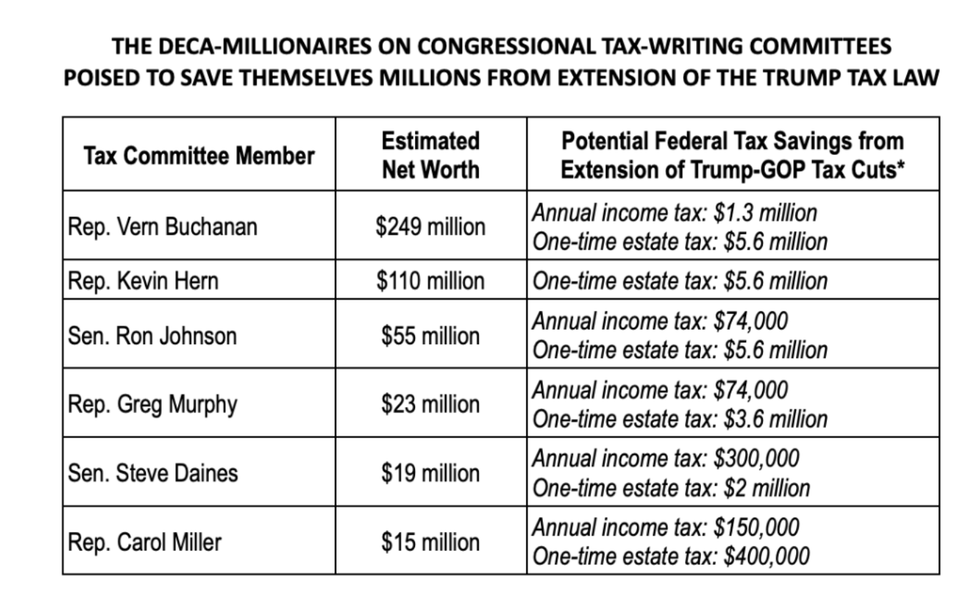
"The wealthiest GOP members could give themselves a roughly $1.8 million annual income tax cut and their families a potential one-time estate tax cut of $22.8 million—a potential total of $24.6 million in tax cuts if they pass legislation to extend the Trump tax bill," ATF's analysis shows.
The number two Republican on the House Ways and Means Committee, Rep. Vern Buchanan of Florida, is worth nearly $250 million, making him one of the richest members of Congress.
If the tax package that Republican lawmakers are assembling is enacted, Buchanan's family stands to save $5.6 million in taxes thanks to an extension of the 2017 law's estate tax exemptions. Buchanan would personally receive $1.3 million in annual income tax breaks under an extension of the 2017 measure.
Sen. Ron Johnson (R-Wis.), who helped secure a major tax gift for the wealthy in the 2017 law, and his family would also benefit to the tune of nearly $6 million from estate tax provisions and other giveaways.
"The multimillionaire Republicans in charge of these key committees cannot properly represent average Americans' tax and spending interests," David Kass, ATF's executive director, said in a statement Thursday. "Their prioritization of extending Trump's tax scam demonstrates their disconnect from middle and working-class constituents' needs."
"While wealthy Democrats also serve on these committees, they aren't promoting continuing the entire Trump tax legislation which primarily benefits rich individuals like them and giant corporations—legislation that would add trillions to the deficit and threaten funding for Social Security, healthcare, education, housing, and other vital public services," Kass added. "A system where millionaires vote for tax benefits favoring other wealthy elites undermines both our economy and democracy."
Under a resolution that House Republicans approved earlier this week, the House Ways and Means Committee is instructed to "submit changes in laws within its jurisdiction that increase the deficit by not more than" $4.5 trillion over the next decade—which would clear the way for an extension of the 2017 tax law that President Donald Trump signed during his first term.
The resolution also instructs the committees that oversee Medicaid and the Supplemental Nutrition Assistance Program to enact more than $1 trillion in cuts to partially offset the massive cost of the tax giveaways, which would primarily benefit the rich.
According to the Institute on Taxation and Economic Policy (ITEP), "the richest 1% would receive an average tax cut of more than $78,000 in 2026 alone, far outstripping tax cuts to taxpayers in any other income group."
"More than two-thirds of the benefits of these changes would go to the richest fifth of Americans, with 21% of the benefits flowing to the richest 1% alone," Steve Wamhoff, ITEP's federal policy director, wrote in a blog post on Wednesday. "Meanwhile, the middle fifth (20%) of Americans would get just 10% of the benefits and the poorest fifth of Americans would receive 1%."
An analysis published Thursday shows that Republicans on key committees in the House and Senate are poised to reap huge windfalls for themselves and their families if the trillions of dollars in tax breaks they've been tasked with crafting become law.
The Americans for Tax Fairness (ATF) report examines GOP members of the House Ways and Means Committee and the Senate Finance Committee. The group found that the average net worth of the committees' Republican members is close to $15 million.
Over two-thirds of the 26 members of the House Ways and Means Committee are millionaires, according to ATF.
"The wealthiest GOP members could give themselves a roughly $1.8 million annual income tax cut and their families a potential one-time estate tax cut of $22.8 million—a potential total of $24.6 million in tax cuts if they pass legislation to extend the Trump tax bill," ATF's analysis shows.
The number two Republican on the House Ways and Means Committee, Rep. Vern Buchanan of Florida, is worth nearly $250 million, making him one of the richest members of Congress.
If the tax package that Republican lawmakers are assembling is enacted, Buchanan's family stands to save $5.6 million in taxes thanks to an extension of the 2017 law's estate tax exemptions. Buchanan would personally receive $1.3 million in annual income tax breaks under an extension of the 2017 measure.
Sen. Ron Johnson (R-Wis.), who helped secure a major tax gift for the wealthy in the 2017 law, and his family would also benefit to the tune of nearly $6 million from estate tax provisions and other giveaways.
"The multimillionaire Republicans in charge of these key committees cannot properly represent average Americans' tax and spending interests," David Kass, ATF's executive director, said in a statement Thursday. "Their prioritization of extending Trump's tax scam demonstrates their disconnect from middle and working-class constituents' needs."
"While wealthy Democrats also serve on these committees, they aren't promoting continuing the entire Trump tax legislation which primarily benefits rich individuals like them and giant corporations—legislation that would add trillions to the deficit and threaten funding for Social Security, healthcare, education, housing, and other vital public services," Kass added. "A system where millionaires vote for tax benefits favoring other wealthy elites undermines both our economy and democracy."
Under a resolution that House Republicans approved earlier this week, the House Ways and Means Committee is instructed to "submit changes in laws within its jurisdiction that increase the deficit by not more than" $4.5 trillion over the next decade—which would clear the way for an extension of the 2017 tax law that President Donald Trump signed during his first term.
The resolution also instructs the committees that oversee Medicaid and the Supplemental Nutrition Assistance Program to enact more than $1 trillion in cuts to partially offset the massive cost of the tax giveaways, which would primarily benefit the rich.
According to the Institute on Taxation and Economic Policy (ITEP), "the richest 1% would receive an average tax cut of more than $78,000 in 2026 alone, far outstripping tax cuts to taxpayers in any other income group."
"More than two-thirds of the benefits of these changes would go to the richest fifth of Americans, with 21% of the benefits flowing to the richest 1% alone," Steve Wamhoff, ITEP's federal policy director, wrote in a blog post on Wednesday. "Meanwhile, the middle fifth (20%) of Americans would get just 10% of the benefits and the poorest fifth of Americans would receive 1%."
An analysis published Thursday shows that Republicans on key committees in the House and Senate are poised to reap huge windfalls for themselves and their families if the trillions of dollars in tax breaks they've been tasked with crafting become law.
The Americans for Tax Fairness (ATF) report examines GOP members of the House Ways and Means Committee and the Senate Finance Committee. The group found that the average net worth of the committees' Republican members is close to $15 million.
Over two-thirds of the 26 members of the House Ways and Means Committee are millionaires, according to ATF.
"The wealthiest GOP members could give themselves a roughly $1.8 million annual income tax cut and their families a potential one-time estate tax cut of $22.8 million—a potential total of $24.6 million in tax cuts if they pass legislation to extend the Trump tax bill," ATF's analysis shows.
The number two Republican on the House Ways and Means Committee, Rep. Vern Buchanan of Florida, is worth nearly $250 million, making him one of the richest members of Congress.
If the tax package that Republican lawmakers are assembling is enacted, Buchanan's family stands to save $5.6 million in taxes thanks to an extension of the 2017 law's estate tax exemptions. Buchanan would personally receive $1.3 million in annual income tax breaks under an extension of the 2017 measure.
Sen. Ron Johnson (R-Wis.), who helped secure a major tax gift for the wealthy in the 2017 law, and his family would also benefit to the tune of nearly $6 million from estate tax provisions and other giveaways.
"The multimillionaire Republicans in charge of these key committees cannot properly represent average Americans' tax and spending interests," David Kass, ATF's executive director, said in a statement Thursday. "Their prioritization of extending Trump's tax scam demonstrates their disconnect from middle and working-class constituents' needs."
"While wealthy Democrats also serve on these committees, they aren't promoting continuing the entire Trump tax legislation which primarily benefits rich individuals like them and giant corporations—legislation that would add trillions to the deficit and threaten funding for Social Security, healthcare, education, housing, and other vital public services," Kass added. "A system where millionaires vote for tax benefits favoring other wealthy elites undermines both our economy and democracy."
Under a resolution that House Republicans approved earlier this week, the House Ways and Means Committee is instructed to "submit changes in laws within its jurisdiction that increase the deficit by not more than" $4.5 trillion over the next decade—which would clear the way for an extension of the 2017 tax law that President Donald Trump signed during his first term.
The resolution also instructs the committees that oversee Medicaid and the Supplemental Nutrition Assistance Program to enact more than $1 trillion in cuts to partially offset the massive cost of the tax giveaways, which would primarily benefit the rich.
According to the Institute on Taxation and Economic Policy (ITEP), "the richest 1% would receive an average tax cut of more than $78,000 in 2026 alone, far outstripping tax cuts to taxpayers in any other income group."
"More than two-thirds of the benefits of these changes would go to the richest fifth of Americans, with 21% of the benefits flowing to the richest 1% alone," Steve Wamhoff, ITEP's federal policy director, wrote in a blog post on Wednesday. "Meanwhile, the middle fifth (20%) of Americans would get just 10% of the benefits and the poorest fifth of Americans would receive 1%."