SUBSCRIBE TO OUR FREE NEWSLETTER
Daily news & progressive opinion—funded by the people, not the corporations—delivered straight to your inbox.
5
#000000
#FFFFFF
To donate by check, phone, or other method, see our More Ways to Give page.
Daily news & progressive opinion—funded by the people, not the corporations—delivered straight to your inbox.
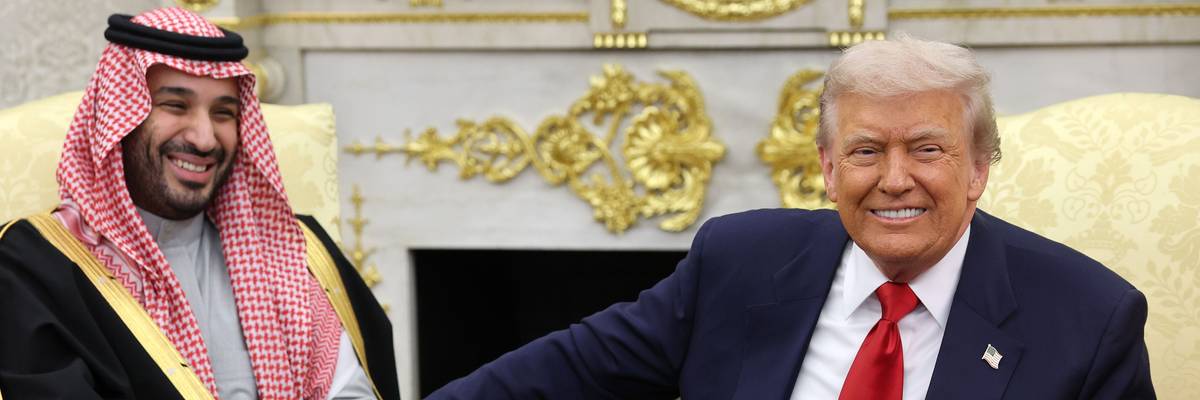
President Donald Trump takes the hand of Crown Prince and Prime Minister Mohammed bin Salman of Saudi Arabia during a bilateral meeting in the Oval Office of the White House on November 18, 2025 in Washington, DC.
It's time for America to dramatically improve relations with Venezuela and Iran, not as a concession to their leaders, but as a pragmatic strategy grounded in diplomacy instead of war.
While President Donald Trump and many of America's top corporate CEOs were bowing down in Washington to Saudi absolute monarch Crown Prince Mohammed bin Salman, the Trump administration was busy escalating (unauthorized and illegal) military actions against Venezuela with the apparent goal of regime change. Last summer, it bombed Iran, killing over 1,000 civilians, in a failed attempt to destroy Iran's nuclear weapons potential.
The US insists Venezuela and Iran are enemies in part because of authoritarian governments and human rights violations. But Saudi Arabia is one of the most authoritarian states in the world, marked by an absolute monarchy, tight control over political expression, and severe penalties for dissent. The US Director of National Intelligence concluded that the Crown Prince, also known as MbS, approved the torture, murder, and dismemberment of Washington Post journalist Jamal Khashoggi in 2018.
So it's the height of hypocrisy for Washington to treat Saudi Arabia as a close friend and Iran and Venezuela as enemies. It has nothing to do with democratic values and human rights but is all about failed and out-of-date Cold War policies and the Saudi's alignment with US corporate interests.
US policy towards Venezuela and Iran is simultaneously cruel and self-defeating. Diplomacy, rather than military threats, would be more effective and in the interests of the U.S. and the world.
Iran
From 1941 to 1953, Iran was a parliamentary democracy with competitive elections, political parties, and a free press. In 1951, the democratic parliament chose Mohammad Mossadegh as Prime Minister. Mossadegh stood for the rule of law, national sovereignty, and social justice. Most of Iran's vast oil reserves were owned or controlled by foreign corporations, particularly the predecessor to British Petroleum (BP), which kept most of the profits. Most significantly, he believed that Iran should remain neutral in the Cold War.
In 1953, the CIA and MI6 staged a coup to overthrow the democratic government, jailing Mossadegh, restoring the Shah to dictatorial rule, and restoring the oil industry to foreign control.
Under the Shah's authoritarian rule, the only effective resistance came from Islamic extremists who hated America for its role in the coup. Ayatollah Khomeini, exiled in 1964 for opposing the Shah, became the spiritual leader of the anti-Shah movement. When, following mass demonstrations in 1979, the Shah's government was overthrown, only Islamists based in Mosques (which could not be closed by the Shah in this religious country) had the organizational discipline and charismatic leadership to outmaneuver rivals. Returning from exile, Khomeini declared “Today is the first day of God’s government.” Khomeini signed a new Constitution declaring a "theocratic state," imposing Sharia law, and giving himself veto power.
When the US admitted the exiled Shah, a group calling itself the Muslim Student Followers of the Imam’s Line, strongly loyal to Khomeini, organized the occupation of the American embassy in Tehran and the hostage-taking of 52 Americans, which lasted 444 days and cemented the hostility between the US and Iran. The US broke diplomatic relations with Iran, which have still not been restored.
Nevertheless, diplomacy has sometimes been successful. In 2015, Iran, the US, and five other world powers signed a treaty, the Joint Comprehensive Plan of Action (JCPOA), limiting Iran's nuclear program in exchange for sanctions relief. The deal was hailed as a major diplomatic breakthrough. In 2018, the first Trump administration tore up the Treaty and instituted punishing economic sanctions.
Iran's political system is a hybrid of somewhat democratic elections combined with a 12-member Council of Guardians, controlled by Khomeini's successor, Ayatollah Khamenei, with the power to disqualify candidates from running. Nevertheless, Iran's hybrid system is more democratic than the absolute monarchy in Saudi Arabia.
This summer, the Trump administration bombed Iran, killing an estimated 1,000 people, in an unsuccessful attempt to destroy Iran's nuclear capacity to potentially build a nuclear bomb, something Iran has repeatedly and consistently said it does not want to do. But according to The Wall Street Journal, "Some analysts are concerned the attacks by Israel and the US may have convinced hard-liners in Tehran that the only way to preserve the regime is to make a run at developing nuclear weapons. 'If Iran decides to weaponize, it will take more time than it would have otherwise,' said Alan Eyre, a former State Department official and member of the U.S. negotiating team under the Obama administration that worked on the 2015 nuclear deal with Iran. But, paradoxically, we might have strengthened their resolve to seek a nuclear weapon now.'”
All the more reason why diplomacy, rather than further military action, may be the best course.
Saudi Arabia
The Saudi theocratic absolute monarchy has been a key US ally for over 80 years. The core bargain is that the Saudis provide oil, the US provides security, and during the Cold War, Saudi Arabia allied with the US against the Soviet Union.
Abdulaziz Ibn Saud (the grandfather of current Crown Prince Mohammed bin Salman) declared the Kingdom of Saudi Arabia in early 1931. It was, and still is, an absolute monarchy, with all authority vested in the King, no representative institutions, and the Wahhabi clerics bestowing divine authority on the King.
In 1933, Saudi Arabia granted oil exploration rights to Standard Oil of California. Concerned about post-war US access to oil and to establishing a Middle East buffer against Soviet influence, FDR met with King Saud in February of 1945 and negotiated a secret agreement known as the Quincy Pact under which the Saudis ensured a steady oil supply and the US provided security and protection to Saudi Arabia and the ruling royal Al Saud family. Ever since, the US has looked the other way at the Saudi's gross abuse of human rights.
In 1951, the US and Saudi Arabia entered into a Mutual Defense Assistance Agreement under which the US would provide arms and military training to the Saudi regime, and the US military would have access to the Dhahran Airfield as a base in the Middle East. The Agreement was aimed at countering Soviet influence in the region.
The alliance somewhat weakened under Presidents Obama and Biden, who spoke more openly about Saudi human rights abuses. Biden called MbS a "pariah" after US intelligence services determined that the Crown Prince authorized the brutal killing and dismemberment of Washington Post columnist Jamal Khashoggi.
Under Trump, the relationship has been even closer and has become more transactional. Trump has downplayed the Khashoggi murder, denying, despite US intelligence reports to the contrary, that the Crown Prince knew anything about the murder and dismemberment of Khashoggi. Trump said of MbBS, “I like him a lot. I like him too much.”
The Trump family has made lucrative business deals with Saudi Arabia. Trump's son-in-law, Jared Kushner, raised $2 billion in investment from the Saudi Sovereign Wealth Fund led by MbS. The Trump organization has raised hundreds of millions of dollars from the Saudis for real estate, hotel, and golf clubs in the nation, including a Trump Tower in Saudi capital Riyadh.
Trump's recent lavish White House dinner in honor of MbS was attended by 50 of America's top corporate leaders. Corporate America seeks to benefit economically from Trump's renewed warm relationship with the Saudis and is unconcerned with the country's authoritarian monarchy and human rights abuses which are much worse than in Iran or Venezuela. David Ellison, the son of Larry Ellison (the second richest man in the world), is hoping for Saudi's Sovereign Wealth Fund to invest 10% of the purchase price for Paramount (which he just bought and owns CBS news) to also merge with Warners (which owns CNN) giving Trump and the Islamist MbS regime substantial influence over two of America's leading sources of news.
Venezuela
Contemporary Venezuela could be described as an "electoral autocracy "or "competitive authoritarianism." Elections are held, but many government opponents are disqualified from running, the vote tally can be corrupt, and the media is heavily censored. In that respect, Venezuela is somewhat comparable to American ally Hungary, where regular elections are still held but the playing field is heavily skewed to ensure that Prime Minister Victor Orban and his allies cannot lose power. In Hungary, there are laws that can ban opposition leaders from running, partisan gerrymandering is extensive, and Orban's government has a near monopoly on media.
Despite (or perhaps because of) Orban's authoritariansm, after Trump welcomed him to the White House, Trump called him a "great leader" and proclaimed "I like and respect him." Despite the similarities between the Maduro and Orban regimes, Trump has declared that "Venezuela is being run by a dictator" and administration sources say: “Maduro is a narcoterrorist—always lead with that word if you want to represent the president’s thinking.”
Sen. Marco Rubio (R-Fla.) is the leading actor in shaping Trump's increasingly aggressive stance towards Venezuela. Trump probably can't spell Venezuela or find it on a map. But Rubio has advocated regime change in Venezuela for years, in large part driven by his hope that it would also lead to regime change in Venezuelan ally Cuba, which the US has unsuccessfully tried to overthrow since Fidel Castro first took power in 1959, replacing the corrupt Cuban dictator Fulgencio Batista.
Rubio is to Trump's Venezuela policy what Stephen Miller is to Trump's immigration policy. Soon after Trump's 2024 election victory, Rubio tried to convince Trump to implement Venezuelan regime change, allegedly because of Maduro's human rights violations and arguably undemocratic election victory. That argument failed to sway Trump to take military action. Rubio then switched arguments, calling Maduro a "narcoterrorist" drug trafficker, this despite the fact that US security analysts have found that Venezuela does not produce or export a significant amount of Fentanyl.
Dropsite News reports that "Trump's personal distaste for drugs and a campaign pledge to use the US military against Mexican drug cartels is an important impetus for Trump greenlighting recent strikes [on Venezuela]. With Trump unable so far to carry out attacks on Mexican cartels, strikes seen as politically untenable, Rubio effectively steered his gaze to Maduro. The potential of access to Venezuela's vast oil resources made the argument that much easier." John Feely, a former U.S. ambassador to Panama, concludes that "Rubio and the more ideological anti-communists in his inner circle have painted Trump into a corner with a paper-thin counter-narcotics pretext."
So Trump has now ordered missile strikes on small fishing boats allegedly carrying Fentanyl from Venezuela to America, so far killing at least 83 people (including the blatant war crime of a second strike to kill two unarmed survivors clinging to the side of the boat). The strikes are illegal under both international and US law. Congress has not authorized them, but Trump claims the right to act alone. He is threatening possible air strikes and even ground offensives against the Venezuelan mainland.
A military offensive is unlikely to remove Maduro. During the first Trump administration, the US sponsored a failed military offensive against Maduro called Operation Gideon. According to the BBC, Operation Gideon has been dubbed the "Bay of Piglets" as it made the failed Bay of Pigs invasion, backed by the CIA, "look like D-Day."
The Need for Diplomacy, Not War, With Venezuela and Iran
In a November 17 essay in Foreign Affairs, Francisco Rodríguez, a senior research fellow at the Center for Economic and Policy Research and a faculty affiliate at the University of Denver’s Josef Korbel School of Global and Public Affairs, concludes that "If Trump does attack Venezuela, it is unlikely to end well...A show of force will probably not be enough to bring down Maduro's regime... Even if US efforts somehow succeeded here, Venezuela's military would almost certainly replace Maduro with an insider. And even if, against all odds, Venezuela's opposition seized control of the country, there is no guaranteed that its ascendance would lead to a durable, democratic transition."
Instead of violent overthrow, Rodríguez proposes a long-term diplomatic strategy to bring about a "grand bargain" between the Maduro regime and the opposition.
The United States, argues Rodríguez in his piece,
[should] use its leverage to get both sides to the negotiating table. Done right, a coexistence deal would have good odds of democratizing Venezuela, at least relative to the alternatives. Decades of politicalscience research show that these kinds of so-called pacted transitions offer one of the most stable avenues for ending authoritarian rule. Latin America alone has multiple states—Brazil, Mexico, Uruguay—in which reforms initiated by an authoritarian government created a level political playing field that has lasted across multiple governments. It is, by contrast, rare to find cases in which an external intervention has led to a durable process of democratization, in the absence of a prolonged military occupation.
For too long, American foreign policy has clung to a rigid framework that divides the world into "good" and "bad" regimes, usually defined not by democratic values and human rights but by their willingness to align with US geopolitical and corporate interests. Nowhere is this more apparent than in America's relationship with three major oil-producing authoritarian or semi-authoritarian states of Saudi Arabia, Iran, and Venezuela.
But at a moment of global transition, climate change, shifting alliances, and growing multipolarity, this framework is outdated and dangerous. It undermines global stability and squanders diplomatic opportunities that could reduce conflict, strengthen security, and improve the living conditions for ordinary people.
It's time for America to dramatically improve relations with Venezuela and Iran, not as a concession to their leaders, but as a pragmatic strategy grounded in negotiations instead of war, peacebuilding, and the long-term interests of the American and global public.
Dear Common Dreams reader, It’s been nearly 30 years since I co-founded Common Dreams with my late wife, Lina Newhouser. We had the radical notion that journalism should serve the public good, not corporate profits. It was clear to us from the outset what it would take to build such a project. No paid advertisements. No corporate sponsors. No millionaire publisher telling us what to think or do. Many people said we wouldn't last a year, but we proved those doubters wrong. Together with a tremendous team of journalists and dedicated staff, we built an independent media outlet free from the constraints of profits and corporate control. Our mission has always been simple: To inform. To inspire. To ignite change for the common good. Building Common Dreams was not easy. Our survival was never guaranteed. When you take on the most powerful forces—Wall Street greed, fossil fuel industry destruction, Big Tech lobbyists, and uber-rich oligarchs who have spent billions upon billions rigging the economy and democracy in their favor—the only bulwark you have is supporters who believe in your work. But here’s the urgent message from me today. It's never been this bad out there. And it's never been this hard to keep us going. At the very moment Common Dreams is most needed, the threats we face are intensifying. We need your support now more than ever. We don't accept corporate advertising and never will. We don't have a paywall because we don't think people should be blocked from critical news based on their ability to pay. Everything we do is funded by the donations of readers like you. When everyone does the little they can afford, we are strong. But if that support retreats or dries up, so do we. Will you donate now to make sure Common Dreams not only survives but thrives? —Craig Brown, Co-founder |
While President Donald Trump and many of America's top corporate CEOs were bowing down in Washington to Saudi absolute monarch Crown Prince Mohammed bin Salman, the Trump administration was busy escalating (unauthorized and illegal) military actions against Venezuela with the apparent goal of regime change. Last summer, it bombed Iran, killing over 1,000 civilians, in a failed attempt to destroy Iran's nuclear weapons potential.
The US insists Venezuela and Iran are enemies in part because of authoritarian governments and human rights violations. But Saudi Arabia is one of the most authoritarian states in the world, marked by an absolute monarchy, tight control over political expression, and severe penalties for dissent. The US Director of National Intelligence concluded that the Crown Prince, also known as MbS, approved the torture, murder, and dismemberment of Washington Post journalist Jamal Khashoggi in 2018.
So it's the height of hypocrisy for Washington to treat Saudi Arabia as a close friend and Iran and Venezuela as enemies. It has nothing to do with democratic values and human rights but is all about failed and out-of-date Cold War policies and the Saudi's alignment with US corporate interests.
US policy towards Venezuela and Iran is simultaneously cruel and self-defeating. Diplomacy, rather than military threats, would be more effective and in the interests of the U.S. and the world.
Iran
From 1941 to 1953, Iran was a parliamentary democracy with competitive elections, political parties, and a free press. In 1951, the democratic parliament chose Mohammad Mossadegh as Prime Minister. Mossadegh stood for the rule of law, national sovereignty, and social justice. Most of Iran's vast oil reserves were owned or controlled by foreign corporations, particularly the predecessor to British Petroleum (BP), which kept most of the profits. Most significantly, he believed that Iran should remain neutral in the Cold War.
In 1953, the CIA and MI6 staged a coup to overthrow the democratic government, jailing Mossadegh, restoring the Shah to dictatorial rule, and restoring the oil industry to foreign control.
Under the Shah's authoritarian rule, the only effective resistance came from Islamic extremists who hated America for its role in the coup. Ayatollah Khomeini, exiled in 1964 for opposing the Shah, became the spiritual leader of the anti-Shah movement. When, following mass demonstrations in 1979, the Shah's government was overthrown, only Islamists based in Mosques (which could not be closed by the Shah in this religious country) had the organizational discipline and charismatic leadership to outmaneuver rivals. Returning from exile, Khomeini declared “Today is the first day of God’s government.” Khomeini signed a new Constitution declaring a "theocratic state," imposing Sharia law, and giving himself veto power.
When the US admitted the exiled Shah, a group calling itself the Muslim Student Followers of the Imam’s Line, strongly loyal to Khomeini, organized the occupation of the American embassy in Tehran and the hostage-taking of 52 Americans, which lasted 444 days and cemented the hostility between the US and Iran. The US broke diplomatic relations with Iran, which have still not been restored.
Nevertheless, diplomacy has sometimes been successful. In 2015, Iran, the US, and five other world powers signed a treaty, the Joint Comprehensive Plan of Action (JCPOA), limiting Iran's nuclear program in exchange for sanctions relief. The deal was hailed as a major diplomatic breakthrough. In 2018, the first Trump administration tore up the Treaty and instituted punishing economic sanctions.
Iran's political system is a hybrid of somewhat democratic elections combined with a 12-member Council of Guardians, controlled by Khomeini's successor, Ayatollah Khamenei, with the power to disqualify candidates from running. Nevertheless, Iran's hybrid system is more democratic than the absolute monarchy in Saudi Arabia.
This summer, the Trump administration bombed Iran, killing an estimated 1,000 people, in an unsuccessful attempt to destroy Iran's nuclear capacity to potentially build a nuclear bomb, something Iran has repeatedly and consistently said it does not want to do. But according to The Wall Street Journal, "Some analysts are concerned the attacks by Israel and the US may have convinced hard-liners in Tehran that the only way to preserve the regime is to make a run at developing nuclear weapons. 'If Iran decides to weaponize, it will take more time than it would have otherwise,' said Alan Eyre, a former State Department official and member of the U.S. negotiating team under the Obama administration that worked on the 2015 nuclear deal with Iran. But, paradoxically, we might have strengthened their resolve to seek a nuclear weapon now.'”
All the more reason why diplomacy, rather than further military action, may be the best course.
Saudi Arabia
The Saudi theocratic absolute monarchy has been a key US ally for over 80 years. The core bargain is that the Saudis provide oil, the US provides security, and during the Cold War, Saudi Arabia allied with the US against the Soviet Union.
Abdulaziz Ibn Saud (the grandfather of current Crown Prince Mohammed bin Salman) declared the Kingdom of Saudi Arabia in early 1931. It was, and still is, an absolute monarchy, with all authority vested in the King, no representative institutions, and the Wahhabi clerics bestowing divine authority on the King.
In 1933, Saudi Arabia granted oil exploration rights to Standard Oil of California. Concerned about post-war US access to oil and to establishing a Middle East buffer against Soviet influence, FDR met with King Saud in February of 1945 and negotiated a secret agreement known as the Quincy Pact under which the Saudis ensured a steady oil supply and the US provided security and protection to Saudi Arabia and the ruling royal Al Saud family. Ever since, the US has looked the other way at the Saudi's gross abuse of human rights.
In 1951, the US and Saudi Arabia entered into a Mutual Defense Assistance Agreement under which the US would provide arms and military training to the Saudi regime, and the US military would have access to the Dhahran Airfield as a base in the Middle East. The Agreement was aimed at countering Soviet influence in the region.
The alliance somewhat weakened under Presidents Obama and Biden, who spoke more openly about Saudi human rights abuses. Biden called MbS a "pariah" after US intelligence services determined that the Crown Prince authorized the brutal killing and dismemberment of Washington Post columnist Jamal Khashoggi.
Under Trump, the relationship has been even closer and has become more transactional. Trump has downplayed the Khashoggi murder, denying, despite US intelligence reports to the contrary, that the Crown Prince knew anything about the murder and dismemberment of Khashoggi. Trump said of MbBS, “I like him a lot. I like him too much.”
The Trump family has made lucrative business deals with Saudi Arabia. Trump's son-in-law, Jared Kushner, raised $2 billion in investment from the Saudi Sovereign Wealth Fund led by MbS. The Trump organization has raised hundreds of millions of dollars from the Saudis for real estate, hotel, and golf clubs in the nation, including a Trump Tower in Saudi capital Riyadh.
Trump's recent lavish White House dinner in honor of MbS was attended by 50 of America's top corporate leaders. Corporate America seeks to benefit economically from Trump's renewed warm relationship with the Saudis and is unconcerned with the country's authoritarian monarchy and human rights abuses which are much worse than in Iran or Venezuela. David Ellison, the son of Larry Ellison (the second richest man in the world), is hoping for Saudi's Sovereign Wealth Fund to invest 10% of the purchase price for Paramount (which he just bought and owns CBS news) to also merge with Warners (which owns CNN) giving Trump and the Islamist MbS regime substantial influence over two of America's leading sources of news.
Venezuela
Contemporary Venezuela could be described as an "electoral autocracy "or "competitive authoritarianism." Elections are held, but many government opponents are disqualified from running, the vote tally can be corrupt, and the media is heavily censored. In that respect, Venezuela is somewhat comparable to American ally Hungary, where regular elections are still held but the playing field is heavily skewed to ensure that Prime Minister Victor Orban and his allies cannot lose power. In Hungary, there are laws that can ban opposition leaders from running, partisan gerrymandering is extensive, and Orban's government has a near monopoly on media.
Despite (or perhaps because of) Orban's authoritariansm, after Trump welcomed him to the White House, Trump called him a "great leader" and proclaimed "I like and respect him." Despite the similarities between the Maduro and Orban regimes, Trump has declared that "Venezuela is being run by a dictator" and administration sources say: “Maduro is a narcoterrorist—always lead with that word if you want to represent the president’s thinking.”
Sen. Marco Rubio (R-Fla.) is the leading actor in shaping Trump's increasingly aggressive stance towards Venezuela. Trump probably can't spell Venezuela or find it on a map. But Rubio has advocated regime change in Venezuela for years, in large part driven by his hope that it would also lead to regime change in Venezuelan ally Cuba, which the US has unsuccessfully tried to overthrow since Fidel Castro first took power in 1959, replacing the corrupt Cuban dictator Fulgencio Batista.
Rubio is to Trump's Venezuela policy what Stephen Miller is to Trump's immigration policy. Soon after Trump's 2024 election victory, Rubio tried to convince Trump to implement Venezuelan regime change, allegedly because of Maduro's human rights violations and arguably undemocratic election victory. That argument failed to sway Trump to take military action. Rubio then switched arguments, calling Maduro a "narcoterrorist" drug trafficker, this despite the fact that US security analysts have found that Venezuela does not produce or export a significant amount of Fentanyl.
Dropsite News reports that "Trump's personal distaste for drugs and a campaign pledge to use the US military against Mexican drug cartels is an important impetus for Trump greenlighting recent strikes [on Venezuela]. With Trump unable so far to carry out attacks on Mexican cartels, strikes seen as politically untenable, Rubio effectively steered his gaze to Maduro. The potential of access to Venezuela's vast oil resources made the argument that much easier." John Feely, a former U.S. ambassador to Panama, concludes that "Rubio and the more ideological anti-communists in his inner circle have painted Trump into a corner with a paper-thin counter-narcotics pretext."
So Trump has now ordered missile strikes on small fishing boats allegedly carrying Fentanyl from Venezuela to America, so far killing at least 83 people (including the blatant war crime of a second strike to kill two unarmed survivors clinging to the side of the boat). The strikes are illegal under both international and US law. Congress has not authorized them, but Trump claims the right to act alone. He is threatening possible air strikes and even ground offensives against the Venezuelan mainland.
A military offensive is unlikely to remove Maduro. During the first Trump administration, the US sponsored a failed military offensive against Maduro called Operation Gideon. According to the BBC, Operation Gideon has been dubbed the "Bay of Piglets" as it made the failed Bay of Pigs invasion, backed by the CIA, "look like D-Day."
The Need for Diplomacy, Not War, With Venezuela and Iran
In a November 17 essay in Foreign Affairs, Francisco Rodríguez, a senior research fellow at the Center for Economic and Policy Research and a faculty affiliate at the University of Denver’s Josef Korbel School of Global and Public Affairs, concludes that "If Trump does attack Venezuela, it is unlikely to end well...A show of force will probably not be enough to bring down Maduro's regime... Even if US efforts somehow succeeded here, Venezuela's military would almost certainly replace Maduro with an insider. And even if, against all odds, Venezuela's opposition seized control of the country, there is no guaranteed that its ascendance would lead to a durable, democratic transition."
Instead of violent overthrow, Rodríguez proposes a long-term diplomatic strategy to bring about a "grand bargain" between the Maduro regime and the opposition.
The United States, argues Rodríguez in his piece,
[should] use its leverage to get both sides to the negotiating table. Done right, a coexistence deal would have good odds of democratizing Venezuela, at least relative to the alternatives. Decades of politicalscience research show that these kinds of so-called pacted transitions offer one of the most stable avenues for ending authoritarian rule. Latin America alone has multiple states—Brazil, Mexico, Uruguay—in which reforms initiated by an authoritarian government created a level political playing field that has lasted across multiple governments. It is, by contrast, rare to find cases in which an external intervention has led to a durable process of democratization, in the absence of a prolonged military occupation.
For too long, American foreign policy has clung to a rigid framework that divides the world into "good" and "bad" regimes, usually defined not by democratic values and human rights but by their willingness to align with US geopolitical and corporate interests. Nowhere is this more apparent than in America's relationship with three major oil-producing authoritarian or semi-authoritarian states of Saudi Arabia, Iran, and Venezuela.
But at a moment of global transition, climate change, shifting alliances, and growing multipolarity, this framework is outdated and dangerous. It undermines global stability and squanders diplomatic opportunities that could reduce conflict, strengthen security, and improve the living conditions for ordinary people.
It's time for America to dramatically improve relations with Venezuela and Iran, not as a concession to their leaders, but as a pragmatic strategy grounded in negotiations instead of war, peacebuilding, and the long-term interests of the American and global public.
While President Donald Trump and many of America's top corporate CEOs were bowing down in Washington to Saudi absolute monarch Crown Prince Mohammed bin Salman, the Trump administration was busy escalating (unauthorized and illegal) military actions against Venezuela with the apparent goal of regime change. Last summer, it bombed Iran, killing over 1,000 civilians, in a failed attempt to destroy Iran's nuclear weapons potential.
The US insists Venezuela and Iran are enemies in part because of authoritarian governments and human rights violations. But Saudi Arabia is one of the most authoritarian states in the world, marked by an absolute monarchy, tight control over political expression, and severe penalties for dissent. The US Director of National Intelligence concluded that the Crown Prince, also known as MbS, approved the torture, murder, and dismemberment of Washington Post journalist Jamal Khashoggi in 2018.
So it's the height of hypocrisy for Washington to treat Saudi Arabia as a close friend and Iran and Venezuela as enemies. It has nothing to do with democratic values and human rights but is all about failed and out-of-date Cold War policies and the Saudi's alignment with US corporate interests.
US policy towards Venezuela and Iran is simultaneously cruel and self-defeating. Diplomacy, rather than military threats, would be more effective and in the interests of the U.S. and the world.
Iran
From 1941 to 1953, Iran was a parliamentary democracy with competitive elections, political parties, and a free press. In 1951, the democratic parliament chose Mohammad Mossadegh as Prime Minister. Mossadegh stood for the rule of law, national sovereignty, and social justice. Most of Iran's vast oil reserves were owned or controlled by foreign corporations, particularly the predecessor to British Petroleum (BP), which kept most of the profits. Most significantly, he believed that Iran should remain neutral in the Cold War.
In 1953, the CIA and MI6 staged a coup to overthrow the democratic government, jailing Mossadegh, restoring the Shah to dictatorial rule, and restoring the oil industry to foreign control.
Under the Shah's authoritarian rule, the only effective resistance came from Islamic extremists who hated America for its role in the coup. Ayatollah Khomeini, exiled in 1964 for opposing the Shah, became the spiritual leader of the anti-Shah movement. When, following mass demonstrations in 1979, the Shah's government was overthrown, only Islamists based in Mosques (which could not be closed by the Shah in this religious country) had the organizational discipline and charismatic leadership to outmaneuver rivals. Returning from exile, Khomeini declared “Today is the first day of God’s government.” Khomeini signed a new Constitution declaring a "theocratic state," imposing Sharia law, and giving himself veto power.
When the US admitted the exiled Shah, a group calling itself the Muslim Student Followers of the Imam’s Line, strongly loyal to Khomeini, organized the occupation of the American embassy in Tehran and the hostage-taking of 52 Americans, which lasted 444 days and cemented the hostility between the US and Iran. The US broke diplomatic relations with Iran, which have still not been restored.
Nevertheless, diplomacy has sometimes been successful. In 2015, Iran, the US, and five other world powers signed a treaty, the Joint Comprehensive Plan of Action (JCPOA), limiting Iran's nuclear program in exchange for sanctions relief. The deal was hailed as a major diplomatic breakthrough. In 2018, the first Trump administration tore up the Treaty and instituted punishing economic sanctions.
Iran's political system is a hybrid of somewhat democratic elections combined with a 12-member Council of Guardians, controlled by Khomeini's successor, Ayatollah Khamenei, with the power to disqualify candidates from running. Nevertheless, Iran's hybrid system is more democratic than the absolute monarchy in Saudi Arabia.
This summer, the Trump administration bombed Iran, killing an estimated 1,000 people, in an unsuccessful attempt to destroy Iran's nuclear capacity to potentially build a nuclear bomb, something Iran has repeatedly and consistently said it does not want to do. But according to The Wall Street Journal, "Some analysts are concerned the attacks by Israel and the US may have convinced hard-liners in Tehran that the only way to preserve the regime is to make a run at developing nuclear weapons. 'If Iran decides to weaponize, it will take more time than it would have otherwise,' said Alan Eyre, a former State Department official and member of the U.S. negotiating team under the Obama administration that worked on the 2015 nuclear deal with Iran. But, paradoxically, we might have strengthened their resolve to seek a nuclear weapon now.'”
All the more reason why diplomacy, rather than further military action, may be the best course.
Saudi Arabia
The Saudi theocratic absolute monarchy has been a key US ally for over 80 years. The core bargain is that the Saudis provide oil, the US provides security, and during the Cold War, Saudi Arabia allied with the US against the Soviet Union.
Abdulaziz Ibn Saud (the grandfather of current Crown Prince Mohammed bin Salman) declared the Kingdom of Saudi Arabia in early 1931. It was, and still is, an absolute monarchy, with all authority vested in the King, no representative institutions, and the Wahhabi clerics bestowing divine authority on the King.
In 1933, Saudi Arabia granted oil exploration rights to Standard Oil of California. Concerned about post-war US access to oil and to establishing a Middle East buffer against Soviet influence, FDR met with King Saud in February of 1945 and negotiated a secret agreement known as the Quincy Pact under which the Saudis ensured a steady oil supply and the US provided security and protection to Saudi Arabia and the ruling royal Al Saud family. Ever since, the US has looked the other way at the Saudi's gross abuse of human rights.
In 1951, the US and Saudi Arabia entered into a Mutual Defense Assistance Agreement under which the US would provide arms and military training to the Saudi regime, and the US military would have access to the Dhahran Airfield as a base in the Middle East. The Agreement was aimed at countering Soviet influence in the region.
The alliance somewhat weakened under Presidents Obama and Biden, who spoke more openly about Saudi human rights abuses. Biden called MbS a "pariah" after US intelligence services determined that the Crown Prince authorized the brutal killing and dismemberment of Washington Post columnist Jamal Khashoggi.
Under Trump, the relationship has been even closer and has become more transactional. Trump has downplayed the Khashoggi murder, denying, despite US intelligence reports to the contrary, that the Crown Prince knew anything about the murder and dismemberment of Khashoggi. Trump said of MbBS, “I like him a lot. I like him too much.”
The Trump family has made lucrative business deals with Saudi Arabia. Trump's son-in-law, Jared Kushner, raised $2 billion in investment from the Saudi Sovereign Wealth Fund led by MbS. The Trump organization has raised hundreds of millions of dollars from the Saudis for real estate, hotel, and golf clubs in the nation, including a Trump Tower in Saudi capital Riyadh.
Trump's recent lavish White House dinner in honor of MbS was attended by 50 of America's top corporate leaders. Corporate America seeks to benefit economically from Trump's renewed warm relationship with the Saudis and is unconcerned with the country's authoritarian monarchy and human rights abuses which are much worse than in Iran or Venezuela. David Ellison, the son of Larry Ellison (the second richest man in the world), is hoping for Saudi's Sovereign Wealth Fund to invest 10% of the purchase price for Paramount (which he just bought and owns CBS news) to also merge with Warners (which owns CNN) giving Trump and the Islamist MbS regime substantial influence over two of America's leading sources of news.
Venezuela
Contemporary Venezuela could be described as an "electoral autocracy "or "competitive authoritarianism." Elections are held, but many government opponents are disqualified from running, the vote tally can be corrupt, and the media is heavily censored. In that respect, Venezuela is somewhat comparable to American ally Hungary, where regular elections are still held but the playing field is heavily skewed to ensure that Prime Minister Victor Orban and his allies cannot lose power. In Hungary, there are laws that can ban opposition leaders from running, partisan gerrymandering is extensive, and Orban's government has a near monopoly on media.
Despite (or perhaps because of) Orban's authoritariansm, after Trump welcomed him to the White House, Trump called him a "great leader" and proclaimed "I like and respect him." Despite the similarities between the Maduro and Orban regimes, Trump has declared that "Venezuela is being run by a dictator" and administration sources say: “Maduro is a narcoterrorist—always lead with that word if you want to represent the president’s thinking.”
Sen. Marco Rubio (R-Fla.) is the leading actor in shaping Trump's increasingly aggressive stance towards Venezuela. Trump probably can't spell Venezuela or find it on a map. But Rubio has advocated regime change in Venezuela for years, in large part driven by his hope that it would also lead to regime change in Venezuelan ally Cuba, which the US has unsuccessfully tried to overthrow since Fidel Castro first took power in 1959, replacing the corrupt Cuban dictator Fulgencio Batista.
Rubio is to Trump's Venezuela policy what Stephen Miller is to Trump's immigration policy. Soon after Trump's 2024 election victory, Rubio tried to convince Trump to implement Venezuelan regime change, allegedly because of Maduro's human rights violations and arguably undemocratic election victory. That argument failed to sway Trump to take military action. Rubio then switched arguments, calling Maduro a "narcoterrorist" drug trafficker, this despite the fact that US security analysts have found that Venezuela does not produce or export a significant amount of Fentanyl.
Dropsite News reports that "Trump's personal distaste for drugs and a campaign pledge to use the US military against Mexican drug cartels is an important impetus for Trump greenlighting recent strikes [on Venezuela]. With Trump unable so far to carry out attacks on Mexican cartels, strikes seen as politically untenable, Rubio effectively steered his gaze to Maduro. The potential of access to Venezuela's vast oil resources made the argument that much easier." John Feely, a former U.S. ambassador to Panama, concludes that "Rubio and the more ideological anti-communists in his inner circle have painted Trump into a corner with a paper-thin counter-narcotics pretext."
So Trump has now ordered missile strikes on small fishing boats allegedly carrying Fentanyl from Venezuela to America, so far killing at least 83 people (including the blatant war crime of a second strike to kill two unarmed survivors clinging to the side of the boat). The strikes are illegal under both international and US law. Congress has not authorized them, but Trump claims the right to act alone. He is threatening possible air strikes and even ground offensives against the Venezuelan mainland.
A military offensive is unlikely to remove Maduro. During the first Trump administration, the US sponsored a failed military offensive against Maduro called Operation Gideon. According to the BBC, Operation Gideon has been dubbed the "Bay of Piglets" as it made the failed Bay of Pigs invasion, backed by the CIA, "look like D-Day."
The Need for Diplomacy, Not War, With Venezuela and Iran
In a November 17 essay in Foreign Affairs, Francisco Rodríguez, a senior research fellow at the Center for Economic and Policy Research and a faculty affiliate at the University of Denver’s Josef Korbel School of Global and Public Affairs, concludes that "If Trump does attack Venezuela, it is unlikely to end well...A show of force will probably not be enough to bring down Maduro's regime... Even if US efforts somehow succeeded here, Venezuela's military would almost certainly replace Maduro with an insider. And even if, against all odds, Venezuela's opposition seized control of the country, there is no guaranteed that its ascendance would lead to a durable, democratic transition."
Instead of violent overthrow, Rodríguez proposes a long-term diplomatic strategy to bring about a "grand bargain" between the Maduro regime and the opposition.
The United States, argues Rodríguez in his piece,
[should] use its leverage to get both sides to the negotiating table. Done right, a coexistence deal would have good odds of democratizing Venezuela, at least relative to the alternatives. Decades of politicalscience research show that these kinds of so-called pacted transitions offer one of the most stable avenues for ending authoritarian rule. Latin America alone has multiple states—Brazil, Mexico, Uruguay—in which reforms initiated by an authoritarian government created a level political playing field that has lasted across multiple governments. It is, by contrast, rare to find cases in which an external intervention has led to a durable process of democratization, in the absence of a prolonged military occupation.
For too long, American foreign policy has clung to a rigid framework that divides the world into "good" and "bad" regimes, usually defined not by democratic values and human rights but by their willingness to align with US geopolitical and corporate interests. Nowhere is this more apparent than in America's relationship with three major oil-producing authoritarian or semi-authoritarian states of Saudi Arabia, Iran, and Venezuela.
But at a moment of global transition, climate change, shifting alliances, and growing multipolarity, this framework is outdated and dangerous. It undermines global stability and squanders diplomatic opportunities that could reduce conflict, strengthen security, and improve the living conditions for ordinary people.
It's time for America to dramatically improve relations with Venezuela and Iran, not as a concession to their leaders, but as a pragmatic strategy grounded in negotiations instead of war, peacebuilding, and the long-term interests of the American and global public.