SUBSCRIBE TO OUR FREE NEWSLETTER
Daily news & progressive opinion—funded by the people, not the corporations—delivered straight to your inbox.
5
#000000
#FFFFFF
To donate by check, phone, or other method, see our More Ways to Give page.
Daily news & progressive opinion—funded by the people, not the corporations—delivered straight to your inbox.
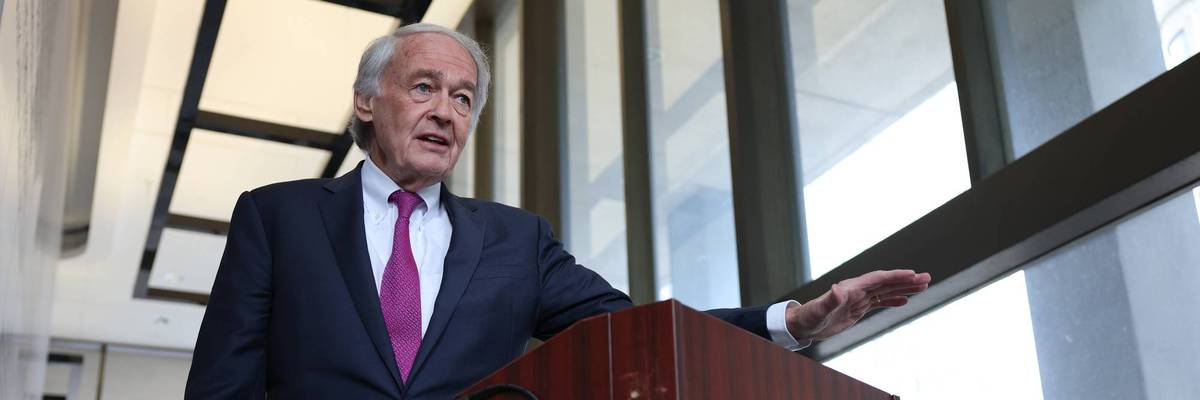
US Sen. Ed Markey (D-Mass.) speaks during a press conference held at the John F. Kennedy Federal Building in Boston, Massachusetts on February 17, 2025.
"We can't sleepwalk into a decision this consequential. The law gives Congress the power to review and block a deal like this, and the Senate will now have the chance to fulfill its statutory responsibility before it's too late."
US Sens. Ed Markey and Jeff Merkley on Thursday continued to push back against President Donald Trump's proposed nuclear energy agreement with Saudi Arabia, setting up a vote on legislation that could block the deal before it takes effect.
"Giving Saudi Arabia access to US civilian nuclear energy technology without ironclad protections to make sure it doesn't provide a foundation for a nuclear bomb is unacceptable," declared Merkley (D-Ore.), a senior member of the Senate Foreign Relations Committee who co-chairs the Nuclear Weapons and Arms Control Working Group with Markey (D-Mass.).
Under Section 123 of the Atomic Energy Act, Congress has 90 days of continuous session to review the deal. The pair of senators introduced a joint resolution of disapproval, on which the Senate is set to vote after November 29. The JRD would need to pass both GOP-controlled chambers by veto-proof majorities to actually block the agreement.
I refuse to let the U.S. sleepwalk into a dangerous nuclear deal with Saudi Arabia. The law gives Congress the power to review and block a deal like this.@markey.senate.gov and I are making sure the Senate fulfills that responsibility before it’s too late.
[image or embed]
— Senator Jeff Merkley (@merkley.senate.gov) October 15, 2026 at 12:37 PM
The senators are alarmed that Trump's agreement lacks a "gold standard" provision barring Saudi Arabia from reprocessing spent fuel or enriching uranium. They are also alarmed that the proposal doesn't require allowing International Atomic Energy Agency investigators to confirm that the nation is not trying to develop a nuclear weapon.
"It is essential that nations pursuing civilian energy programs agree to the 'gold standard' of restrictions on fuel reprocessing and enrichment and rigorous inspections to ensure that a nuclear energy program doesn't become a covert nuclear weapons program," Merkley argued. "We can't sleepwalk into a decision this consequential. The law gives Congress the power to review and block a deal like this, and the Senate will now have the chance to fulfill its statutory responsibility before it's too late."
The details of the agreement have concerned not only progressive senators, but also nuclear nonproliferation experts.
"The US-Saudi nuclear deal is about megatons, not megawatts. Trump should not be sharing nuclear bomb technology with a nation that US intelligence says may want nuclear weapons," said Markey. "This deal is the starting gun for a Middle East nuclear arms race. Congress must reject it."
The introduction came roughly a month after Markey and Merkley partnered with Sen. Bernie Sanders (I-Vt.) for another JRD designed to block a $5 billion conventional weapons sale to Saudi Arabia, which includes over 10,000 joint direct attack munition guidance kits and a similar number of "dumb bombs" that can be combined to create precision weapons.
"I am deeply concerned by the kingdom's human rights abuses, the security of the region as the war in Iran rages on, and the proxy war that is escalating between Iran and Saudi Arabia in Yemen," Markey said at the time. "Further escalation in the Saudi-Iran proxy war will worsen an already dire humanitarian catastrophe in Yemen and risks setting off a nuclear arms race between Iran and Saudi Arabia."
Dear Common Dreams reader, It’s been nearly 30 years since I co-founded Common Dreams with my late wife, Lina Newhouser. We had the radical notion that journalism should serve the public good, not corporate profits. It was clear to us from the outset what it would take to build such a project. No paid advertisements. No corporate sponsors. No millionaire publisher telling us what to think or do. Many people said we wouldn't last a year, but we proved those doubters wrong. Together with a tremendous team of journalists and dedicated staff, we built an independent media outlet free from the constraints of profits and corporate control. Our mission has always been simple: To inform. To inspire. To ignite change for the common good. Building Common Dreams was not easy. Our survival was never guaranteed. When you take on the most powerful forces—Wall Street greed, fossil fuel industry destruction, Big Tech lobbyists, and uber-rich oligarchs who have spent billions upon billions rigging the economy and democracy in their favor—the only bulwark you have is supporters who believe in your work. But here’s the urgent message from me today. It's never been this bad out there. And it's never been this hard to keep us going. At the very moment Common Dreams is most needed, the threats we face are intensifying. We need your support now more than ever. We don't accept corporate advertising and never will. We don't have a paywall because we don't think people should be blocked from critical news based on their ability to pay. Everything we do is funded by the donations of readers like you. When everyone does the little they can afford, we are strong. But if that support retreats or dries up, so do we. Will you donate now to make sure Common Dreams not only survives but thrives? —Craig Brown, Co-founder |
US Sens. Ed Markey and Jeff Merkley on Thursday continued to push back against President Donald Trump's proposed nuclear energy agreement with Saudi Arabia, setting up a vote on legislation that could block the deal before it takes effect.
"Giving Saudi Arabia access to US civilian nuclear energy technology without ironclad protections to make sure it doesn't provide a foundation for a nuclear bomb is unacceptable," declared Merkley (D-Ore.), a senior member of the Senate Foreign Relations Committee who co-chairs the Nuclear Weapons and Arms Control Working Group with Markey (D-Mass.).
Under Section 123 of the Atomic Energy Act, Congress has 90 days of continuous session to review the deal. The pair of senators introduced a joint resolution of disapproval, on which the Senate is set to vote after November 29. The JRD would need to pass both GOP-controlled chambers by veto-proof majorities to actually block the agreement.
I refuse to let the U.S. sleepwalk into a dangerous nuclear deal with Saudi Arabia. The law gives Congress the power to review and block a deal like this.@markey.senate.gov and I are making sure the Senate fulfills that responsibility before it’s too late.
[image or embed]
— Senator Jeff Merkley (@merkley.senate.gov) October 15, 2026 at 12:37 PM
The senators are alarmed that Trump's agreement lacks a "gold standard" provision barring Saudi Arabia from reprocessing spent fuel or enriching uranium. They are also alarmed that the proposal doesn't require allowing International Atomic Energy Agency investigators to confirm that the nation is not trying to develop a nuclear weapon.
"It is essential that nations pursuing civilian energy programs agree to the 'gold standard' of restrictions on fuel reprocessing and enrichment and rigorous inspections to ensure that a nuclear energy program doesn't become a covert nuclear weapons program," Merkley argued. "We can't sleepwalk into a decision this consequential. The law gives Congress the power to review and block a deal like this, and the Senate will now have the chance to fulfill its statutory responsibility before it's too late."
The details of the agreement have concerned not only progressive senators, but also nuclear nonproliferation experts.
"The US-Saudi nuclear deal is about megatons, not megawatts. Trump should not be sharing nuclear bomb technology with a nation that US intelligence says may want nuclear weapons," said Markey. "This deal is the starting gun for a Middle East nuclear arms race. Congress must reject it."
The introduction came roughly a month after Markey and Merkley partnered with Sen. Bernie Sanders (I-Vt.) for another JRD designed to block a $5 billion conventional weapons sale to Saudi Arabia, which includes over 10,000 joint direct attack munition guidance kits and a similar number of "dumb bombs" that can be combined to create precision weapons.
"I am deeply concerned by the kingdom's human rights abuses, the security of the region as the war in Iran rages on, and the proxy war that is escalating between Iran and Saudi Arabia in Yemen," Markey said at the time. "Further escalation in the Saudi-Iran proxy war will worsen an already dire humanitarian catastrophe in Yemen and risks setting off a nuclear arms race between Iran and Saudi Arabia."
US Sens. Ed Markey and Jeff Merkley on Thursday continued to push back against President Donald Trump's proposed nuclear energy agreement with Saudi Arabia, setting up a vote on legislation that could block the deal before it takes effect.
"Giving Saudi Arabia access to US civilian nuclear energy technology without ironclad protections to make sure it doesn't provide a foundation for a nuclear bomb is unacceptable," declared Merkley (D-Ore.), a senior member of the Senate Foreign Relations Committee who co-chairs the Nuclear Weapons and Arms Control Working Group with Markey (D-Mass.).
Under Section 123 of the Atomic Energy Act, Congress has 90 days of continuous session to review the deal. The pair of senators introduced a joint resolution of disapproval, on which the Senate is set to vote after November 29. The JRD would need to pass both GOP-controlled chambers by veto-proof majorities to actually block the agreement.
I refuse to let the U.S. sleepwalk into a dangerous nuclear deal with Saudi Arabia. The law gives Congress the power to review and block a deal like this.@markey.senate.gov and I are making sure the Senate fulfills that responsibility before it’s too late.
[image or embed]
— Senator Jeff Merkley (@merkley.senate.gov) October 15, 2026 at 12:37 PM
The senators are alarmed that Trump's agreement lacks a "gold standard" provision barring Saudi Arabia from reprocessing spent fuel or enriching uranium. They are also alarmed that the proposal doesn't require allowing International Atomic Energy Agency investigators to confirm that the nation is not trying to develop a nuclear weapon.
"It is essential that nations pursuing civilian energy programs agree to the 'gold standard' of restrictions on fuel reprocessing and enrichment and rigorous inspections to ensure that a nuclear energy program doesn't become a covert nuclear weapons program," Merkley argued. "We can't sleepwalk into a decision this consequential. The law gives Congress the power to review and block a deal like this, and the Senate will now have the chance to fulfill its statutory responsibility before it's too late."
The details of the agreement have concerned not only progressive senators, but also nuclear nonproliferation experts.
"The US-Saudi nuclear deal is about megatons, not megawatts. Trump should not be sharing nuclear bomb technology with a nation that US intelligence says may want nuclear weapons," said Markey. "This deal is the starting gun for a Middle East nuclear arms race. Congress must reject it."
The introduction came roughly a month after Markey and Merkley partnered with Sen. Bernie Sanders (I-Vt.) for another JRD designed to block a $5 billion conventional weapons sale to Saudi Arabia, which includes over 10,000 joint direct attack munition guidance kits and a similar number of "dumb bombs" that can be combined to create precision weapons.
"I am deeply concerned by the kingdom's human rights abuses, the security of the region as the war in Iran rages on, and the proxy war that is escalating between Iran and Saudi Arabia in Yemen," Markey said at the time. "Further escalation in the Saudi-Iran proxy war will worsen an already dire humanitarian catastrophe in Yemen and risks setting off a nuclear arms race between Iran and Saudi Arabia."