SUBSCRIBE TO OUR FREE NEWSLETTER
Daily news & progressive opinion—funded by the people, not the corporations—delivered straight to your inbox.
5
#000000
#FFFFFF
To donate by check, phone, or other method, see our More Ways to Give page.
Daily news & progressive opinion—funded by the people, not the corporations—delivered straight to your inbox.
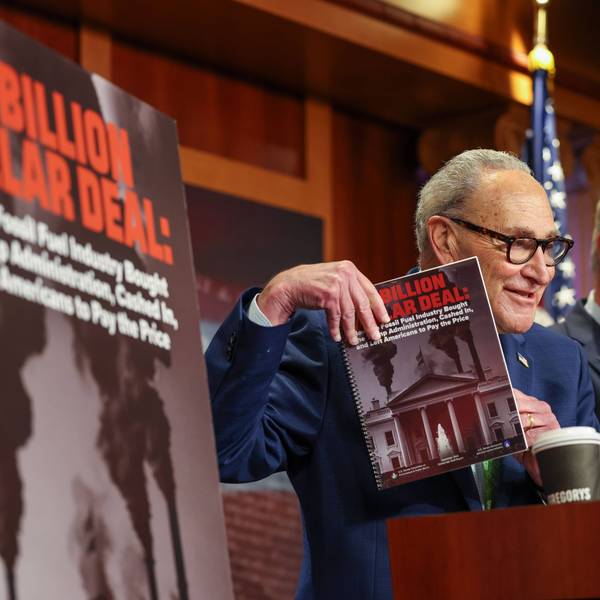
“Trump is getting Americans coming and going. He’s forcing higher power bills on them by blocking clean energy, then he’s fattening the wallets of his cronies," said former Democratic Washington Gov. Jay Inslee.
President Donald Trump's obsession with canceling clean energy projects is bad not just for the climate, but for the US economy as a whole.
An analysis released Thursday by nonprofit green energy advocate E2 and conducted by consulting firm BW Research estimates that clean energy projects that have been shut down or downsized during Trump's second term would have added $55 billion to the annual gross domestic product (GDP).
The analysis finds that, in addition to delivering a hit to GDP, scrapping the projects lead to 470,000 fewer jobs, including 42,000 construction jobs related to battery storage, 33,000 construction jobs related to solar projects, and 28,000 construction jobs related to electric vehicle projects.
The cancelations will also hit governments' coffers, as they are projected to deliver a $12 billion annual reduction in tax revenues.
The report points to two big components in Trump White House's attack on clean energy: the Republican Party's 2025 budget law, which rolled back tax credits for clean energy programs, and the administration's own policies, including payoffs to companies to halt project development and a permitting ban on new solar and wind projects.
Bob Keefe, executive director of E2, said the numbers outlined in the analysis show that "making it harder to build clean energy projects means lost jobs, lost investments, lost electricity supplies, and lost local tax revenues."
"Add it all up and it’s clear," Keefe added, "that federal actions to stop clean energy are costing all of us—consumers, businesses and our national economy—big time."
Michael Timberlake, director of research and publications at E2, commented that Trump's policies are "hitting exactly the kinds of projects America needs most: domestic manufacturing, battery storage, solar, wind, and electric vehicles."
“The losses go far beyond the direct jobs announced by companies," Timberlake said. "Every cancelled factory or power project means fewer construction workers on site, fewer suppliers filling orders, fewer dollars flowing through local economies, and fewer tax revenues for schools, fire departments, roads, and public services."
A Friday report in The Guardian similarly highlighted the economic damage being done by Trump's war on clean energy, with a particular focus on the Trump administration's unprecedented policy of paying energy companies to relinquish leases for offshore wind projects they had already purchased.
Jenny Rowland-Shea, senior director for conservation policy at the Center for American Progress, told The Guardian that the administration is "trying to snuff out an entire form of energy," which she said was a particularly irrational thing to do when Americans' utility bills are spiking.
"It’s at a time when the United States needs more energy," said Rowland-Shea. "As people’s rates are going up for electricity, as we see data centers gobbling up more energy."
Former Democratic Washington Gov. Jay Inslee, whose 2020 presidential campaign focused heavily on combating the climate crisis, accused Trump and his administration of "mugging" the American public by forcing them to needlessly pay more for energy.
“Trump is getting Americans coming and going,” said Inslee. “He’s forcing higher power bills on them by blocking clean energy, then he’s fattening the wallets of his cronies—all with billions of our tax dollars.”
Dear Common Dreams reader, It’s been nearly 30 years since I co-founded Common Dreams with my late wife, Lina Newhouser. We had the radical notion that journalism should serve the public good, not corporate profits. It was clear to us from the outset what it would take to build such a project. No paid advertisements. No corporate sponsors. No millionaire publisher telling us what to think or do. Many people said we wouldn't last a year, but we proved those doubters wrong. Together with a tremendous team of journalists and dedicated staff, we built an independent media outlet free from the constraints of profits and corporate control. Our mission has always been simple: To inform. To inspire. To ignite change for the common good. Building Common Dreams was not easy. Our survival was never guaranteed. When you take on the most powerful forces—Wall Street greed, fossil fuel industry destruction, Big Tech lobbyists, and uber-rich oligarchs who have spent billions upon billions rigging the economy and democracy in their favor—the only bulwark you have is supporters who believe in your work. But here’s the urgent message from me today. It's never been this bad out there. And it's never been this hard to keep us going. At the very moment Common Dreams is most needed, the threats we face are intensifying. We need your support now more than ever. We don't accept corporate advertising and never will. We don't have a paywall because we don't think people should be blocked from critical news based on their ability to pay. Everything we do is funded by the donations of readers like you. When everyone does the little they can afford, we are strong. But if that support retreats or dries up, so do we. Will you donate now to make sure Common Dreams not only survives but thrives? —Craig Brown, Co-founder |
President Donald Trump's obsession with canceling clean energy projects is bad not just for the climate, but for the US economy as a whole.
An analysis released Thursday by nonprofit green energy advocate E2 and conducted by consulting firm BW Research estimates that clean energy projects that have been shut down or downsized during Trump's second term would have added $55 billion to the annual gross domestic product (GDP).
The analysis finds that, in addition to delivering a hit to GDP, scrapping the projects lead to 470,000 fewer jobs, including 42,000 construction jobs related to battery storage, 33,000 construction jobs related to solar projects, and 28,000 construction jobs related to electric vehicle projects.
The cancelations will also hit governments' coffers, as they are projected to deliver a $12 billion annual reduction in tax revenues.
The report points to two big components in Trump White House's attack on clean energy: the Republican Party's 2025 budget law, which rolled back tax credits for clean energy programs, and the administration's own policies, including payoffs to companies to halt project development and a permitting ban on new solar and wind projects.
Bob Keefe, executive director of E2, said the numbers outlined in the analysis show that "making it harder to build clean energy projects means lost jobs, lost investments, lost electricity supplies, and lost local tax revenues."
"Add it all up and it’s clear," Keefe added, "that federal actions to stop clean energy are costing all of us—consumers, businesses and our national economy—big time."
Michael Timberlake, director of research and publications at E2, commented that Trump's policies are "hitting exactly the kinds of projects America needs most: domestic manufacturing, battery storage, solar, wind, and electric vehicles."
“The losses go far beyond the direct jobs announced by companies," Timberlake said. "Every cancelled factory or power project means fewer construction workers on site, fewer suppliers filling orders, fewer dollars flowing through local economies, and fewer tax revenues for schools, fire departments, roads, and public services."
A Friday report in The Guardian similarly highlighted the economic damage being done by Trump's war on clean energy, with a particular focus on the Trump administration's unprecedented policy of paying energy companies to relinquish leases for offshore wind projects they had already purchased.
Jenny Rowland-Shea, senior director for conservation policy at the Center for American Progress, told The Guardian that the administration is "trying to snuff out an entire form of energy," which she said was a particularly irrational thing to do when Americans' utility bills are spiking.
"It’s at a time when the United States needs more energy," said Rowland-Shea. "As people’s rates are going up for electricity, as we see data centers gobbling up more energy."
Former Democratic Washington Gov. Jay Inslee, whose 2020 presidential campaign focused heavily on combating the climate crisis, accused Trump and his administration of "mugging" the American public by forcing them to needlessly pay more for energy.
“Trump is getting Americans coming and going,” said Inslee. “He’s forcing higher power bills on them by blocking clean energy, then he’s fattening the wallets of his cronies—all with billions of our tax dollars.”
President Donald Trump's obsession with canceling clean energy projects is bad not just for the climate, but for the US economy as a whole.
An analysis released Thursday by nonprofit green energy advocate E2 and conducted by consulting firm BW Research estimates that clean energy projects that have been shut down or downsized during Trump's second term would have added $55 billion to the annual gross domestic product (GDP).
The analysis finds that, in addition to delivering a hit to GDP, scrapping the projects lead to 470,000 fewer jobs, including 42,000 construction jobs related to battery storage, 33,000 construction jobs related to solar projects, and 28,000 construction jobs related to electric vehicle projects.
The cancelations will also hit governments' coffers, as they are projected to deliver a $12 billion annual reduction in tax revenues.
The report points to two big components in Trump White House's attack on clean energy: the Republican Party's 2025 budget law, which rolled back tax credits for clean energy programs, and the administration's own policies, including payoffs to companies to halt project development and a permitting ban on new solar and wind projects.
Bob Keefe, executive director of E2, said the numbers outlined in the analysis show that "making it harder to build clean energy projects means lost jobs, lost investments, lost electricity supplies, and lost local tax revenues."
"Add it all up and it’s clear," Keefe added, "that federal actions to stop clean energy are costing all of us—consumers, businesses and our national economy—big time."
Michael Timberlake, director of research and publications at E2, commented that Trump's policies are "hitting exactly the kinds of projects America needs most: domestic manufacturing, battery storage, solar, wind, and electric vehicles."
“The losses go far beyond the direct jobs announced by companies," Timberlake said. "Every cancelled factory or power project means fewer construction workers on site, fewer suppliers filling orders, fewer dollars flowing through local economies, and fewer tax revenues for schools, fire departments, roads, and public services."
A Friday report in The Guardian similarly highlighted the economic damage being done by Trump's war on clean energy, with a particular focus on the Trump administration's unprecedented policy of paying energy companies to relinquish leases for offshore wind projects they had already purchased.
Jenny Rowland-Shea, senior director for conservation policy at the Center for American Progress, told The Guardian that the administration is "trying to snuff out an entire form of energy," which she said was a particularly irrational thing to do when Americans' utility bills are spiking.
"It’s at a time when the United States needs more energy," said Rowland-Shea. "As people’s rates are going up for electricity, as we see data centers gobbling up more energy."
Former Democratic Washington Gov. Jay Inslee, whose 2020 presidential campaign focused heavily on combating the climate crisis, accused Trump and his administration of "mugging" the American public by forcing them to needlessly pay more for energy.
“Trump is getting Americans coming and going,” said Inslee. “He’s forcing higher power bills on them by blocking clean energy, then he’s fattening the wallets of his cronies—all with billions of our tax dollars.”