5
#000000
#FFFFFF
To donate by check, phone, or other method, see our More Ways to Give page.
Daily news & progressive opinion—funded by the people, not the corporations—delivered straight to your inbox.

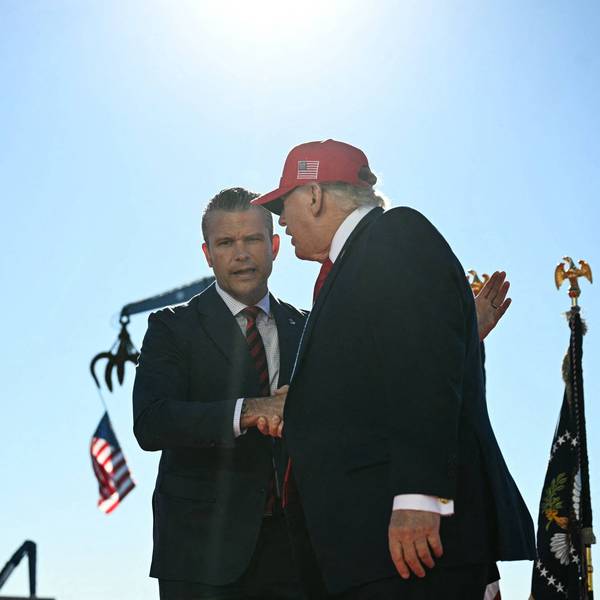
President Donald Trump and Secretary of Defense Pete Hegseth attend a dignified transfer for US service members killed during operations in the Middle East, at Dover Air Force Base in Dover, Delaware, on July 22, 2026.
Trump has "lost the Iran War in every way possible in less than six months," said one critic.
The illegal war with Iran that President Donald Trump said would be over in a matter of weeks entered its sixth month on Friday, and there is little sign of it wrapping up in the near future.
A Friday report in The Washington Post marking the six-month anniversary of the illegal war noted that Trump's ability to decisively win the conflict declined markedly "after Iranian leaders discovered that they could withstand intense bombardment and slowly degrade the world’s most powerful military with a cheap combination of mines and drones."
The biggest weapon in Iran's arsenal has been its ability to shut down the Strait of Hormuz, a vital shipping lane for petroleum. Since the strait's closure, oil and gas prices have soared, costing US consumers an estimated $71.5 billion more to fill up their cars than they otherwise would have paid.
Trump this week has tried to claim that the strait has actually been reopened, but the Post found that the president's proclamations do not match reality.
"More than 100 ships traversed the Strait of Hormuz on average every day before the war," the Post wrote. "Just five went through on one day this week, according to Kpler, a commodities and shipping tracker."
A Friday report in The Associated Press focused on the White House's announcements this week of new measures to put economic pressure on Iran, which are a sign that the administration no longer thinks it can use military force to force Tehran's hand.
"The turn to using sanctions as the cudgel of choice," wrote the AP, "comes as the administration weighs diminished munitions stockpiles after months of war, sparking concerns that the prolonged conflict could undermine US military readiness in other parts of the globe."
The AP also flagged a shift in rhetoric from Trump, who once promised the war would end quickly but now says he's "not in a hurry" to end the campaign.
Harrison Mann, a former US Defense Intelligence Agency officer, wrote in an analysis published by Zeteo on Thursday that Trump has "lost the Iran War in every way possible in less than six months," which he said would mark "the arrogant, violent end of American dominance in the Middle East."
In fact, Mann argued that Trump lost the Iran War three different ways: The first in his failed attempt to force regime change in Tehran, the second in an aborted campaign to incite an Iranian Kurdish uprising, and finally in his desperate efforts to reopen the Strait of Hormuz.
All of these failures have combined to put Iran in a decisively stronger position than it was in before the war began, Mann wrote.
"After another four months of Trump threats, half-hearted bombing runs, and not one but two US blockades of Iran, Tehran’s military exercises formal authority over at least a third of the ships transiting the strait," he wrote. "Plus, it now regularly shoots at 'unauthorized' ships with impunity."
US Rep. Don Breyer (D-Va.) summed up the failure of Trump's war in a Friday social media post.
"When Trump began his illegal, unpopular war with Iran, he said it would last a week," Breyer wrote. "SIX MONTHS later: The administration has lied about our casualties and the deaths of civilians, the stated objectives haven't been met, Iran has a new economic weapon in the Strait of Hormuz, the region is less stable, our prices are higher, our allies are angry, our adversaries are emboldened, and there's no end in sight."
This country and this world are at a monumental crossroads. US voters have an opportunity to beat back the forces of fascism and confront the billionaires who are rigging the economy, our media system, and our democracy, making it increasingly impossible for ordinary people to get by. We’re not just talking about the election. We’re talking about what must be done once these fascist elements are vanquished from power. We need a bolder set of solutions than what either major party has so far been willing to offer and a working-class movement ready to fight like hell for it. Trump didn't emerge from nowhere. The conditions that fueled MAGA authoritarianism were created by decades of radical neoliberal economic policies and a corrupt political system dominated by corporate interests. They slashed taxes on the super-rich, promising that the benefits would trickle down. They said giveaways to the corporate titans would make life more affordable for the rest of us. It was all bullshit. And when a bitter, betrayed populace searches for someone to blame, right-wing demagogues have little trouble finding scapegoats. People know when they're being lied to, but you won't hear any of this from the corporate media. Only independent journalism—powered and funded by people who believe in building a better world—can deliver truly trustworthy daily news. If you share our vision, please contribute whatever you can to sustain our work. |
The illegal war with Iran that President Donald Trump said would be over in a matter of weeks entered its sixth month on Friday, and there is little sign of it wrapping up in the near future.
A Friday report in The Washington Post marking the six-month anniversary of the illegal war noted that Trump's ability to decisively win the conflict declined markedly "after Iranian leaders discovered that they could withstand intense bombardment and slowly degrade the world’s most powerful military with a cheap combination of mines and drones."
The biggest weapon in Iran's arsenal has been its ability to shut down the Strait of Hormuz, a vital shipping lane for petroleum. Since the strait's closure, oil and gas prices have soared, costing US consumers an estimated $71.5 billion more to fill up their cars than they otherwise would have paid.
Trump this week has tried to claim that the strait has actually been reopened, but the Post found that the president's proclamations do not match reality.
"More than 100 ships traversed the Strait of Hormuz on average every day before the war," the Post wrote. "Just five went through on one day this week, according to Kpler, a commodities and shipping tracker."
A Friday report in The Associated Press focused on the White House's announcements this week of new measures to put economic pressure on Iran, which are a sign that the administration no longer thinks it can use military force to force Tehran's hand.
"The turn to using sanctions as the cudgel of choice," wrote the AP, "comes as the administration weighs diminished munitions stockpiles after months of war, sparking concerns that the prolonged conflict could undermine US military readiness in other parts of the globe."
The AP also flagged a shift in rhetoric from Trump, who once promised the war would end quickly but now says he's "not in a hurry" to end the campaign.
Harrison Mann, a former US Defense Intelligence Agency officer, wrote in an analysis published by Zeteo on Thursday that Trump has "lost the Iran War in every way possible in less than six months," which he said would mark "the arrogant, violent end of American dominance in the Middle East."
In fact, Mann argued that Trump lost the Iran War three different ways: The first in his failed attempt to force regime change in Tehran, the second in an aborted campaign to incite an Iranian Kurdish uprising, and finally in his desperate efforts to reopen the Strait of Hormuz.
All of these failures have combined to put Iran in a decisively stronger position than it was in before the war began, Mann wrote.
"After another four months of Trump threats, half-hearted bombing runs, and not one but two US blockades of Iran, Tehran’s military exercises formal authority over at least a third of the ships transiting the strait," he wrote. "Plus, it now regularly shoots at 'unauthorized' ships with impunity."
US Rep. Don Breyer (D-Va.) summed up the failure of Trump's war in a Friday social media post.
"When Trump began his illegal, unpopular war with Iran, he said it would last a week," Breyer wrote. "SIX MONTHS later: The administration has lied about our casualties and the deaths of civilians, the stated objectives haven't been met, Iran has a new economic weapon in the Strait of Hormuz, the region is less stable, our prices are higher, our allies are angry, our adversaries are emboldened, and there's no end in sight."