SUBSCRIBE TO OUR FREE NEWSLETTER
Daily news & progressive opinion—funded by the people, not the corporations—delivered straight to your inbox.
5
#000000
#FFFFFF
To donate by check, phone, or other method, see our More Ways to Give page.
Daily news & progressive opinion—funded by the people, not the corporations—delivered straight to your inbox.
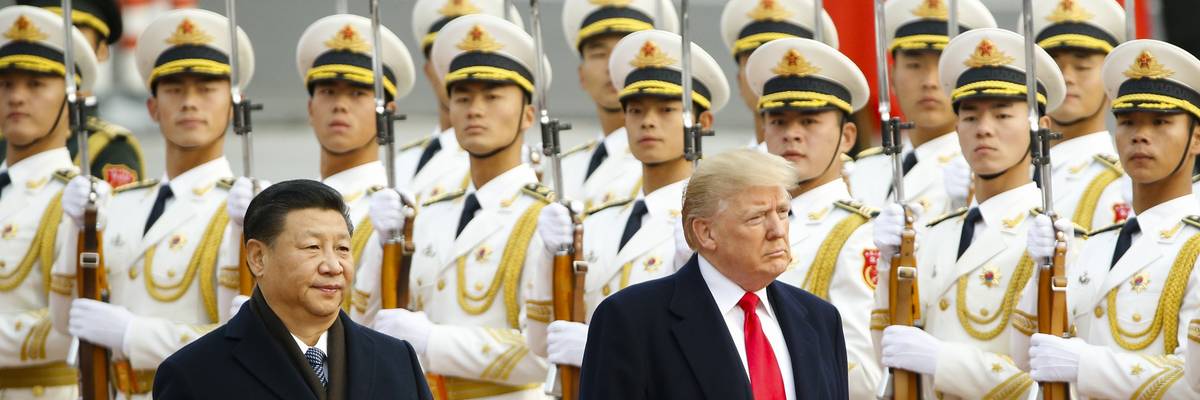
US President Donald Trump takes part in a welcoming ceremony with China's President Xi Jinping on November 9, 2017 in Beijing, China. Trump is on a 10-day trip to Asia.
Why the current stalemate in the Persian Gulf could very well spell the official beginning of the multipolar world we've heard so much about.
The war launched by Israel and the United States on Iran on February 28 has already proven a turning point in world history. So many elements of geopolitics have coalesced in it that we won’t understand its full significance for some time to come. A ceasefire, especially one as chaotic and fragile as this one, is not the end of war, so the new realities may soon be replaced by others. But safe to say that none of the countries of the regions directly impacted by this war so far—from the Levant and the Persian Gulf all the way to South Asia, and of course the United States and Israel—will be able to return to the status quo antebellum. The abrupt withdrawal of the United Arab Emirates (UAE) from OPEC in late April has already destabilized the Saudi-led oil cartel, and with Emiratis doubling down on their alliance with Israel, the future of the Gulf Cooperation Council (GCC) itself is now uncertain. No one can reliably predict whether the glitzy global lifestyles of the Gulf countries, those of the UAE in particular, will survive long-term the shock they have received via Iranian missiles and drones. It is likely that the economic impact of the closure of the Strait of Hormuz and the damage to energy infrastructure throughout the Gulf will be felt in far corners of the world for years in unpredictable ways. Already, crisis conditions exist in many countries, especially in the Global South—power and food shortages and higher prices across the board.
Marine traffic may start to flow safely again through the strait at some point, but on whose terms will that be? Certainly not those of the United States, whose leaders are only starting to realize that they cannot conclude the hostilities as and when they see fit. Iran has used the hiatus in active fighting to begin to develop, in consultation with Russia, China, and Oman, a new framework for governance over the strait. No one should doubt that China and Russia have sided with Iran in the war, though each did so “without showing its hand,” to put it in war-gaming language. Aside from openly condemning what it called unprovoked aggression, Russia maintained a balanced posture. China has kept an even lower profile, leading to many supporters of Iran asking why it was not coming to the latter’s aid as it was battered by two of the most powerful militaries. But a few days into the war, The New York Times reported on concrete US intelligence that Russia was providing Iran with actionable information on US targets across the Gulf. In early May, the Times reported that the Caspian Sea has become a route for Russian supplies for Iran’s drone production.
And China’s involvement, however concealed, could be sensed even before the war in the fact that in January Iran moved from the US-owned GPS to the more advanced Chinese BeiDou satellite constellation. It has also been reported by The Financial Times that in late 2024, Iran’s Islamic Revolutionary Guard Corps (IRGC) took possession of a high-resolution Earth-observation satellite from a Chinese company, delivered to it mid-orbit and hence fully functional. This report was denied by the Chinese government. But if true, it would mean that the US is facing in war for the first time ever an adversary that has access to satellite imagery as precise as its own. So, it is likely that China has aided Iran in the same way it helped Pakistan in May last year in its conflict with India, assistance that was confirmed at the time by the latter’s military: quietly sharing its space-, cyber- and electromagnetic-spectrum capabilities. It cannot be denied that Iran has deployed its missiles and drones with unexpected accuracy.
The closure of the Strait of Hormuz and the damage to energy infrastructure throughout the Gulf will be felt in far corners of the world for years in unpredictable ways.
The confrontations in South Asia and the Gulf over the last year are in fact linked in one other way: its performance in the war with its much larger neighbor and traditional adversary raised Pakistan’s geopolitical stature in the region to the point that it could present itself as a mediator in the Iran war when the need arose for one, a surprising turnaround for what has often been considered in the West something akin to a rogue nation. But the Pakistani military establishment has long experience of ingratiating US administrations without surrendering its own interests, and in Trump, his family, and allies seems to have met an equal partner in corruption. China and Russia did finally “show their hand” on April 7 but on a diplomatic battleground in Manhattan, far from the kinetic battlespace of the Gulf. They both vetoed Bahrain’s Security Council resolution, which called for Iran to unilaterally relinquish its control over the Strait of Hormuz but made no mention of the launching of the war against it during ongoing nuclear negotiations. Obviously, just one country’s veto would have sufficed. A point had been made.
A movement of the geopolitical tectonic plates is perceptible in these developments, and it doesn’t appear to be favorable to the powers that launched this war. Whatever the agreements, if any, that materialize from the Islamabad process, Iran has demonstrated its capacity for closing and opening the strait at will and may emerge from the war as a major regional power which can control 20 percent of the world’s oil and LNG production and other vital supply chains. If this happens, Israel’s war on Iran, intended to give it the ability to act at will throughout the region, will have resulted in failure. Given his own domestic political and legal vulnerabilities as an election approaches, can Prime Minister Benjamin Netanyahu afford to let that happen? And can US President Donald Trump prevent Netanyahu from scuttling any agreement he might be willing to sign with the Iranians to evade his own political reckoning in the fall mid-terms? The peace of the world depends on how these questions are answered. Israel itself appears very unimpressive relative to Iran at this moment, busy killing civilians and bulldozing villages north of its border in Lebanon while Iran strengthens its geopolitical position.
By successfully backing Pakistan without showing its hand last May, China had already staked a claim to being a preeminent power in South Asia. And repeating that strategy now with Iran, it has made a bid for a similar position in the Persian Gulf and Middle East. Observers have argued for some time, and we have all vaguely sensed, that we now live in a multipolar world, not the unipolar one of the Post-Cold War years, with the US as singular global hegemon. But when exactly did this passage take place? Some date the end of US unipolarity to Xi Jinping’s speech to the 19th National Congress of the Communist Party in 2017; others, to the beginning of China’s Road and Belt Initiative in 2013, which now includes more than 140 countries worldwide. Regardless of which hypothesis turns out to be the more convincing one, the “rise” of China and its alliance with Russia are obviously at the core of this ongoing geopolitical transition.
Soon after Donald Trump’s “Liberation Day” last year, which tore up the global trade regime, China had already calmly forced a retreat, decisively weaponizing its unassailable position in global supply chains. But some in Washington still act as if geopolitics today are the way they were described by Zbigniew Brzezinsky in 1997, in The Grand Chessboard: American Primacy and Its Geostrategic Imperatives, a semiofficial encomium to the unipolar world that was then emerging: he seemed to envision a geopolitical game of chess with effectively one player moving all the pieces. Brzezinski believed (or hoped) that no US administration would be careless enough to allow the formation of an alliance between Russia, China, and Iran to challenge American power in Eurasia, which he considered central to its newfound global “supremacy.” Much the same point had been made in January 1993, by outgoing Secretary of State, Lawrence Eagleburger, in his parting memorandum to his incoming successor, Warren Christopher. That dreaded alliance of the future identified by Eagleburger and Brzezinski is now a reality.
During this war, Iran has suffered enormous physical damage, from which it will take decades to recover, even under the best of postwar conditions. And for the regime in Tehran, even if it looks at mere survival, not unreasonably, as a triumph, this might eventually turn out to be a pyrrhic victory, as the basic problem of legitimacy that it faces with respect to portions of its own citizenry still remains, although it has been temporarily suspended during the war. Nevertheless, it seems to be the case that, quietly backed by Russia and China, Iran has succeeded for now in bringing its powerful foreign foes to a stalemate, a standoff that formally announces the end of the unipolar world. Calls from some “America-firsters” for the US to shrink its global footprint and focus on its own hemisphere are in line with the larger geopolitical changes it is now living through.
During the so-called ceasefire, senior officials from across Europe and the Middle East have been making their way to Moscow and Beijing. We should expect an increase of interest across the Global South in BRICS and the linked Shanghai Security Organization (SCO)—Iran is a full member of both—and their vision of an alternative multipolar world order, which calls for strengthening multilateral institutions, above all the United Nations, while the US acts more and more unilaterally, even when this clearly undermines its own interests. It may turn out that Trump is the last American president to proceed under the presumption of a unipolar world, a vision that has now had a brutal collision with multipolar reality.
Dear Common Dreams reader, It’s been nearly 30 years since I co-founded Common Dreams with my late wife, Lina Newhouser. We had the radical notion that journalism should serve the public good, not corporate profits. It was clear to us from the outset what it would take to build such a project. No paid advertisements. No corporate sponsors. No millionaire publisher telling us what to think or do. Many people said we wouldn't last a year, but we proved those doubters wrong. Together with a tremendous team of journalists and dedicated staff, we built an independent media outlet free from the constraints of profits and corporate control. Our mission has always been simple: To inform. To inspire. To ignite change for the common good. Building Common Dreams was not easy. Our survival was never guaranteed. When you take on the most powerful forces—Wall Street greed, fossil fuel industry destruction, Big Tech lobbyists, and uber-rich oligarchs who have spent billions upon billions rigging the economy and democracy in their favor—the only bulwark you have is supporters who believe in your work. But here’s the urgent message from me today. It's never been this bad out there. And it's never been this hard to keep us going. At the very moment Common Dreams is most needed, the threats we face are intensifying. We need your support now more than ever. We don't accept corporate advertising and never will. We don't have a paywall because we don't think people should be blocked from critical news based on their ability to pay. Everything we do is funded by the donations of readers like you. When everyone does the little they can afford, we are strong. But if that support retreats or dries up, so do we. Will you donate now to make sure Common Dreams not only survives but thrives? —Craig Brown, Co-founder |
The war launched by Israel and the United States on Iran on February 28 has already proven a turning point in world history. So many elements of geopolitics have coalesced in it that we won’t understand its full significance for some time to come. A ceasefire, especially one as chaotic and fragile as this one, is not the end of war, so the new realities may soon be replaced by others. But safe to say that none of the countries of the regions directly impacted by this war so far—from the Levant and the Persian Gulf all the way to South Asia, and of course the United States and Israel—will be able to return to the status quo antebellum. The abrupt withdrawal of the United Arab Emirates (UAE) from OPEC in late April has already destabilized the Saudi-led oil cartel, and with Emiratis doubling down on their alliance with Israel, the future of the Gulf Cooperation Council (GCC) itself is now uncertain. No one can reliably predict whether the glitzy global lifestyles of the Gulf countries, those of the UAE in particular, will survive long-term the shock they have received via Iranian missiles and drones. It is likely that the economic impact of the closure of the Strait of Hormuz and the damage to energy infrastructure throughout the Gulf will be felt in far corners of the world for years in unpredictable ways. Already, crisis conditions exist in many countries, especially in the Global South—power and food shortages and higher prices across the board.
Marine traffic may start to flow safely again through the strait at some point, but on whose terms will that be? Certainly not those of the United States, whose leaders are only starting to realize that they cannot conclude the hostilities as and when they see fit. Iran has used the hiatus in active fighting to begin to develop, in consultation with Russia, China, and Oman, a new framework for governance over the strait. No one should doubt that China and Russia have sided with Iran in the war, though each did so “without showing its hand,” to put it in war-gaming language. Aside from openly condemning what it called unprovoked aggression, Russia maintained a balanced posture. China has kept an even lower profile, leading to many supporters of Iran asking why it was not coming to the latter’s aid as it was battered by two of the most powerful militaries. But a few days into the war, The New York Times reported on concrete US intelligence that Russia was providing Iran with actionable information on US targets across the Gulf. In early May, the Times reported that the Caspian Sea has become a route for Russian supplies for Iran’s drone production.
And China’s involvement, however concealed, could be sensed even before the war in the fact that in January Iran moved from the US-owned GPS to the more advanced Chinese BeiDou satellite constellation. It has also been reported by The Financial Times that in late 2024, Iran’s Islamic Revolutionary Guard Corps (IRGC) took possession of a high-resolution Earth-observation satellite from a Chinese company, delivered to it mid-orbit and hence fully functional. This report was denied by the Chinese government. But if true, it would mean that the US is facing in war for the first time ever an adversary that has access to satellite imagery as precise as its own. So, it is likely that China has aided Iran in the same way it helped Pakistan in May last year in its conflict with India, assistance that was confirmed at the time by the latter’s military: quietly sharing its space-, cyber- and electromagnetic-spectrum capabilities. It cannot be denied that Iran has deployed its missiles and drones with unexpected accuracy.
The closure of the Strait of Hormuz and the damage to energy infrastructure throughout the Gulf will be felt in far corners of the world for years in unpredictable ways.
The confrontations in South Asia and the Gulf over the last year are in fact linked in one other way: its performance in the war with its much larger neighbor and traditional adversary raised Pakistan’s geopolitical stature in the region to the point that it could present itself as a mediator in the Iran war when the need arose for one, a surprising turnaround for what has often been considered in the West something akin to a rogue nation. But the Pakistani military establishment has long experience of ingratiating US administrations without surrendering its own interests, and in Trump, his family, and allies seems to have met an equal partner in corruption. China and Russia did finally “show their hand” on April 7 but on a diplomatic battleground in Manhattan, far from the kinetic battlespace of the Gulf. They both vetoed Bahrain’s Security Council resolution, which called for Iran to unilaterally relinquish its control over the Strait of Hormuz but made no mention of the launching of the war against it during ongoing nuclear negotiations. Obviously, just one country’s veto would have sufficed. A point had been made.
A movement of the geopolitical tectonic plates is perceptible in these developments, and it doesn’t appear to be favorable to the powers that launched this war. Whatever the agreements, if any, that materialize from the Islamabad process, Iran has demonstrated its capacity for closing and opening the strait at will and may emerge from the war as a major regional power which can control 20 percent of the world’s oil and LNG production and other vital supply chains. If this happens, Israel’s war on Iran, intended to give it the ability to act at will throughout the region, will have resulted in failure. Given his own domestic political and legal vulnerabilities as an election approaches, can Prime Minister Benjamin Netanyahu afford to let that happen? And can US President Donald Trump prevent Netanyahu from scuttling any agreement he might be willing to sign with the Iranians to evade his own political reckoning in the fall mid-terms? The peace of the world depends on how these questions are answered. Israel itself appears very unimpressive relative to Iran at this moment, busy killing civilians and bulldozing villages north of its border in Lebanon while Iran strengthens its geopolitical position.
By successfully backing Pakistan without showing its hand last May, China had already staked a claim to being a preeminent power in South Asia. And repeating that strategy now with Iran, it has made a bid for a similar position in the Persian Gulf and Middle East. Observers have argued for some time, and we have all vaguely sensed, that we now live in a multipolar world, not the unipolar one of the Post-Cold War years, with the US as singular global hegemon. But when exactly did this passage take place? Some date the end of US unipolarity to Xi Jinping’s speech to the 19th National Congress of the Communist Party in 2017; others, to the beginning of China’s Road and Belt Initiative in 2013, which now includes more than 140 countries worldwide. Regardless of which hypothesis turns out to be the more convincing one, the “rise” of China and its alliance with Russia are obviously at the core of this ongoing geopolitical transition.
Soon after Donald Trump’s “Liberation Day” last year, which tore up the global trade regime, China had already calmly forced a retreat, decisively weaponizing its unassailable position in global supply chains. But some in Washington still act as if geopolitics today are the way they were described by Zbigniew Brzezinsky in 1997, in The Grand Chessboard: American Primacy and Its Geostrategic Imperatives, a semiofficial encomium to the unipolar world that was then emerging: he seemed to envision a geopolitical game of chess with effectively one player moving all the pieces. Brzezinski believed (or hoped) that no US administration would be careless enough to allow the formation of an alliance between Russia, China, and Iran to challenge American power in Eurasia, which he considered central to its newfound global “supremacy.” Much the same point had been made in January 1993, by outgoing Secretary of State, Lawrence Eagleburger, in his parting memorandum to his incoming successor, Warren Christopher. That dreaded alliance of the future identified by Eagleburger and Brzezinski is now a reality.
During this war, Iran has suffered enormous physical damage, from which it will take decades to recover, even under the best of postwar conditions. And for the regime in Tehran, even if it looks at mere survival, not unreasonably, as a triumph, this might eventually turn out to be a pyrrhic victory, as the basic problem of legitimacy that it faces with respect to portions of its own citizenry still remains, although it has been temporarily suspended during the war. Nevertheless, it seems to be the case that, quietly backed by Russia and China, Iran has succeeded for now in bringing its powerful foreign foes to a stalemate, a standoff that formally announces the end of the unipolar world. Calls from some “America-firsters” for the US to shrink its global footprint and focus on its own hemisphere are in line with the larger geopolitical changes it is now living through.
During the so-called ceasefire, senior officials from across Europe and the Middle East have been making their way to Moscow and Beijing. We should expect an increase of interest across the Global South in BRICS and the linked Shanghai Security Organization (SCO)—Iran is a full member of both—and their vision of an alternative multipolar world order, which calls for strengthening multilateral institutions, above all the United Nations, while the US acts more and more unilaterally, even when this clearly undermines its own interests. It may turn out that Trump is the last American president to proceed under the presumption of a unipolar world, a vision that has now had a brutal collision with multipolar reality.
The war launched by Israel and the United States on Iran on February 28 has already proven a turning point in world history. So many elements of geopolitics have coalesced in it that we won’t understand its full significance for some time to come. A ceasefire, especially one as chaotic and fragile as this one, is not the end of war, so the new realities may soon be replaced by others. But safe to say that none of the countries of the regions directly impacted by this war so far—from the Levant and the Persian Gulf all the way to South Asia, and of course the United States and Israel—will be able to return to the status quo antebellum. The abrupt withdrawal of the United Arab Emirates (UAE) from OPEC in late April has already destabilized the Saudi-led oil cartel, and with Emiratis doubling down on their alliance with Israel, the future of the Gulf Cooperation Council (GCC) itself is now uncertain. No one can reliably predict whether the glitzy global lifestyles of the Gulf countries, those of the UAE in particular, will survive long-term the shock they have received via Iranian missiles and drones. It is likely that the economic impact of the closure of the Strait of Hormuz and the damage to energy infrastructure throughout the Gulf will be felt in far corners of the world for years in unpredictable ways. Already, crisis conditions exist in many countries, especially in the Global South—power and food shortages and higher prices across the board.
Marine traffic may start to flow safely again through the strait at some point, but on whose terms will that be? Certainly not those of the United States, whose leaders are only starting to realize that they cannot conclude the hostilities as and when they see fit. Iran has used the hiatus in active fighting to begin to develop, in consultation with Russia, China, and Oman, a new framework for governance over the strait. No one should doubt that China and Russia have sided with Iran in the war, though each did so “without showing its hand,” to put it in war-gaming language. Aside from openly condemning what it called unprovoked aggression, Russia maintained a balanced posture. China has kept an even lower profile, leading to many supporters of Iran asking why it was not coming to the latter’s aid as it was battered by two of the most powerful militaries. But a few days into the war, The New York Times reported on concrete US intelligence that Russia was providing Iran with actionable information on US targets across the Gulf. In early May, the Times reported that the Caspian Sea has become a route for Russian supplies for Iran’s drone production.
And China’s involvement, however concealed, could be sensed even before the war in the fact that in January Iran moved from the US-owned GPS to the more advanced Chinese BeiDou satellite constellation. It has also been reported by The Financial Times that in late 2024, Iran’s Islamic Revolutionary Guard Corps (IRGC) took possession of a high-resolution Earth-observation satellite from a Chinese company, delivered to it mid-orbit and hence fully functional. This report was denied by the Chinese government. But if true, it would mean that the US is facing in war for the first time ever an adversary that has access to satellite imagery as precise as its own. So, it is likely that China has aided Iran in the same way it helped Pakistan in May last year in its conflict with India, assistance that was confirmed at the time by the latter’s military: quietly sharing its space-, cyber- and electromagnetic-spectrum capabilities. It cannot be denied that Iran has deployed its missiles and drones with unexpected accuracy.
The closure of the Strait of Hormuz and the damage to energy infrastructure throughout the Gulf will be felt in far corners of the world for years in unpredictable ways.
The confrontations in South Asia and the Gulf over the last year are in fact linked in one other way: its performance in the war with its much larger neighbor and traditional adversary raised Pakistan’s geopolitical stature in the region to the point that it could present itself as a mediator in the Iran war when the need arose for one, a surprising turnaround for what has often been considered in the West something akin to a rogue nation. But the Pakistani military establishment has long experience of ingratiating US administrations without surrendering its own interests, and in Trump, his family, and allies seems to have met an equal partner in corruption. China and Russia did finally “show their hand” on April 7 but on a diplomatic battleground in Manhattan, far from the kinetic battlespace of the Gulf. They both vetoed Bahrain’s Security Council resolution, which called for Iran to unilaterally relinquish its control over the Strait of Hormuz but made no mention of the launching of the war against it during ongoing nuclear negotiations. Obviously, just one country’s veto would have sufficed. A point had been made.
A movement of the geopolitical tectonic plates is perceptible in these developments, and it doesn’t appear to be favorable to the powers that launched this war. Whatever the agreements, if any, that materialize from the Islamabad process, Iran has demonstrated its capacity for closing and opening the strait at will and may emerge from the war as a major regional power which can control 20 percent of the world’s oil and LNG production and other vital supply chains. If this happens, Israel’s war on Iran, intended to give it the ability to act at will throughout the region, will have resulted in failure. Given his own domestic political and legal vulnerabilities as an election approaches, can Prime Minister Benjamin Netanyahu afford to let that happen? And can US President Donald Trump prevent Netanyahu from scuttling any agreement he might be willing to sign with the Iranians to evade his own political reckoning in the fall mid-terms? The peace of the world depends on how these questions are answered. Israel itself appears very unimpressive relative to Iran at this moment, busy killing civilians and bulldozing villages north of its border in Lebanon while Iran strengthens its geopolitical position.
By successfully backing Pakistan without showing its hand last May, China had already staked a claim to being a preeminent power in South Asia. And repeating that strategy now with Iran, it has made a bid for a similar position in the Persian Gulf and Middle East. Observers have argued for some time, and we have all vaguely sensed, that we now live in a multipolar world, not the unipolar one of the Post-Cold War years, with the US as singular global hegemon. But when exactly did this passage take place? Some date the end of US unipolarity to Xi Jinping’s speech to the 19th National Congress of the Communist Party in 2017; others, to the beginning of China’s Road and Belt Initiative in 2013, which now includes more than 140 countries worldwide. Regardless of which hypothesis turns out to be the more convincing one, the “rise” of China and its alliance with Russia are obviously at the core of this ongoing geopolitical transition.
Soon after Donald Trump’s “Liberation Day” last year, which tore up the global trade regime, China had already calmly forced a retreat, decisively weaponizing its unassailable position in global supply chains. But some in Washington still act as if geopolitics today are the way they were described by Zbigniew Brzezinsky in 1997, in The Grand Chessboard: American Primacy and Its Geostrategic Imperatives, a semiofficial encomium to the unipolar world that was then emerging: he seemed to envision a geopolitical game of chess with effectively one player moving all the pieces. Brzezinski believed (or hoped) that no US administration would be careless enough to allow the formation of an alliance between Russia, China, and Iran to challenge American power in Eurasia, which he considered central to its newfound global “supremacy.” Much the same point had been made in January 1993, by outgoing Secretary of State, Lawrence Eagleburger, in his parting memorandum to his incoming successor, Warren Christopher. That dreaded alliance of the future identified by Eagleburger and Brzezinski is now a reality.
During this war, Iran has suffered enormous physical damage, from which it will take decades to recover, even under the best of postwar conditions. And for the regime in Tehran, even if it looks at mere survival, not unreasonably, as a triumph, this might eventually turn out to be a pyrrhic victory, as the basic problem of legitimacy that it faces with respect to portions of its own citizenry still remains, although it has been temporarily suspended during the war. Nevertheless, it seems to be the case that, quietly backed by Russia and China, Iran has succeeded for now in bringing its powerful foreign foes to a stalemate, a standoff that formally announces the end of the unipolar world. Calls from some “America-firsters” for the US to shrink its global footprint and focus on its own hemisphere are in line with the larger geopolitical changes it is now living through.
During the so-called ceasefire, senior officials from across Europe and the Middle East have been making their way to Moscow and Beijing. We should expect an increase of interest across the Global South in BRICS and the linked Shanghai Security Organization (SCO)—Iran is a full member of both—and their vision of an alternative multipolar world order, which calls for strengthening multilateral institutions, above all the United Nations, while the US acts more and more unilaterally, even when this clearly undermines its own interests. It may turn out that Trump is the last American president to proceed under the presumption of a unipolar world, a vision that has now had a brutal collision with multipolar reality.