SUBSCRIBE TO OUR FREE NEWSLETTER
Daily news & progressive opinion—funded by the people, not the corporations—delivered straight to your inbox.
5
#000000
#FFFFFF
To donate by check, phone, or other method, see our More Ways to Give page.
Daily news & progressive opinion—funded by the people, not the corporations—delivered straight to your inbox.
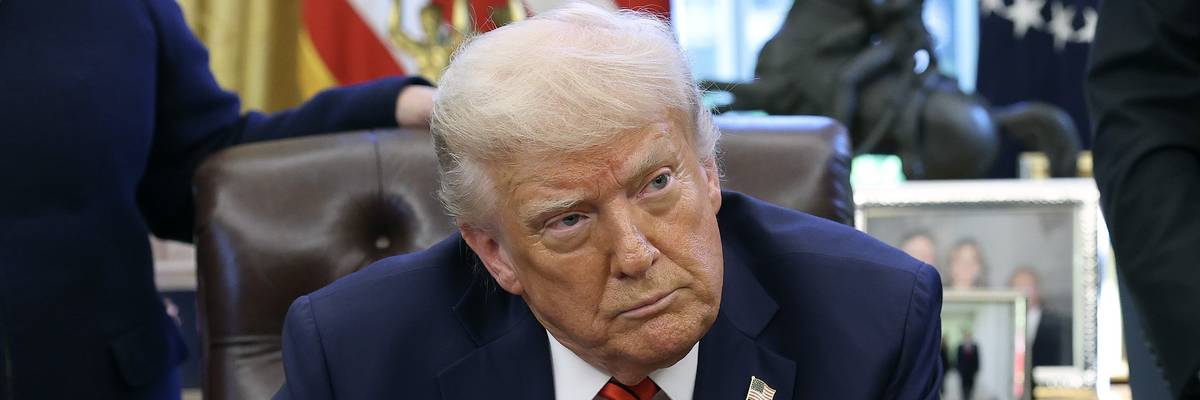
U.S. President Donald Trump speaks to reporters after signing a proclamation in the Oval Office at the White House on April 17, 2025 in Washington, D.C.
A whopping 72% of respondents said that they believe it is "likely" that Trump's policies will cause an economic recession in the short term.
As U.S. President Donald Trump nears the 100-day mark of his second term, a recent ABC News/Washington Post/Ipsos poll shows that his approval rating now sits at a historic low of 39%, a nadir that prompted one prominent progressive to remark that the negative public sentiment comes as "the resistance is just beginning."
Sen. Bernie Sanders (I-Vt.), who has mounted a highly successful "Fighting Oligarchy" tour across America in recent months, highlighted the findings of the poll on Sunday and wrote: "The American people do not want oligarchy, authoritarianism, or attacks on Social Security, Medicaid, or the VA," speaking of the U.S. Department of Veterans Affairs.
The poll, which conducted a random national sample of 2,464 adults in English and Spanish between April 18-22, found discontent among voters when it comes to Trump's handling of multiple policies issues, particularly on the economy.
A whopping 72% of respondents said that they believe it is "likely" that Trump's policies—such as sweeping tariffs—will cause an economic recession in the short term.
What's more, 53% say the economy is worse since Trump took office and 62% said that the prices for things they rely on have gone up.
Trump's overall approval on immigration policy, one of his core campaign issues, is also less than 50%. When it comes to his handling of immigration—an area where Trump has moved to roll back birthright citizenship, deported U.S. citizens, and invoked a rarely used wartime authority to deport Venezuelan nationals to a megaprison in El Salvador, among other measures—his approval rating sits at 46%, according to the ABC News/Washington Post/Ipsos poll.
Additionally, over 55% of Americans say Trump is "going too far" when it comes to seeking to expand the power of the presidency, closing federal agencies, laying off federal employees to reduce the size of government, and taking measures agains this political foes.
Overall, his approval among Americans has dipped from 45% positive in February to 39% positive on the eve of the 100-day mark, which is on Tuesday.
According to The Washington Post's analysis of the poll results, Trump's approval at 100 days in both of his terms is lower than any other president's at or near the 100-day mark "since polls began." Polling data on this question stretches back to former President Franklin Delano Roosevelt's (FDR) third term, per the Post, when his approval rating was at 68% at the 100-day point. ABC News' write up of the poll results says that "Trump has the lowest 100-day job approval rating of any president in the past 80 years."
Some have drawn parallels between Trump and FDR, whose first 15 weeks in office in 1933 were dominated by a push to work with Congress on economic recovery and relief for working people, the first phase of what's known as the "New Deal." However, historians have noted that in substance the two could not be more different.
In reporting piece published Monday, the Post noted that Roosevelt's push in the first 100 days led to major new laws, while Trump largely relies on executive order.
"Roosevelt spent an awful lot of time trying to craft constitutional justifications in legislation, and draft it in such a way that the courts might accept it," Anthony Badger, a historian and author of FDR: The First Hundred Days, told the Post. "He wasn't trying to do it by executive order."
The historian and author Eric Rauchway told CNN recently that substantively Trump's policies are the "opposite of the New Deal."
Trump "seems to be taking apart regulatory mechanisms. He seems to be drawing down public investment in a variety of areas, including the arts and so forth. He seems to be, as far as I can tell, diminishing resources sent to the Social Security Administration, which of course is the central piece of the New Deal’s proto-welfare state," Racuhway told the outlet.
In a similar vein to Sanders, former Labor Secretary Robert Reich wrote Monday that Trump's actions in his first 100 days serves as a call to mobilization and to "loudly and boldly sound the alarm."
"The U.S. Constitution is in peril. Civil and human rights are being trampled upon. The economy is in disarray," wrote Reich. "At this rate, we won't make it through the second hundred days."
Reich suggested that that answer is for Americans to speak out and urge lawmakers in Congress, both chambers of which are currently GOP-controlled, to launch impeachment proceedings against Trump.
"Americans must be mobilized into such a huge wave of anger and disgust that members of the House are compelled to impeach Trump (for the third time) and enough senators are moved to finally convict him," he concluded.
Dear Common Dreams reader, It’s been nearly 30 years since I co-founded Common Dreams with my late wife, Lina Newhouser. We had the radical notion that journalism should serve the public good, not corporate profits. It was clear to us from the outset what it would take to build such a project. No paid advertisements. No corporate sponsors. No millionaire publisher telling us what to think or do. Many people said we wouldn't last a year, but we proved those doubters wrong. Together with a tremendous team of journalists and dedicated staff, we built an independent media outlet free from the constraints of profits and corporate control. Our mission has always been simple: To inform. To inspire. To ignite change for the common good. Building Common Dreams was not easy. Our survival was never guaranteed. When you take on the most powerful forces—Wall Street greed, fossil fuel industry destruction, Big Tech lobbyists, and uber-rich oligarchs who have spent billions upon billions rigging the economy and democracy in their favor—the only bulwark you have is supporters who believe in your work. But here’s the urgent message from me today. It's never been this bad out there. And it's never been this hard to keep us going. At the very moment Common Dreams is most needed, the threats we face are intensifying. We need your support now more than ever. We don't accept corporate advertising and never will. We don't have a paywall because we don't think people should be blocked from critical news based on their ability to pay. Everything we do is funded by the donations of readers like you. When everyone does the little they can afford, we are strong. But if that support retreats or dries up, so do we. Will you donate now to make sure Common Dreams not only survives but thrives? —Craig Brown, Co-founder |
As U.S. President Donald Trump nears the 100-day mark of his second term, a recent ABC News/Washington Post/Ipsos poll shows that his approval rating now sits at a historic low of 39%, a nadir that prompted one prominent progressive to remark that the negative public sentiment comes as "the resistance is just beginning."
Sen. Bernie Sanders (I-Vt.), who has mounted a highly successful "Fighting Oligarchy" tour across America in recent months, highlighted the findings of the poll on Sunday and wrote: "The American people do not want oligarchy, authoritarianism, or attacks on Social Security, Medicaid, or the VA," speaking of the U.S. Department of Veterans Affairs.
The poll, which conducted a random national sample of 2,464 adults in English and Spanish between April 18-22, found discontent among voters when it comes to Trump's handling of multiple policies issues, particularly on the economy.
A whopping 72% of respondents said that they believe it is "likely" that Trump's policies—such as sweeping tariffs—will cause an economic recession in the short term.
What's more, 53% say the economy is worse since Trump took office and 62% said that the prices for things they rely on have gone up.
Trump's overall approval on immigration policy, one of his core campaign issues, is also less than 50%. When it comes to his handling of immigration—an area where Trump has moved to roll back birthright citizenship, deported U.S. citizens, and invoked a rarely used wartime authority to deport Venezuelan nationals to a megaprison in El Salvador, among other measures—his approval rating sits at 46%, according to the ABC News/Washington Post/Ipsos poll.
Additionally, over 55% of Americans say Trump is "going too far" when it comes to seeking to expand the power of the presidency, closing federal agencies, laying off federal employees to reduce the size of government, and taking measures agains this political foes.
Overall, his approval among Americans has dipped from 45% positive in February to 39% positive on the eve of the 100-day mark, which is on Tuesday.
According to The Washington Post's analysis of the poll results, Trump's approval at 100 days in both of his terms is lower than any other president's at or near the 100-day mark "since polls began." Polling data on this question stretches back to former President Franklin Delano Roosevelt's (FDR) third term, per the Post, when his approval rating was at 68% at the 100-day point. ABC News' write up of the poll results says that "Trump has the lowest 100-day job approval rating of any president in the past 80 years."
Some have drawn parallels between Trump and FDR, whose first 15 weeks in office in 1933 were dominated by a push to work with Congress on economic recovery and relief for working people, the first phase of what's known as the "New Deal." However, historians have noted that in substance the two could not be more different.
In reporting piece published Monday, the Post noted that Roosevelt's push in the first 100 days led to major new laws, while Trump largely relies on executive order.
"Roosevelt spent an awful lot of time trying to craft constitutional justifications in legislation, and draft it in such a way that the courts might accept it," Anthony Badger, a historian and author of FDR: The First Hundred Days, told the Post. "He wasn't trying to do it by executive order."
The historian and author Eric Rauchway told CNN recently that substantively Trump's policies are the "opposite of the New Deal."
Trump "seems to be taking apart regulatory mechanisms. He seems to be drawing down public investment in a variety of areas, including the arts and so forth. He seems to be, as far as I can tell, diminishing resources sent to the Social Security Administration, which of course is the central piece of the New Deal’s proto-welfare state," Racuhway told the outlet.
In a similar vein to Sanders, former Labor Secretary Robert Reich wrote Monday that Trump's actions in his first 100 days serves as a call to mobilization and to "loudly and boldly sound the alarm."
"The U.S. Constitution is in peril. Civil and human rights are being trampled upon. The economy is in disarray," wrote Reich. "At this rate, we won't make it through the second hundred days."
Reich suggested that that answer is for Americans to speak out and urge lawmakers in Congress, both chambers of which are currently GOP-controlled, to launch impeachment proceedings against Trump.
"Americans must be mobilized into such a huge wave of anger and disgust that members of the House are compelled to impeach Trump (for the third time) and enough senators are moved to finally convict him," he concluded.
As U.S. President Donald Trump nears the 100-day mark of his second term, a recent ABC News/Washington Post/Ipsos poll shows that his approval rating now sits at a historic low of 39%, a nadir that prompted one prominent progressive to remark that the negative public sentiment comes as "the resistance is just beginning."
Sen. Bernie Sanders (I-Vt.), who has mounted a highly successful "Fighting Oligarchy" tour across America in recent months, highlighted the findings of the poll on Sunday and wrote: "The American people do not want oligarchy, authoritarianism, or attacks on Social Security, Medicaid, or the VA," speaking of the U.S. Department of Veterans Affairs.
The poll, which conducted a random national sample of 2,464 adults in English and Spanish between April 18-22, found discontent among voters when it comes to Trump's handling of multiple policies issues, particularly on the economy.
A whopping 72% of respondents said that they believe it is "likely" that Trump's policies—such as sweeping tariffs—will cause an economic recession in the short term.
What's more, 53% say the economy is worse since Trump took office and 62% said that the prices for things they rely on have gone up.
Trump's overall approval on immigration policy, one of his core campaign issues, is also less than 50%. When it comes to his handling of immigration—an area where Trump has moved to roll back birthright citizenship, deported U.S. citizens, and invoked a rarely used wartime authority to deport Venezuelan nationals to a megaprison in El Salvador, among other measures—his approval rating sits at 46%, according to the ABC News/Washington Post/Ipsos poll.
Additionally, over 55% of Americans say Trump is "going too far" when it comes to seeking to expand the power of the presidency, closing federal agencies, laying off federal employees to reduce the size of government, and taking measures agains this political foes.
Overall, his approval among Americans has dipped from 45% positive in February to 39% positive on the eve of the 100-day mark, which is on Tuesday.
According to The Washington Post's analysis of the poll results, Trump's approval at 100 days in both of his terms is lower than any other president's at or near the 100-day mark "since polls began." Polling data on this question stretches back to former President Franklin Delano Roosevelt's (FDR) third term, per the Post, when his approval rating was at 68% at the 100-day point. ABC News' write up of the poll results says that "Trump has the lowest 100-day job approval rating of any president in the past 80 years."
Some have drawn parallels between Trump and FDR, whose first 15 weeks in office in 1933 were dominated by a push to work with Congress on economic recovery and relief for working people, the first phase of what's known as the "New Deal." However, historians have noted that in substance the two could not be more different.
In reporting piece published Monday, the Post noted that Roosevelt's push in the first 100 days led to major new laws, while Trump largely relies on executive order.
"Roosevelt spent an awful lot of time trying to craft constitutional justifications in legislation, and draft it in such a way that the courts might accept it," Anthony Badger, a historian and author of FDR: The First Hundred Days, told the Post. "He wasn't trying to do it by executive order."
The historian and author Eric Rauchway told CNN recently that substantively Trump's policies are the "opposite of the New Deal."
Trump "seems to be taking apart regulatory mechanisms. He seems to be drawing down public investment in a variety of areas, including the arts and so forth. He seems to be, as far as I can tell, diminishing resources sent to the Social Security Administration, which of course is the central piece of the New Deal’s proto-welfare state," Racuhway told the outlet.
In a similar vein to Sanders, former Labor Secretary Robert Reich wrote Monday that Trump's actions in his first 100 days serves as a call to mobilization and to "loudly and boldly sound the alarm."
"The U.S. Constitution is in peril. Civil and human rights are being trampled upon. The economy is in disarray," wrote Reich. "At this rate, we won't make it through the second hundred days."
Reich suggested that that answer is for Americans to speak out and urge lawmakers in Congress, both chambers of which are currently GOP-controlled, to launch impeachment proceedings against Trump.
"Americans must be mobilized into such a huge wave of anger and disgust that members of the House are compelled to impeach Trump (for the third time) and enough senators are moved to finally convict him," he concluded.