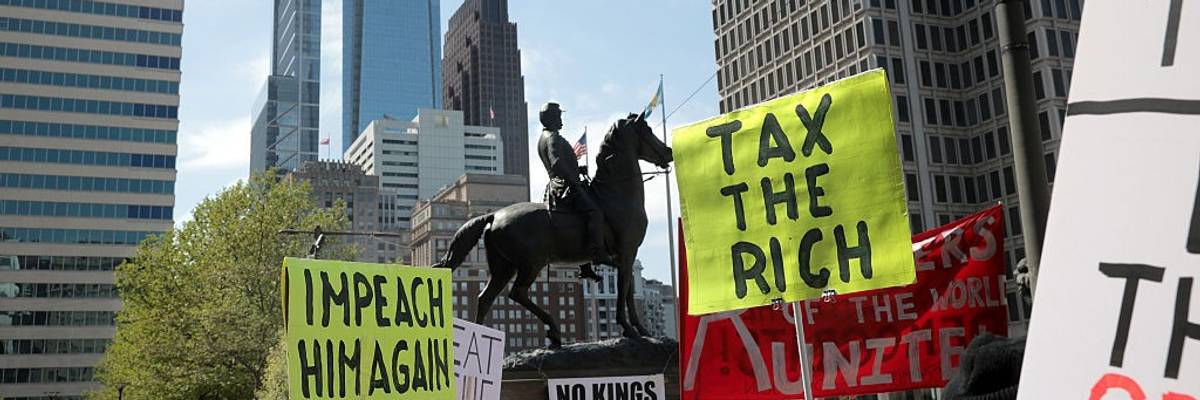
Supporters rally ahead of a Sen. Bernie Sanders (I-Vt.) May Day rally at City Hall on May 1, 2025 in Philadelphia.
As Trump Recession Looms, New WSJ Poll Backs Call for Democrats to Embrace Economic Populism
"It feels like it's on the brink, it's on the precipice of this recession," one economist said this week.
A new poll from The Wall Street Journal released Tuesday is sparking calls on more Democrats to embrace economic populism, as it shows that Americans are still feeling gloomy about their financial prospects.
According to the poll, a record-low 25% of Americans now say they have a good chance at improving their standard of living, while almost 70% said they no longer believe that merely working hard is enough to get ahead.
On top of all this, more than 75% lack confidence that future generations will be better off than they are today.
The poll shows that US President Donald Trump is facing problems similar to the ones that former President Joe Biden faced over his last year in office, in that economic pessimism appears high even as the unemployment rate and the rate of inflation appear low by historical standards.
One major issue that appears to be weighing down economic sentiment is the cost of housing, as The Wall Street Journal writes that "fewer than one-quarter of respondents said they were very confident they could buy a home if they wanted to," while "some 56% said they had little or no confidence they could do so."
Democratic pollster John Anzalone took stock of the poll in a post on X and said that it "shows how important it is for Dems to get a strong economic message" given that "70% of people said they believe the American dream no longer holds true."
Democratic media operative Dan Ancona zeroed in on a question in the poll showing that a majority of Americans agreed with the statement that Trump and the GOP "are trying to scare and divide Americans so they can cut their own taxes and keep wealth flowing to the very rich."
In fact, roughly 27% of respondents who voted for Trump in the 2024 presidential election either somewhat or strongly agreed with that statement. Given this, Ancona called the populist economic framing "a pretty good starting point."
Rep. Ro Khanna (D-Calif.) also jumped at the findings of the WSJ poll and said that stamping out economic inequality in the US needed to be Democrats' priority.
"We must tackle the economic divides tearing our nation apart and make the economic independence of every family and community our highest mission," he declared. "I call it a new economic patriotism."
The WSJ poll showing Americans' sour economic mood comes as more economic forecasters have been raising the odds of a recession hitting the US economy.
Fortune reported on Tuesday that investment bank UBS believes the probability of a recession occurring in the near future has grown significantly in recent months, although it notes there is still a great deal of uncertainty over what the economy will look like in six months.
"The key message is the US economy, by these hard data measures, is locked in a prolonged phase of stagnation or slow contraction, warranting caution even as outright collapse has not yet materialized," wrote Fortune. "This aligns with other analysts' warnings that, even if a recession doesn't materialize, the economy is headed for a bout of 1970s-style 'stagflation,' a combination of a stagnating economy and rising inflation."
Moody's Analytics chief economist Mark Zandi has also been sounding the alarm about the state of the American economy, and he believes state-level data are already showing the US "on the edge of recession," according to Newsweek.
As Zandi explained this week, both California and New York, which together account for over 20% of American gross domestic product, are essentially flat at the moment, while southern states that have been the strongest in terms of economic growth in recent years have been slowing down.
"I don't think the economy is in a recession, at least not at this point," Zandi said in an interview with Newsweek. "But it feels like it's on the brink, it's on the precipice of this recession."
Along with a potential impending recession, former Labor Secretary Robert Reich pointed out that Americans are well aware of structural inequalities.
"CEO pay is up 1,085% since 1978, while worker pay is up just 24%. Millions live paycheck to paycheck as they struggle to afford basic goods," said Reich. "Is it any wonder why 70% of people said they believe the American dream no longer holds true or never did?"
We are at a crossroads
This country and this world are at a monumental crossroads. In a few short weeks, US voters will have an opportunity to beat back the forces of fascism and confront the billionaires who are rigging the economy, our media system, and our democracy, making it increasingly impossible for ordinary people to get by. We’re not just talking about the election. We’re talking about what must be done once these fascist elements are vanquished from power. We need a bolder set of solutions than what either major party has so far been willing to offer and a working-class movement ready to fight like hell for it. Trump didn't emerge from nowhere. The conditions that fueled MAGA authoritarianism were created by decades of radical neoliberal economic policies and a corrupt political system dominated by corporate interests. They slashed taxes on the super-rich, promising that the benefits would trickle down. They said giveaways to the corporate titans would make life more affordable for the rest of us. It was all bullshit. And when a bitter, betrayed populace searches for someone to blame, right-wing demagogues have little trouble finding scapegoats. People know when they're being lied to, but you won't hear any of this from the corporate media. Only independent journalism—powered and funded by people who believe in building a better world—can deliver truly trustworthy daily news. Our Fall Campaign is underway, and we need your help. To power our newsroom through the rest of the year, we need to raise $125,000 by midnight on October 31. So if you share our vision, please contribute whatever you can to sustain our work. |
A new poll from The Wall Street Journal released Tuesday is sparking calls on more Democrats to embrace economic populism, as it shows that Americans are still feeling gloomy about their financial prospects.
According to the poll, a record-low 25% of Americans now say they have a good chance at improving their standard of living, while almost 70% said they no longer believe that merely working hard is enough to get ahead.
On top of all this, more than 75% lack confidence that future generations will be better off than they are today.
The poll shows that US President Donald Trump is facing problems similar to the ones that former President Joe Biden faced over his last year in office, in that economic pessimism appears high even as the unemployment rate and the rate of inflation appear low by historical standards.
One major issue that appears to be weighing down economic sentiment is the cost of housing, as The Wall Street Journal writes that "fewer than one-quarter of respondents said they were very confident they could buy a home if they wanted to," while "some 56% said they had little or no confidence they could do so."
Democratic pollster John Anzalone took stock of the poll in a post on X and said that it "shows how important it is for Dems to get a strong economic message" given that "70% of people said they believe the American dream no longer holds true."
Democratic media operative Dan Ancona zeroed in on a question in the poll showing that a majority of Americans agreed with the statement that Trump and the GOP "are trying to scare and divide Americans so they can cut their own taxes and keep wealth flowing to the very rich."
In fact, roughly 27% of respondents who voted for Trump in the 2024 presidential election either somewhat or strongly agreed with that statement. Given this, Ancona called the populist economic framing "a pretty good starting point."
Rep. Ro Khanna (D-Calif.) also jumped at the findings of the WSJ poll and said that stamping out economic inequality in the US needed to be Democrats' priority.
"We must tackle the economic divides tearing our nation apart and make the economic independence of every family and community our highest mission," he declared. "I call it a new economic patriotism."
The WSJ poll showing Americans' sour economic mood comes as more economic forecasters have been raising the odds of a recession hitting the US economy.
Fortune reported on Tuesday that investment bank UBS believes the probability of a recession occurring in the near future has grown significantly in recent months, although it notes there is still a great deal of uncertainty over what the economy will look like in six months.
"The key message is the US economy, by these hard data measures, is locked in a prolonged phase of stagnation or slow contraction, warranting caution even as outright collapse has not yet materialized," wrote Fortune. "This aligns with other analysts' warnings that, even if a recession doesn't materialize, the economy is headed for a bout of 1970s-style 'stagflation,' a combination of a stagnating economy and rising inflation."
Moody's Analytics chief economist Mark Zandi has also been sounding the alarm about the state of the American economy, and he believes state-level data are already showing the US "on the edge of recession," according to Newsweek.
As Zandi explained this week, both California and New York, which together account for over 20% of American gross domestic product, are essentially flat at the moment, while southern states that have been the strongest in terms of economic growth in recent years have been slowing down.
"I don't think the economy is in a recession, at least not at this point," Zandi said in an interview with Newsweek. "But it feels like it's on the brink, it's on the precipice of this recession."
Along with a potential impending recession, former Labor Secretary Robert Reich pointed out that Americans are well aware of structural inequalities.
"CEO pay is up 1,085% since 1978, while worker pay is up just 24%. Millions live paycheck to paycheck as they struggle to afford basic goods," said Reich. "Is it any wonder why 70% of people said they believe the American dream no longer holds true or never did?"
- Economist Says Fed Warning Shows Trump Driving US Economy 'Toward Disaster' ›
- 'The American People Do Not Want Oligarchy': Poll Shows Trump's Approval at Historic Low at 100-Day Mark ›
- Economic Anxiety of Americans Surges Under Trump: Poll ›
- Polling Shows 'American Families Are Trapped in a Cycle of Debt' | Common Dreams ›
- Trump Economic Approval Hits All-Time Low as White House Official Insists ‘Nothing Bad Is Happening’ | Common Dreams ›
- Opinion | New Polling Shows That the Bottom Has Fallen Out for Trump’s Economic Job Performance | Common Dreams ›
A new poll from The Wall Street Journal released Tuesday is sparking calls on more Democrats to embrace economic populism, as it shows that Americans are still feeling gloomy about their financial prospects.
According to the poll, a record-low 25% of Americans now say they have a good chance at improving their standard of living, while almost 70% said they no longer believe that merely working hard is enough to get ahead.
On top of all this, more than 75% lack confidence that future generations will be better off than they are today.
The poll shows that US President Donald Trump is facing problems similar to the ones that former President Joe Biden faced over his last year in office, in that economic pessimism appears high even as the unemployment rate and the rate of inflation appear low by historical standards.
One major issue that appears to be weighing down economic sentiment is the cost of housing, as The Wall Street Journal writes that "fewer than one-quarter of respondents said they were very confident they could buy a home if they wanted to," while "some 56% said they had little or no confidence they could do so."
Democratic pollster John Anzalone took stock of the poll in a post on X and said that it "shows how important it is for Dems to get a strong economic message" given that "70% of people said they believe the American dream no longer holds true."
Democratic media operative Dan Ancona zeroed in on a question in the poll showing that a majority of Americans agreed with the statement that Trump and the GOP "are trying to scare and divide Americans so they can cut their own taxes and keep wealth flowing to the very rich."
In fact, roughly 27% of respondents who voted for Trump in the 2024 presidential election either somewhat or strongly agreed with that statement. Given this, Ancona called the populist economic framing "a pretty good starting point."
Rep. Ro Khanna (D-Calif.) also jumped at the findings of the WSJ poll and said that stamping out economic inequality in the US needed to be Democrats' priority.
"We must tackle the economic divides tearing our nation apart and make the economic independence of every family and community our highest mission," he declared. "I call it a new economic patriotism."
The WSJ poll showing Americans' sour economic mood comes as more economic forecasters have been raising the odds of a recession hitting the US economy.
Fortune reported on Tuesday that investment bank UBS believes the probability of a recession occurring in the near future has grown significantly in recent months, although it notes there is still a great deal of uncertainty over what the economy will look like in six months.
"The key message is the US economy, by these hard data measures, is locked in a prolonged phase of stagnation or slow contraction, warranting caution even as outright collapse has not yet materialized," wrote Fortune. "This aligns with other analysts' warnings that, even if a recession doesn't materialize, the economy is headed for a bout of 1970s-style 'stagflation,' a combination of a stagnating economy and rising inflation."
Moody's Analytics chief economist Mark Zandi has also been sounding the alarm about the state of the American economy, and he believes state-level data are already showing the US "on the edge of recession," according to Newsweek.
As Zandi explained this week, both California and New York, which together account for over 20% of American gross domestic product, are essentially flat at the moment, while southern states that have been the strongest in terms of economic growth in recent years have been slowing down.
"I don't think the economy is in a recession, at least not at this point," Zandi said in an interview with Newsweek. "But it feels like it's on the brink, it's on the precipice of this recession."
Along with a potential impending recession, former Labor Secretary Robert Reich pointed out that Americans are well aware of structural inequalities.
"CEO pay is up 1,085% since 1978, while worker pay is up just 24%. Millions live paycheck to paycheck as they struggle to afford basic goods," said Reich. "Is it any wonder why 70% of people said they believe the American dream no longer holds true or never did?"
- Economist Says Fed Warning Shows Trump Driving US Economy 'Toward Disaster' ›
- 'The American People Do Not Want Oligarchy': Poll Shows Trump's Approval at Historic Low at 100-Day Mark ›
- Economic Anxiety of Americans Surges Under Trump: Poll ›
- Polling Shows 'American Families Are Trapped in a Cycle of Debt' | Common Dreams ›
- Trump Economic Approval Hits All-Time Low as White House Official Insists ‘Nothing Bad Is Happening’ | Common Dreams ›
- Opinion | New Polling Shows That the Bottom Has Fallen Out for Trump’s Economic Job Performance | Common Dreams ›