SUBSCRIBE TO OUR FREE NEWSLETTER
Daily news & progressive opinion—funded by the people, not the corporations—delivered straight to your inbox.
5
#000000
#FFFFFF
To donate by check, phone, or other method, see our More Ways to Give page.
Daily news & progressive opinion—funded by the people, not the corporations—delivered straight to your inbox.
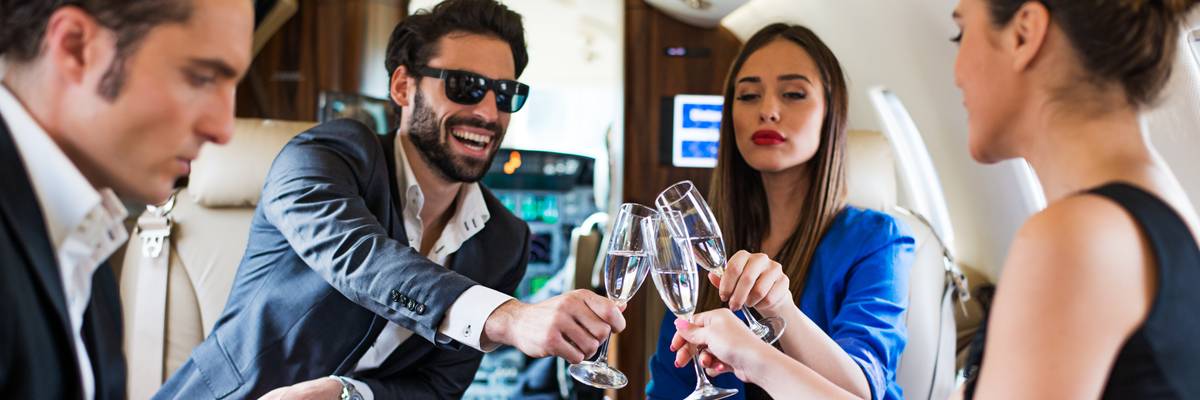
People raise a toast while traveling aboard a private jet in this undated stock photo.
"It’s time to stop making taxpayers subsidize luxury private jet travel and use our resources to green other industries," said one of the report's authors.
A handful of the world's wealthiest people are traveling aboard some of the planet's most polluting vehicles while receiving substantial public subsidies, according to a new report documenting how taxpayers and commercial airline passengers are funding billionaires' private jet lifestyles due to corporate lobbying, tax breaks, and other policies.
The Institute for Policy Studies' (IPS) "High Flyers 2026: The High Cost of Private Jet Excess," released on Friday, notes that only about 256,000 people around the world—roughly 0.003% of the global population—fly on private jets. Yet these ultrawealthy travelers account for a disproportionate share of aviation activity while paying a fraction of the taxes that fund air traffic infrastructure.
According to the report—which is co-authored by Chuck Collins, Omar Ocampo, Kalena Thomhave, and Emily Wagner—private jets and charter services account for roughly 16% of flight operations handled by the US Federal Aviation Administration (FAA), while noncommercial private jets account for about 7% of airspace activity.
NEW: Private jet travel — the most ecologically destructive form of transportation — is increasing among the wealthiest 0.003% of people. Taxpayers and commercial flyers are subsidizing it.It's time to tax this reckless consumption. REPORT:
[image or embed]
— Institute for Policy Studies (@ips-dc.org) September 18, 2026 at 6:05 AM
However, private jets contribute less than 0.6% of the taxes flowing into the Airport and Airway Trust Fund, which helps finance FAA operations.
"We all pay for the harms of private jet excess," the report states. "US taxpayers and commercial air travelers subsidize the luxury private jet transportation sector. Private jets fail to pay their fair share of their use of airspace and the costs of their carbon pollution, shifting the burden to everyone else."
The disparity is particularly stark when the climate consequences of private aviation are taken into account. IPS found that a passenger traveling by private jet is responsible for roughly 10 to 14 times the emissions of a passenger on a commercial airline and around 50 times those of a passenger traveling the same route by rail. On some low-carbon rail systems, the disparity can exceed 200-fold.
"Private jets are the super-polluters. On a warming planet, private jet operations are indefensible," the report's authors wrote. "Private jets account for a small sliver of aviation activity, but they are the most polluting form of transport and represent the fastest-growing segment of aviation emissions."
The report also found that at least half of private jet operations are for recreational, vacation, and personal luxury travel.
"The ultrarich and greedy corporations are private jet-setting at the expense of the rest of us," Collins told The Guardian on Friday. "The rest of us should not have to pay for the luxury excess of the private jet billionaire class."
The report comes amid increasing criticism of tax policies that have made private aircraft particularly lucrative investments for wealthy Americans. Last year, US President Donald Trump signed legislation permanently implementing 100% bonus depreciation for qualifying business assets, allowing full tax deductions for certain purchases—including private aircraft—in the year they are acquired.
In a May opinion piece published by Common Dreams, Collins and Wagner slammed what they described as "a massive tax break for billionaires and centimillionaires that use the most polluting form of transportation on the planet."
A corporation that buys a $50 million private jet could potentially deduct the entire purchase price from its taxes in the year of acquisition, meaning "ordinary taxpayers pick up the tab for the private jet industry and billionaire high flyers," according to Collins and Wagner.
The Trump administration has also recently declined to close another tax loophole benefiting wealthy private jet users. A proposal by Democratic senators would have changed the rules governing the so-called Standard Industry Fare Level method for calculating the taxable value of personal flights aboard corporate aircraft. The lawmakers argued that the system allows wealthy executives to substantially undervalue their personal use nof company jets.
"While working families struggle to afford groceries, housing, and gas," Sen. Chris Van Hollen (D-Md.) said earlier this month, the Trump administration "focuses on tax breaks for billionaires—including tax breaks for private jets. What a disgrace."
The private jet industry has also benefited from efforts to shield aircraft owners from scrutiny. Earlier this year, House Republicans sought to restrict government use of flight tracking data that can help identify privately owned aircraft for taxation purposes.
“Oh look—Republicans helping private-jet billionaires avoid paying taxes," Sen. Sheldon Whitehouse (D-RI) quipped in June. "If only they worked that hard for consumers.”
IPS noted the private aviation industry's substantial political influence. The National Business Aviation Association spent approximately $2 million lobbying for the sector in 2025, including on policies concerning tax breaks and private flight secrecy.
The report's authors list policy changes they say would help "decarbonize private jet users' indefensible behavior."
"A luxury tax of 10% on used jets and 5% on new jets could have raised more than $3 billion in 2025, funds that could be invested in sustainable ground transportation," they asserted.
"Congress should strip a private jet tax avoidance provision from the pending air traffic safety legislation, the ALERT Act," the authors argued.
The report also calls for:
“Since we first released our analysis on the costs of private jet travel to taxpayers and the planet in 2023, we’ve seen a shocking and irresponsible rise in the use of private jet travel,” Ocampo said in a statement.
“Unfortunately, the private jet lobby has worked hard to lower the tax obligations of the ultrawealthy," he added. "Meanwhile, the aviation industry pushes false solutions on the climate crisis. It’s time to stop making taxpayers subsidize luxury private jet travel and use our resources to green other industries.”
Dear Common Dreams reader, It’s been nearly 30 years since I co-founded Common Dreams with my late wife, Lina Newhouser. We had the radical notion that journalism should serve the public good, not corporate profits. It was clear to us from the outset what it would take to build such a project. No paid advertisements. No corporate sponsors. No millionaire publisher telling us what to think or do. Many people said we wouldn't last a year, but we proved those doubters wrong. Together with a tremendous team of journalists and dedicated staff, we built an independent media outlet free from the constraints of profits and corporate control. Our mission has always been simple: To inform. To inspire. To ignite change for the common good. Building Common Dreams was not easy. Our survival was never guaranteed. When you take on the most powerful forces—Wall Street greed, fossil fuel industry destruction, Big Tech lobbyists, and uber-rich oligarchs who have spent billions upon billions rigging the economy and democracy in their favor—the only bulwark you have is supporters who believe in your work. But here’s the urgent message from me today. It's never been this bad out there. And it's never been this hard to keep us going. At the very moment Common Dreams is most needed, the threats we face are intensifying. We need your support now more than ever. We don't accept corporate advertising and never will. We don't have a paywall because we don't think people should be blocked from critical news based on their ability to pay. Everything we do is funded by the donations of readers like you. When everyone does the little they can afford, we are strong. But if that support retreats or dries up, so do we. Will you donate now to make sure Common Dreams not only survives but thrives? —Craig Brown, Co-founder |
A handful of the world's wealthiest people are traveling aboard some of the planet's most polluting vehicles while receiving substantial public subsidies, according to a new report documenting how taxpayers and commercial airline passengers are funding billionaires' private jet lifestyles due to corporate lobbying, tax breaks, and other policies.
The Institute for Policy Studies' (IPS) "High Flyers 2026: The High Cost of Private Jet Excess," released on Friday, notes that only about 256,000 people around the world—roughly 0.003% of the global population—fly on private jets. Yet these ultrawealthy travelers account for a disproportionate share of aviation activity while paying a fraction of the taxes that fund air traffic infrastructure.
According to the report—which is co-authored by Chuck Collins, Omar Ocampo, Kalena Thomhave, and Emily Wagner—private jets and charter services account for roughly 16% of flight operations handled by the US Federal Aviation Administration (FAA), while noncommercial private jets account for about 7% of airspace activity.
NEW: Private jet travel — the most ecologically destructive form of transportation — is increasing among the wealthiest 0.003% of people. Taxpayers and commercial flyers are subsidizing it.It's time to tax this reckless consumption. REPORT:
[image or embed]
— Institute for Policy Studies (@ips-dc.org) September 18, 2026 at 6:05 AM
However, private jets contribute less than 0.6% of the taxes flowing into the Airport and Airway Trust Fund, which helps finance FAA operations.
"We all pay for the harms of private jet excess," the report states. "US taxpayers and commercial air travelers subsidize the luxury private jet transportation sector. Private jets fail to pay their fair share of their use of airspace and the costs of their carbon pollution, shifting the burden to everyone else."
The disparity is particularly stark when the climate consequences of private aviation are taken into account. IPS found that a passenger traveling by private jet is responsible for roughly 10 to 14 times the emissions of a passenger on a commercial airline and around 50 times those of a passenger traveling the same route by rail. On some low-carbon rail systems, the disparity can exceed 200-fold.
"Private jets are the super-polluters. On a warming planet, private jet operations are indefensible," the report's authors wrote. "Private jets account for a small sliver of aviation activity, but they are the most polluting form of transport and represent the fastest-growing segment of aviation emissions."
The report also found that at least half of private jet operations are for recreational, vacation, and personal luxury travel.
"The ultrarich and greedy corporations are private jet-setting at the expense of the rest of us," Collins told The Guardian on Friday. "The rest of us should not have to pay for the luxury excess of the private jet billionaire class."
The report comes amid increasing criticism of tax policies that have made private aircraft particularly lucrative investments for wealthy Americans. Last year, US President Donald Trump signed legislation permanently implementing 100% bonus depreciation for qualifying business assets, allowing full tax deductions for certain purchases—including private aircraft—in the year they are acquired.
In a May opinion piece published by Common Dreams, Collins and Wagner slammed what they described as "a massive tax break for billionaires and centimillionaires that use the most polluting form of transportation on the planet."
A corporation that buys a $50 million private jet could potentially deduct the entire purchase price from its taxes in the year of acquisition, meaning "ordinary taxpayers pick up the tab for the private jet industry and billionaire high flyers," according to Collins and Wagner.
The Trump administration has also recently declined to close another tax loophole benefiting wealthy private jet users. A proposal by Democratic senators would have changed the rules governing the so-called Standard Industry Fare Level method for calculating the taxable value of personal flights aboard corporate aircraft. The lawmakers argued that the system allows wealthy executives to substantially undervalue their personal use nof company jets.
"While working families struggle to afford groceries, housing, and gas," Sen. Chris Van Hollen (D-Md.) said earlier this month, the Trump administration "focuses on tax breaks for billionaires—including tax breaks for private jets. What a disgrace."
The private jet industry has also benefited from efforts to shield aircraft owners from scrutiny. Earlier this year, House Republicans sought to restrict government use of flight tracking data that can help identify privately owned aircraft for taxation purposes.
“Oh look—Republicans helping private-jet billionaires avoid paying taxes," Sen. Sheldon Whitehouse (D-RI) quipped in June. "If only they worked that hard for consumers.”
IPS noted the private aviation industry's substantial political influence. The National Business Aviation Association spent approximately $2 million lobbying for the sector in 2025, including on policies concerning tax breaks and private flight secrecy.
The report's authors list policy changes they say would help "decarbonize private jet users' indefensible behavior."
"A luxury tax of 10% on used jets and 5% on new jets could have raised more than $3 billion in 2025, funds that could be invested in sustainable ground transportation," they asserted.
"Congress should strip a private jet tax avoidance provision from the pending air traffic safety legislation, the ALERT Act," the authors argued.
The report also calls for:
“Since we first released our analysis on the costs of private jet travel to taxpayers and the planet in 2023, we’ve seen a shocking and irresponsible rise in the use of private jet travel,” Ocampo said in a statement.
“Unfortunately, the private jet lobby has worked hard to lower the tax obligations of the ultrawealthy," he added. "Meanwhile, the aviation industry pushes false solutions on the climate crisis. It’s time to stop making taxpayers subsidize luxury private jet travel and use our resources to green other industries.”
A handful of the world's wealthiest people are traveling aboard some of the planet's most polluting vehicles while receiving substantial public subsidies, according to a new report documenting how taxpayers and commercial airline passengers are funding billionaires' private jet lifestyles due to corporate lobbying, tax breaks, and other policies.
The Institute for Policy Studies' (IPS) "High Flyers 2026: The High Cost of Private Jet Excess," released on Friday, notes that only about 256,000 people around the world—roughly 0.003% of the global population—fly on private jets. Yet these ultrawealthy travelers account for a disproportionate share of aviation activity while paying a fraction of the taxes that fund air traffic infrastructure.
According to the report—which is co-authored by Chuck Collins, Omar Ocampo, Kalena Thomhave, and Emily Wagner—private jets and charter services account for roughly 16% of flight operations handled by the US Federal Aviation Administration (FAA), while noncommercial private jets account for about 7% of airspace activity.
NEW: Private jet travel — the most ecologically destructive form of transportation — is increasing among the wealthiest 0.003% of people. Taxpayers and commercial flyers are subsidizing it.It's time to tax this reckless consumption. REPORT:
[image or embed]
— Institute for Policy Studies (@ips-dc.org) September 18, 2026 at 6:05 AM
However, private jets contribute less than 0.6% of the taxes flowing into the Airport and Airway Trust Fund, which helps finance FAA operations.
"We all pay for the harms of private jet excess," the report states. "US taxpayers and commercial air travelers subsidize the luxury private jet transportation sector. Private jets fail to pay their fair share of their use of airspace and the costs of their carbon pollution, shifting the burden to everyone else."
The disparity is particularly stark when the climate consequences of private aviation are taken into account. IPS found that a passenger traveling by private jet is responsible for roughly 10 to 14 times the emissions of a passenger on a commercial airline and around 50 times those of a passenger traveling the same route by rail. On some low-carbon rail systems, the disparity can exceed 200-fold.
"Private jets are the super-polluters. On a warming planet, private jet operations are indefensible," the report's authors wrote. "Private jets account for a small sliver of aviation activity, but they are the most polluting form of transport and represent the fastest-growing segment of aviation emissions."
The report also found that at least half of private jet operations are for recreational, vacation, and personal luxury travel.
"The ultrarich and greedy corporations are private jet-setting at the expense of the rest of us," Collins told The Guardian on Friday. "The rest of us should not have to pay for the luxury excess of the private jet billionaire class."
The report comes amid increasing criticism of tax policies that have made private aircraft particularly lucrative investments for wealthy Americans. Last year, US President Donald Trump signed legislation permanently implementing 100% bonus depreciation for qualifying business assets, allowing full tax deductions for certain purchases—including private aircraft—in the year they are acquired.
In a May opinion piece published by Common Dreams, Collins and Wagner slammed what they described as "a massive tax break for billionaires and centimillionaires that use the most polluting form of transportation on the planet."
A corporation that buys a $50 million private jet could potentially deduct the entire purchase price from its taxes in the year of acquisition, meaning "ordinary taxpayers pick up the tab for the private jet industry and billionaire high flyers," according to Collins and Wagner.
The Trump administration has also recently declined to close another tax loophole benefiting wealthy private jet users. A proposal by Democratic senators would have changed the rules governing the so-called Standard Industry Fare Level method for calculating the taxable value of personal flights aboard corporate aircraft. The lawmakers argued that the system allows wealthy executives to substantially undervalue their personal use nof company jets.
"While working families struggle to afford groceries, housing, and gas," Sen. Chris Van Hollen (D-Md.) said earlier this month, the Trump administration "focuses on tax breaks for billionaires—including tax breaks for private jets. What a disgrace."
The private jet industry has also benefited from efforts to shield aircraft owners from scrutiny. Earlier this year, House Republicans sought to restrict government use of flight tracking data that can help identify privately owned aircraft for taxation purposes.
“Oh look—Republicans helping private-jet billionaires avoid paying taxes," Sen. Sheldon Whitehouse (D-RI) quipped in June. "If only they worked that hard for consumers.”
IPS noted the private aviation industry's substantial political influence. The National Business Aviation Association spent approximately $2 million lobbying for the sector in 2025, including on policies concerning tax breaks and private flight secrecy.
The report's authors list policy changes they say would help "decarbonize private jet users' indefensible behavior."
"A luxury tax of 10% on used jets and 5% on new jets could have raised more than $3 billion in 2025, funds that could be invested in sustainable ground transportation," they asserted.
"Congress should strip a private jet tax avoidance provision from the pending air traffic safety legislation, the ALERT Act," the authors argued.
The report also calls for:
“Since we first released our analysis on the costs of private jet travel to taxpayers and the planet in 2023, we’ve seen a shocking and irresponsible rise in the use of private jet travel,” Ocampo said in a statement.
“Unfortunately, the private jet lobby has worked hard to lower the tax obligations of the ultrawealthy," he added. "Meanwhile, the aviation industry pushes false solutions on the climate crisis. It’s time to stop making taxpayers subsidize luxury private jet travel and use our resources to green other industries.”