SUBSCRIBE TO OUR FREE NEWSLETTER
Daily news & progressive opinion—funded by the people, not the corporations—delivered straight to your inbox.
5
#000000
#FFFFFF
To donate by check, phone, or other method, see our More Ways to Give page.

Over 1,700 people attended a packed-house rally in a former waterfront warehouse in Portland, Maine on Monday as Sen. Bernie Sanders championed the working-class populist candidacies of Graham Platner for US Senate and Troy Jackson for governor in front of a crowd that never missed a chance to boo and rail against Republican Sen. Susan Collins—and the billionaire class that has benefited most from her nearly 30-year career in Washington, DC.
"We are coming for you, Susan Collins," said Bill Jefferson, a Vietnam veteran and peace activist, who opened the Memorial Day event by noting "the horror of combat and unbearable losses" that come with war.
Jackson, a fifth generation logger from northern Maine who previously served as president of the State Senate, denounced a political system in which "people that can write the biggest checks" win while working people—stretched to the breaking point week after week just trying to get by—always end up on the losing end.
"What little time we have is being stolen by the oligarchy," —Troy Jackson
"This is a hard point sometimes to get across," said Jackson, "but honestly, I'm running for governor because we've been robbed by so many things in this world by the people who control it, but there's never been any greater robbery than that of our time. It's something that we can never get back. The time that we have with our parents, our children, and our loved ones is limited. It's finite."
"What little time we have is being stolen by the oligarchy," said Jackson, "who see our lives, who see us as nothing more than a commodity—something to monetize."
"We can't afford to wait any longer," he said, before declaring: "Our time is now!"
Ahead of the Democratic Party primary in Maine on June 9, where he faces a large field of candidates looking to take over from outgoing Democratic Gov. Janet Mills, Jackson said that "solidarity" between the people of the state is not a word, but a "lifestyle," and that campaigning next to Sanders and Platner is about building a movement with the strength of working people behind it.
"Right here in Maine," he said, "we are going to remind the world that the Democratic Party is the party of the working class and we're damn well going to fight for it for a change."
 Graham Platner and Troy Jackson raise hands together during the event at Thompson's Point in Portland, Maine on Monday, May 25, 2026. (Photo: Peter Logue/flickr/Graham for Maine)
Kelli Brennan, president of the Maine State Nurses Association (MSNA), told the crowd that the fight at hand is against President Donald Trump and "his billionaire buddies," but also about building a better society where Medicare for All is embraced and people are not profiting off the sickness of others.
"This isn't about the right versus the left," said Brennan. "This is about the haves versus the have-nots; the billionaires versus the working class; and healthcare capitalism has no place in the world of healing."
After Gov. Mills dropped out of the race for the US Senate last month, the primary is no longer the obstacle it once was for Platner's campaign, which now has its sights firmly set on the general election against Collins. After a similar rally on Sunday further north in Orono, Platner told the crowd in Portland, the state's largest city, that the strength his campaign has shown thus far is more a credit to them than to him.
"Senator Sanders asked a question in his 2020 presidential run," said Platner. "Are you willing to fight for somebody you don't know as much as you are willing to fight for yourself? If this campaign is any indication, the answer in Maine is a resounding yes."
"This isn't about the right versus the left. This is about the haves versus the have-nots; the billionaires versus the working class." —Kelli Brennan, MSNA president
Back in September, Sanders became the first major political figure to endorse Platner at a Labor Day event when the campaign was just a few weeks old. In the months since, Platner explained Monday, he has seen firsthand what the question posed by the man he credits with inspiring him politically means in practice.
"I've heard from students who fear not only for themselves, but for their parents and their grandparents, the people who gave them everything and whose Social Security checks get smaller each month as everything else gets more expensive," said Platner. "I've heard from fishermen, who—with all the challenges they face—are concerned about how tariffs are impacting their neighbors who are contractors. Or I've heard from loggers who fear for the nurses and the teachers in their communities who seem to never be paid what we know they are owed."
"Here in Maine, we are ready to fight as hard for the people we do not know as we are for the ones that we do," Platner thundered. "It is who we are and it is who we will always be."
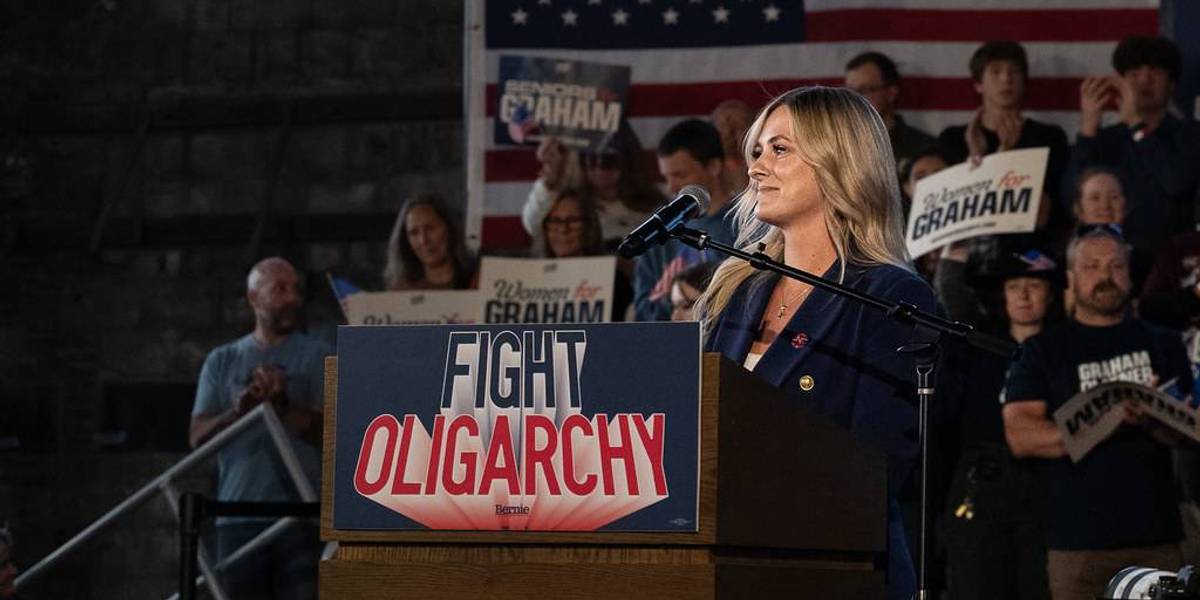 Kelli Brennan, president of the Maine State Nurses Association (MSNA), speaks at the 2026 Memorial Day rally against oligarchy in Portland. (Photo: flickr/ Graham for Maine)
"This movement—our movement—is not divided by age or by class or by gender or by race," he continued. "It's not divided by where you live in Maine or for how long. This is a movement of Maine, by Maine, and for Maine. And we are going to take back what is ours, because for decades—they have taken. Piece by piece, store by store, hospital by hospital, home by home—they have taken. They took so much they began to think that we didn't exist at all, but they don't know Maine."
Recalling claims by establishment Democrats like Sen. Elissa Slotkin (D-Mich.), who last year complained that Sanders’ use of the word “oligarchy” wouldn’t resonate with Americans even as he had drawn more than 100,000 people to rallies on the nationwide Fighting Oligarchy tour, Platner jokingly checked with the crowd before using the term.
“There’s a word I want to use to describe what we are fighting,” he said. “Before I use it, I just want to make sure. Can you raise your hand if you know what the word ‘oligarchy’ means?”
"That's what I thought," said Platner as hands shot up across the crowd.
"Piece by piece, store by store, hospital by hospital, home by home—they have taken. They took so much they began to think that we didn't exist at all, but they don't know Maine."—Graham Platner
The word, defined by Merriam-Webster as "a system of government where all power is concentrated in the hands of a small, elite group," appeared well understood by attendees who filed out of the building after the rally.
"Balancing society with us versus the 1%, fighting the oligarchy... That's very important to me as a concern for the future," a resident named Ben Russell, who attended the rally with his young family, told Common Dreams. "We brought life into this world, and we'd like it to not devolve into some cyberpunk dystopia."
The rally speakers, along with Sanders, Jackson, and Platner, offered a "brand of politics that cares about all the people," Russell said, "and not just allowing the greed of a few Americans to ruin it for the rest of us."
Sanders, in his remarks, said that oligarchs, the billionaires, the corporate media, and too many folks in Congress are in the habit of telling people that the society we have now is just "the way it is—you can't do better than that."
But the message from candidates like Jackson and Platner, as well as the nationwide push to confront the oligarchy, is to stand firmly against that position.
"We're here to say that we can do a hell of a lot better than that," said Sanders. "We can create an economy that works for all of us, not just the billionaire class."
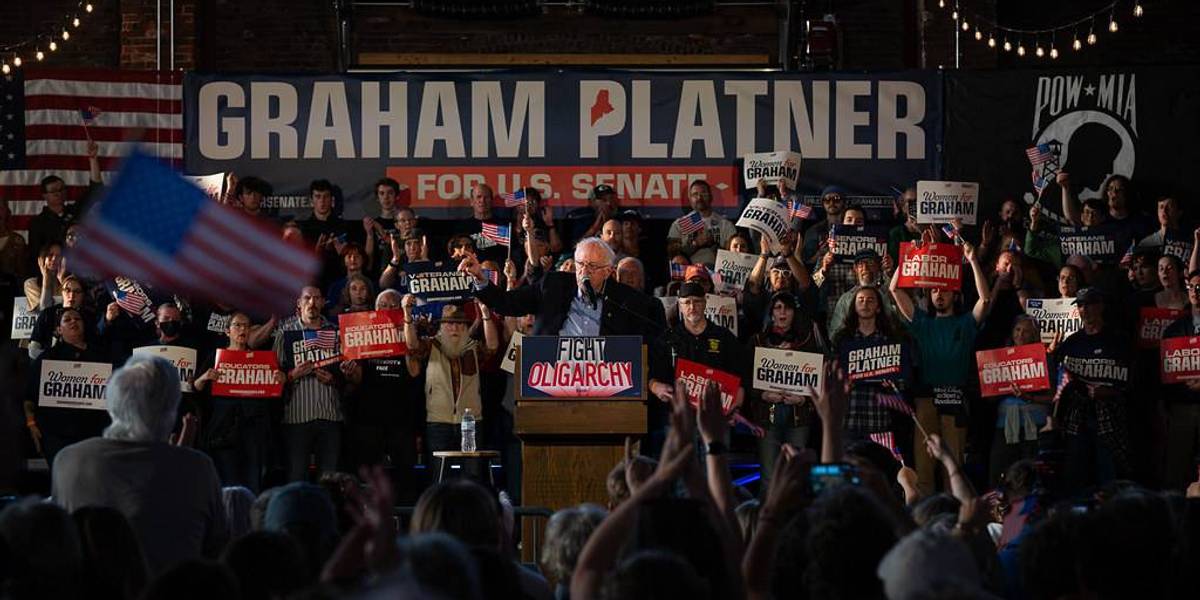 Sen. Bernie Sanders speaks the rally with Troy Jackson and Graham Platner to speak out against oligarchy in Portland, Maine on Monday, May 25, 2026. (Photo: flickr/Graham for Maine)
Another rallygoer, who asked not to be identified, said she was motivated to spend Memorial Day at an indoor political event because "the billionaires are running this country right now, and we have a criminal wannabe billionaire king in the White House who's allowing it to happen."
"My son has to live with me because he can't afford to live on his own," she told Common Dreams, referring to a living arrangement that's grown more common for adults aged 18-34 across the country.
Among Americans aged 25-34, the share living with their parents has jumped over 87% over the past two decades, US Census data shows, as adults struggle to afford housing.
At the rally, Sanders asked the crowd whether "everybody here in Portland [has] great housing at an affordable cost," leading the crowd to answer with a resounding, "No!"
"Well, nobody in Burlington, Vermont does either," said the senator. "And all over this country, what we're seeing is people paying 40, 50% of their limited incomes on housing."
"We can create an economy that works for all of us, not just the billionaire class." —Sen. Bernie Sanders
The housing affordability crisis is well known to Mainers and Portland residents, with a 2023 study finding the state was in need of 84,000 new housing units by 2030 in order to meet demand. Last year, the National Low Income Housing Coalition found that a full-time worker in Maine must earn $28.42 an hour to afford a two-bedroom apartment at fair market rent—but the median hourly wage in the state is just $24.19, while the minimum wage is $15.50.
Roughly half of renters in Cumberland County, where Portland is located, were spending more than 30% of their income on housing costs in 2020-24, qualifying them as cost-burdened, according to a Census survey.
At the rally, the crowd expressed anger at the impact of the housing affordability crisis on people at all income levels, booing loudly when Sanders noted that 800,000 Americans are now homeless.
"I think [it] is really unfortunate in the wealthiest country in the world that we can't take care of those people," Russell told Common Dreams.
 Potential voters cheer during the rally. (Photo: flickr/Graham for Maine)
Along with loudly booing Collins throughout the speeches, the crowd erupted in cheers at Platner's demand that US tax dollars be used to "build schools and hospitals in America instead of bombs to drop on them in Gaza," and at Sanders' call to pass "legislation to get super [political action committees] out of the political process."
"I want the day to come when young people who want to run for public office," said Sanders, can do so "without having to beg wealthy people and billionaires for campaign contributions."
Planter, who has said that before last year he never aspired to any public service beyond serving as harbor office in his small town of Sullivan, credited Sanders for his relentless commitment to a message that says "we can have an economy and a government that works for the 99% and not just the 1%." But Platner also emphasized that "we are not going to get any of this with speeches alone or with any politician alone."
"No one is coming to save us. We need one thing, something the man speaking after me has been fighting for for 60 years. We need a political revolution," said Platner, drawing some of the biggest applause of the night. "It is thousands of people across Maine, millions across America, acting together, creating a movement too powerful for money to buy."
Platner followed with a call for attendees to volunteer for his and Jackson's campaigns, emphasizing that doing so would be an opportunity to connect with people who may have different political beliefs or affiliations.
"It is taking precious time out of our weeks, week after week, and doing something that isn't complicated, but is hard: talking to our neighbors at their doors, overcoming our differences, and bringing them into our fight because this is the fight of our lives," said Platner.
The message stuck with one voter, who said as she was leaving the venue, "People have to take back the power, and this bunch of people can do that."
Those who gathered in Portland, she said, were "not coming from any other place except who they are as individuals and what they want to see for their families."
Over 1,700 people attended a packed-house rally in a former waterfront warehouse in Portland, Maine on Monday as Sen. Bernie Sanders championed the working-class populist candidacies of Graham Platner for US Senate and Troy Jackson for governor in front of a crowd that never missed a chance to boo and rail against Republican Sen. Susan Collins—and the billionaire class that has benefited most from her nearly 30-year career in Washington, DC.
"We are coming for you, Susan Collins," said Bill Jefferson, a Vietnam veteran and peace activist, who opened the Memorial Day event by noting "the horror of combat and unbearable losses" that come with war.
Jackson, a fifth generation logger from northern Maine who previously served as president of the State Senate, denounced a political system in which "people that can write the biggest checks" win while working people—stretched to the breaking point week after week just trying to get by—always end up on the losing end.
"What little time we have is being stolen by the oligarchy," —Troy Jackson
"This is a hard point sometimes to get across," said Jackson, "but honestly, I'm running for governor because we've been robbed by so many things in this world by the people who control it, but there's never been any greater robbery than that of our time. It's something that we can never get back. The time that we have with our parents, our children, and our loved ones is limited. It's finite."
"What little time we have is being stolen by the oligarchy," said Jackson, "who see our lives, who see us as nothing more than a commodity—something to monetize."
"We can't afford to wait any longer," he said, before declaring: "Our time is now!"
Ahead of the Democratic Party primary in Maine on June 9, where he faces a large field of candidates looking to take over from outgoing Democratic Gov. Janet Mills, Jackson said that "solidarity" between the people of the state is not a word, but a "lifestyle," and that campaigning next to Sanders and Platner is about building a movement with the strength of working people behind it.
"Right here in Maine," he said, "we are going to remind the world that the Democratic Party is the party of the working class and we're damn well going to fight for it for a change."
Graham Platner and Troy Jackson raise hands together during the event at Thompson's Point in Portland, Maine on Monday, May 25, 2026. (Photo: Peter Logue/flickr/Graham for Maine)
Kelli Brennan, president of the Maine State Nurses Association (MSNA), told the crowd that the fight at hand is against President Donald Trump and "his billionaire buddies," but also about building a better society where Medicare for All is embraced and people are not profiting off the sickness of others.
"This isn't about the right versus the left," said Brennan. "This is about the haves versus the have-nots; the billionaires versus the working class; and healthcare capitalism has no place in the world of healing."
After Gov. Mills dropped out of the race for the US Senate last month, the primary is no longer the obstacle it once was for Platner's campaign, which now has its sights firmly set on the general election against Collins. After a similar rally on Sunday further north in Orono, Platner told the crowd in Portland, the state's largest city, that the strength his campaign has shown thus far is more a credit to them than to him.
"Senator Sanders asked a question in his 2020 presidential run," said Platner. "Are you willing to fight for somebody you don't know as much as you are willing to fight for yourself? If this campaign is any indication, the answer in Maine is a resounding yes."
"This isn't about the right versus the left. This is about the haves versus the have-nots; the billionaires versus the working class." —Kelli Brennan, MSNA president
Back in September, Sanders became the first major political figure to endorse Platner at a Labor Day event when the campaign was just a few weeks old. In the months since, Platner explained Monday, he has seen firsthand what the question posed by the man he credits with inspiring him politically means in practice.
"I've heard from students who fear not only for themselves, but for their parents and their grandparents, the people who gave them everything and whose Social Security checks get smaller each month as everything else gets more expensive," said Platner. "I've heard from fishermen, who—with all the challenges they face—are concerned about how tariffs are impacting their neighbors who are contractors. Or I've heard from loggers who fear for the nurses and the teachers in their communities who seem to never be paid what we know they are owed."
"Here in Maine, we are ready to fight as hard for the people we do not know as we are for the ones that we do," Platner thundered. "It is who we are and it is who we will always be."
Kelli Brennan, president of the Maine State Nurses Association (MSNA), speaks at the 2026 Memorial Day rally against oligarchy in Portland. (Photo: flickr/ Graham for Maine)
"This movement—our movement—is not divided by age or by class or by gender or by race," he continued. "It's not divided by where you live in Maine or for how long. This is a movement of Maine, by Maine, and for Maine. And we are going to take back what is ours, because for decades—they have taken. Piece by piece, store by store, hospital by hospital, home by home—they have taken. They took so much they began to think that we didn't exist at all, but they don't know Maine."
Recalling claims by establishment Democrats like Sen. Elissa Slotkin (D-Mich.), who last year complained that Sanders’ use of the word “oligarchy” wouldn’t resonate with Americans even as he had drawn more than 100,000 people to rallies on the nationwide Fighting Oligarchy tour, Platner jokingly checked with the crowd before using the term.
“There’s a word I want to use to describe what we are fighting,” he said. “Before I use it, I just want to make sure. Can you raise your hand if you know what the word ‘oligarchy’ means?”
"That's what I thought," said Platner as hands shot up across the crowd.
"Piece by piece, store by store, hospital by hospital, home by home—they have taken. They took so much they began to think that we didn't exist at all, but they don't know Maine."—Graham Platner
The word, defined by Merriam-Webster as "a system of government where all power is concentrated in the hands of a small, elite group," appeared well understood by attendees who filed out of the building after the rally.
"Balancing society with us versus the 1%, fighting the oligarchy... That's very important to me as a concern for the future," a resident named Ben Russell, who attended the rally with his young family, told Common Dreams. "We brought life into this world, and we'd like it to not devolve into some cyberpunk dystopia."
The rally speakers, along with Sanders, Jackson, and Platner, offered a "brand of politics that cares about all the people," Russell said, "and not just allowing the greed of a few Americans to ruin it for the rest of us."
Sanders, in his remarks, said that oligarchs, the billionaires, the corporate media, and too many folks in Congress are in the habit of telling people that the society we have now is just "the way it is—you can't do better than that."
But the message from candidates like Jackson and Platner, as well as the nationwide push to confront the oligarchy, is to stand firmly against that position.
"We're here to say that we can do a hell of a lot better than that," said Sanders. "We can create an economy that works for all of us, not just the billionaire class."
Sen. Bernie Sanders speaks the rally with Troy Jackson and Graham Platner to speak out against oligarchy in Portland, Maine on Monday, May 25, 2026. (Photo: flickr/Graham for Maine)
Another rallygoer, who asked not to be identified, said she was motivated to spend Memorial Day at an indoor political event because "the billionaires are running this country right now, and we have a criminal wannabe billionaire king in the White House who's allowing it to happen."
"My son has to live with me because he can't afford to live on his own," she told Common Dreams, referring to a living arrangement that's grown more common for adults aged 18-34 across the country.
Among Americans aged 25-34, the share living with their parents has jumped over 87% over the past two decades, US Census data shows, as adults struggle to afford housing.
At the rally, Sanders asked the crowd whether "everybody here in Portland [has] great housing at an affordable cost," leading the crowd to answer with a resounding, "No!"
"Well, nobody in Burlington, Vermont does either," said the senator. "And all over this country, what we're seeing is people paying 40, 50% of their limited incomes on housing."
"We can create an economy that works for all of us, not just the billionaire class." —Sen. Bernie Sanders
The housing affordability crisis is well known to Mainers and Portland residents, with a 2023 study finding the state was in need of 84,000 new housing units by 2030 in order to meet demand. Last year, the National Low Income Housing Coalition found that a full-time worker in Maine must earn $28.42 an hour to afford a two-bedroom apartment at fair market rent—but the median hourly wage in the state is just $24.19, while the minimum wage is $15.50.
Roughly half of renters in Cumberland County, where Portland is located, were spending more than 30% of their income on housing costs in 2020-24, qualifying them as cost-burdened, according to a Census survey.
At the rally, the crowd expressed anger at the impact of the housing affordability crisis on people at all income levels, booing loudly when Sanders noted that 800,000 Americans are now homeless.
"I think [it] is really unfortunate in the wealthiest country in the world that we can't take care of those people," Russell told Common Dreams.
Potential voters cheer during the rally. (Photo: flickr/Graham for Maine)
Along with loudly booing Collins throughout the speeches, the crowd erupted in cheers at Platner's demand that US tax dollars be used to "build schools and hospitals in America instead of bombs to drop on them in Gaza," and at Sanders' call to pass "legislation to get super [political action committees] out of the political process."
"I want the day to come when young people who want to run for public office," said Sanders, can do so "without having to beg wealthy people and billionaires for campaign contributions."
Planter, who has said that before last year he never aspired to any public service beyond serving as harbor office in his small town of Sullivan, credited Sanders for his relentless commitment to a message that says "we can have an economy and a government that works for the 99% and not just the 1%." But Platner also emphasized that "we are not going to get any of this with speeches alone or with any politician alone."
"No one is coming to save us. We need one thing, something the man speaking after me has been fighting for for 60 years. We need a political revolution," said Platner, drawing some of the biggest applause of the night. "It is thousands of people across Maine, millions across America, acting together, creating a movement too powerful for money to buy."
Platner followed with a call for attendees to volunteer for his and Jackson's campaigns, emphasizing that doing so would be an opportunity to connect with people who may have different political beliefs or affiliations.
"It is taking precious time out of our weeks, week after week, and doing something that isn't complicated, but is hard: talking to our neighbors at their doors, overcoming our differences, and bringing them into our fight because this is the fight of our lives," said Platner.
The message stuck with one voter, who said as she was leaving the venue, "People have to take back the power, and this bunch of people can do that."
Those who gathered in Portland, she said, were "not coming from any other place except who they are as individuals and what they want to see for their families."
Over 1,700 people attended a packed-house rally in a former waterfront warehouse in Portland, Maine on Monday as Sen. Bernie Sanders championed the working-class populist candidacies of Graham Platner for US Senate and Troy Jackson for governor in front of a crowd that never missed a chance to boo and rail against Republican Sen. Susan Collins—and the billionaire class that has benefited most from her nearly 30-year career in Washington, DC.
"We are coming for you, Susan Collins," said Bill Jefferson, a Vietnam veteran and peace activist, who opened the Memorial Day event by noting "the horror of combat and unbearable losses" that come with war.
Jackson, a fifth generation logger from northern Maine who previously served as president of the State Senate, denounced a political system in which "people that can write the biggest checks" win while working people—stretched to the breaking point week after week just trying to get by—always end up on the losing end.
"What little time we have is being stolen by the oligarchy," —Troy Jackson
"This is a hard point sometimes to get across," said Jackson, "but honestly, I'm running for governor because we've been robbed by so many things in this world by the people who control it, but there's never been any greater robbery than that of our time. It's something that we can never get back. The time that we have with our parents, our children, and our loved ones is limited. It's finite."
"What little time we have is being stolen by the oligarchy," said Jackson, "who see our lives, who see us as nothing more than a commodity—something to monetize."
"We can't afford to wait any longer," he said, before declaring: "Our time is now!"
Ahead of the Democratic Party primary in Maine on June 9, where he faces a large field of candidates looking to take over from outgoing Democratic Gov. Janet Mills, Jackson said that "solidarity" between the people of the state is not a word, but a "lifestyle," and that campaigning next to Sanders and Platner is about building a movement with the strength of working people behind it.
"Right here in Maine," he said, "we are going to remind the world that the Democratic Party is the party of the working class and we're damn well going to fight for it for a change."
Graham Platner and Troy Jackson raise hands together during the event at Thompson's Point in Portland, Maine on Monday, May 25, 2026. (Photo: Peter Logue/flickr/Graham for Maine)
Kelli Brennan, president of the Maine State Nurses Association (MSNA), told the crowd that the fight at hand is against President Donald Trump and "his billionaire buddies," but also about building a better society where Medicare for All is embraced and people are not profiting off the sickness of others.
"This isn't about the right versus the left," said Brennan. "This is about the haves versus the have-nots; the billionaires versus the working class; and healthcare capitalism has no place in the world of healing."
After Gov. Mills dropped out of the race for the US Senate last month, the primary is no longer the obstacle it once was for Platner's campaign, which now has its sights firmly set on the general election against Collins. After a similar rally on Sunday further north in Orono, Platner told the crowd in Portland, the state's largest city, that the strength his campaign has shown thus far is more a credit to them than to him.
"Senator Sanders asked a question in his 2020 presidential run," said Platner. "Are you willing to fight for somebody you don't know as much as you are willing to fight for yourself? If this campaign is any indication, the answer in Maine is a resounding yes."
"This isn't about the right versus the left. This is about the haves versus the have-nots; the billionaires versus the working class." —Kelli Brennan, MSNA president
Back in September, Sanders became the first major political figure to endorse Platner at a Labor Day event when the campaign was just a few weeks old. In the months since, Platner explained Monday, he has seen firsthand what the question posed by the man he credits with inspiring him politically means in practice.
"I've heard from students who fear not only for themselves, but for their parents and their grandparents, the people who gave them everything and whose Social Security checks get smaller each month as everything else gets more expensive," said Platner. "I've heard from fishermen, who—with all the challenges they face—are concerned about how tariffs are impacting their neighbors who are contractors. Or I've heard from loggers who fear for the nurses and the teachers in their communities who seem to never be paid what we know they are owed."
"Here in Maine, we are ready to fight as hard for the people we do not know as we are for the ones that we do," Platner thundered. "It is who we are and it is who we will always be."
Kelli Brennan, president of the Maine State Nurses Association (MSNA), speaks at the 2026 Memorial Day rally against oligarchy in Portland. (Photo: flickr/ Graham for Maine)
"This movement—our movement—is not divided by age or by class or by gender or by race," he continued. "It's not divided by where you live in Maine or for how long. This is a movement of Maine, by Maine, and for Maine. And we are going to take back what is ours, because for decades—they have taken. Piece by piece, store by store, hospital by hospital, home by home—they have taken. They took so much they began to think that we didn't exist at all, but they don't know Maine."
Recalling claims by establishment Democrats like Sen. Elissa Slotkin (D-Mich.), who last year complained that Sanders’ use of the word “oligarchy” wouldn’t resonate with Americans even as he had drawn more than 100,000 people to rallies on the nationwide Fighting Oligarchy tour, Platner jokingly checked with the crowd before using the term.
“There’s a word I want to use to describe what we are fighting,” he said. “Before I use it, I just want to make sure. Can you raise your hand if you know what the word ‘oligarchy’ means?”
"That's what I thought," said Platner as hands shot up across the crowd.
"Piece by piece, store by store, hospital by hospital, home by home—they have taken. They took so much they began to think that we didn't exist at all, but they don't know Maine."—Graham Platner
The word, defined by Merriam-Webster as "a system of government where all power is concentrated in the hands of a small, elite group," appeared well understood by attendees who filed out of the building after the rally.
"Balancing society with us versus the 1%, fighting the oligarchy... That's very important to me as a concern for the future," a resident named Ben Russell, who attended the rally with his young family, told Common Dreams. "We brought life into this world, and we'd like it to not devolve into some cyberpunk dystopia."
The rally speakers, along with Sanders, Jackson, and Platner, offered a "brand of politics that cares about all the people," Russell said, "and not just allowing the greed of a few Americans to ruin it for the rest of us."
Sanders, in his remarks, said that oligarchs, the billionaires, the corporate media, and too many folks in Congress are in the habit of telling people that the society we have now is just "the way it is—you can't do better than that."
But the message from candidates like Jackson and Platner, as well as the nationwide push to confront the oligarchy, is to stand firmly against that position.
"We're here to say that we can do a hell of a lot better than that," said Sanders. "We can create an economy that works for all of us, not just the billionaire class."
Sen. Bernie Sanders speaks the rally with Troy Jackson and Graham Platner to speak out against oligarchy in Portland, Maine on Monday, May 25, 2026. (Photo: flickr/Graham for Maine)
Another rallygoer, who asked not to be identified, said she was motivated to spend Memorial Day at an indoor political event because "the billionaires are running this country right now, and we have a criminal wannabe billionaire king in the White House who's allowing it to happen."
"My son has to live with me because he can't afford to live on his own," she told Common Dreams, referring to a living arrangement that's grown more common for adults aged 18-34 across the country.
Among Americans aged 25-34, the share living with their parents has jumped over 87% over the past two decades, US Census data shows, as adults struggle to afford housing.
At the rally, Sanders asked the crowd whether "everybody here in Portland [has] great housing at an affordable cost," leading the crowd to answer with a resounding, "No!"
"Well, nobody in Burlington, Vermont does either," said the senator. "And all over this country, what we're seeing is people paying 40, 50% of their limited incomes on housing."
"We can create an economy that works for all of us, not just the billionaire class." —Sen. Bernie Sanders
The housing affordability crisis is well known to Mainers and Portland residents, with a 2023 study finding the state was in need of 84,000 new housing units by 2030 in order to meet demand. Last year, the National Low Income Housing Coalition found that a full-time worker in Maine must earn $28.42 an hour to afford a two-bedroom apartment at fair market rent—but the median hourly wage in the state is just $24.19, while the minimum wage is $15.50.
Roughly half of renters in Cumberland County, where Portland is located, were spending more than 30% of their income on housing costs in 2020-24, qualifying them as cost-burdened, according to a Census survey.
At the rally, the crowd expressed anger at the impact of the housing affordability crisis on people at all income levels, booing loudly when Sanders noted that 800,000 Americans are now homeless.
"I think [it] is really unfortunate in the wealthiest country in the world that we can't take care of those people," Russell told Common Dreams.
Potential voters cheer during the rally. (Photo: flickr/Graham for Maine)
Along with loudly booing Collins throughout the speeches, the crowd erupted in cheers at Platner's demand that US tax dollars be used to "build schools and hospitals in America instead of bombs to drop on them in Gaza," and at Sanders' call to pass "legislation to get super [political action committees] out of the political process."
"I want the day to come when young people who want to run for public office," said Sanders, can do so "without having to beg wealthy people and billionaires for campaign contributions."
Planter, who has said that before last year he never aspired to any public service beyond serving as harbor office in his small town of Sullivan, credited Sanders for his relentless commitment to a message that says "we can have an economy and a government that works for the 99% and not just the 1%." But Platner also emphasized that "we are not going to get any of this with speeches alone or with any politician alone."
"No one is coming to save us. We need one thing, something the man speaking after me has been fighting for for 60 years. We need a political revolution," said Platner, drawing some of the biggest applause of the night. "It is thousands of people across Maine, millions across America, acting together, creating a movement too powerful for money to buy."
Platner followed with a call for attendees to volunteer for his and Jackson's campaigns, emphasizing that doing so would be an opportunity to connect with people who may have different political beliefs or affiliations.
"It is taking precious time out of our weeks, week after week, and doing something that isn't complicated, but is hard: talking to our neighbors at their doors, overcoming our differences, and bringing them into our fight because this is the fight of our lives," said Platner.
The message stuck with one voter, who said as she was leaving the venue, "People have to take back the power, and this bunch of people can do that."
Those who gathered in Portland, she said, were "not coming from any other place except who they are as individuals and what they want to see for their families."