

SUBSCRIBE TO OUR FREE NEWSLETTER
Daily news & progressive opinion—funded by the people, not the corporations—delivered straight to your inbox.
5
#000000
#FFFFFF
To donate by check, phone, or other method, see our More Ways to Give page.
Daily news & progressive opinion—funded by the people, not the corporations—delivered straight to your inbox.
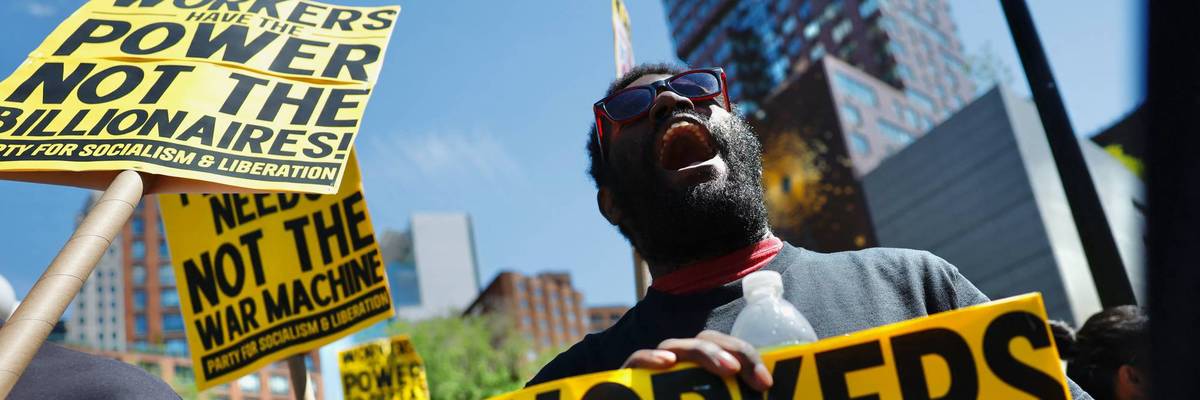
“During the ‘No Kings’ demonstrations, we showed what we’re against. May Day is the day we’re making clear what we are fighting for," said one organizer.
In thousands of locations across the United States, workers and students are taking off from work and school and swearing off shopping on Friday as part of a national May Day protest.
May Day Strong, a coalition of activist groups and unions organizing the events, said more than 4,000 actions, from marches to pickets to displays of peaceful civil disobedience, were underway.
It is yet another nationwide display of coordinated resistance to the Trump administration's agenda, including its war in Iran and its use of US Immigration and Customs Enforcement (ICE) to attack immigrant communities, issues that were at the forefront of March's "No Kings" protests.
Six young protesters with the Sunrise Movement were taken into custody after blocking a bridge in Minneapolis in what they said was an act of "nonviolent noncooperation" to "stand up to the war in Iran and against ICE terrorizing our neighbors and our cities."
Dozens more Sunrise protesters in Portland held a sit-in in the lobby of a Hilton hotel that was housing top officials with the Department of Homeland Security, leading to eight arrests.
"It's May 1st, it's workers' day," one of the protesters was recorded saying while being led away by police. "Don't forget that you have power."
In New York, over 100 activists lined up outside every entrance to the New York Stock Exchange in downtown Manhattan, banging drums and chanting "No ICE, no war!" where they were met by a flood of cops.
In the spirit of May Day, a global day of solidarity among workers, Sulma Arias, the executive director of the social justice organization People's Action, said Friday's "Workers Over Billionaires" protests are just as much about confronting injustices as about building an alternative.
“During the ‘No Kings’ demonstrations, we showed what we’re against. May Day is the day we’re making clear what we are fighting for," Arias said. "We are for affordable housing for low-income people. We are for free healthcare for all. We are for utility laws that ensure every home stays warm in the winter and cool in the summer at costs that a person on a fixed income can afford. We are for the right to a fair and equal vote for Americans from every race and in every state. May Day is our day to assert and defend our rights.”
"They want us afraid. They want us divided. But on May 1, we refuse."
Despite claims by President Donald Trump that the US is entering an economic "golden age" under his leadership, a Gallup poll released this week found that 55% of Americans said their finances were getting worse, the highest number ever recorded in more than 20 years of polling, and even higher than in the doldrums of the Great Recession.
A coalition of labor unions across several major cities, including Philadelphia, Chicago, and Los Angeles, has coordinated what has been called an "economic blackout," which includes avoiding buying from private sector retailers.
"When we say 'workers over billionaires,' 'billionaires' is not just this amorphous figure, right? They're real people," said Jana Korn, the chief of staff for the Philadelphia Council AFL-CIO, in an interview with The Real News Network. "In Philadelphia, we're kind of a poor city. We don't have that many billionaires, but we have one. The CEO of Comcast is the only billionaire that lives in the city."
"So why should we, as a city, accept that they take and take from us? And then with that money, what do they do? They donate to Trump's ballroom project," she continued. "People in Philadelphia are struggling... Our transportation system barely works. We're at risk of having 17 schools close down this year."
Some labor organizers have described economic boycotts, undertaken as part of prior mass protest movements against the second Trump administration, as an act of building strength for something larger, such as a future general strike.
"I think really for us in the labor movement," Korn said, "[the boycott is] about how do we build the capacity to really disrupt, to strike when necessary, to shut things down when we have to. And that's something that we have not been called to do as a labor movement in a very long time."
Other unions have used May Day to confront their own employers directly. In New Orleans, hundreds of nurses at University Medical Center announced that they were beginning a five-day strike after attempting to negotiate a contract for more than two years.
In New York City, Amazon workers unionized with the Teamsters assembled on the steps of the public library before marching to Amazon's corporate offices to demand the company cut its contracts with ICE, which has used its cloud computing services to target immigrants, including some Amazon workers and contractors.
Matt Multari, who has worked as an Amazon driver for a year and a half, told Mother Jones that he joined the protest to "demand the one thing that’s worth fighting for in this life: respect."
Masih Fouladi, executive director of the California Immigrant Policy Center, said, "May Day is a moment of reckoning."
"Immigrant communities—from farmworkers in our fields to nurses in our hospitals, from refugees fleeing war to families who have built their lives here for generations—are under siege," she said. "They want us afraid. They want us divided. But on May 1, we refuse."
"Workers and immigrants—documented and undocumented, native-born and newly arrived," she said, "will stand together in the streets because we know the truth: there is no workers' rights without immigrant rights, and there is no justice for working people here while our tax dollars fund devastation abroad."
Dear Common Dreams reader, It’s been nearly 30 years since I co-founded Common Dreams with my late wife, Lina Newhouser. We had the radical notion that journalism should serve the public good, not corporate profits. It was clear to us from the outset what it would take to build such a project. No paid advertisements. No corporate sponsors. No millionaire publisher telling us what to think or do. Many people said we wouldn't last a year, but we proved those doubters wrong. Together with a tremendous team of journalists and dedicated staff, we built an independent media outlet free from the constraints of profits and corporate control. Our mission has always been simple: To inform. To inspire. To ignite change for the common good. Building Common Dreams was not easy. Our survival was never guaranteed. When you take on the most powerful forces—Wall Street greed, fossil fuel industry destruction, Big Tech lobbyists, and uber-rich oligarchs who have spent billions upon billions rigging the economy and democracy in their favor—the only bulwark you have is supporters who believe in your work. But here’s the urgent message from me today. It's never been this bad out there. And it's never been this hard to keep us going. At the very moment Common Dreams is most needed, the threats we face are intensifying. We need your support now more than ever. We don't accept corporate advertising and never will. We don't have a paywall because we don't think people should be blocked from critical news based on their ability to pay. Everything we do is funded by the donations of readers like you. When everyone does the little they can afford, we are strong. But if that support retreats or dries up, so do we. Will you donate now to make sure Common Dreams not only survives but thrives? —Craig Brown, Co-founder |
In thousands of locations across the United States, workers and students are taking off from work and school and swearing off shopping on Friday as part of a national May Day protest.
May Day Strong, a coalition of activist groups and unions organizing the events, said more than 4,000 actions, from marches to pickets to displays of peaceful civil disobedience, were underway.
It is yet another nationwide display of coordinated resistance to the Trump administration's agenda, including its war in Iran and its use of US Immigration and Customs Enforcement (ICE) to attack immigrant communities, issues that were at the forefront of March's "No Kings" protests.
Six young protesters with the Sunrise Movement were taken into custody after blocking a bridge in Minneapolis in what they said was an act of "nonviolent noncooperation" to "stand up to the war in Iran and against ICE terrorizing our neighbors and our cities."
Dozens more Sunrise protesters in Portland held a sit-in in the lobby of a Hilton hotel that was housing top officials with the Department of Homeland Security, leading to eight arrests.
"It's May 1st, it's workers' day," one of the protesters was recorded saying while being led away by police. "Don't forget that you have power."
In New York, over 100 activists lined up outside every entrance to the New York Stock Exchange in downtown Manhattan, banging drums and chanting "No ICE, no war!" where they were met by a flood of cops.
In the spirit of May Day, a global day of solidarity among workers, Sulma Arias, the executive director of the social justice organization People's Action, said Friday's "Workers Over Billionaires" protests are just as much about confronting injustices as about building an alternative.
“During the ‘No Kings’ demonstrations, we showed what we’re against. May Day is the day we’re making clear what we are fighting for," Arias said. "We are for affordable housing for low-income people. We are for free healthcare for all. We are for utility laws that ensure every home stays warm in the winter and cool in the summer at costs that a person on a fixed income can afford. We are for the right to a fair and equal vote for Americans from every race and in every state. May Day is our day to assert and defend our rights.”
"They want us afraid. They want us divided. But on May 1, we refuse."
Despite claims by President Donald Trump that the US is entering an economic "golden age" under his leadership, a Gallup poll released this week found that 55% of Americans said their finances were getting worse, the highest number ever recorded in more than 20 years of polling, and even higher than in the doldrums of the Great Recession.
A coalition of labor unions across several major cities, including Philadelphia, Chicago, and Los Angeles, has coordinated what has been called an "economic blackout," which includes avoiding buying from private sector retailers.
"When we say 'workers over billionaires,' 'billionaires' is not just this amorphous figure, right? They're real people," said Jana Korn, the chief of staff for the Philadelphia Council AFL-CIO, in an interview with The Real News Network. "In Philadelphia, we're kind of a poor city. We don't have that many billionaires, but we have one. The CEO of Comcast is the only billionaire that lives in the city."
"So why should we, as a city, accept that they take and take from us? And then with that money, what do they do? They donate to Trump's ballroom project," she continued. "People in Philadelphia are struggling... Our transportation system barely works. We're at risk of having 17 schools close down this year."
Some labor organizers have described economic boycotts, undertaken as part of prior mass protest movements against the second Trump administration, as an act of building strength for something larger, such as a future general strike.
"I think really for us in the labor movement," Korn said, "[the boycott is] about how do we build the capacity to really disrupt, to strike when necessary, to shut things down when we have to. And that's something that we have not been called to do as a labor movement in a very long time."
Other unions have used May Day to confront their own employers directly. In New Orleans, hundreds of nurses at University Medical Center announced that they were beginning a five-day strike after attempting to negotiate a contract for more than two years.
In New York City, Amazon workers unionized with the Teamsters assembled on the steps of the public library before marching to Amazon's corporate offices to demand the company cut its contracts with ICE, which has used its cloud computing services to target immigrants, including some Amazon workers and contractors.
Matt Multari, who has worked as an Amazon driver for a year and a half, told Mother Jones that he joined the protest to "demand the one thing that’s worth fighting for in this life: respect."
Masih Fouladi, executive director of the California Immigrant Policy Center, said, "May Day is a moment of reckoning."
"Immigrant communities—from farmworkers in our fields to nurses in our hospitals, from refugees fleeing war to families who have built their lives here for generations—are under siege," she said. "They want us afraid. They want us divided. But on May 1, we refuse."
"Workers and immigrants—documented and undocumented, native-born and newly arrived," she said, "will stand together in the streets because we know the truth: there is no workers' rights without immigrant rights, and there is no justice for working people here while our tax dollars fund devastation abroad."
In thousands of locations across the United States, workers and students are taking off from work and school and swearing off shopping on Friday as part of a national May Day protest.
May Day Strong, a coalition of activist groups and unions organizing the events, said more than 4,000 actions, from marches to pickets to displays of peaceful civil disobedience, were underway.
It is yet another nationwide display of coordinated resistance to the Trump administration's agenda, including its war in Iran and its use of US Immigration and Customs Enforcement (ICE) to attack immigrant communities, issues that were at the forefront of March's "No Kings" protests.
Six young protesters with the Sunrise Movement were taken into custody after blocking a bridge in Minneapolis in what they said was an act of "nonviolent noncooperation" to "stand up to the war in Iran and against ICE terrorizing our neighbors and our cities."
Dozens more Sunrise protesters in Portland held a sit-in in the lobby of a Hilton hotel that was housing top officials with the Department of Homeland Security, leading to eight arrests.
"It's May 1st, it's workers' day," one of the protesters was recorded saying while being led away by police. "Don't forget that you have power."
In New York, over 100 activists lined up outside every entrance to the New York Stock Exchange in downtown Manhattan, banging drums and chanting "No ICE, no war!" where they were met by a flood of cops.
In the spirit of May Day, a global day of solidarity among workers, Sulma Arias, the executive director of the social justice organization People's Action, said Friday's "Workers Over Billionaires" protests are just as much about confronting injustices as about building an alternative.
“During the ‘No Kings’ demonstrations, we showed what we’re against. May Day is the day we’re making clear what we are fighting for," Arias said. "We are for affordable housing for low-income people. We are for free healthcare for all. We are for utility laws that ensure every home stays warm in the winter and cool in the summer at costs that a person on a fixed income can afford. We are for the right to a fair and equal vote for Americans from every race and in every state. May Day is our day to assert and defend our rights.”
"They want us afraid. They want us divided. But on May 1, we refuse."
Despite claims by President Donald Trump that the US is entering an economic "golden age" under his leadership, a Gallup poll released this week found that 55% of Americans said their finances were getting worse, the highest number ever recorded in more than 20 years of polling, and even higher than in the doldrums of the Great Recession.
A coalition of labor unions across several major cities, including Philadelphia, Chicago, and Los Angeles, has coordinated what has been called an "economic blackout," which includes avoiding buying from private sector retailers.
"When we say 'workers over billionaires,' 'billionaires' is not just this amorphous figure, right? They're real people," said Jana Korn, the chief of staff for the Philadelphia Council AFL-CIO, in an interview with The Real News Network. "In Philadelphia, we're kind of a poor city. We don't have that many billionaires, but we have one. The CEO of Comcast is the only billionaire that lives in the city."
"So why should we, as a city, accept that they take and take from us? And then with that money, what do they do? They donate to Trump's ballroom project," she continued. "People in Philadelphia are struggling... Our transportation system barely works. We're at risk of having 17 schools close down this year."
Some labor organizers have described economic boycotts, undertaken as part of prior mass protest movements against the second Trump administration, as an act of building strength for something larger, such as a future general strike.
"I think really for us in the labor movement," Korn said, "[the boycott is] about how do we build the capacity to really disrupt, to strike when necessary, to shut things down when we have to. And that's something that we have not been called to do as a labor movement in a very long time."
Other unions have used May Day to confront their own employers directly. In New Orleans, hundreds of nurses at University Medical Center announced that they were beginning a five-day strike after attempting to negotiate a contract for more than two years.
In New York City, Amazon workers unionized with the Teamsters assembled on the steps of the public library before marching to Amazon's corporate offices to demand the company cut its contracts with ICE, which has used its cloud computing services to target immigrants, including some Amazon workers and contractors.
Matt Multari, who has worked as an Amazon driver for a year and a half, told Mother Jones that he joined the protest to "demand the one thing that’s worth fighting for in this life: respect."
Masih Fouladi, executive director of the California Immigrant Policy Center, said, "May Day is a moment of reckoning."
"Immigrant communities—from farmworkers in our fields to nurses in our hospitals, from refugees fleeing war to families who have built their lives here for generations—are under siege," she said. "They want us afraid. They want us divided. But on May 1, we refuse."
"Workers and immigrants—documented and undocumented, native-born and newly arrived," she said, "will stand together in the streets because we know the truth: there is no workers' rights without immigrant rights, and there is no justice for working people here while our tax dollars fund devastation abroad."

