

SUBSCRIBE TO OUR FREE NEWSLETTER
Daily news & progressive opinion—funded by the people, not the corporations—delivered straight to your inbox.
5
#000000
#FFFFFF
To donate by check, phone, or other method, see our More Ways to Give page.
Daily news & progressive opinion—funded by the people, not the corporations—delivered straight to your inbox.
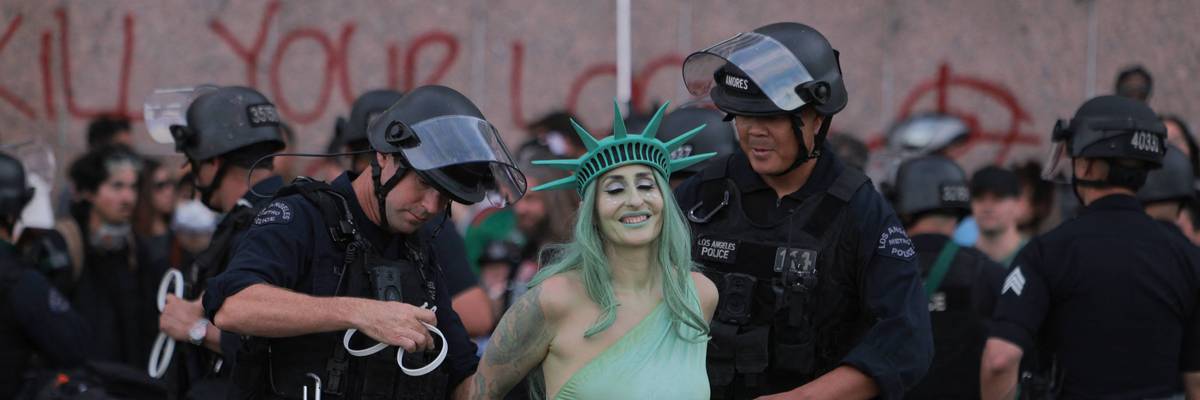
LAPD officers arrest a protester dressed as Lady Liberty in chains following clashes near the Metropolitan Detention Center during the "No Kings" national day of protest in Los Angeles on March 28, 2026. Huge crowds of protesters rallied across the United States on March 28 against President Donald Trump, venting their fury over what they see as his authoritarian style of governing, his hardline immigration policies and the war with Iran.
Why there is cause for both celebration and concern.
It’s easy to both celebrate and criticize the “No Kings” marches—and perhaps some of both is warranted.
The latest “No Kings” march in San Francisco, like others, featured a broad and diverse forest of protest signs spanning from moderately liberal to strongly left/progressive. There were American flags (many appropriately upside-down), copies of the Constitution, basic urges to rescue democracy and the vote; there were signs against Trump’s murderous and illegal war on Iran; signs for Palestinian rights and freedom; signs denouncing oligarchy and the billionaire class; and a wide array of others (one of my personal favorites from a friend’s octogenarian mom read, “I have dementia and even I know better.”)
It was inspiring to be among tens of thousands locally and more than eight million nationwide. When you get a record eight million people into the streets protesting fascism, war, and bigotry (and a host of other concerns), that’s something to celebrate. It’s no minor feat to mobilize so many millions nationwide to spend hours of their weekend marching and chanting for our rights and our future.
Before we get to the criticism and growing calls for change within this change movement, it’s important to honor the accomplishment of providing this avenue for mass dissent. “No Kings” and related movements have created a valuable space for public uprising and expression, a space that encourages and could enable other forms of dissent, disruption, and organizing.
I’ve been to every “No Kings” and dozens of other protests and marches against this insane, viciously destructive administration. It has been both inspiring and at times frustrating. It is remarkable we have assembled so many millions so quickly against Trump and his horrendous, harmful policies. It’s also true that the messages have been diffuse and diverse, lacking in concrete demands or impact. Weekend marches every few months have limited effect, but they’ve been an important start that we should build on now.
If we’re going to build a meaningful and lasting resistance movement that creates real impact and change, we need both the broader masses of liberals and moderates and the strong, sharp voices of progressives and the left.
“No Kings” and affiliated groups are a broad and loose yet growing coalition of liberals, moderates, some Republicans and former Trump supporters, as well as more progressive and left-wing activists. This coalition of dissent is united in at least a few things: we are against Trump and his assaults on democracy, the Constitution, government for the people, as well as on immigrants and core human values like diversity, equity, and inclusion.
Promisingly, evolving research shows that a strong and growing majority of “No Kings” protesters are being organized through a protest infrastructure and are motivated most by outrage at Trump’s illegal, murderous war on Iran, as well as by attacks on immigrants and protesters.
At the same time, it is problematic and concerning when “No Kings” features top Democrats in Congress who receive huge amounts of AIPAC funding and who have offered meager, milk toast resistance to Trump and who have helped uphold Israel’s genocidal war crimes and annihilation of Gaza. It is a very real problem and limitation for a movement to provide a platform for (and to align closely with) Democrats who, other than some basic opposition to Trump, have maintained this country’s murderous and deeply inequitable status quo. As some have pointed out, most “No Kings” protests featured little mention of the war on Iran or the US-aided Israeli annihilation of Gaza.
Decisions like that have led many lefties to diss and dismiss “No Kings” in ways that are both partly accurate and also simplistic and counterproductive. Some have repudiated “No Kings” as merely an AIPAC-run front group for the mainstream Democratic Party; others have announced they’re not attending because they believe “No Kings” is mostly a bunch of flag-toting liberals and moderates who aren’t allies with long-term left movements (and they are at least partly right). These are old, old divisions and wounds, nothing new. But if we’re going to build a meaningful and lasting resistance movement that creates real impact and change, we need both the broader masses of liberals and moderates and the strong, sharp voices of progressives and the left.
Why? Because, as an extra-astute op-ed in the New York Times explained, our troubles are not just about Trump—they are about this country as well. While we need a massive “big tent” resistance against this horrendous man and moment, we also need a sustained and independent mass movement against America’s bipartisan wars, its bipartisan military-industrial complex, its bipartisan marriage to corporate power and interests. As nightmarish as things are now, they sure weren’t “great” under Biden or previous Democratic administrations—they just weren’t as disastrously awful, in most ways. While Trump is enabling Israel’s sickening assaults on Gaza, Lebanon, and elsewhere, Biden did that as well.
This moment requires more both/and thinking and strategy. We need both the huge, unifying if diffuse mass protests and more concrete, impactful actions, whether huge or not. We need both a big Democratic victory in the midterms and a strong resistance movement that is independent of the party. We need to both celebrate and critique (and change) the “No Kings” rallies.
There is room and reason for both support and criticism of “No Kings.” The important thing is to be engaged and constructive. Build up, don't tear down. Come out and support the massive marches even if you have criticisms and frustrations. Create alternative actions, work with any allies you can, and build those up. Sneering and sniping from the sidelines isn’t useful. It’s also not helpful if we merely defend “No Kings” against that criticism. We must be a part of making this movement and moment all it needs to be.
If we are serious about stopping Trump’s atrocious policies, we must grow not only in numbers but in our focus and strategy.
As a writer and activist with more than 40 years of experience in the streets, I urge liberals and leftists to move through these age-old disputes and seek common ground wherever and whenever possible. We will often continue to disagree. I want to see more liberals at antiwar and pro-Palestine protests and more radical actions. I want more liberals to see that our real common enemy is the corporate neoliberal establishment; the military-industrial “forever war” complex; this country’s deep racism, sexism, classism, and homophobia; and America’s grotesque inequality and deprivations amid insane private wealth. Liberals and lefties will never agree on everything and won’t always support the same candidates or causes; but we must collaborate and coalesce to every extent possible.
As a writer and activist on the left who has participated in and analyzed movements for decades, I think it’s time for a significant shift in the “No Kings” movement, toward greater political independence and separation from the Democratic Party. Yes, many if not most of us will work hard to help Democrats win the midterms—but the movement must be separate if it is to grow and have greater impact. We can’t have a resistance movement closely allied with a party that, as a whole (with some notable exceptions), enables genocidal war crimes and forever wars.
If we are serious about stopping Trump’s atrocious policies, we must grow not only in numbers but in our focus and strategy. Weekend marches every few months are not nearly enough. “No Kings” has created a vast platform and momentum—the question is, what do we do with it now, and how do we create concrete, meaningful change? How do these movements directly confront and challenge power?
One promising answer is the upcoming May Day “general strike” actions, including mass work stoppages and boycotts. As Common Dreams reported, Indivisible and other groups are supporting this more confrontational and potentially impactful effort. A similar general strike by Minnesota activists in January following ICE’s murders of Renee Nicole Good and Alex Pretti has provided an inspiring model for upcoming actions.
In the months and years ahead, there will be challenging ongoing questions about where this resistance movement puts its dollars and energy; about people’s varying willingness and abilities to put their time, energies, and bodies on the line against intensifying fascism and war; and about the need to build “big tent” mass movement unity and/or (I emphatically say “and”) more targeted and consequential actions to stop or slow Trump’s machinery of death and destruction.
Much like the divisions around the Democratic Party between centrists, liberals, and progressives, these divides and questions in the resistance will persist and, to some extent, may never get fully resolved. In this critical moment, having amassed eight million in the streets, we have an opportunity, in fact an obligation, to forge new alliances, and work with and beyond our differences—both to help stop today’s Trumpian “MAGA” insanities and to create meaningful long-term change toward peace, justice, and greater equality, no matter who wins the next two elections. I’ll be here for it all, and hope you will, too.
Dear Common Dreams reader, It’s been nearly 30 years since I co-founded Common Dreams with my late wife, Lina Newhouser. We had the radical notion that journalism should serve the public good, not corporate profits. It was clear to us from the outset what it would take to build such a project. No paid advertisements. No corporate sponsors. No millionaire publisher telling us what to think or do. Many people said we wouldn't last a year, but we proved those doubters wrong. Together with a tremendous team of journalists and dedicated staff, we built an independent media outlet free from the constraints of profits and corporate control. Our mission has always been simple: To inform. To inspire. To ignite change for the common good. Building Common Dreams was not easy. Our survival was never guaranteed. When you take on the most powerful forces—Wall Street greed, fossil fuel industry destruction, Big Tech lobbyists, and uber-rich oligarchs who have spent billions upon billions rigging the economy and democracy in their favor—the only bulwark you have is supporters who believe in your work. But here’s the urgent message from me today. It's never been this bad out there. And it's never been this hard to keep us going. At the very moment Common Dreams is most needed, the threats we face are intensifying. We need your support now more than ever. We don't accept corporate advertising and never will. We don't have a paywall because we don't think people should be blocked from critical news based on their ability to pay. Everything we do is funded by the donations of readers like you. When everyone does the little they can afford, we are strong. But if that support retreats or dries up, so do we. Will you donate now to make sure Common Dreams not only survives but thrives? —Craig Brown, Co-founder |
It’s easy to both celebrate and criticize the “No Kings” marches—and perhaps some of both is warranted.
The latest “No Kings” march in San Francisco, like others, featured a broad and diverse forest of protest signs spanning from moderately liberal to strongly left/progressive. There were American flags (many appropriately upside-down), copies of the Constitution, basic urges to rescue democracy and the vote; there were signs against Trump’s murderous and illegal war on Iran; signs for Palestinian rights and freedom; signs denouncing oligarchy and the billionaire class; and a wide array of others (one of my personal favorites from a friend’s octogenarian mom read, “I have dementia and even I know better.”)
It was inspiring to be among tens of thousands locally and more than eight million nationwide. When you get a record eight million people into the streets protesting fascism, war, and bigotry (and a host of other concerns), that’s something to celebrate. It’s no minor feat to mobilize so many millions nationwide to spend hours of their weekend marching and chanting for our rights and our future.
Before we get to the criticism and growing calls for change within this change movement, it’s important to honor the accomplishment of providing this avenue for mass dissent. “No Kings” and related movements have created a valuable space for public uprising and expression, a space that encourages and could enable other forms of dissent, disruption, and organizing.
I’ve been to every “No Kings” and dozens of other protests and marches against this insane, viciously destructive administration. It has been both inspiring and at times frustrating. It is remarkable we have assembled so many millions so quickly against Trump and his horrendous, harmful policies. It’s also true that the messages have been diffuse and diverse, lacking in concrete demands or impact. Weekend marches every few months have limited effect, but they’ve been an important start that we should build on now.
If we’re going to build a meaningful and lasting resistance movement that creates real impact and change, we need both the broader masses of liberals and moderates and the strong, sharp voices of progressives and the left.
“No Kings” and affiliated groups are a broad and loose yet growing coalition of liberals, moderates, some Republicans and former Trump supporters, as well as more progressive and left-wing activists. This coalition of dissent is united in at least a few things: we are against Trump and his assaults on democracy, the Constitution, government for the people, as well as on immigrants and core human values like diversity, equity, and inclusion.
Promisingly, evolving research shows that a strong and growing majority of “No Kings” protesters are being organized through a protest infrastructure and are motivated most by outrage at Trump’s illegal, murderous war on Iran, as well as by attacks on immigrants and protesters.
At the same time, it is problematic and concerning when “No Kings” features top Democrats in Congress who receive huge amounts of AIPAC funding and who have offered meager, milk toast resistance to Trump and who have helped uphold Israel’s genocidal war crimes and annihilation of Gaza. It is a very real problem and limitation for a movement to provide a platform for (and to align closely with) Democrats who, other than some basic opposition to Trump, have maintained this country’s murderous and deeply inequitable status quo. As some have pointed out, most “No Kings” protests featured little mention of the war on Iran or the US-aided Israeli annihilation of Gaza.
Decisions like that have led many lefties to diss and dismiss “No Kings” in ways that are both partly accurate and also simplistic and counterproductive. Some have repudiated “No Kings” as merely an AIPAC-run front group for the mainstream Democratic Party; others have announced they’re not attending because they believe “No Kings” is mostly a bunch of flag-toting liberals and moderates who aren’t allies with long-term left movements (and they are at least partly right). These are old, old divisions and wounds, nothing new. But if we’re going to build a meaningful and lasting resistance movement that creates real impact and change, we need both the broader masses of liberals and moderates and the strong, sharp voices of progressives and the left.
Why? Because, as an extra-astute op-ed in the New York Times explained, our troubles are not just about Trump—they are about this country as well. While we need a massive “big tent” resistance against this horrendous man and moment, we also need a sustained and independent mass movement against America’s bipartisan wars, its bipartisan military-industrial complex, its bipartisan marriage to corporate power and interests. As nightmarish as things are now, they sure weren’t “great” under Biden or previous Democratic administrations—they just weren’t as disastrously awful, in most ways. While Trump is enabling Israel’s sickening assaults on Gaza, Lebanon, and elsewhere, Biden did that as well.
This moment requires more both/and thinking and strategy. We need both the huge, unifying if diffuse mass protests and more concrete, impactful actions, whether huge or not. We need both a big Democratic victory in the midterms and a strong resistance movement that is independent of the party. We need to both celebrate and critique (and change) the “No Kings” rallies.
There is room and reason for both support and criticism of “No Kings.” The important thing is to be engaged and constructive. Build up, don't tear down. Come out and support the massive marches even if you have criticisms and frustrations. Create alternative actions, work with any allies you can, and build those up. Sneering and sniping from the sidelines isn’t useful. It’s also not helpful if we merely defend “No Kings” against that criticism. We must be a part of making this movement and moment all it needs to be.
If we are serious about stopping Trump’s atrocious policies, we must grow not only in numbers but in our focus and strategy.
As a writer and activist with more than 40 years of experience in the streets, I urge liberals and leftists to move through these age-old disputes and seek common ground wherever and whenever possible. We will often continue to disagree. I want to see more liberals at antiwar and pro-Palestine protests and more radical actions. I want more liberals to see that our real common enemy is the corporate neoliberal establishment; the military-industrial “forever war” complex; this country’s deep racism, sexism, classism, and homophobia; and America’s grotesque inequality and deprivations amid insane private wealth. Liberals and lefties will never agree on everything and won’t always support the same candidates or causes; but we must collaborate and coalesce to every extent possible.
As a writer and activist on the left who has participated in and analyzed movements for decades, I think it’s time for a significant shift in the “No Kings” movement, toward greater political independence and separation from the Democratic Party. Yes, many if not most of us will work hard to help Democrats win the midterms—but the movement must be separate if it is to grow and have greater impact. We can’t have a resistance movement closely allied with a party that, as a whole (with some notable exceptions), enables genocidal war crimes and forever wars.
If we are serious about stopping Trump’s atrocious policies, we must grow not only in numbers but in our focus and strategy. Weekend marches every few months are not nearly enough. “No Kings” has created a vast platform and momentum—the question is, what do we do with it now, and how do we create concrete, meaningful change? How do these movements directly confront and challenge power?
One promising answer is the upcoming May Day “general strike” actions, including mass work stoppages and boycotts. As Common Dreams reported, Indivisible and other groups are supporting this more confrontational and potentially impactful effort. A similar general strike by Minnesota activists in January following ICE’s murders of Renee Nicole Good and Alex Pretti has provided an inspiring model for upcoming actions.
In the months and years ahead, there will be challenging ongoing questions about where this resistance movement puts its dollars and energy; about people’s varying willingness and abilities to put their time, energies, and bodies on the line against intensifying fascism and war; and about the need to build “big tent” mass movement unity and/or (I emphatically say “and”) more targeted and consequential actions to stop or slow Trump’s machinery of death and destruction.
Much like the divisions around the Democratic Party between centrists, liberals, and progressives, these divides and questions in the resistance will persist and, to some extent, may never get fully resolved. In this critical moment, having amassed eight million in the streets, we have an opportunity, in fact an obligation, to forge new alliances, and work with and beyond our differences—both to help stop today’s Trumpian “MAGA” insanities and to create meaningful long-term change toward peace, justice, and greater equality, no matter who wins the next two elections. I’ll be here for it all, and hope you will, too.
It’s easy to both celebrate and criticize the “No Kings” marches—and perhaps some of both is warranted.
The latest “No Kings” march in San Francisco, like others, featured a broad and diverse forest of protest signs spanning from moderately liberal to strongly left/progressive. There were American flags (many appropriately upside-down), copies of the Constitution, basic urges to rescue democracy and the vote; there were signs against Trump’s murderous and illegal war on Iran; signs for Palestinian rights and freedom; signs denouncing oligarchy and the billionaire class; and a wide array of others (one of my personal favorites from a friend’s octogenarian mom read, “I have dementia and even I know better.”)
It was inspiring to be among tens of thousands locally and more than eight million nationwide. When you get a record eight million people into the streets protesting fascism, war, and bigotry (and a host of other concerns), that’s something to celebrate. It’s no minor feat to mobilize so many millions nationwide to spend hours of their weekend marching and chanting for our rights and our future.
Before we get to the criticism and growing calls for change within this change movement, it’s important to honor the accomplishment of providing this avenue for mass dissent. “No Kings” and related movements have created a valuable space for public uprising and expression, a space that encourages and could enable other forms of dissent, disruption, and organizing.
I’ve been to every “No Kings” and dozens of other protests and marches against this insane, viciously destructive administration. It has been both inspiring and at times frustrating. It is remarkable we have assembled so many millions so quickly against Trump and his horrendous, harmful policies. It’s also true that the messages have been diffuse and diverse, lacking in concrete demands or impact. Weekend marches every few months have limited effect, but they’ve been an important start that we should build on now.
If we’re going to build a meaningful and lasting resistance movement that creates real impact and change, we need both the broader masses of liberals and moderates and the strong, sharp voices of progressives and the left.
“No Kings” and affiliated groups are a broad and loose yet growing coalition of liberals, moderates, some Republicans and former Trump supporters, as well as more progressive and left-wing activists. This coalition of dissent is united in at least a few things: we are against Trump and his assaults on democracy, the Constitution, government for the people, as well as on immigrants and core human values like diversity, equity, and inclusion.
Promisingly, evolving research shows that a strong and growing majority of “No Kings” protesters are being organized through a protest infrastructure and are motivated most by outrage at Trump’s illegal, murderous war on Iran, as well as by attacks on immigrants and protesters.
At the same time, it is problematic and concerning when “No Kings” features top Democrats in Congress who receive huge amounts of AIPAC funding and who have offered meager, milk toast resistance to Trump and who have helped uphold Israel’s genocidal war crimes and annihilation of Gaza. It is a very real problem and limitation for a movement to provide a platform for (and to align closely with) Democrats who, other than some basic opposition to Trump, have maintained this country’s murderous and deeply inequitable status quo. As some have pointed out, most “No Kings” protests featured little mention of the war on Iran or the US-aided Israeli annihilation of Gaza.
Decisions like that have led many lefties to diss and dismiss “No Kings” in ways that are both partly accurate and also simplistic and counterproductive. Some have repudiated “No Kings” as merely an AIPAC-run front group for the mainstream Democratic Party; others have announced they’re not attending because they believe “No Kings” is mostly a bunch of flag-toting liberals and moderates who aren’t allies with long-term left movements (and they are at least partly right). These are old, old divisions and wounds, nothing new. But if we’re going to build a meaningful and lasting resistance movement that creates real impact and change, we need both the broader masses of liberals and moderates and the strong, sharp voices of progressives and the left.
Why? Because, as an extra-astute op-ed in the New York Times explained, our troubles are not just about Trump—they are about this country as well. While we need a massive “big tent” resistance against this horrendous man and moment, we also need a sustained and independent mass movement against America’s bipartisan wars, its bipartisan military-industrial complex, its bipartisan marriage to corporate power and interests. As nightmarish as things are now, they sure weren’t “great” under Biden or previous Democratic administrations—they just weren’t as disastrously awful, in most ways. While Trump is enabling Israel’s sickening assaults on Gaza, Lebanon, and elsewhere, Biden did that as well.
This moment requires more both/and thinking and strategy. We need both the huge, unifying if diffuse mass protests and more concrete, impactful actions, whether huge or not. We need both a big Democratic victory in the midterms and a strong resistance movement that is independent of the party. We need to both celebrate and critique (and change) the “No Kings” rallies.
There is room and reason for both support and criticism of “No Kings.” The important thing is to be engaged and constructive. Build up, don't tear down. Come out and support the massive marches even if you have criticisms and frustrations. Create alternative actions, work with any allies you can, and build those up. Sneering and sniping from the sidelines isn’t useful. It’s also not helpful if we merely defend “No Kings” against that criticism. We must be a part of making this movement and moment all it needs to be.
If we are serious about stopping Trump’s atrocious policies, we must grow not only in numbers but in our focus and strategy.
As a writer and activist with more than 40 years of experience in the streets, I urge liberals and leftists to move through these age-old disputes and seek common ground wherever and whenever possible. We will often continue to disagree. I want to see more liberals at antiwar and pro-Palestine protests and more radical actions. I want more liberals to see that our real common enemy is the corporate neoliberal establishment; the military-industrial “forever war” complex; this country’s deep racism, sexism, classism, and homophobia; and America’s grotesque inequality and deprivations amid insane private wealth. Liberals and lefties will never agree on everything and won’t always support the same candidates or causes; but we must collaborate and coalesce to every extent possible.
As a writer and activist on the left who has participated in and analyzed movements for decades, I think it’s time for a significant shift in the “No Kings” movement, toward greater political independence and separation from the Democratic Party. Yes, many if not most of us will work hard to help Democrats win the midterms—but the movement must be separate if it is to grow and have greater impact. We can’t have a resistance movement closely allied with a party that, as a whole (with some notable exceptions), enables genocidal war crimes and forever wars.
If we are serious about stopping Trump’s atrocious policies, we must grow not only in numbers but in our focus and strategy. Weekend marches every few months are not nearly enough. “No Kings” has created a vast platform and momentum—the question is, what do we do with it now, and how do we create concrete, meaningful change? How do these movements directly confront and challenge power?
One promising answer is the upcoming May Day “general strike” actions, including mass work stoppages and boycotts. As Common Dreams reported, Indivisible and other groups are supporting this more confrontational and potentially impactful effort. A similar general strike by Minnesota activists in January following ICE’s murders of Renee Nicole Good and Alex Pretti has provided an inspiring model for upcoming actions.
In the months and years ahead, there will be challenging ongoing questions about where this resistance movement puts its dollars and energy; about people’s varying willingness and abilities to put their time, energies, and bodies on the line against intensifying fascism and war; and about the need to build “big tent” mass movement unity and/or (I emphatically say “and”) more targeted and consequential actions to stop or slow Trump’s machinery of death and destruction.
Much like the divisions around the Democratic Party between centrists, liberals, and progressives, these divides and questions in the resistance will persist and, to some extent, may never get fully resolved. In this critical moment, having amassed eight million in the streets, we have an opportunity, in fact an obligation, to forge new alliances, and work with and beyond our differences—both to help stop today’s Trumpian “MAGA” insanities and to create meaningful long-term change toward peace, justice, and greater equality, no matter who wins the next two elections. I’ll be here for it all, and hope you will, too.

