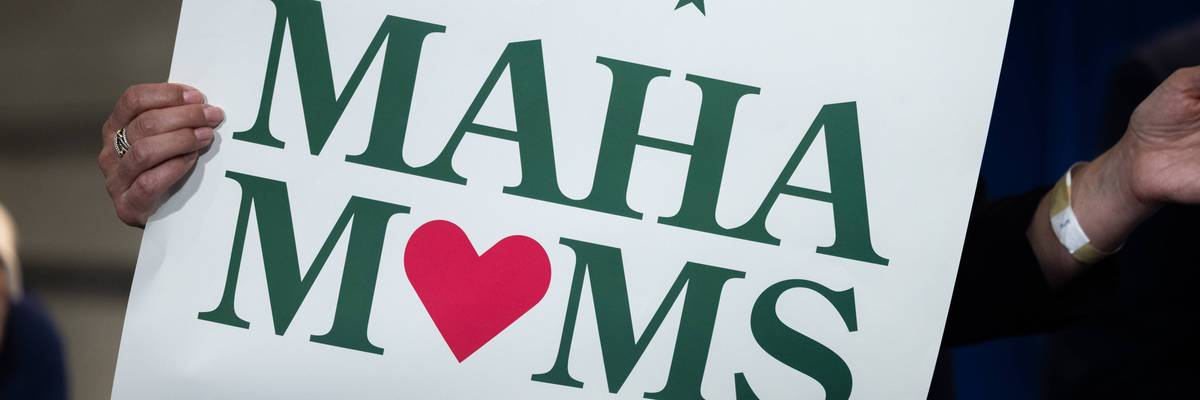
Supporters of the Make America Healthy Again movement are seen at a news conference on removing synthetic dyes from America's food supply, at the US Health and Human Services Department headquarters in Washington, DC on April 22, 2025.
Toxic Betrayal: Report Details How Trump Duped His MAHA Base by Appeasing Corporate Interests
The MAHA movement "reminded the American public of the dangers of toxic chemicals in our air and water... But then the Trump administration either did nothing—or gave industry permission to pollute more.”
It's been seven months since more than 30 leaders of the "Make America Healthy Again" movement told the Trump administration that they were losing patience, and demanded to see evidence that the US Environmental Protection Agency took seriously millions of Americans' concerns about toxic "forever chemicals" and microplastics.
"MAHA is a mandate, not a marketing campaign," the advocates told EPA Administrator Lee Zeldin, calling for an end to both corporate-friendly loopholes in regulations and the "revolving door" that saw chemical lobbyists hired by the agency tasked with regulating the industry.
But on Monday, the government watchdog Public Citizen revealed that 20 out of 21 environmental chemicals that the White House pledged to address in its May 2025 "MAHA Report" have been subject to less, not more, regulation under the Trump administration.
For nine of the chemicals, including the carcinogenic herbicide atrazine, mercury, and per- and polyfluoroalkyl substances (PFAS)—often called forever chemicals—President Donald Trump and his top officials have loosened public health regulations.
For 10 of them, the administration has taken none of the action promised in the MAHA Report, and in the case of the cancer-causing herbicide glyphosate, Trump issued an executive order not only endorsing the use of the chemical but mandating its production—a year after Bayer, the parent company of the chemical firm that uses glyphosate in popular weedkiller Roundup, donated $1 million to Trump's inaugural campaign.
Public Citizen found just one substance, microplastics, for which the administration has "taken any step toward regulation, and at best it was a baby step"—announcing in April that microplastics may be considered for regulation in the future and that the government would study measuring and removing them from the human body.
The report identifies the lifted limits on forever chemicals, loosened regulations on air pollution, and action on glyphosate as "among the most egregious betrayals" of the MAHA movement that helped elect Trump.
"These examples show how the Trump administration’s retreat on chemicals in the environment is failing to keep Americans healthy," reads the report.
Despite the warning from MAHA leaders earlier this year, Public Citizen research director Peter Whoriskey wrote, the administration's conduct has shown that "MAHA is worse than an empty slogan. It’s a sham."
Nearly two years into Trump's second term in office—despite the fact that MAHA leader Robert F. Kennedy Jr. is the president's secretary of health and human services—key regulatory posts have been filled by former industry lobbyists and officials, such as David Fotouhi, who as the deputy administrator of the EPA is the agency’s second-highest official.
During his legal career, Fotouhi defended the company International Paper when it was sued for contaminating the environment with forever chemicals.
Eight out of 10 top leadership roles at the Office of Chemical Safety and Pollution Prevention and the Office of Air and Radiation are filled by "officials, lawyers, and lobbyists who previously worked for chemical oil, chemical, and agriculture companies," reads the report.
"For years, Kennedy, like other leaders in the MAHA movement, accused federal regulators of being controlled by corporate lobbyists and failing to protect Americans from dangerous industrial and agricultural chemicals. Accordingly, they campaigned to curtail corporate influence at the EPA and other federal agencies," wrote Whoriskey.
But with Kennedy at his side, "the Trump administration has not only accommodated industry demands but appointed industry lobbyists and other officials to senior positions in the EPA."
The report also takes aim at persistent claims by Trump administration officials, including in the MAHA Report, that they will use "gold standard science" to evaluate environmental dangers.
The White House has made that all but impossible by disbanding the Office of Research and Development, which has conducted research on the impact of chemicals on humans, the report says.
The government's top air pollution research facility in Chapel Hill, North Carolina, was also shut down, while all the members of the EPA's Clean Air Scientific Advisory Committee and the Clean Air Act Advisory Committee were ousted.
“The MAHA Report reminded the American public of the dangers of toxic chemicals in our air and water,” said Whoriskey in a statement. “It was described as a ‘call to action.’ But then the Trump administration either did nothing—or gave industry permission to pollute more.”
We are at a crossroads
This country and this world are at a monumental crossroads. In a few short weeks, US voters will have an opportunity to beat back the forces of fascism and confront the billionaires who are rigging the economy, our media system, and our democracy, making it increasingly impossible for ordinary people to get by. We’re not just talking about the election. We’re talking about what must be done once these fascist elements are vanquished from power. We need a bolder set of solutions than what either major party has so far been willing to offer and a working-class movement ready to fight like hell for it. Trump didn't emerge from nowhere. The conditions that fueled MAGA authoritarianism were created by decades of radical neoliberal economic policies and a corrupt political system dominated by corporate interests. They slashed taxes on the super-rich, promising that the benefits would trickle down. They said giveaways to the corporate titans would make life more affordable for the rest of us. It was all bullshit. And when a bitter, betrayed populace searches for someone to blame, right-wing demagogues have little trouble finding scapegoats. People know when they're being lied to, but you won't hear any of this from the corporate media. Only independent journalism—powered and funded by people who believe in building a better world—can deliver truly trustworthy daily news. Our Fall Campaign is underway, and we need your help. To power our newsroom through the rest of the year, we need to raise $125,000 by midnight on October 31. So if you share our vision, please contribute whatever you can to sustain our work. |
It's been seven months since more than 30 leaders of the "Make America Healthy Again" movement told the Trump administration that they were losing patience, and demanded to see evidence that the US Environmental Protection Agency took seriously millions of Americans' concerns about toxic "forever chemicals" and microplastics.
"MAHA is a mandate, not a marketing campaign," the advocates told EPA Administrator Lee Zeldin, calling for an end to both corporate-friendly loopholes in regulations and the "revolving door" that saw chemical lobbyists hired by the agency tasked with regulating the industry.
But on Monday, the government watchdog Public Citizen revealed that 20 out of 21 environmental chemicals that the White House pledged to address in its May 2025 "MAHA Report" have been subject to less, not more, regulation under the Trump administration.
For nine of the chemicals, including the carcinogenic herbicide atrazine, mercury, and per- and polyfluoroalkyl substances (PFAS)—often called forever chemicals—President Donald Trump and his top officials have loosened public health regulations.
For 10 of them, the administration has taken none of the action promised in the MAHA Report, and in the case of the cancer-causing herbicide glyphosate, Trump issued an executive order not only endorsing the use of the chemical but mandating its production—a year after Bayer, the parent company of the chemical firm that uses glyphosate in popular weedkiller Roundup, donated $1 million to Trump's inaugural campaign.
Public Citizen found just one substance, microplastics, for which the administration has "taken any step toward regulation, and at best it was a baby step"—announcing in April that microplastics may be considered for regulation in the future and that the government would study measuring and removing them from the human body.
The report identifies the lifted limits on forever chemicals, loosened regulations on air pollution, and action on glyphosate as "among the most egregious betrayals" of the MAHA movement that helped elect Trump.
"These examples show how the Trump administration’s retreat on chemicals in the environment is failing to keep Americans healthy," reads the report.
Despite the warning from MAHA leaders earlier this year, Public Citizen research director Peter Whoriskey wrote, the administration's conduct has shown that "MAHA is worse than an empty slogan. It’s a sham."
Nearly two years into Trump's second term in office—despite the fact that MAHA leader Robert F. Kennedy Jr. is the president's secretary of health and human services—key regulatory posts have been filled by former industry lobbyists and officials, such as David Fotouhi, who as the deputy administrator of the EPA is the agency’s second-highest official.
During his legal career, Fotouhi defended the company International Paper when it was sued for contaminating the environment with forever chemicals.
Eight out of 10 top leadership roles at the Office of Chemical Safety and Pollution Prevention and the Office of Air and Radiation are filled by "officials, lawyers, and lobbyists who previously worked for chemical oil, chemical, and agriculture companies," reads the report.
"For years, Kennedy, like other leaders in the MAHA movement, accused federal regulators of being controlled by corporate lobbyists and failing to protect Americans from dangerous industrial and agricultural chemicals. Accordingly, they campaigned to curtail corporate influence at the EPA and other federal agencies," wrote Whoriskey.
But with Kennedy at his side, "the Trump administration has not only accommodated industry demands but appointed industry lobbyists and other officials to senior positions in the EPA."
The report also takes aim at persistent claims by Trump administration officials, including in the MAHA Report, that they will use "gold standard science" to evaluate environmental dangers.
The White House has made that all but impossible by disbanding the Office of Research and Development, which has conducted research on the impact of chemicals on humans, the report says.
The government's top air pollution research facility in Chapel Hill, North Carolina, was also shut down, while all the members of the EPA's Clean Air Scientific Advisory Committee and the Clean Air Act Advisory Committee were ousted.
“The MAHA Report reminded the American public of the dangers of toxic chemicals in our air and water,” said Whoriskey in a statement. “It was described as a ‘call to action.’ But then the Trump administration either did nothing—or gave industry permission to pollute more.”
- 'This Is the PFAS Presidency': Trump EPA Approves Another Forever Chemical Pesticide ›
- 'A National Outrage': Days After Monsanto Ruling, Trump EPA Approves More Forever Chemical Pesticides ›