SUBSCRIBE TO OUR FREE NEWSLETTER
Daily news & progressive opinion—funded by the people, not the corporations—delivered straight to your inbox.
5
#000000
#FFFFFF
To donate by check, phone, or other method, see our More Ways to Give page.
Daily news & progressive opinion—funded by the people, not the corporations—delivered straight to your inbox.
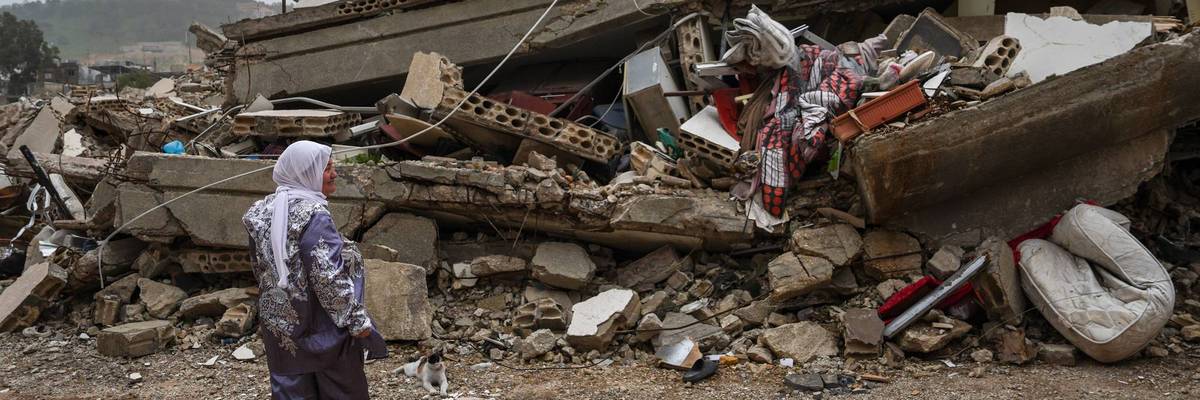
A woman surveys the damage to her home that was destroyed by an Israeli air-strike that killed seven of her neighbors in Nabatieh on the second day of a cease-fire between Israel and Lebanon, on April 18, 2026, in Nabatieh, Lebanon.
UN experts have said Israel's "destruction of urban and village housing that displaced persons would have returned to, is consistent with the pattern of domicide that was initiated during the genocide in Gaza."
Despite a ceasefire announced Friday, after US President Donald Trump said Israel was "PROHIBITED" from continuing to strike Lebanon, Israel continued to level villages and homes across southern Lebanon from Friday into Saturday in what has been described as a continuation of its "Gaza tactics."
Just as it did in Gaza, Israeli Army Radio announced Friday night that Israel had established a "yellow line" in southern Lebanon about 10 kilometers north of the Israeli border, effectively allowing Israel to occupy about 10% of Lebanese territory and maintain control of 55 towns and villages.
According to a report by Lebanon’s National Council for Scientific Research, Israeli forces have been destroying more than 1,000 homes per day since March 2, sometimes wiping out entire villages across southern Lebanon.
The campaign escalated later in the month after Israeli Defense Minister Israel Katz ordered the military to "accelerate the destruction of Lebanese homes" near the Israeli border based on the "model in Gaza," where Israel has destroyed around 90% of all infrastructure and left most of the population sheltering in tents.
Israel has described this as an effort to destroy Hezbollah infrastructure. But the razing of entire villages has often appeared indiscriminate, and numerous attacks have targeted or damaged schools, hospitals, and other nonmilitary infrastructure. More than 40,000 homes have reportedly been destroyed or damaged.
Demolitions and land-clearing operations have continued after Friday's ceasefire, according to reporters on the ground in Lebanon for Al Jazeera. Israeli artillery also reportedly shelled areas around Beit Lif, al-Qantara, and Toul.
On Friday, Israel warned tens of thousands of displaced Lebanese civilians in southern Lebanon not to return to their homes despite the ceasefire, although some have begun to make the trek anyway. Many have found their former homes reduced to rubble.
“There’s destruction, and it’s unlivable," said one resident who was displaced from his home in Nabatieh. "We’re taking our things and leaving again."
Israel said Saturday that it had also carried out new airstrikes in southern Lebanon against people who approached the newly established yellow line. The Israeli military claimed that individuals crossed from north of the line toward Israeli troops, prompting "precise strikes" by air and ground forces against them.
An Israeli military statement described those approaching as "terrorists" who violated the ceasefire and said it carried out the strikes in "self-defense against threats." However, it did not specify what threat those approaching the line posed.
Previous attacks that Israel has said were directed at Hezbollah fighters have devastated civilian areas in southern Lebanon, as well as Beirut and its surrounding suburbs.
According to Lebanon’s Health Ministry, which does not distinguish between military and civilian casualties, more than 2,167 people have been killed since Israel renewed its attacks in Lebanon on March 2.
In Gaza, despite a ceasefire, nearly 100 Palestinians have been killed near the yellow line since it was established in October 2025. Those killed have included at least 36 women, children, and elderly people, according to TRT World.
On Wednesday, a group of United Nations experts denounced what they called Israel's "illegal aggression and indiscriminate bombing campaign" aimed at occupying land in violation of the UN Charter.
“The issuance of blanket evacuation orders, combined with the destruction of urban and village housing that displaced persons would have returned to, is consistent with the pattern of domicide that was initiated during the genocide in Gaza,” they warned.
On Saturday, a group of peacekeepers with the United Nations Interim Force in Lebanon also came under attack, resulting in the death of a French soldier. Lebanon's Foreign Ministry condemned the attack and pledged to identify the "perpetrators."
UN peacekeepers and French officials have said the attack was most likely carried out by Hezbollah, but Hezbollah has denied responsibility.
Israel's continued attacks on Lebanon also threaten to derail not only its ceasefire with Lebanon but also the US ceasefire with Iran.
After the announcement of a ceasefire between Israel and Lebanon on Friday, Iran briefly reopened the Strait of Hormuz to unrestricted travel. But on Saturday, following reports of Israel's violations of the ceasefire, it was once again closed.
While Iranian officials said the proximate reason for the closure was the continuation of US President Donald Trump's blockade of the strait, they have also indicated that they want Israel to stop attacking Lebanon as part of the ceasefire.
This country and this world are at a monumental crossroads. US voters have an opportunity to beat back the forces of fascism and confront the billionaires who are rigging the economy, our media system, and our democracy, making it increasingly impossible for ordinary people to get by. We’re not just talking about the election. We’re talking about what must be done once these fascist elements are vanquished from power. We need a bolder set of solutions than what either major party has so far been willing to offer and a working-class movement ready to fight like hell for it. Trump didn't emerge from nowhere. The conditions that fueled MAGA authoritarianism were created by decades of radical neoliberal economic policies and a corrupt political system dominated by corporate interests. They slashed taxes on the super-rich, promising that the benefits would trickle down. They said giveaways to the corporate titans would make life more affordable for the rest of us. It was all bullshit. And when a bitter, betrayed populace searches for someone to blame, right-wing demagogues have little trouble finding scapegoats. People know when they're being lied to, but you won't hear any of this from the corporate media. Only independent journalism—powered and funded by people who believe in building a better world—can deliver truly trustworthy daily news. If you share our vision, please contribute whatever you can to sustain our work. |
Despite a ceasefire announced Friday, after US President Donald Trump said Israel was "PROHIBITED" from continuing to strike Lebanon, Israel continued to level villages and homes across southern Lebanon from Friday into Saturday in what has been described as a continuation of its "Gaza tactics."
Just as it did in Gaza, Israeli Army Radio announced Friday night that Israel had established a "yellow line" in southern Lebanon about 10 kilometers north of the Israeli border, effectively allowing Israel to occupy about 10% of Lebanese territory and maintain control of 55 towns and villages.
According to a report by Lebanon’s National Council for Scientific Research, Israeli forces have been destroying more than 1,000 homes per day since March 2, sometimes wiping out entire villages across southern Lebanon.
The campaign escalated later in the month after Israeli Defense Minister Israel Katz ordered the military to "accelerate the destruction of Lebanese homes" near the Israeli border based on the "model in Gaza," where Israel has destroyed around 90% of all infrastructure and left most of the population sheltering in tents.
Israel has described this as an effort to destroy Hezbollah infrastructure. But the razing of entire villages has often appeared indiscriminate, and numerous attacks have targeted or damaged schools, hospitals, and other nonmilitary infrastructure. More than 40,000 homes have reportedly been destroyed or damaged.
Demolitions and land-clearing operations have continued after Friday's ceasefire, according to reporters on the ground in Lebanon for Al Jazeera. Israeli artillery also reportedly shelled areas around Beit Lif, al-Qantara, and Toul.
On Friday, Israel warned tens of thousands of displaced Lebanese civilians in southern Lebanon not to return to their homes despite the ceasefire, although some have begun to make the trek anyway. Many have found their former homes reduced to rubble.
“There’s destruction, and it’s unlivable," said one resident who was displaced from his home in Nabatieh. "We’re taking our things and leaving again."
Israel said Saturday that it had also carried out new airstrikes in southern Lebanon against people who approached the newly established yellow line. The Israeli military claimed that individuals crossed from north of the line toward Israeli troops, prompting "precise strikes" by air and ground forces against them.
An Israeli military statement described those approaching as "terrorists" who violated the ceasefire and said it carried out the strikes in "self-defense against threats." However, it did not specify what threat those approaching the line posed.
Previous attacks that Israel has said were directed at Hezbollah fighters have devastated civilian areas in southern Lebanon, as well as Beirut and its surrounding suburbs.
According to Lebanon’s Health Ministry, which does not distinguish between military and civilian casualties, more than 2,167 people have been killed since Israel renewed its attacks in Lebanon on March 2.
In Gaza, despite a ceasefire, nearly 100 Palestinians have been killed near the yellow line since it was established in October 2025. Those killed have included at least 36 women, children, and elderly people, according to TRT World.
On Wednesday, a group of United Nations experts denounced what they called Israel's "illegal aggression and indiscriminate bombing campaign" aimed at occupying land in violation of the UN Charter.
“The issuance of blanket evacuation orders, combined with the destruction of urban and village housing that displaced persons would have returned to, is consistent with the pattern of domicide that was initiated during the genocide in Gaza,” they warned.
On Saturday, a group of peacekeepers with the United Nations Interim Force in Lebanon also came under attack, resulting in the death of a French soldier. Lebanon's Foreign Ministry condemned the attack and pledged to identify the "perpetrators."
UN peacekeepers and French officials have said the attack was most likely carried out by Hezbollah, but Hezbollah has denied responsibility.
Israel's continued attacks on Lebanon also threaten to derail not only its ceasefire with Lebanon but also the US ceasefire with Iran.
After the announcement of a ceasefire between Israel and Lebanon on Friday, Iran briefly reopened the Strait of Hormuz to unrestricted travel. But on Saturday, following reports of Israel's violations of the ceasefire, it was once again closed.
While Iranian officials said the proximate reason for the closure was the continuation of US President Donald Trump's blockade of the strait, they have also indicated that they want Israel to stop attacking Lebanon as part of the ceasefire.