5
#000000
#FFFFFF
To donate by check, phone, or other method, see our More Ways to Give page.
Daily news & progressive opinion—funded by the people, not the corporations—delivered straight to your inbox.

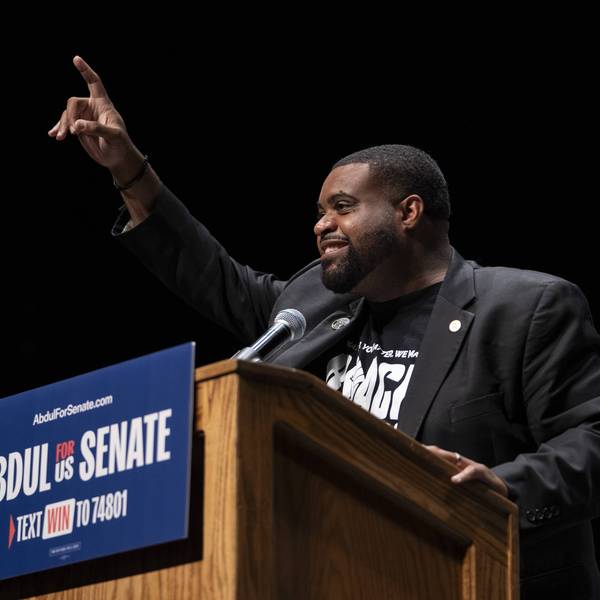
William Lawrence, a cofounder of the Sunrise Movement and Democratic candidate for the US House of Representatives in Michigan, holds a sign at a rally in support of a data center moratorium in Lansing on July 13, 2026.
Lawrence said his win showed that voters "are tired of Silicon Valley billionaires and DC insiders determining the future of our towns and our country."
Dr. Abdul El-Sayed was not the only Michigan progressive to take down a well-funded establishment opponent in a Democratic primary on Tuesday night.
In central Michigan’s 7th congressional district, Democratic voters picked William Lawrence, a co-founder of the youth-led Sunrise Movement climate activist group, to represent them over two centrist candidates—retired Navy SEAL Matt Maasdam and former ambassador to Ukraine Bridget Brink—as the party seeks to flip one of the nation’s most vulnerable GOP-controlled seats in November.
Many of the same obstacles El-Sayed faced en route to his party's Senate nomination were also faced by Lawrence, who triumphed over a split opposition with nearly 44% of the vote on Tuesday.
He faced over $4.5 million in outside spending aimed at defeating him and boosting his opponents, according to Federal Election Commission filings, including over $1 million from a pass-through group for Democratic Majority for Israel.
While rejecting corporate PAC money, Lawrence championed Medicare for All, legislation to curb money in politics, and an end to arms sales to Israel.
But he also distinguished himself by harnessing voters’ growing fear and frustration with the expansion of artificial intelligence data centers, framing them as an imposition by unaccountable “tech billionaires” without regard for the public’s concerns about rising energy prices, diminishing water supplies, and pollution.
According to Politico’s E&E News, 12 data centers are already operating or have been proposed in Michigan’s 7th district alone. In contrast with his opponents, Lawrence took the clearest position on the issue, calling for a 12-month federal moratorium on new data-center construction and joining local opposition movements as proposed sites sprang up across his district.
“Tonight the people of Michigan’s 7th District sent a clear message: They are tired of Silicon Valley billionaires and DC insiders determining the future of our towns and our country,” Lawrence said in a statement following his victory. “They want an unbought representative who isn’t afraid to stand up to leaders of both parties and fight for working people.”
Lawrence will seek to knock off first-term Republican Rep. Tom Barrett in November's general election, whom the Cook Political Report describes as one of the most vulnerable GOP incumbents as Democrats seek to flip the House.
While Democratic politicians have been much more vocal opponents of data centers, stopping the expansion of the facilities has proven to be a bipartisan issue among the electorate, including in Michigan.
In an April poll sponsored by the Detroit Regional Chamber, 55% of likely general election voters said they'd oppose a data center within 25 miles of their home, while just 33% said they'd be open to it. While nearly two-thirds of Democrats expressed opposition, so did more than half of Republicans.
It's likely that fierce opposition to data centers will remain central to Lawrence's broader message about fighting a cost-of-living crisis increasingly tied to an unpopular President Donald Trump.
“I think anyone who has concerns should come out and knock on doors,” Lawrence recently told The New York Times when asked about his ability to garner support from swing voters. “What they’ll hear is people are furious about data centers. Trump voters are getting off the Trump train because of Iran. Nobody could afford the essentials. They’re sick of corporate-funded politicians. That’s why we’ve built the momentum.”
Like El-Sayed’s battle with Republican former Rep. Mike Rogers, Lawrence’s bid to oust Barrett, a MAGA hardliner with a deep stable of wealthy backers, will prove yet another front in the ongoing war between the insurgent left wing of the Democratic Party and its establishment over whether tacking to the center is necessary to win competitive races against Republicans.
Lawrence's win is also a victory for Sen. Bernie Sanders (I-Vt.), who campaigned with him, El-Sayed, and the progressive Michigan state Rep. Donovan McKinney, who ousted incumbent US Rep. Shri Thanedar on Tuesday in the 13th congressional district in Detroit.
Lawrence, whose campaign knocked on over 100,000 doors across the district during the primary, said his victory on Tuesday night showed that "only organized people can beat organized money."
Dear Common Dreams reader, It’s been nearly 30 years since I co-founded Common Dreams with my late wife, Lina Newhouser. We had the radical notion that journalism should serve the public good, not corporate profits. It was clear to us from the outset what it would take to build such a project. No paid advertisements. No corporate sponsors. No millionaire publisher telling us what to think or do. Many people said we wouldn't last a year, but we proved those doubters wrong. Together with a tremendous team of journalists and dedicated staff, we built an independent media outlet free from the constraints of profits and corporate control. Our mission has always been simple: To inform. To inspire. To ignite change for the common good. Building Common Dreams was not easy. Our survival was never guaranteed. When you take on the most powerful forces—Wall Street greed, fossil fuel industry destruction, Big Tech lobbyists, and uber-rich oligarchs who have spent billions upon billions rigging the economy and democracy in their favor—the only bulwark you have is supporters who believe in your work. But here’s the urgent message from me today. It's never been this bad out there. And it's never been this hard to keep us going. At the very moment Common Dreams is most needed, the threats we face are intensifying. We need your support now more than ever. We don't accept corporate advertising and never will. We don't have a paywall because we don't think people should be blocked from critical news based on their ability to pay. Everything we do is funded by the donations of readers like you. When everyone does the little they can afford, we are strong. But if that support retreats or dries up, so do we. Will you donate now to make sure Common Dreams not only survives but thrives? —Craig Brown, Co-founder |
Dr. Abdul El-Sayed was not the only Michigan progressive to take down a well-funded establishment opponent in a Democratic primary on Tuesday night.
In central Michigan’s 7th congressional district, Democratic voters picked William Lawrence, a co-founder of the youth-led Sunrise Movement climate activist group, to represent them over two centrist candidates—retired Navy SEAL Matt Maasdam and former ambassador to Ukraine Bridget Brink—as the party seeks to flip one of the nation’s most vulnerable GOP-controlled seats in November.
Many of the same obstacles El-Sayed faced en route to his party's Senate nomination were also faced by Lawrence, who triumphed over a split opposition with nearly 44% of the vote on Tuesday.
He faced over $4.5 million in outside spending aimed at defeating him and boosting his opponents, according to Federal Election Commission filings, including over $1 million from a pass-through group for Democratic Majority for Israel.
While rejecting corporate PAC money, Lawrence championed Medicare for All, legislation to curb money in politics, and an end to arms sales to Israel.
But he also distinguished himself by harnessing voters’ growing fear and frustration with the expansion of artificial intelligence data centers, framing them as an imposition by unaccountable “tech billionaires” without regard for the public’s concerns about rising energy prices, diminishing water supplies, and pollution.
According to Politico’s E&E News, 12 data centers are already operating or have been proposed in Michigan’s 7th district alone. In contrast with his opponents, Lawrence took the clearest position on the issue, calling for a 12-month federal moratorium on new data-center construction and joining local opposition movements as proposed sites sprang up across his district.
“Tonight the people of Michigan’s 7th District sent a clear message: They are tired of Silicon Valley billionaires and DC insiders determining the future of our towns and our country,” Lawrence said in a statement following his victory. “They want an unbought representative who isn’t afraid to stand up to leaders of both parties and fight for working people.”
Lawrence will seek to knock off first-term Republican Rep. Tom Barrett in November's general election, whom the Cook Political Report describes as one of the most vulnerable GOP incumbents as Democrats seek to flip the House.
While Democratic politicians have been much more vocal opponents of data centers, stopping the expansion of the facilities has proven to be a bipartisan issue among the electorate, including in Michigan.
In an April poll sponsored by the Detroit Regional Chamber, 55% of likely general election voters said they'd oppose a data center within 25 miles of their home, while just 33% said they'd be open to it. While nearly two-thirds of Democrats expressed opposition, so did more than half of Republicans.
It's likely that fierce opposition to data centers will remain central to Lawrence's broader message about fighting a cost-of-living crisis increasingly tied to an unpopular President Donald Trump.
“I think anyone who has concerns should come out and knock on doors,” Lawrence recently told The New York Times when asked about his ability to garner support from swing voters. “What they’ll hear is people are furious about data centers. Trump voters are getting off the Trump train because of Iran. Nobody could afford the essentials. They’re sick of corporate-funded politicians. That’s why we’ve built the momentum.”
Like El-Sayed’s battle with Republican former Rep. Mike Rogers, Lawrence’s bid to oust Barrett, a MAGA hardliner with a deep stable of wealthy backers, will prove yet another front in the ongoing war between the insurgent left wing of the Democratic Party and its establishment over whether tacking to the center is necessary to win competitive races against Republicans.
Lawrence's win is also a victory for Sen. Bernie Sanders (I-Vt.), who campaigned with him, El-Sayed, and the progressive Michigan state Rep. Donovan McKinney, who ousted incumbent US Rep. Shri Thanedar on Tuesday in the 13th congressional district in Detroit.
Lawrence, whose campaign knocked on over 100,000 doors across the district during the primary, said his victory on Tuesday night showed that "only organized people can beat organized money."
Dr. Abdul El-Sayed was not the only Michigan progressive to take down a well-funded establishment opponent in a Democratic primary on Tuesday night.
In central Michigan’s 7th congressional district, Democratic voters picked William Lawrence, a co-founder of the youth-led Sunrise Movement climate activist group, to represent them over two centrist candidates—retired Navy SEAL Matt Maasdam and former ambassador to Ukraine Bridget Brink—as the party seeks to flip one of the nation’s most vulnerable GOP-controlled seats in November.
Many of the same obstacles El-Sayed faced en route to his party's Senate nomination were also faced by Lawrence, who triumphed over a split opposition with nearly 44% of the vote on Tuesday.
He faced over $4.5 million in outside spending aimed at defeating him and boosting his opponents, according to Federal Election Commission filings, including over $1 million from a pass-through group for Democratic Majority for Israel.
While rejecting corporate PAC money, Lawrence championed Medicare for All, legislation to curb money in politics, and an end to arms sales to Israel.
But he also distinguished himself by harnessing voters’ growing fear and frustration with the expansion of artificial intelligence data centers, framing them as an imposition by unaccountable “tech billionaires” without regard for the public’s concerns about rising energy prices, diminishing water supplies, and pollution.
According to Politico’s E&E News, 12 data centers are already operating or have been proposed in Michigan’s 7th district alone. In contrast with his opponents, Lawrence took the clearest position on the issue, calling for a 12-month federal moratorium on new data-center construction and joining local opposition movements as proposed sites sprang up across his district.
“Tonight the people of Michigan’s 7th District sent a clear message: They are tired of Silicon Valley billionaires and DC insiders determining the future of our towns and our country,” Lawrence said in a statement following his victory. “They want an unbought representative who isn’t afraid to stand up to leaders of both parties and fight for working people.”
Lawrence will seek to knock off first-term Republican Rep. Tom Barrett in November's general election, whom the Cook Political Report describes as one of the most vulnerable GOP incumbents as Democrats seek to flip the House.
While Democratic politicians have been much more vocal opponents of data centers, stopping the expansion of the facilities has proven to be a bipartisan issue among the electorate, including in Michigan.
In an April poll sponsored by the Detroit Regional Chamber, 55% of likely general election voters said they'd oppose a data center within 25 miles of their home, while just 33% said they'd be open to it. While nearly two-thirds of Democrats expressed opposition, so did more than half of Republicans.
It's likely that fierce opposition to data centers will remain central to Lawrence's broader message about fighting a cost-of-living crisis increasingly tied to an unpopular President Donald Trump.
“I think anyone who has concerns should come out and knock on doors,” Lawrence recently told The New York Times when asked about his ability to garner support from swing voters. “What they’ll hear is people are furious about data centers. Trump voters are getting off the Trump train because of Iran. Nobody could afford the essentials. They’re sick of corporate-funded politicians. That’s why we’ve built the momentum.”
Like El-Sayed’s battle with Republican former Rep. Mike Rogers, Lawrence’s bid to oust Barrett, a MAGA hardliner with a deep stable of wealthy backers, will prove yet another front in the ongoing war between the insurgent left wing of the Democratic Party and its establishment over whether tacking to the center is necessary to win competitive races against Republicans.
Lawrence's win is also a victory for Sen. Bernie Sanders (I-Vt.), who campaigned with him, El-Sayed, and the progressive Michigan state Rep. Donovan McKinney, who ousted incumbent US Rep. Shri Thanedar on Tuesday in the 13th congressional district in Detroit.
Lawrence, whose campaign knocked on over 100,000 doors across the district during the primary, said his victory on Tuesday night showed that "only organized people can beat organized money."