SUBSCRIBE TO OUR FREE NEWSLETTER
Daily news & progressive opinion—funded by the people, not the corporations—delivered straight to your inbox.
5
#000000
#FFFFFF
To donate by check, phone, or other method, see our More Ways to Give page.
Daily news & progressive opinion—funded by the people, not the corporations—delivered straight to your inbox.
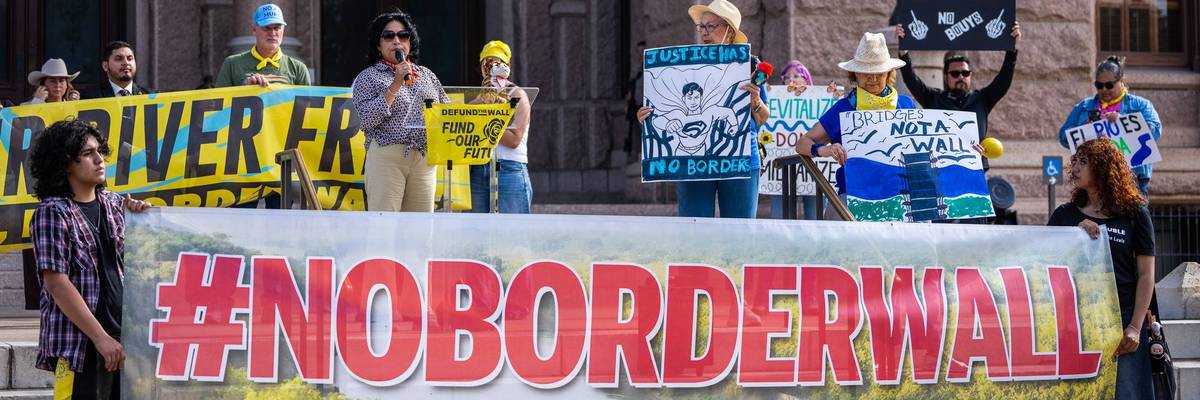
Gloria Galindo, from Friends of the Wildlife Corridor and Friends of Salineño, speaks at a rally against continued border wall expansion in the Big Bend region, hosted by the Texas Says No Border Wall coalition at the Texas State Capitol in Austin, on May 19, 2026
"We have brought this extraordinary challenge because, for us, the Big Bend is not an empty place on a map. It is our home."
A coalition of Texas ranchers, landowners, business owners, and conservationists in the Big Bend region on Monday sued the Trump administration over plans to build border barriers and other destructive infrastructure across one of the most remote and environmentally sensitive stretches of the US-Mexico border.
The lawsuit—filed in the US District Court for the District of Columbia by Conserve Big Bend and six landowners with the backing of many others—challenges the administration’s determination that the region is an area of “high illegal entry" under Section 102 of the Illegal Immigration Reform and Immigrant Responsibility Act (IIRIRA) of 1996, a finding the plaintiffs say is contradicted by the government’s own statistics.
"That high illegal entry determination is the legal predicate for defendants’ invocation of extraordinary power to immediately construct a 30-foot-high border wall while bypassing all federal, state, and local procedural protections," the complaint states. "That determination is legally and factually unsound and unsupported."
"A host of government statistics and other public reporting [show] that the opposite is true," the lawsuit notes. "The Big Bend sector is the area of the lowest illegal entry along the southwest border... The Big Bend sector has recorded the fewest yearly apprehensions of any Southwest sector for the last 53 years, with last year’s numbers being the lowest yearly apprehension total recorded by any sector in the region since 1967."
The suit comes as the Trump administration presses forward with a $46 billion border security construction program authorized by Congress, including 30-foot steel bollard walls, vehicle barriers, roads, lighting, cameras, and other surveillance infrastructure.
The plaintiffs argue that the administration is abusing the extraordinary authority granted to the Department of Homeland Security (DHS) under the IIRIRA, to sidestep laws protecting wildlife, water, Indigenous rights, historic resources, and private property.
“Thank you, President Trump. You’ve secured the border. But now let it go. It’s time," Laura Allen said at a Monday press conference in Marfa announcing the lawsuit. A former Val Verde County judge and two-time Trump voter, Allen's family owns a ranch that would be divided by the proposed border barrier.
David Keller, an archaeologist and historian who lives in the region, spoke at the press conference. He accused officials supporting the administration's proposal of being "woefully unprepared for the hornet’s nest they stirred up because they had no idea how much we love this place."
“For us, the Big Bend is not an empty place on the map,” Keller stressed. “It is our home.”
Earlier this year, the Trump administration waived dozens of environmental laws—including the National Park Service Organic Act, Endangered Species Act, and National Wild and Scenic Rivers Act—to expedite the construction of border roads and barriers through Big Bend National Park.
This isn't the first court challenge to the administration's Big Bend border barrier plans. Last month, the Presidio Municipal Development District sued to stop construction, citing alleged violations of the Rivers and Harbors Act. But after DHS added that law to its waiver, US District Judge Reggie Walton—an appointee of former President George W. Bush—ruled that the plaintiffs could not prevail on the merits and declined to block construction plans, declaring that the administration was legally allowed to bypass the legislation.
“Under federal statute, the secretary of homeland security is granted extraordinary, expedited powers to construct border barriers and sweep aside dozens of federal protections, environmental laws, and ordinary due process,” Clara Bensen, a board member with Conserve Big Bend and head of communications for the No Big Bend Wall initiative, said in a statement Monday. “But Congress explicitly set a strict legal prerequisite for that extraordinary power: it can only be invoked in designated areas of ‘high illegal entry.’”
"The government’s own official statistics tell the real story," Bensen added. "You cannot legally bypass the laws of this country by fabricating an emergency that does not exist. Declaring over 500 miles of steep cliff faces and perilously rugged desert an area of ‘high illegal entry’ is not just detached from reality, under federal law, it is arbitrary, capricious, and unlawful.”
Also last month, People of La Junta for Preservation—a Native American advocacy group focused on protecting Indigenous historical and cultural sites in the Big Bend region—sued the administration, arguing that construction threatens sacred sites of the Lipan Apache people. The complaint also challenges DHS' authority to conduct work inside Big Bend National Park.
Amid intense opposition spanning the political spectrum, US Customs and Border Protection Commissioner Rodney Scott last month announced a temporary pause on construction in Big Bend National Park pending an “on-the-ground evaluation."
Some conservatives who oppose the administration's plans have cited the inviolability of private property rights, which Lico Miller, whose land is in the path of the border barrier, called "the bedrock of Texas sovereignty" during Monday's press conference.
“The moment we allow any government—state or federal—to come in and seize private land and tell us what is good for us and what constitutes an emergency, we set a precedent that will come back and bite every single Texan,” he argued. “If they can take our land along the river today, they can come for yours tomorrow.”
Dear Common Dreams reader, It’s been nearly 30 years since I co-founded Common Dreams with my late wife, Lina Newhouser. We had the radical notion that journalism should serve the public good, not corporate profits. It was clear to us from the outset what it would take to build such a project. No paid advertisements. No corporate sponsors. No millionaire publisher telling us what to think or do. Many people said we wouldn't last a year, but we proved those doubters wrong. Together with a tremendous team of journalists and dedicated staff, we built an independent media outlet free from the constraints of profits and corporate control. Our mission has always been simple: To inform. To inspire. To ignite change for the common good. Building Common Dreams was not easy. Our survival was never guaranteed. When you take on the most powerful forces—Wall Street greed, fossil fuel industry destruction, Big Tech lobbyists, and uber-rich oligarchs who have spent billions upon billions rigging the economy and democracy in their favor—the only bulwark you have is supporters who believe in your work. But here’s the urgent message from me today. It's never been this bad out there. And it's never been this hard to keep us going. At the very moment Common Dreams is most needed, the threats we face are intensifying. We need your support now more than ever. We don't accept corporate advertising and never will. We don't have a paywall because we don't think people should be blocked from critical news based on their ability to pay. Everything we do is funded by the donations of readers like you. When everyone does the little they can afford, we are strong. But if that support retreats or dries up, so do we. Will you donate now to make sure Common Dreams not only survives but thrives? —Craig Brown, Co-founder |
A coalition of Texas ranchers, landowners, business owners, and conservationists in the Big Bend region on Monday sued the Trump administration over plans to build border barriers and other destructive infrastructure across one of the most remote and environmentally sensitive stretches of the US-Mexico border.
The lawsuit—filed in the US District Court for the District of Columbia by Conserve Big Bend and six landowners with the backing of many others—challenges the administration’s determination that the region is an area of “high illegal entry" under Section 102 of the Illegal Immigration Reform and Immigrant Responsibility Act (IIRIRA) of 1996, a finding the plaintiffs say is contradicted by the government’s own statistics.
"That high illegal entry determination is the legal predicate for defendants’ invocation of extraordinary power to immediately construct a 30-foot-high border wall while bypassing all federal, state, and local procedural protections," the complaint states. "That determination is legally and factually unsound and unsupported."
"A host of government statistics and other public reporting [show] that the opposite is true," the lawsuit notes. "The Big Bend sector is the area of the lowest illegal entry along the southwest border... The Big Bend sector has recorded the fewest yearly apprehensions of any Southwest sector for the last 53 years, with last year’s numbers being the lowest yearly apprehension total recorded by any sector in the region since 1967."
The suit comes as the Trump administration presses forward with a $46 billion border security construction program authorized by Congress, including 30-foot steel bollard walls, vehicle barriers, roads, lighting, cameras, and other surveillance infrastructure.
The plaintiffs argue that the administration is abusing the extraordinary authority granted to the Department of Homeland Security (DHS) under the IIRIRA, to sidestep laws protecting wildlife, water, Indigenous rights, historic resources, and private property.
“Thank you, President Trump. You’ve secured the border. But now let it go. It’s time," Laura Allen said at a Monday press conference in Marfa announcing the lawsuit. A former Val Verde County judge and two-time Trump voter, Allen's family owns a ranch that would be divided by the proposed border barrier.
David Keller, an archaeologist and historian who lives in the region, spoke at the press conference. He accused officials supporting the administration's proposal of being "woefully unprepared for the hornet’s nest they stirred up because they had no idea how much we love this place."
“For us, the Big Bend is not an empty place on the map,” Keller stressed. “It is our home.”
Earlier this year, the Trump administration waived dozens of environmental laws—including the National Park Service Organic Act, Endangered Species Act, and National Wild and Scenic Rivers Act—to expedite the construction of border roads and barriers through Big Bend National Park.
This isn't the first court challenge to the administration's Big Bend border barrier plans. Last month, the Presidio Municipal Development District sued to stop construction, citing alleged violations of the Rivers and Harbors Act. But after DHS added that law to its waiver, US District Judge Reggie Walton—an appointee of former President George W. Bush—ruled that the plaintiffs could not prevail on the merits and declined to block construction plans, declaring that the administration was legally allowed to bypass the legislation.
“Under federal statute, the secretary of homeland security is granted extraordinary, expedited powers to construct border barriers and sweep aside dozens of federal protections, environmental laws, and ordinary due process,” Clara Bensen, a board member with Conserve Big Bend and head of communications for the No Big Bend Wall initiative, said in a statement Monday. “But Congress explicitly set a strict legal prerequisite for that extraordinary power: it can only be invoked in designated areas of ‘high illegal entry.’”
"The government’s own official statistics tell the real story," Bensen added. "You cannot legally bypass the laws of this country by fabricating an emergency that does not exist. Declaring over 500 miles of steep cliff faces and perilously rugged desert an area of ‘high illegal entry’ is not just detached from reality, under federal law, it is arbitrary, capricious, and unlawful.”
Also last month, People of La Junta for Preservation—a Native American advocacy group focused on protecting Indigenous historical and cultural sites in the Big Bend region—sued the administration, arguing that construction threatens sacred sites of the Lipan Apache people. The complaint also challenges DHS' authority to conduct work inside Big Bend National Park.
Amid intense opposition spanning the political spectrum, US Customs and Border Protection Commissioner Rodney Scott last month announced a temporary pause on construction in Big Bend National Park pending an “on-the-ground evaluation."
Some conservatives who oppose the administration's plans have cited the inviolability of private property rights, which Lico Miller, whose land is in the path of the border barrier, called "the bedrock of Texas sovereignty" during Monday's press conference.
“The moment we allow any government—state or federal—to come in and seize private land and tell us what is good for us and what constitutes an emergency, we set a precedent that will come back and bite every single Texan,” he argued. “If they can take our land along the river today, they can come for yours tomorrow.”
A coalition of Texas ranchers, landowners, business owners, and conservationists in the Big Bend region on Monday sued the Trump administration over plans to build border barriers and other destructive infrastructure across one of the most remote and environmentally sensitive stretches of the US-Mexico border.
The lawsuit—filed in the US District Court for the District of Columbia by Conserve Big Bend and six landowners with the backing of many others—challenges the administration’s determination that the region is an area of “high illegal entry" under Section 102 of the Illegal Immigration Reform and Immigrant Responsibility Act (IIRIRA) of 1996, a finding the plaintiffs say is contradicted by the government’s own statistics.
"That high illegal entry determination is the legal predicate for defendants’ invocation of extraordinary power to immediately construct a 30-foot-high border wall while bypassing all federal, state, and local procedural protections," the complaint states. "That determination is legally and factually unsound and unsupported."
"A host of government statistics and other public reporting [show] that the opposite is true," the lawsuit notes. "The Big Bend sector is the area of the lowest illegal entry along the southwest border... The Big Bend sector has recorded the fewest yearly apprehensions of any Southwest sector for the last 53 years, with last year’s numbers being the lowest yearly apprehension total recorded by any sector in the region since 1967."
The suit comes as the Trump administration presses forward with a $46 billion border security construction program authorized by Congress, including 30-foot steel bollard walls, vehicle barriers, roads, lighting, cameras, and other surveillance infrastructure.
The plaintiffs argue that the administration is abusing the extraordinary authority granted to the Department of Homeland Security (DHS) under the IIRIRA, to sidestep laws protecting wildlife, water, Indigenous rights, historic resources, and private property.
“Thank you, President Trump. You’ve secured the border. But now let it go. It’s time," Laura Allen said at a Monday press conference in Marfa announcing the lawsuit. A former Val Verde County judge and two-time Trump voter, Allen's family owns a ranch that would be divided by the proposed border barrier.
David Keller, an archaeologist and historian who lives in the region, spoke at the press conference. He accused officials supporting the administration's proposal of being "woefully unprepared for the hornet’s nest they stirred up because they had no idea how much we love this place."
“For us, the Big Bend is not an empty place on the map,” Keller stressed. “It is our home.”
Earlier this year, the Trump administration waived dozens of environmental laws—including the National Park Service Organic Act, Endangered Species Act, and National Wild and Scenic Rivers Act—to expedite the construction of border roads and barriers through Big Bend National Park.
This isn't the first court challenge to the administration's Big Bend border barrier plans. Last month, the Presidio Municipal Development District sued to stop construction, citing alleged violations of the Rivers and Harbors Act. But after DHS added that law to its waiver, US District Judge Reggie Walton—an appointee of former President George W. Bush—ruled that the plaintiffs could not prevail on the merits and declined to block construction plans, declaring that the administration was legally allowed to bypass the legislation.
“Under federal statute, the secretary of homeland security is granted extraordinary, expedited powers to construct border barriers and sweep aside dozens of federal protections, environmental laws, and ordinary due process,” Clara Bensen, a board member with Conserve Big Bend and head of communications for the No Big Bend Wall initiative, said in a statement Monday. “But Congress explicitly set a strict legal prerequisite for that extraordinary power: it can only be invoked in designated areas of ‘high illegal entry.’”
"The government’s own official statistics tell the real story," Bensen added. "You cannot legally bypass the laws of this country by fabricating an emergency that does not exist. Declaring over 500 miles of steep cliff faces and perilously rugged desert an area of ‘high illegal entry’ is not just detached from reality, under federal law, it is arbitrary, capricious, and unlawful.”
Also last month, People of La Junta for Preservation—a Native American advocacy group focused on protecting Indigenous historical and cultural sites in the Big Bend region—sued the administration, arguing that construction threatens sacred sites of the Lipan Apache people. The complaint also challenges DHS' authority to conduct work inside Big Bend National Park.
Amid intense opposition spanning the political spectrum, US Customs and Border Protection Commissioner Rodney Scott last month announced a temporary pause on construction in Big Bend National Park pending an “on-the-ground evaluation."
Some conservatives who oppose the administration's plans have cited the inviolability of private property rights, which Lico Miller, whose land is in the path of the border barrier, called "the bedrock of Texas sovereignty" during Monday's press conference.
“The moment we allow any government—state or federal—to come in and seize private land and tell us what is good for us and what constitutes an emergency, we set a precedent that will come back and bite every single Texan,” he argued. “If they can take our land along the river today, they can come for yours tomorrow.”