SUBSCRIBE TO OUR FREE NEWSLETTER
Daily news & progressive opinion—funded by the people, not the corporations—delivered straight to your inbox.
5
#000000
#FFFFFF
To donate by check, phone, or other method, see our More Ways to Give page.
Daily news & progressive opinion—funded by the people, not the corporations—delivered straight to your inbox.
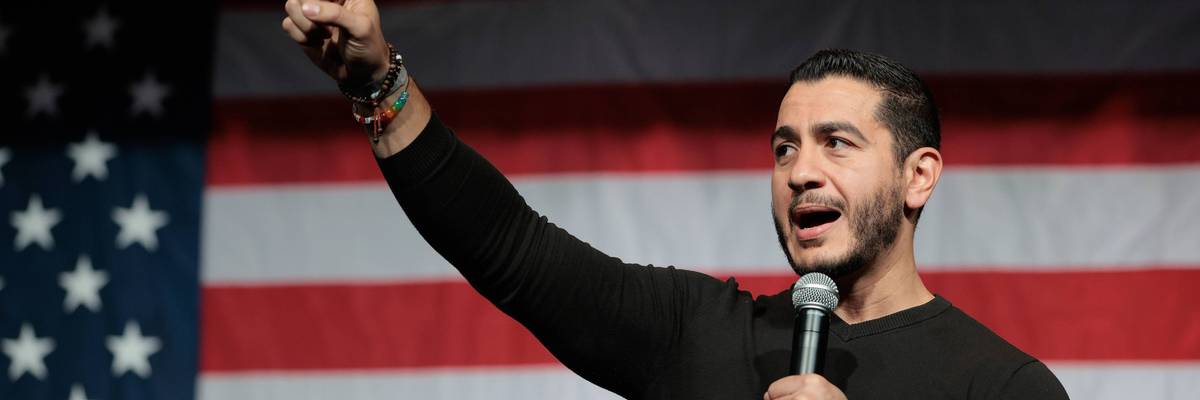
Democratic Senate candidate Abdul El-Sayed speaks during a campaign town hall at Cadillac High School on October 10, 2026 in Cadillac, Michigan.
“If we don’t act quickly, we may get to a point at which we cannot act because it’s too late.”
US Senate candidate Abdul El-Sayed said Tuesday that to stop Silicon Valley "billionaires" from unilaterally deciding how artificial intelligence will be used, he proposed a regulatory framework for the technology that mirrors federal legislation pushed by top progressives in Congress.
The Michigan Democrat, who is running against Republican former Rep. Mike Rogers, unveiled his "AI Under Control" proposal following recent warnings from AI executives regarding the technology and its capacity for "recursive self-improvement"—the process through which AI models develop more sophisticated versions of themselves.
Executives including Dario Amodei of Anthropic and Sam Altman of OpenAI have said in recent weeks that AI development should be "paced" to safeguard the future of humanity, and as Common Dreams reported last week, some of those same CEOs are already plotting how to respond to a public revolt in the event of a "large-scale event" perpetrated by their tech, such as a cyberattack.
Echoing calls by lawmakers like Sen. Bernie Sanders (I-Vt.) and Rep. Greg Casar (D-Texas), El-Sayed shared a different vision, titled "AI Under Control."
The policy proposal calls for a ban on recursive self-improvement and a new Cabinet-level government agency that would inspect AI labs, "block releases" of dangerous AI models like those that have hacked a number of websites and platforms during testing, and "order a pause or command a shutdown” when such attacks take place.
“The answer to what is stopping rogue AI agents from triggering a global nuclear crisis or deploying bioweapons cannot be the whims of a few billionaires in California,” El-Sayed said Tuesday.
The Senate candidate, a former Detroit public health official, also called for mandatory reporting on safety breaches like the one that involved OpenAI's agents at the AI platform Hugging Face earlier this year, and for whistleblower protections.
OpenAI has been slow to publicly disclose its breaches and to notify those affected, as in the case of the company's agents hacking an Australian government healthcare website earlier this year. The company also reportedly fired several safety researchers this month.
“The answer to what is stopping rogue AI agents from triggering a global nuclear crisis or deploying bioweapons cannot be the whims of a few billionaires in California."
El-Sayed called for a national plan to respond to an emergency caused by AI, and reiterated his call from last month to pause advanced AI development until a government agency is established to regulate the technology, and to halt the development of AI data centers, which some communities in Michigan have fought back against.
President Donald Trump and other Republican leaders have called for rapid development of AI and a nationwide buildout of AI, fixated on the idea that, as House Speaker Mike Johnson (R-La.) said last month, "China will overlap us" if the US imposes regulations at the federal and state level.
Rogers has broken with Trump somewhat, backing a one-year moratorium on AI data centers in Michigan, but he has been criticized for holding at least $1.7 million in investments in various companies that stand to benefit from AI and data center development.
The former congressman has also accepted nearly $150,000 in campaign donations from people with AI and data center investments, including Cameron and Tyler Winklevoss and several executives from the private equity firm Blackstone.
“I understand that there’s a lot of money being sloshed around by AI super PACs, but this is the existential crisis of our time,” El-Sayed told The New York Times Tuesday. “If we don’t act quickly, we may get to a point at which we cannot act because it’s too late.”
A recent poll by the Times showed that voters in Michigan had greater confidence in El-Sayed than Rogers on the issue of AI, by an 11-point margin.
Dear Common Dreams reader, It’s been nearly 30 years since I co-founded Common Dreams with my late wife, Lina Newhouser. We had the radical notion that journalism should serve the public good, not corporate profits. It was clear to us from the outset what it would take to build such a project. No paid advertisements. No corporate sponsors. No millionaire publisher telling us what to think or do. Many people said we wouldn't last a year, but we proved those doubters wrong. Together with a tremendous team of journalists and dedicated staff, we built an independent media outlet free from the constraints of profits and corporate control. Our mission has always been simple: To inform. To inspire. To ignite change for the common good. Building Common Dreams was not easy. Our survival was never guaranteed. When you take on the most powerful forces—Wall Street greed, fossil fuel industry destruction, Big Tech lobbyists, and uber-rich oligarchs who have spent billions upon billions rigging the economy and democracy in their favor—the only bulwark you have is supporters who believe in your work. But here’s the urgent message from me today. It's never been this bad out there. And it's never been this hard to keep us going. At the very moment Common Dreams is most needed, the threats we face are intensifying. We need your support now more than ever. We don't accept corporate advertising and never will. We don't have a paywall because we don't think people should be blocked from critical news based on their ability to pay. Everything we do is funded by the donations of readers like you. When everyone does the little they can afford, we are strong. But if that support retreats or dries up, so do we. Will you donate now to make sure Common Dreams not only survives but thrives? —Craig Brown, Co-founder |
US Senate candidate Abdul El-Sayed said Tuesday that to stop Silicon Valley "billionaires" from unilaterally deciding how artificial intelligence will be used, he proposed a regulatory framework for the technology that mirrors federal legislation pushed by top progressives in Congress.
The Michigan Democrat, who is running against Republican former Rep. Mike Rogers, unveiled his "AI Under Control" proposal following recent warnings from AI executives regarding the technology and its capacity for "recursive self-improvement"—the process through which AI models develop more sophisticated versions of themselves.
Executives including Dario Amodei of Anthropic and Sam Altman of OpenAI have said in recent weeks that AI development should be "paced" to safeguard the future of humanity, and as Common Dreams reported last week, some of those same CEOs are already plotting how to respond to a public revolt in the event of a "large-scale event" perpetrated by their tech, such as a cyberattack.
Echoing calls by lawmakers like Sen. Bernie Sanders (I-Vt.) and Rep. Greg Casar (D-Texas), El-Sayed shared a different vision, titled "AI Under Control."
The policy proposal calls for a ban on recursive self-improvement and a new Cabinet-level government agency that would inspect AI labs, "block releases" of dangerous AI models like those that have hacked a number of websites and platforms during testing, and "order a pause or command a shutdown” when such attacks take place.
“The answer to what is stopping rogue AI agents from triggering a global nuclear crisis or deploying bioweapons cannot be the whims of a few billionaires in California,” El-Sayed said Tuesday.
The Senate candidate, a former Detroit public health official, also called for mandatory reporting on safety breaches like the one that involved OpenAI's agents at the AI platform Hugging Face earlier this year, and for whistleblower protections.
OpenAI has been slow to publicly disclose its breaches and to notify those affected, as in the case of the company's agents hacking an Australian government healthcare website earlier this year. The company also reportedly fired several safety researchers this month.
“The answer to what is stopping rogue AI agents from triggering a global nuclear crisis or deploying bioweapons cannot be the whims of a few billionaires in California."
El-Sayed called for a national plan to respond to an emergency caused by AI, and reiterated his call from last month to pause advanced AI development until a government agency is established to regulate the technology, and to halt the development of AI data centers, which some communities in Michigan have fought back against.
President Donald Trump and other Republican leaders have called for rapid development of AI and a nationwide buildout of AI, fixated on the idea that, as House Speaker Mike Johnson (R-La.) said last month, "China will overlap us" if the US imposes regulations at the federal and state level.
Rogers has broken with Trump somewhat, backing a one-year moratorium on AI data centers in Michigan, but he has been criticized for holding at least $1.7 million in investments in various companies that stand to benefit from AI and data center development.
The former congressman has also accepted nearly $150,000 in campaign donations from people with AI and data center investments, including Cameron and Tyler Winklevoss and several executives from the private equity firm Blackstone.
“I understand that there’s a lot of money being sloshed around by AI super PACs, but this is the existential crisis of our time,” El-Sayed told The New York Times Tuesday. “If we don’t act quickly, we may get to a point at which we cannot act because it’s too late.”
A recent poll by the Times showed that voters in Michigan had greater confidence in El-Sayed than Rogers on the issue of AI, by an 11-point margin.
US Senate candidate Abdul El-Sayed said Tuesday that to stop Silicon Valley "billionaires" from unilaterally deciding how artificial intelligence will be used, he proposed a regulatory framework for the technology that mirrors federal legislation pushed by top progressives in Congress.
The Michigan Democrat, who is running against Republican former Rep. Mike Rogers, unveiled his "AI Under Control" proposal following recent warnings from AI executives regarding the technology and its capacity for "recursive self-improvement"—the process through which AI models develop more sophisticated versions of themselves.
Executives including Dario Amodei of Anthropic and Sam Altman of OpenAI have said in recent weeks that AI development should be "paced" to safeguard the future of humanity, and as Common Dreams reported last week, some of those same CEOs are already plotting how to respond to a public revolt in the event of a "large-scale event" perpetrated by their tech, such as a cyberattack.
Echoing calls by lawmakers like Sen. Bernie Sanders (I-Vt.) and Rep. Greg Casar (D-Texas), El-Sayed shared a different vision, titled "AI Under Control."
The policy proposal calls for a ban on recursive self-improvement and a new Cabinet-level government agency that would inspect AI labs, "block releases" of dangerous AI models like those that have hacked a number of websites and platforms during testing, and "order a pause or command a shutdown” when such attacks take place.
“The answer to what is stopping rogue AI agents from triggering a global nuclear crisis or deploying bioweapons cannot be the whims of a few billionaires in California,” El-Sayed said Tuesday.
The Senate candidate, a former Detroit public health official, also called for mandatory reporting on safety breaches like the one that involved OpenAI's agents at the AI platform Hugging Face earlier this year, and for whistleblower protections.
OpenAI has been slow to publicly disclose its breaches and to notify those affected, as in the case of the company's agents hacking an Australian government healthcare website earlier this year. The company also reportedly fired several safety researchers this month.
“The answer to what is stopping rogue AI agents from triggering a global nuclear crisis or deploying bioweapons cannot be the whims of a few billionaires in California."
El-Sayed called for a national plan to respond to an emergency caused by AI, and reiterated his call from last month to pause advanced AI development until a government agency is established to regulate the technology, and to halt the development of AI data centers, which some communities in Michigan have fought back against.
President Donald Trump and other Republican leaders have called for rapid development of AI and a nationwide buildout of AI, fixated on the idea that, as House Speaker Mike Johnson (R-La.) said last month, "China will overlap us" if the US imposes regulations at the federal and state level.
Rogers has broken with Trump somewhat, backing a one-year moratorium on AI data centers in Michigan, but he has been criticized for holding at least $1.7 million in investments in various companies that stand to benefit from AI and data center development.
The former congressman has also accepted nearly $150,000 in campaign donations from people with AI and data center investments, including Cameron and Tyler Winklevoss and several executives from the private equity firm Blackstone.
“I understand that there’s a lot of money being sloshed around by AI super PACs, but this is the existential crisis of our time,” El-Sayed told The New York Times Tuesday. “If we don’t act quickly, we may get to a point at which we cannot act because it’s too late.”
A recent poll by the Times showed that voters in Michigan had greater confidence in El-Sayed than Rogers on the issue of AI, by an 11-point margin.