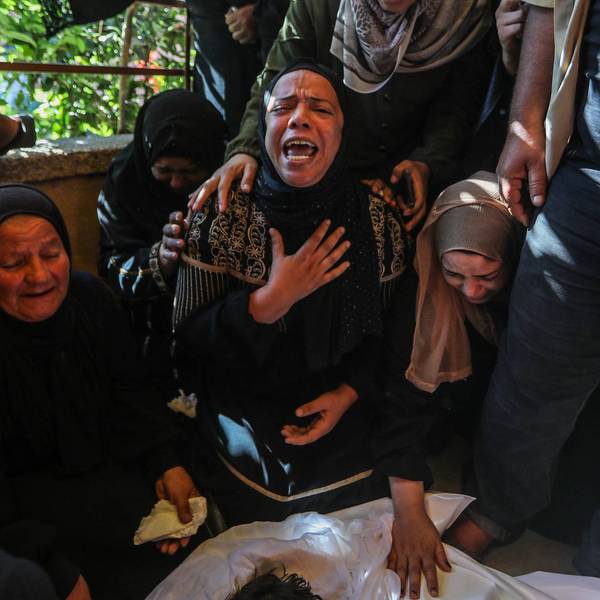
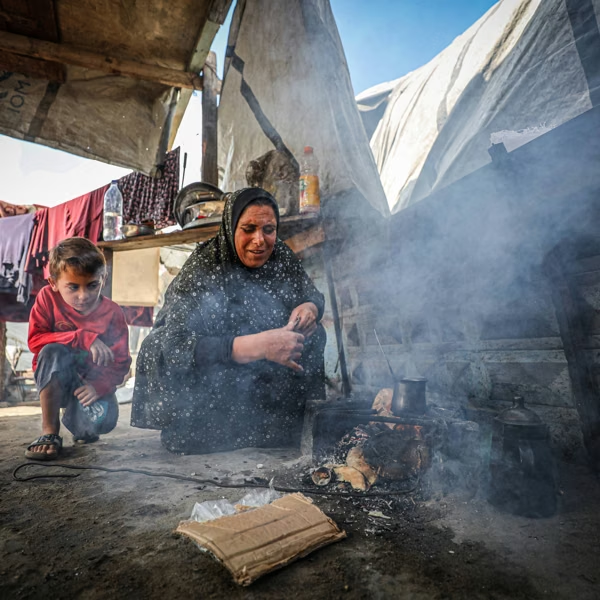
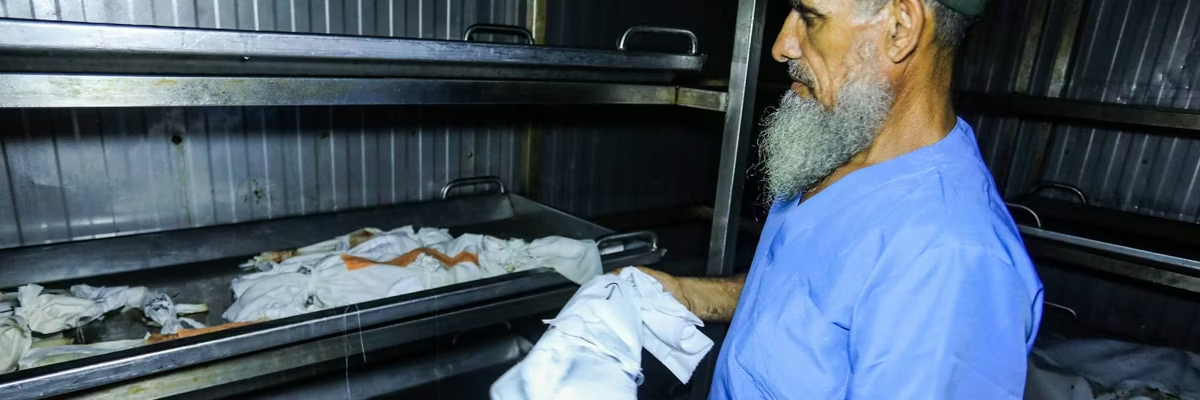
A worker at Nasser Hospital's morgue adds the wrapped body of a dead newborn baby to a tray containing 19 other miscarriage victims, on July 13, 2026 in Khan Younis, Gaza, Palestine.
Official Reports 'Unprecedented' Rise in Gaza Miscarriages Amid Israeli Genocide
One US author called the staggering surge a "reproductive genocide that Western feminists can't be allowed to ignore."
A senior medical official in the Gaza Strip sounded the alarm on Tuesday over a dramatic rise in miscarriages in the Palestinian exclave, with nearly 4,000 cases reported during the first half of 2026 amid Israel's ongoing genocide.
Gaza Medical Relief Director Bassam Zaqout said that 3,958 miscarriages were recorded in Gaza during the first half of this year—an increase the doctor called "unprecedented," and a serious risk to the health of pregnant women and their unborn fetuses.
Zaqout cited the soaring miscarriage rate to factors in Israel's genocidal assault on Gaza, including the destruction of the strip's infrastructure, unsanitary living conditions in camps for forcibly displaced Palestinians—where numerous babies have died of hypothermia—lack of hot water and hygiene supplies, and relentless terror caused by Israel Defense Forces bombing.
The Gaza Health Ministry documented 921 miscarriages and 2,004 live births in April. This staggering ratio—460 miscarriages for every 1,000 live births—is more than double that in neighboring nations Israel and Egypt.
Live births have also dropped dramatically in Gaza this year, from 5,210 in January, to 3,433 in February, 3,233 in March, 2,004 in April, and just 1,701 in May 2026, according to the ministry.
Last month, the Gaza Center for Human Rights said that the alarming rise in miscarriages is due to the systematic destruction of Gaza’s healthcare system, repeated attacks on hospitals, and widespread deprivation of food, medicine, and essential medical services amid 33 months of what United Nations experts and others have described as a genocide.
The Gaza Center for Human Rights said the following factors are the most significant drivers of the miscarriage crisis:
- The widespread destruction of hospitals, primary healthcare centers, maternity wards, and fertility clinics;
- Repeated attacks on medical personnel, including the killing, detention, and targeting of healthcare workers;
- Mass malnutrition caused by Israel's siege;
- The collapse of maternal and child healthcare services; and
- Restrictions on the entry of essential medicines and medical supplies needed by pregnant women and newborns.
The center also noted that Article II of the Genocide Convention—the legal basis for the South Africa-led genocide case against Israel currently before the International Court of Justice—includes “imposing measures intended to prevent births within the group” in its definition of the crime.
United Nations officials and other experts have accused Israel of “systematically” using reproductive, sexual, and other forms of gender-based violence against Palestinians in Gaza and committing “genocidal acts” by deliberately destroying reproductive and healthcare facilities in the strip.
There has also been a documented surge in birth defects among Gaza newborns. According to the Gaza Health Ministry, congenital anomalies doubled in 2025 compared with 2022.
Successive medical warnings of a long-term health catastrophe in the Gaza Strip, with a notable increase in fetal deformities and miscarriages resulting from the harsh conditions of war. pic.twitter.com/T2rN6XQec6
— Eye on Palestine (@EyeonPalestine) June 25, 2026
Experts attribute the increase to many of the same factors driving miscarriages, pointing to contaminated water and widespread malnutrition, including the former famine that killed at least hundreds of Palestinians in Gaza, many of them children and infants.
Zaqout warned that Gaza’s health crisis is worsening as severe shortages of medicines, equipment, diagnostic tools, and laboratory supplies persist amid the strip's heavily damaged healthcare infrastructure and ongoing siege. He also noted the epidemics of diseases such as chickenpox, waterborne illnesses, and respiratory infections.
Numerous Palestinian women have lost their pregnancies due to direct acute trauma inflicted by Israeli bombs and bullets, which have often also killed would-be mothers. Israeli invaders have also ordered the evacuation of Gaza's hospitals, forcing staff to leave prematurely born babies to die and decompose in incubators.
A United Nations commission of inquiry reported last month that approximately 30% of the more than 73,000 Palestinians killed during Israel's 33-month war on Gaza were children—many of whom were deliberately targeted. Israeli forces have killed more than 21,500 Gazan children, including 1,022 babies, since the October 7, 2023 Hamas-led attack, according to the Gaza Government Media Office.
The United Nations Children's Fund has called Gaza "the most dangerous place in the world to be a child."
We are at a crossroads
This country and this world are at a monumental crossroads. In a few short weeks, US voters will have an opportunity to beat back the forces of fascism and confront the billionaires who are rigging the economy, our media system, and our democracy, making it increasingly impossible for ordinary people to get by. We’re not just talking about the election. We’re talking about what must be done once these fascist elements are vanquished from power. We need a bolder set of solutions than what either major party has so far been willing to offer and a working-class movement ready to fight like hell for it. Trump didn't emerge from nowhere. The conditions that fueled MAGA authoritarianism were created by decades of radical neoliberal economic policies and a corrupt political system dominated by corporate interests. They slashed taxes on the super-rich, promising that the benefits would trickle down. They said giveaways to the corporate titans would make life more affordable for the rest of us. It was all bullshit. And when a bitter, betrayed populace searches for someone to blame, right-wing demagogues have little trouble finding scapegoats. People know when they're being lied to, but you won't hear any of this from the corporate media. Only independent journalism—powered and funded by people who believe in building a better world—can deliver truly trustworthy daily news. Our Fall Campaign is underway, and we need your help. To power our newsroom through the rest of the year, we need to raise $125,000 by midnight on October 31. So if you share our vision, please contribute whatever you can to sustain our work. |
A senior medical official in the Gaza Strip sounded the alarm on Tuesday over a dramatic rise in miscarriages in the Palestinian exclave, with nearly 4,000 cases reported during the first half of 2026 amid Israel's ongoing genocide.
Gaza Medical Relief Director Bassam Zaqout said that 3,958 miscarriages were recorded in Gaza during the first half of this year—an increase the doctor called "unprecedented," and a serious risk to the health of pregnant women and their unborn fetuses.
Zaqout cited the soaring miscarriage rate to factors in Israel's genocidal assault on Gaza, including the destruction of the strip's infrastructure, unsanitary living conditions in camps for forcibly displaced Palestinians—where numerous babies have died of hypothermia—lack of hot water and hygiene supplies, and relentless terror caused by Israel Defense Forces bombing.
The Gaza Health Ministry documented 921 miscarriages and 2,004 live births in April. This staggering ratio—460 miscarriages for every 1,000 live births—is more than double that in neighboring nations Israel and Egypt.
Live births have also dropped dramatically in Gaza this year, from 5,210 in January, to 3,433 in February, 3,233 in March, 2,004 in April, and just 1,701 in May 2026, according to the ministry.
Last month, the Gaza Center for Human Rights said that the alarming rise in miscarriages is due to the systematic destruction of Gaza’s healthcare system, repeated attacks on hospitals, and widespread deprivation of food, medicine, and essential medical services amid 33 months of what United Nations experts and others have described as a genocide.
The Gaza Center for Human Rights said the following factors are the most significant drivers of the miscarriage crisis:
- The widespread destruction of hospitals, primary healthcare centers, maternity wards, and fertility clinics;
- Repeated attacks on medical personnel, including the killing, detention, and targeting of healthcare workers;
- Mass malnutrition caused by Israel's siege;
- The collapse of maternal and child healthcare services; and
- Restrictions on the entry of essential medicines and medical supplies needed by pregnant women and newborns.
The center also noted that Article II of the Genocide Convention—the legal basis for the South Africa-led genocide case against Israel currently before the International Court of Justice—includes “imposing measures intended to prevent births within the group” in its definition of the crime.
United Nations officials and other experts have accused Israel of “systematically” using reproductive, sexual, and other forms of gender-based violence against Palestinians in Gaza and committing “genocidal acts” by deliberately destroying reproductive and healthcare facilities in the strip.
There has also been a documented surge in birth defects among Gaza newborns. According to the Gaza Health Ministry, congenital anomalies doubled in 2025 compared with 2022.
Successive medical warnings of a long-term health catastrophe in the Gaza Strip, with a notable increase in fetal deformities and miscarriages resulting from the harsh conditions of war. pic.twitter.com/T2rN6XQec6
— Eye on Palestine (@EyeonPalestine) June 25, 2026
Experts attribute the increase to many of the same factors driving miscarriages, pointing to contaminated water and widespread malnutrition, including the former famine that killed at least hundreds of Palestinians in Gaza, many of them children and infants.
Zaqout warned that Gaza’s health crisis is worsening as severe shortages of medicines, equipment, diagnostic tools, and laboratory supplies persist amid the strip's heavily damaged healthcare infrastructure and ongoing siege. He also noted the epidemics of diseases such as chickenpox, waterborne illnesses, and respiratory infections.
Numerous Palestinian women have lost their pregnancies due to direct acute trauma inflicted by Israeli bombs and bullets, which have often also killed would-be mothers. Israeli invaders have also ordered the evacuation of Gaza's hospitals, forcing staff to leave prematurely born babies to die and decompose in incubators.
A United Nations commission of inquiry reported last month that approximately 30% of the more than 73,000 Palestinians killed during Israel's 33-month war on Gaza were children—many of whom were deliberately targeted. Israeli forces have killed more than 21,500 Gazan children, including 1,022 babies, since the October 7, 2023 Hamas-led attack, according to the Gaza Government Media Office.
The United Nations Children's Fund has called Gaza "the most dangerous place in the world to be a child."
- What Crimes Have These Babies Committed? ›
- 1,022 Babies Among 21,500+ Children Killed by Israel in 1,000 Days of Gaza Genocide ›
- Cold Weather Kills Baby in Flooded Gaza Tent as UN Warns of Crisis for Mothers and Children ›
- 'An Avoidable Disaster': Israeli Blockade of Gaza Could Starve Hundreds of Premature Babies ›
- 30% of Those Killed in Gaza Genocide Were Children, Many From 'Deliberate' Targeting: UN Commission ›
- Thousands of Babies Being Born Into 'Hell' in Gaza, Says UNICEF ›
A senior medical official in the Gaza Strip sounded the alarm on Tuesday over a dramatic rise in miscarriages in the Palestinian exclave, with nearly 4,000 cases reported during the first half of 2026 amid Israel's ongoing genocide.
Gaza Medical Relief Director Bassam Zaqout said that 3,958 miscarriages were recorded in Gaza during the first half of this year—an increase the doctor called "unprecedented," and a serious risk to the health of pregnant women and their unborn fetuses.
Zaqout cited the soaring miscarriage rate to factors in Israel's genocidal assault on Gaza, including the destruction of the strip's infrastructure, unsanitary living conditions in camps for forcibly displaced Palestinians—where numerous babies have died of hypothermia—lack of hot water and hygiene supplies, and relentless terror caused by Israel Defense Forces bombing.
The Gaza Health Ministry documented 921 miscarriages and 2,004 live births in April. This staggering ratio—460 miscarriages for every 1,000 live births—is more than double that in neighboring nations Israel and Egypt.
Live births have also dropped dramatically in Gaza this year, from 5,210 in January, to 3,433 in February, 3,233 in March, 2,004 in April, and just 1,701 in May 2026, according to the ministry.
Last month, the Gaza Center for Human Rights said that the alarming rise in miscarriages is due to the systematic destruction of Gaza’s healthcare system, repeated attacks on hospitals, and widespread deprivation of food, medicine, and essential medical services amid 33 months of what United Nations experts and others have described as a genocide.
The Gaza Center for Human Rights said the following factors are the most significant drivers of the miscarriage crisis:
- The widespread destruction of hospitals, primary healthcare centers, maternity wards, and fertility clinics;
- Repeated attacks on medical personnel, including the killing, detention, and targeting of healthcare workers;
- Mass malnutrition caused by Israel's siege;
- The collapse of maternal and child healthcare services; and
- Restrictions on the entry of essential medicines and medical supplies needed by pregnant women and newborns.
The center also noted that Article II of the Genocide Convention—the legal basis for the South Africa-led genocide case against Israel currently before the International Court of Justice—includes “imposing measures intended to prevent births within the group” in its definition of the crime.
United Nations officials and other experts have accused Israel of “systematically” using reproductive, sexual, and other forms of gender-based violence against Palestinians in Gaza and committing “genocidal acts” by deliberately destroying reproductive and healthcare facilities in the strip.
There has also been a documented surge in birth defects among Gaza newborns. According to the Gaza Health Ministry, congenital anomalies doubled in 2025 compared with 2022.
Successive medical warnings of a long-term health catastrophe in the Gaza Strip, with a notable increase in fetal deformities and miscarriages resulting from the harsh conditions of war. pic.twitter.com/T2rN6XQec6
— Eye on Palestine (@EyeonPalestine) June 25, 2026
Experts attribute the increase to many of the same factors driving miscarriages, pointing to contaminated water and widespread malnutrition, including the former famine that killed at least hundreds of Palestinians in Gaza, many of them children and infants.
Zaqout warned that Gaza’s health crisis is worsening as severe shortages of medicines, equipment, diagnostic tools, and laboratory supplies persist amid the strip's heavily damaged healthcare infrastructure and ongoing siege. He also noted the epidemics of diseases such as chickenpox, waterborne illnesses, and respiratory infections.
Numerous Palestinian women have lost their pregnancies due to direct acute trauma inflicted by Israeli bombs and bullets, which have often also killed would-be mothers. Israeli invaders have also ordered the evacuation of Gaza's hospitals, forcing staff to leave prematurely born babies to die and decompose in incubators.
A United Nations commission of inquiry reported last month that approximately 30% of the more than 73,000 Palestinians killed during Israel's 33-month war on Gaza were children—many of whom were deliberately targeted. Israeli forces have killed more than 21,500 Gazan children, including 1,022 babies, since the October 7, 2023 Hamas-led attack, according to the Gaza Government Media Office.
The United Nations Children's Fund has called Gaza "the most dangerous place in the world to be a child."
- What Crimes Have These Babies Committed? ›
- 1,022 Babies Among 21,500+ Children Killed by Israel in 1,000 Days of Gaza Genocide ›
- Cold Weather Kills Baby in Flooded Gaza Tent as UN Warns of Crisis for Mothers and Children ›
- 'An Avoidable Disaster': Israeli Blockade of Gaza Could Starve Hundreds of Premature Babies ›
- 30% of Those Killed in Gaza Genocide Were Children, Many From 'Deliberate' Targeting: UN Commission ›
- Thousands of Babies Being Born Into 'Hell' in Gaza, Says UNICEF ›