SUBSCRIBE TO OUR FREE NEWSLETTER
Daily news & progressive opinion—funded by the people, not the corporations—delivered straight to your inbox.
5
#000000
#FFFFFF
To donate by check, phone, or other method, see our More Ways to Give page.
Daily news & progressive opinion—funded by the people, not the corporations—delivered straight to your inbox.
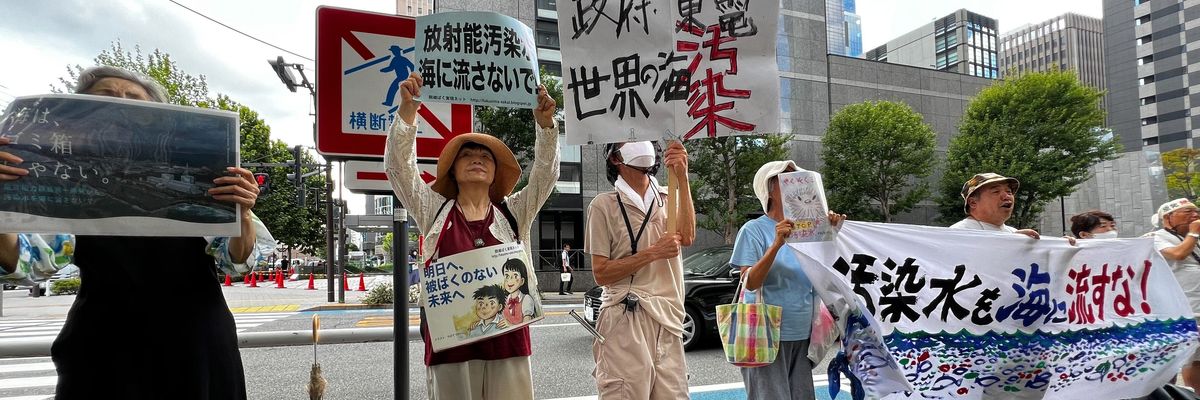
Protesters stand outside of the headquarters of the Tokyo Electric Power Company as it released the first Fukushima wastewater into the Pacific Ocean.
In response, China said it would ban the import of all Japanese ocean products, with one ministry spokesperson calling Japan's decision "selfish."
At around 1:00 pm local time Thursday, the Tokyo Electric Power Company began to discharge wastewater from the Fukushima nuclear plant, in keeping with the schedule Japan announced Tuesday.
In response, South Korean protestors attempted to enter the Japanese Embassy in Seoul, and China said it would ban the import of all Japanese ocean products.
"The ocean is the common property of all humankind, not a place for Japan to arbitrarily dump nuclear-contaminated water," Chinese foreign ministry spokesperson Wang Wenbin said ahead of the first release of water Thursday, as The Guardian reported.
Wang also called the decision "extremely selfish."
"The sea is not Japan's trash bin."
The Chinese customs agency said it would immediately and "completely suspend the import of aquatic products originating in Japan" to "prevent the risk of radioactive contamination of food safety." This means that, in addition to seafood, marine products like seaweed or sea salt would also be covered, CNN explained.
In South Korea, around 50 people gathered for a protest outside the Japanese Embassy in Seoul, Reuters reported. A group of them entered the building and reached the eighth floor, where they unfurled banners.
"The sea is not Japan's trash bin," one banner read. "Stop releasing contaminated water at once."
Police arrested 16 people for trespassing, physically carrying and dragging some out of the building and on to a bus, a Reuters photographer said.
While South Korea's opposition Democratic Party leader Lee Jae-myung calls the Fukushima release an "act of terror," the country's government under President Yoon Suk Yeol has backed Japan's decision, Deutsche Welle explained. However, the release is unpopular with the public, with more than 80% opposing the release and more than 60% vowing not to eat Japanese seafood afterward, The Associated Press reported. This has prompted the government to threaten Japan with a lawsuit if radiation levels surpass the safety limit, according to DW.
"I totally oppose the Japanese plan. The radioactive wastewater is truly a bad thing," Seoul resident Lee Jae-kyung told AP. "My feelings toward Japan have worsened because of the wastewater release."
The governments of Hong Kong and Macao have also placed a more limited ban on seafood from 10 Japanese prefectures including Fukushima. Hong Kong chief executive John Lee called Japan's decision to release the water "irresponsible," according to The Guardian. There, the release also drew protests, with demonstrators ripping up a sign with the Japanese flag and the words, "No trace of humanity. An enemy of the whole world," when they reached the consulate, as AP reported.
Domestically, too, the release has prompted opposition from fishers and environmental groups, as well as concern from citizens.
"I'm not going to buy fish from Fukushima again and I will ask the sushi restaurant where I usually go where they are buying their stocks from. And I definitely will not go to any of the beaches there with my children until I am absolutely sure that it is safe again," Kanako Hosomura, who lives less than 200 kilometers from the plant, told DW.
Around 400 protesters gathered outside the Tokyo Electric Power Company (TEPCO) headquarters Thursday morning, Greenpeace Japan tweeted.
The protests continued even after the release began.
Japan insists that its plan for the release is safe, and the International Atomic Energy Agency has concluded it is "consistent with relevant international safety standards." TEPCO is first treating the water in an advanced liquid processing system to remove everything except for the radioactive tritium, which is not possible to remove because it is an isotope of hydrogen, a key component of water, as NPR explained. The water containing the tritium is then further diluted with seawater to one-seventh of the World Health Organization's safety standard, according to DW. The government says some nuclear plants release tritium-contaminated wastewater at higher levels, NPR reported. And The Guardian observed that Chinese plants also release wastewater into the ocean.
TEPCO said it would release 7,800 tons of water over the next 17 days, and around 31,200 tons by April, according to DW. The entire process is expected to take around three decades.
Edwin Lyman, the director of nuclear power safety at the Union of Concerned Scientists in Washington, D.C., told NPR that Japan's plan was "the least bad of a bunch of bad options."
"The idea of deliberately discharging hazardous substances into the environment, into the ocean is repugnant," Lyman said. "But unfortunately, if you do look at it from the technical perspective, it's hard to argue that the impacts of this discharge would be worse than those that are occurring at nuclear power plants that are operating worldwide."
However, Woods Hole Oceanographic Institute senior scientist Ken Buesseler said it would be better to keep the waste stored on land where it could be watched.
While he didn't think the waste posed a threat to the wider Pacific, "nearshore in Japan could be affected in the long term because of accumulation of non-tritium forms of radioactivity," Buesseler told NPR.

Dear Common Dreams reader, It’s been nearly 30 years since I co-founded Common Dreams with my late wife, Lina Newhouser. We had the radical notion that journalism should serve the public good, not corporate profits. It was clear to us from the outset what it would take to build such a project. No paid advertisements. No corporate sponsors. No millionaire publisher telling us what to think or do. Many people said we wouldn't last a year, but we proved those doubters wrong. Together with a tremendous team of journalists and dedicated staff, we built an independent media outlet free from the constraints of profits and corporate control. Our mission has always been simple: To inform. To inspire. To ignite change for the common good. Building Common Dreams was not easy. Our survival was never guaranteed. When you take on the most powerful forces—Wall Street greed, fossil fuel industry destruction, Big Tech lobbyists, and uber-rich oligarchs who have spent billions upon billions rigging the economy and democracy in their favor—the only bulwark you have is supporters who believe in your work. But here’s the urgent message from me today. It's never been this bad out there. And it's never been this hard to keep us going. At the very moment Common Dreams is most needed, the threats we face are intensifying. We need your support now more than ever. We don't accept corporate advertising and never will. We don't have a paywall because we don't think people should be blocked from critical news based on their ability to pay. Everything we do is funded by the donations of readers like you. When everyone does the little they can afford, we are strong. But if that support retreats or dries up, so do we. Will you donate now to make sure Common Dreams not only survives but thrives? —Craig Brown, Co-founder |
At around 1:00 pm local time Thursday, the Tokyo Electric Power Company began to discharge wastewater from the Fukushima nuclear plant, in keeping with the schedule Japan announced Tuesday.
In response, South Korean protestors attempted to enter the Japanese Embassy in Seoul, and China said it would ban the import of all Japanese ocean products.
"The ocean is the common property of all humankind, not a place for Japan to arbitrarily dump nuclear-contaminated water," Chinese foreign ministry spokesperson Wang Wenbin said ahead of the first release of water Thursday, as The Guardian reported.
Wang also called the decision "extremely selfish."
"The sea is not Japan's trash bin."
The Chinese customs agency said it would immediately and "completely suspend the import of aquatic products originating in Japan" to "prevent the risk of radioactive contamination of food safety." This means that, in addition to seafood, marine products like seaweed or sea salt would also be covered, CNN explained.
In South Korea, around 50 people gathered for a protest outside the Japanese Embassy in Seoul, Reuters reported. A group of them entered the building and reached the eighth floor, where they unfurled banners.
"The sea is not Japan's trash bin," one banner read. "Stop releasing contaminated water at once."
Police arrested 16 people for trespassing, physically carrying and dragging some out of the building and on to a bus, a Reuters photographer said.
While South Korea's opposition Democratic Party leader Lee Jae-myung calls the Fukushima release an "act of terror," the country's government under President Yoon Suk Yeol has backed Japan's decision, Deutsche Welle explained. However, the release is unpopular with the public, with more than 80% opposing the release and more than 60% vowing not to eat Japanese seafood afterward, The Associated Press reported. This has prompted the government to threaten Japan with a lawsuit if radiation levels surpass the safety limit, according to DW.
"I totally oppose the Japanese plan. The radioactive wastewater is truly a bad thing," Seoul resident Lee Jae-kyung told AP. "My feelings toward Japan have worsened because of the wastewater release."
The governments of Hong Kong and Macao have also placed a more limited ban on seafood from 10 Japanese prefectures including Fukushima. Hong Kong chief executive John Lee called Japan's decision to release the water "irresponsible," according to The Guardian. There, the release also drew protests, with demonstrators ripping up a sign with the Japanese flag and the words, "No trace of humanity. An enemy of the whole world," when they reached the consulate, as AP reported.
Domestically, too, the release has prompted opposition from fishers and environmental groups, as well as concern from citizens.
"I'm not going to buy fish from Fukushima again and I will ask the sushi restaurant where I usually go where they are buying their stocks from. And I definitely will not go to any of the beaches there with my children until I am absolutely sure that it is safe again," Kanako Hosomura, who lives less than 200 kilometers from the plant, told DW.
Around 400 protesters gathered outside the Tokyo Electric Power Company (TEPCO) headquarters Thursday morning, Greenpeace Japan tweeted.
The protests continued even after the release began.
Japan insists that its plan for the release is safe, and the International Atomic Energy Agency has concluded it is "consistent with relevant international safety standards." TEPCO is first treating the water in an advanced liquid processing system to remove everything except for the radioactive tritium, which is not possible to remove because it is an isotope of hydrogen, a key component of water, as NPR explained. The water containing the tritium is then further diluted with seawater to one-seventh of the World Health Organization's safety standard, according to DW. The government says some nuclear plants release tritium-contaminated wastewater at higher levels, NPR reported. And The Guardian observed that Chinese plants also release wastewater into the ocean.
TEPCO said it would release 7,800 tons of water over the next 17 days, and around 31,200 tons by April, according to DW. The entire process is expected to take around three decades.
Edwin Lyman, the director of nuclear power safety at the Union of Concerned Scientists in Washington, D.C., told NPR that Japan's plan was "the least bad of a bunch of bad options."
"The idea of deliberately discharging hazardous substances into the environment, into the ocean is repugnant," Lyman said. "But unfortunately, if you do look at it from the technical perspective, it's hard to argue that the impacts of this discharge would be worse than those that are occurring at nuclear power plants that are operating worldwide."
However, Woods Hole Oceanographic Institute senior scientist Ken Buesseler said it would be better to keep the waste stored on land where it could be watched.
While he didn't think the waste posed a threat to the wider Pacific, "nearshore in Japan could be affected in the long term because of accumulation of non-tritium forms of radioactivity," Buesseler told NPR.

At around 1:00 pm local time Thursday, the Tokyo Electric Power Company began to discharge wastewater from the Fukushima nuclear plant, in keeping with the schedule Japan announced Tuesday.
In response, South Korean protestors attempted to enter the Japanese Embassy in Seoul, and China said it would ban the import of all Japanese ocean products.
"The ocean is the common property of all humankind, not a place for Japan to arbitrarily dump nuclear-contaminated water," Chinese foreign ministry spokesperson Wang Wenbin said ahead of the first release of water Thursday, as The Guardian reported.
Wang also called the decision "extremely selfish."
"The sea is not Japan's trash bin."
The Chinese customs agency said it would immediately and "completely suspend the import of aquatic products originating in Japan" to "prevent the risk of radioactive contamination of food safety." This means that, in addition to seafood, marine products like seaweed or sea salt would also be covered, CNN explained.
In South Korea, around 50 people gathered for a protest outside the Japanese Embassy in Seoul, Reuters reported. A group of them entered the building and reached the eighth floor, where they unfurled banners.
"The sea is not Japan's trash bin," one banner read. "Stop releasing contaminated water at once."
Police arrested 16 people for trespassing, physically carrying and dragging some out of the building and on to a bus, a Reuters photographer said.
While South Korea's opposition Democratic Party leader Lee Jae-myung calls the Fukushima release an "act of terror," the country's government under President Yoon Suk Yeol has backed Japan's decision, Deutsche Welle explained. However, the release is unpopular with the public, with more than 80% opposing the release and more than 60% vowing not to eat Japanese seafood afterward, The Associated Press reported. This has prompted the government to threaten Japan with a lawsuit if radiation levels surpass the safety limit, according to DW.
"I totally oppose the Japanese plan. The radioactive wastewater is truly a bad thing," Seoul resident Lee Jae-kyung told AP. "My feelings toward Japan have worsened because of the wastewater release."
The governments of Hong Kong and Macao have also placed a more limited ban on seafood from 10 Japanese prefectures including Fukushima. Hong Kong chief executive John Lee called Japan's decision to release the water "irresponsible," according to The Guardian. There, the release also drew protests, with demonstrators ripping up a sign with the Japanese flag and the words, "No trace of humanity. An enemy of the whole world," when they reached the consulate, as AP reported.
Domestically, too, the release has prompted opposition from fishers and environmental groups, as well as concern from citizens.
"I'm not going to buy fish from Fukushima again and I will ask the sushi restaurant where I usually go where they are buying their stocks from. And I definitely will not go to any of the beaches there with my children until I am absolutely sure that it is safe again," Kanako Hosomura, who lives less than 200 kilometers from the plant, told DW.
Around 400 protesters gathered outside the Tokyo Electric Power Company (TEPCO) headquarters Thursday morning, Greenpeace Japan tweeted.
The protests continued even after the release began.
Japan insists that its plan for the release is safe, and the International Atomic Energy Agency has concluded it is "consistent with relevant international safety standards." TEPCO is first treating the water in an advanced liquid processing system to remove everything except for the radioactive tritium, which is not possible to remove because it is an isotope of hydrogen, a key component of water, as NPR explained. The water containing the tritium is then further diluted with seawater to one-seventh of the World Health Organization's safety standard, according to DW. The government says some nuclear plants release tritium-contaminated wastewater at higher levels, NPR reported. And The Guardian observed that Chinese plants also release wastewater into the ocean.
TEPCO said it would release 7,800 tons of water over the next 17 days, and around 31,200 tons by April, according to DW. The entire process is expected to take around three decades.
Edwin Lyman, the director of nuclear power safety at the Union of Concerned Scientists in Washington, D.C., told NPR that Japan's plan was "the least bad of a bunch of bad options."
"The idea of deliberately discharging hazardous substances into the environment, into the ocean is repugnant," Lyman said. "But unfortunately, if you do look at it from the technical perspective, it's hard to argue that the impacts of this discharge would be worse than those that are occurring at nuclear power plants that are operating worldwide."
However, Woods Hole Oceanographic Institute senior scientist Ken Buesseler said it would be better to keep the waste stored on land where it could be watched.
While he didn't think the waste posed a threat to the wider Pacific, "nearshore in Japan could be affected in the long term because of accumulation of non-tritium forms of radioactivity," Buesseler told NPR.