

SUBSCRIBE TO OUR FREE NEWSLETTER
Daily news & progressive opinion—funded by the people, not the corporations—delivered straight to your inbox.
5
#000000
#FFFFFF
To donate by check, phone, or other method, see our More Ways to Give page.
Daily news & progressive opinion—funded by the people, not the corporations—delivered straight to your inbox.

Firefighters found that the materials on the buildings burned at a "highly unusual" speed that has raised suspicions of foul play.
A massive fire broke out at several high-rise apartment buildings in Hong Kong's Tai Po district on Wednesday, leaving dozens of people dead and hundreds more missing.
According to BBC, local officials say that at least 36 people died as a result of the blaze, while 279 people are still unaccounted for.
More than 750 firefighters were called to put out the blaze, which Hong Kong-based publication the Standard called "the city’s worst fire in nearly two decades."
The fire's cause is still unknown, although the Guardian reported local officials said that it "had started in some of the external bamboo and mesh scaffolding that encased the towers before spreading inside them."
BBC noted that Hong Kong is one of the few major cities in the world to still use bamboo, which is highly combustable, when constructing modern buildings.
"Local media reports in March said the government's development bureau had been trying to phase out the use of bamboo because of safety concerns," BBC wrote. "The push towards using metal instead of bamboo came after a spate of scaffolding-related deaths in Hong Kong."
The Standard also reported Hong Kong Secretary for Security Chris Tang Ping-keung said that the government would open a criminal investigation after firefighters found that the materials on the buildings burned at a "highly unusual" speed that has raised suspicions of foul play.
Hong Kong Chief Executive John Lee Ka-chiu said he was "extremely saddened" by the tragedy and he vowed a full investigation into the fire's causes. For the time being, however, he said, "the top priority is to extinguish the fire, rescue trapped residents, treat the injured, and provide support for follow-up arrangements."

Between 11 pm Thursday and midnight Friday local time, the Hong Kong Observatory recorded more than 6.2 inches of rain, the most rain in an hour since 1884.
The heaviest rainfall in 140 years brought deadly flooding to Hong Kong Friday.
The deluge killed two, injured more than 140, flooded streets and tunnels, and shuttered schools and the stock market.
"I've never seen scenes like this before. Even during previous typhoons, it was never this severe," Connie Cheung, a 65-year-old assistant nurse, told Reuters. "It's quite terrifying."
Between 11 pm Thursday and midnight Friday local time, the Hong Kong Observatory recorded more than 6.2 inches of rain, according to CNN. That's the most rain in an hour since 1884, when record-keeping started. The deluge prompted the weather agency to announce a "black" rainstorm warning—the highest possible.
"Hong Kong is experiencing a once-in-a-century torrential rainstorm, and 'extreme conditions' have made the situation serious in many districts," chief executive John Lee wrote on Facebook during the storm.
The rain came from once-typhoon Haikui, which made landfall in Fujian, China, Tuesday, Reuters reported. While it has since weakened to a tropical depression, it continues to dump rain while moving slowly. The climate crisis, caused mostly by the burning of fossil fuels, is making tropical storms more extreme, as Al Jazeera noted. At the same time, a warmer atmosphere holds more moisture—at a rate of 7% per 1.8°F of warming. The Hong Kong deluge comes days after Greece experienced its wettest 24-hours on record, as one official said.
"This is fast becoming the new normal," the activist group Climate Defiance wrote on the site formerly known as Twitter. "How is this normal? How can this go on?"
The storm killed at least two people, whom police found floating in flood waters, as The Associated Press reported. The fire department helped 110 people evacuate.
Rain flooded streets and subway stations, stranding commuters including professor Stuart Hargreaves, who told CNN he had to sleep in his car after the roads became "impassible."
"Water was coming over the hood of the car and I thought it was going to flood the engine," he said.
Hargreaves found a safe place to park for the night, and said when he drove home the streets were full of debris from flooding and landslides. Schools were closed Friday "due to extreme conditions," and authorities also urged workers not to go into the office, as Al Jazeera reported.
"I have instructed all government departments to race against time, concentrate firepower on the aftermath work, and repair the affected roads and community facilities as soon as possible."
The remnants of Haikui also brought extreme rainfall to southern China, where Shenzhen recorded a record 18.4 inches of rain, and more than 11,000 were evacuated from Meizhou in Guangdong province, as AP reported. In Shenzhen, schools were also closed, as well as some offices and subway stations, according to Reuters. Schools were closed or delayed in 10 Guangdong districts. Beijing also warned several of its neighborhoods to prepare for heavy flooding through Saturday, AP said.
In Hong Kong, the government began recovery efforts.
"I have instructed all government departments to race against time, concentrate firepower on the aftermath work, and repair the affected roads and community facilities as soon as possible," Lee wrote on Facebook.
However, some residents of Hong Kong expressed concerns online that the territory had not been prepared for the inundation, and Greenpeace East Asia raised questions about the city's ability to adapt to the climate crisis, noting that the storm overflowed the city's drainage system and that the city did not take advantage of its emergency alert systems.
"Greenpeace Hong Kong urges the government to study the impacts of climate change, identify high-risk areas, create long-term response strategies, improve emergency response capabilities, and propel the development of renewable energy and energy conservation measures," the group wrote on social media.
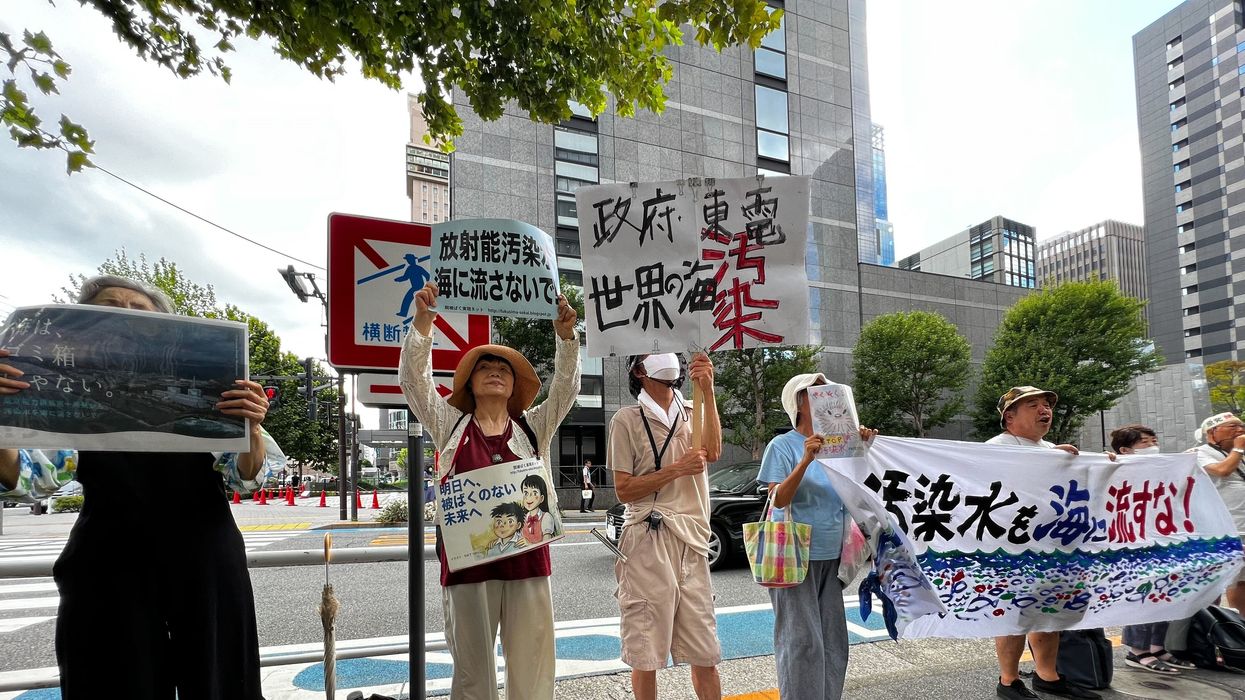
In response, China said it would ban the import of all Japanese ocean products, with one ministry spokesperson calling Japan's decision "selfish."
At around 1:00 pm local time Thursday, the Tokyo Electric Power Company began to discharge wastewater from the Fukushima nuclear plant, in keeping with the schedule Japan announced Tuesday.
In response, South Korean protestors attempted to enter the Japanese Embassy in Seoul, and China said it would ban the import of all Japanese ocean products.
"The ocean is the common property of all humankind, not a place for Japan to arbitrarily dump nuclear-contaminated water," Chinese foreign ministry spokesperson Wang Wenbin said ahead of the first release of water Thursday, as The Guardian reported.
Wang also called the decision "extremely selfish."
"The sea is not Japan's trash bin."
The Chinese customs agency said it would immediately and "completely suspend the import of aquatic products originating in Japan" to "prevent the risk of radioactive contamination of food safety." This means that, in addition to seafood, marine products like seaweed or sea salt would also be covered, CNN explained.
In South Korea, around 50 people gathered for a protest outside the Japanese Embassy in Seoul, Reuters reported. A group of them entered the building and reached the eighth floor, where they unfurled banners.
"The sea is not Japan's trash bin," one banner read. "Stop releasing contaminated water at once."
Police arrested 16 people for trespassing, physically carrying and dragging some out of the building and on to a bus, a Reuters photographer said.
While South Korea's opposition Democratic Party leader Lee Jae-myung calls the Fukushima release an "act of terror," the country's government under President Yoon Suk Yeol has backed Japan's decision, Deutsche Welle explained. However, the release is unpopular with the public, with more than 80% opposing the release and more than 60% vowing not to eat Japanese seafood afterward, The Associated Press reported. This has prompted the government to threaten Japan with a lawsuit if radiation levels surpass the safety limit, according to DW.
"I totally oppose the Japanese plan. The radioactive wastewater is truly a bad thing," Seoul resident Lee Jae-kyung told AP. "My feelings toward Japan have worsened because of the wastewater release."
The governments of Hong Kong and Macao have also placed a more limited ban on seafood from 10 Japanese prefectures including Fukushima. Hong Kong chief executive John Lee called Japan's decision to release the water "irresponsible," according to The Guardian. There, the release also drew protests, with demonstrators ripping up a sign with the Japanese flag and the words, "No trace of humanity. An enemy of the whole world," when they reached the consulate, as AP reported.
Domestically, too, the release has prompted opposition from fishers and environmental groups, as well as concern from citizens.
"I'm not going to buy fish from Fukushima again and I will ask the sushi restaurant where I usually go where they are buying their stocks from. And I definitely will not go to any of the beaches there with my children until I am absolutely sure that it is safe again," Kanako Hosomura, who lives less than 200 kilometers from the plant, told DW.
Around 400 protesters gathered outside the Tokyo Electric Power Company (TEPCO) headquarters Thursday morning, Greenpeace Japan tweeted.
The protests continued even after the release began.
Japan insists that its plan for the release is safe, and the International Atomic Energy Agency has concluded it is "consistent with relevant international safety standards." TEPCO is first treating the water in an advanced liquid processing system to remove everything except for the radioactive tritium, which is not possible to remove because it is an isotope of hydrogen, a key component of water, as NPR explained. The water containing the tritium is then further diluted with seawater to one-seventh of the World Health Organization's safety standard, according to DW. The government says some nuclear plants release tritium-contaminated wastewater at higher levels, NPR reported. And The Guardian observed that Chinese plants also release wastewater into the ocean.
TEPCO said it would release 7,800 tons of water over the next 17 days, and around 31,200 tons by April, according to DW. The entire process is expected to take around three decades.
Edwin Lyman, the director of nuclear power safety at the Union of Concerned Scientists in Washington, D.C., told NPR that Japan's plan was "the least bad of a bunch of bad options."
"The idea of deliberately discharging hazardous substances into the environment, into the ocean is repugnant," Lyman said. "But unfortunately, if you do look at it from the technical perspective, it's hard to argue that the impacts of this discharge would be worse than those that are occurring at nuclear power plants that are operating worldwide."
However, Woods Hole Oceanographic Institute senior scientist Ken Buesseler said it would be better to keep the waste stored on land where it could be watched.
While he didn't think the waste posed a threat to the wider Pacific, "nearshore in Japan could be affected in the long term because of accumulation of non-tritium forms of radioactivity," Buesseler told NPR.

"This case has been an obscene injustice," Amnesty's Hana Young said as the mass trial began. "Peaceful political opposition is not a crime."
As the 90-day trial of 16 pro-democracy figures began Monday in Hong Kong, the global human rights group Amnesty International blasted what it called the "politically motivated" charges against the defendants, while urging authorities to drop the case.
The 16 defendants are part of a group of 47 people including former lawmakers, ex-district councilors, academics, and activists who were arrested in January 2021 and subsequently charged with "conspiracy to commit subversion" in alleged violation of a 2020 national security law. The legislation has been condemned by legal experts and activists as a threat to both human rights and Hong Kong's purported autonomy from Beijing.
The 16 pleaded not guilty Monday; the other 31 previously entered guilty pleas. All of the so-called Hong Kong 47 stand accused of plotting to turn Hong Kong's legislature into a "lethal constitutional weapon" against the Chinese government. In a break with Hong Kong's common law judicial tradition, the case is being tried by a trio of hand-picked prosecutors instead of a jury.
"This case has been an obscene injustice since the unprecedented mass prosecution of the 47 defendants began in March 2021," Amnesty deputy regional director Hana Young said in a statement. "In a trial that lays bare the intrinsically abusive nature of the national security law, some of the defendants face up to life in prison simply for taking part in political party 'primaries.'"
The five defendants accused of being "major organizers" of the plot are: Benny Tai, a legal scholar; Au Nok-hin, an ex-legislator; Chiu Ka-yin and Chung Kam-lun, former district council members; and Gordon Ng Ching-hang, an activist.
“They are forced to make the impossible decision between pleading guilty to a nonexistent crime for a potential reduction in sentence, or fighting a losing battle under the unjust national security law," Young added. "Most of the 47 have been detained for two years without trial, due to the extremely stringent bail threshold which in effect creates an assumption against bail in national security cases. Whatever happens in the trial, that injustice alone can never be undone."
Young continued:
With this mass trial, the Hong Kong government is attempting to shut off all meaningful political participation in Hong Kong. But the fact that people came to the court today to protest against these prosecutions, despite the risks, showed that the Hong Kong authorities will never be able to fully crush dissent.
People must be allowed to freely express their opinions in Hong Kong, without the threat of jail. Peaceful political opposition is not a crime.
"The charges against the 47 are based entirely upon claimed hypothetical threats to national security," Young added. "All those still detained in the case should be immediately released and the charges against all dropped."
There was a heavy police presence outside the West Kowloon Magistrates' Courts as the trial got underway Monday. Protesters, including members of the progressive League of Social Democrats, staged small demonstrations outside the building before being dispersed.
"Primary elections are something that happens in every democratic country," one supporter of the defendants told Agence France-Presse outside the court. "But I don't know why something like this has happened in Hong Kong, that holding primaries is being considered breaking the law."
During both the Trump and Biden administrations, the United States—which Beijing accuses of "interference in Hong Kong affairs" and "anti-China destabilization"—imposed sanctions on a handful of Hong Kong and Chinese officials in connection with the crackdown. Biden also recently extended a program that shields Hong Kong residents from deportation.

A Hong Kong man has become the first confirmed patient to be reinfected with coronavirus, raising fresh concerns Monday that immunity to the potentially deadly virus may be short-lived.
A research team at the University of Hong Kong, led by Dr. Kelvin Kai-Wang, announced on Monday that a 33-year-old man who was first infected by SARS-CoV-2 in March apparently contracted the virus for a second time while recently traveling in Europe. The confirmed reinfection suggests that some patients who recover from Covid-19 may only be temporarily immune to the virus, although scientists pointed to the fact that reinfection is common with other coronaviruses.
"This is the world's first documentation of a patient who recovered from Covid-19 but got another episode of Covid-19 afterwards," the researchers said in a statement reported by the medical news site STAT. "Our findings suggest that Covid-19 may persist in the global human population, as is the case for other common-cold associated human coronaviruses, even if patients have acquired immunity via natural infection."
While there have been several reported cases of presumed reinfection in the United States, none of these have been confirmed by testing. There have also been cases of recovered patients testing positive for the virus a second time because they still carry viral fragments, sometimes for weeks.
The New York Times reports the Hong Kong man was first diagnosed with Covid-19 on March 26. Although he suffered only mild symptoms, he was hospitalized three days later as required by Hong Kong health regulations. He was released from hospital on April 14 after testing negative twice. After returning from a trip to Spain and the United Kingdom, he again tested positive on August 15. The new test revealed he was infected with a strain of the virus that is prevalent in Europe.
Immunologists around the world said it is too soon to determine whether the Hong Kong case was cause for broader concern.
"There have been more than 24 million cases reported to date," World Health Organization coronavirus specialist Maria Van Kerkhov said at a media briefing on Monday. "We need to look at something like this at a population level."
"The second infection was completely asymptomatic--his immune response prevented the disease from getting worse," tweeted Prof. Akiko Iwasaki, a Yale University immunologist who was not involved in the research. "This is no cause for alarm--this is a textbook example of how immunity should work," she added.
However, Iwasaki said that asymptomatic carriers can still infect others with the virus, highlighting the importance of vaccine development.
"In order to provide herd immunity, a potent vaccine is needed to induce immunity that prevents both reinfection and disease," she said.
Dr. Jeffrey Shaman, an epidemiologist at Columbia University in New York, concurred with Iwasaki's assessment that the Hong Kong case is no cause for alarm. However, Shaman told the Times that "it remains very, very concerning... that we may be subject to repeat infection with this virus."
According to the Johns Hopkins University Coronavirus Resource Center, there have been more than 25.5 million worldwide Covid-19 cases and just over 810,000 deaths as of Monday afternoon. The U.S. leads the world in both number of cases (5.7 million) and deaths (just over 177,000). The daily average number of new US coronavirus cases has been on the decline, with new reported cases over the past week averaging around 47,000 per day, down from a peak average of 67,317 on July 22, according to Johns Hopkins.
State health officials attribute the decline in new cases to safety guidelines including social distancing and wearing masks.
"Face coverings have made a difference," Washington state Health Secretary Dr. John Wiesman said last week.
However, government health officials also cautioned that although infections are trending in a positive direction, now is not the time to relax prevention and containment measures.
"This could turn around very quickly if we're not careful," warned Adm. Brett Giroir, the Trump administration physician in charge of supervising coronavirus testing. "We saw that early on after Memorial Day and the couple weeks afterward that sort of started the current outbreak."
As many schools and colleges across the U.S. prepare to re-open for fall classes, there are widespread fears that they will become the next significant incubators of coronavirus outbreaks, especially when summer gives way to autumn and temperatures begin to drop.
The Trump administration recently declared teachers to be "critical infrastructure workers," meaning that educators who may have been exposed to the virus but who show no symptoms can return to classrooms without quarantining for 14 days as recommended by public health agencies.
Many teachers have expressed serious concerns and outrage about returning to work amid a pandemic that is nowhere near under control, despite the administration's claims to the contrary. There have been numerous reports of educators preparing their wills and even writing their own obituaries as they contemplate the worst-case scenarios resulting from being forced back to work.

The New York Police Department (NYPD) can generally rely on corporate media as allies on controversial police issues. A case in point was the New York subway protests earlier this month, in which the activist group Decolonize This Place organized hundreds of people to occupy New York City subway stations to demand free transit for all and an end to racialized overpolicing on the subway system. There was one injury reported.
The prospect of an event overtly critical of police tactics had Fox News (1/31/20) scandalized. "Antifa Plans Massive Anti-Cop Action in NY Subways," its headline read. Quoting the Police Benevolent Association, it claimed that the "anti-police movement" is aiming for the "destruction of public order." Like Fox, Britain's Daily Mail (2/1/20) appeared particularly appalled that demonstrators were covering their faces: "Masked Anti-Cop Protesters Storm Grand Central During Rush Hour and Vandalize Subway Stations Across New York," ran its headline.
Local news like ABC7 New York (2/5/20) claimed that the masked "vandals" were part of a "criminal effort" that had "trashed" the subway. Examples of subway destruction offered amounted to squirting glue into card readers and locking a door open, allowing commuters to ride for free. Reporter Derick Waller also told viewers that protesters painted vulgar messages, the camera panning to a wall reading "No NYPD" to illustrate. ABC ended with an appeal to arrest protesters: "Anyone with information is urged to call the NYPD's Crime Stoppers Hotline."
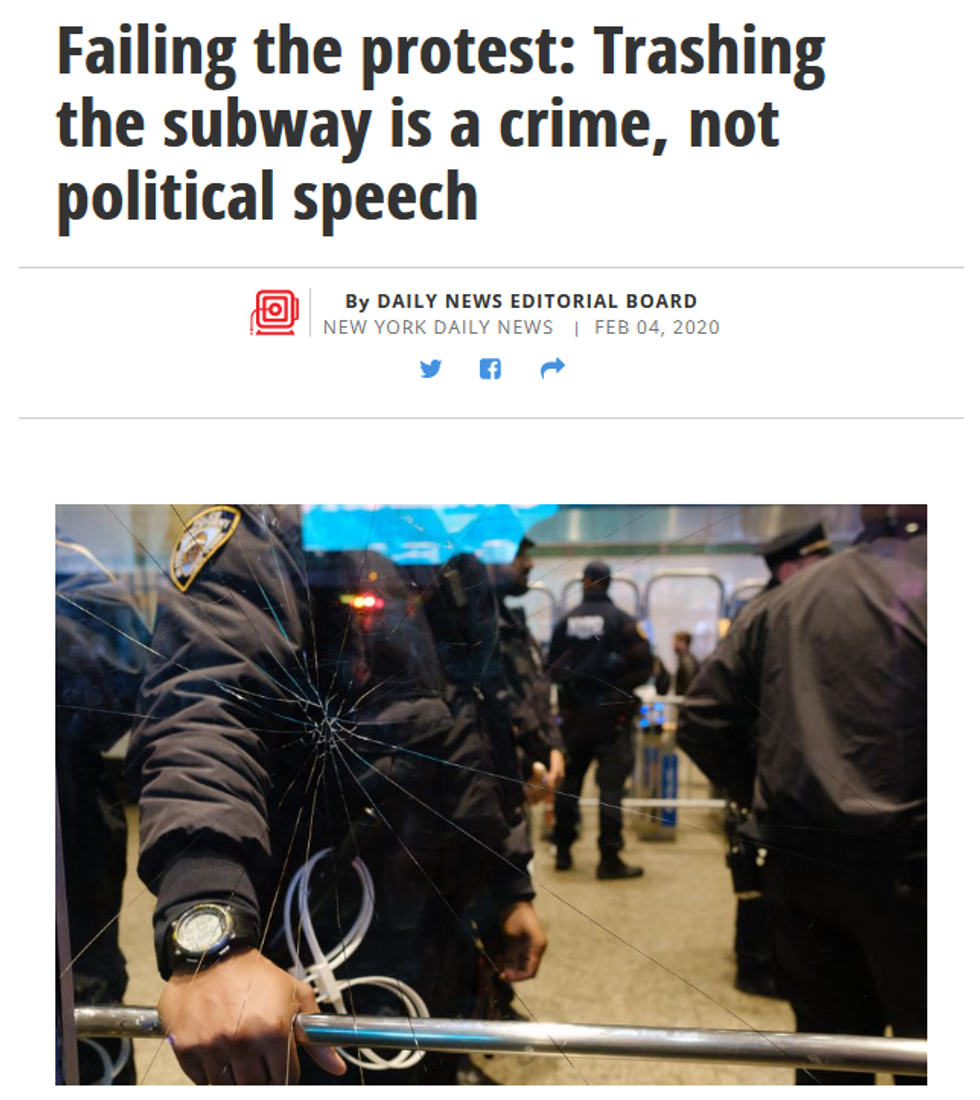
This was hardly Shay's Rebellion. Yet the New York Daily News (2/4/20) was still outraged: "Trashing The Subway, Is a Crime, Not Political Speech," it argued, as it called for state retribution.
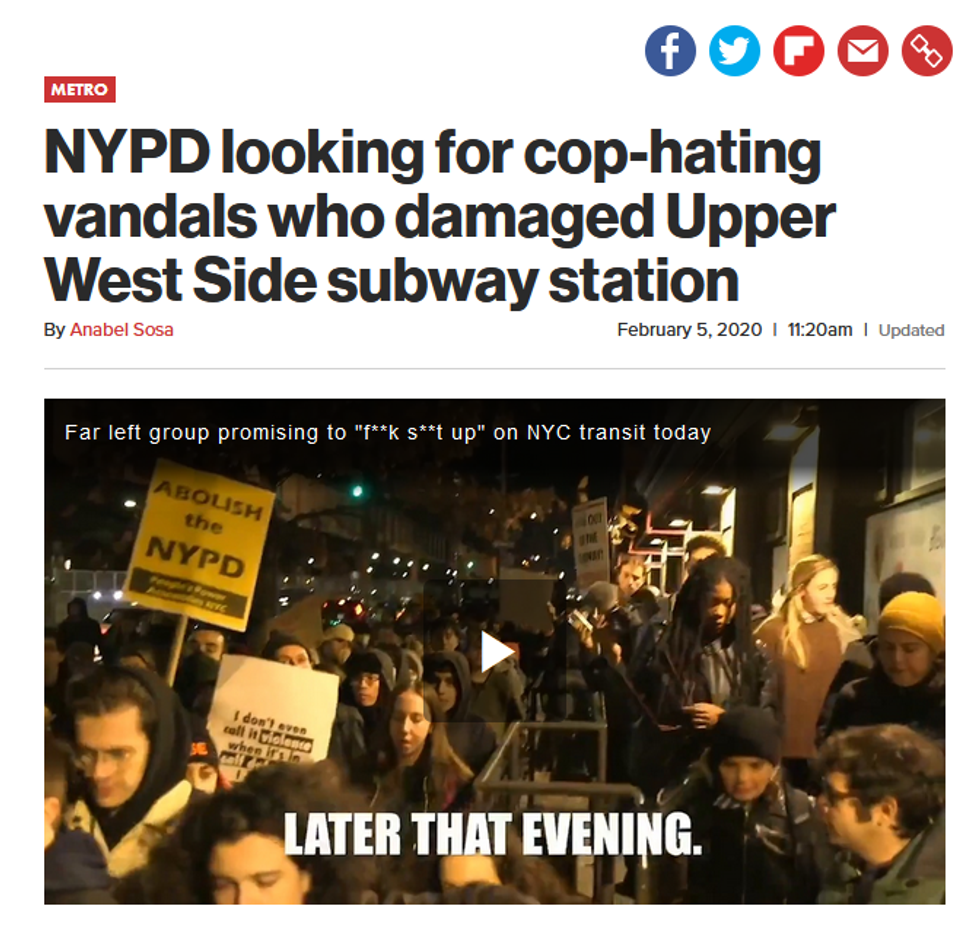
But it was perhaps the New York Post--noted for repeating NYPD talking points (FAIR.org, 7/26/19)--that was the most dead set against the action. "Cop-hating vandals" and "radical agitators" "stormed Grand Central Terminal during rush hour," "wreaking havoc" and holding "hateful signs" like "No Fare No Cops," it told readers (1/31/20, 2/5/20). The cop-haters, according to one source (2/1/20), were carrying out a "twisted agenda" of "violence against police." Throughout its reporting, the only sources were anonymous police officials, leading the stories to sound very much like they were written by the NYPD themselves.
This love of police is not extended to Hong Kong officers, however. In comparison to New York City, where the extent of the damage was limited to what small amounts of paint and glue could do, in October, Hong Kong demonstrators shut down the entire subway system (that carries 5 million daily) by bombing trains and stations. While reporting on the bombing, the New York Post (10/12/19) insisted that they were not anti-cop vandals, but peaceful "pro-democracy protesters" defending the autonomy of the city state against Beijing. An earlier subway clash was described (New York Post, 8/12/19) as police launching a "violent crackdown on pro-democracy demonstrators."
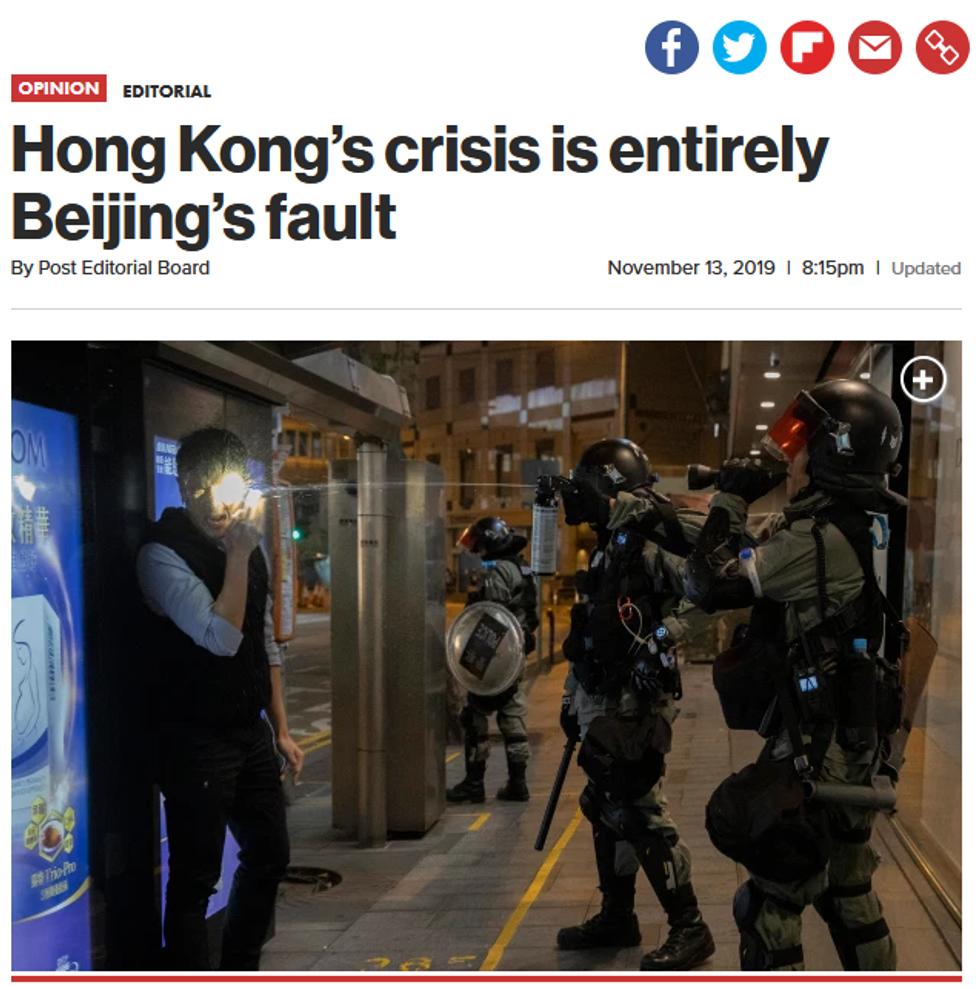
Another Post editorial (11/13/20) made it absolutely clear who they thought was responsible: "Hong Kong's Crisis Is Entirely Beijing's Fault" was its headline, as the editorial board condemned the "relentless drive to remove all [the pro-democracy protesters'] liberties."
Corporate media that appeared so alarmed with New Yorkers wearing masks glorified their counterparts in Hong Kong doing the same thing. The first sentence of CNBC's report (10/4/19) on the government's mask ban and the subsequent subway shutdown included the remarkable phrase, "pro-democracy protesters torched businesses and metro stations," a combination of terms--"pro-democracy" and "torched"--not likely to be seen had US leftists done the same thing. While emphasizing that in response to the mask ban, protesters "hurled petrol bombs at police," the report maintained that they were part of a "pro-democracy movement."
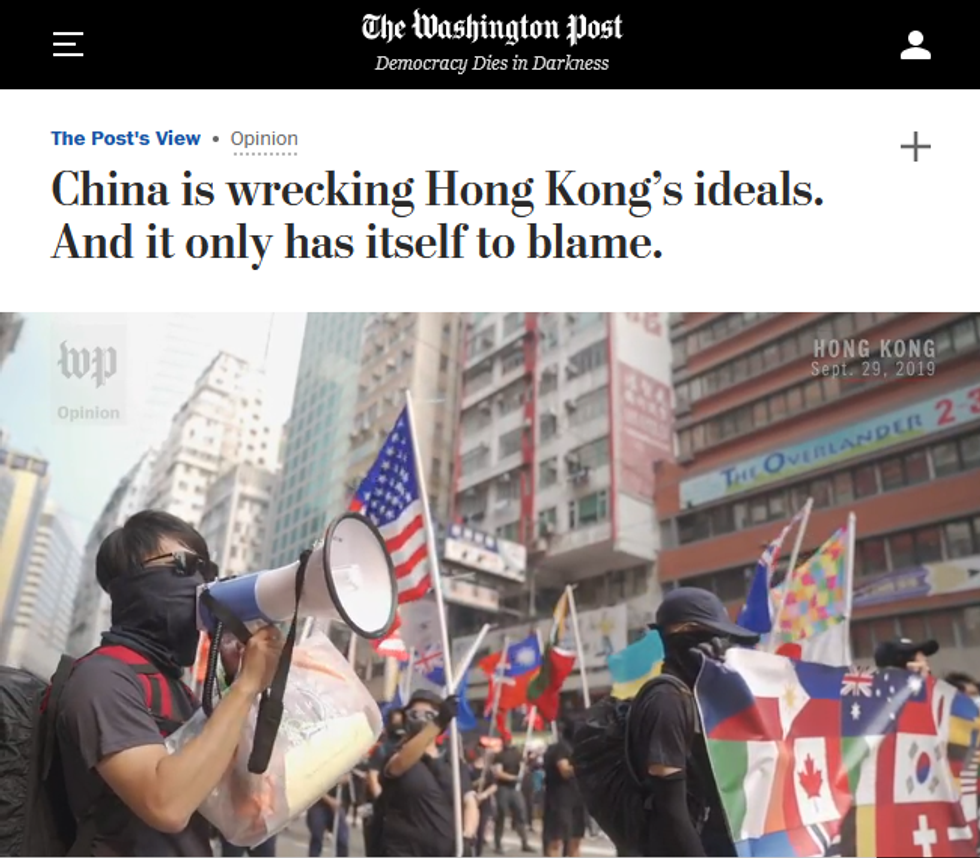
Reuters (10/5/19) and the BBC (10/4/19) also described thousands of masked activists shutting down the entire subway network, by bombing stations and setting fire to trains, as part of a "pro-democracy" protest. The Washington Post's editorial (10/5/19) on the subject presented the masked activists as champions of the "rule of law," protesting against "police brutality" and "excessive use of force," and trying to "preserve their free market and political liberties." China is solely at fault, it concluded.
The message from the media is clear: Their protesters are good, regardless of what they do; ours are vandals, thugs or criminals. Their cops are bad; ours are unimpeachable heroes under fire for just doing their jobs. Journalists that work closely with police, credulously repeating their statements and printing copaganda, pushing a dubious "war on cops" narrative echoed by Trump himself, can effortlessly turn into anarcho-communists challenging authority, depending on the nation being reported on.

As countries across the world suspended air travel to China as a preventive measure for the coronavirus outbreak spreading across the Asian country, some airlines are offering discounted flights to Hong Kong in May--as long as travelers agree to a six-hour layover in the city of Wuhan, part of the Hubei region where the outbreak began in December.
Sara Nelson, president of the Association of Flight Attendants-CWA union, told Common Dreams that selling discounted flights routed through the city at the center of the outbreak is unacceptable. Nelson called on world governments to make sure that public health is prioritized in air travel.
"Public health is not a commodity," said Nelson. "We need responsible leadership from our government in coordination with all stakeholders."
In a statement Friday, Nelson called on airlines to protect the health of their crews.
"The government must work with our airlines to discontinue all service, with consideration for evacuation of flight crew, and with consideration to service that facilitates efforts by public health officials to contain spread of the virus," said Nelson.
American Airlines and Delta announced Friday they are suspending flights to and from China due to the disease. The global tourism industry is expected to take a hit from the illness--one worse than the impact of the SARS outbreak in 2003, according to Bocom International transportation analyst Luya You.
"The benchmark everyone is comparing this to is SARS in 2003," You said. "The actual cost and negative impact of this virus could be greater because more Chinese are traveling than before. The cost of preventing travel, grounding flights, is magnitudes higher than what it was in 2003."
Bloomberg News broke the story of cheap flights through Wuhan Thursday evening, citing travel website Kayak:
Flying with China Southern Airlines Co. to John F. Kennedy International on May 20 costs only $193, according to travel booking site kayak.com. The trip includes 6 hours and 35 minutes in Wuhan. The next-cheapest ticket, with China Eastern Airlines Co. via Shanghai, is $487. Direct American Airlines Inc. flights are on offer for $2,688.
The deeply discounted flights reportedly popped up on the site after the virus spread across China and into at least 14 other countries.
Businesss Insider confirmed Friday morning that there are cheap offers for flights routed through Wuhan scheduled for May on Orbitz.

Politics and photography have a lot in common. If you believe Susan Sontag, they involve a desire to control and frame reality. Taking pictures has become a method to certify experience, whereas the news have become a way of interpreting the world according to our interests. The notion that it is possible to do so with impunity explains why we struggle nowadays to distinguish what is convenient from what is right. Pragmatic consensus has become the exception, and a society divided between doctrinaire camps has become the norm. Public discourse has become uncivil, and an obsession with messianic leaders and theatrical narratives has prevented us from focusing on the real problems that afflict our societies.
Showbiz politics
Politics today have become yet another form of entertainment. Campaigns are not run by defending a particular notion of happiness, but by transforming politicians into celebrities. Debates are not about political knowledge, but likeability. Representatives across the aisle are more than our adversaries, and building bridges is rarely an option. Attempts to understand different points of view require looking through inverted lenses - something neither easy nor comfortable - and most politicians do not have an appetite for low-key politics in the age of spectacle and social media.
Donald Trump is a byproduct of the times we are living. An incompetent President for a system that was unable to adapt to economic disruption and inequality. Most of his leadership has been done on Twitter, and all that Mr. Trump has to offer outside the digital world are thoughtless foreign policy decisions and a disturbing fondness for authoritarian regimes. Few presidents have been able to inflict such damage in such a period of time. Even fewer political parties have willingly committed their future to a President that has no respect for neither democratic institutions nor the rule of law.
Politics today have become yet another form of entertainment.
Mr. Trump will not rise to the challenges ahead. The question is if politicians and journalists will descend to his level. Many representatives care too much about impeachment and too little about the consequences of polarisation and partisanship. As for journalists, we seem unable to take our eyes off the President and have overlooked everything that should have been learned during the last presidential campaign. The result is a poisonous information ecosystem that encourages a superficial and affective approach to politics and that undermines institutions and public trust in our democratic systems.
False prophets
Three years after Donald Trump's election, the world is not a better place. Syria is in ruins. Latin America is in turmoil. Hong Kong is struggling for freedom. And in Europe, populist far-right parties are gaining momentum. In Spain, Vox has become a force to be reckoned with in just three years. In France, Marine Le Pen threatens to unseat Emmanuel Macron, while in Italy, Matteo Salvini is plotting his return to power. In the East, Hungary is completing its transformation into an illiberal democracy under Viktor Orban, while the Polish government attempts to undermine judicial independence and bully journalists into submission.
Far-right populists are not a danger just because of the ideas they impart, but because they further polarisation and undermine democratic legitimacy. Before their entree, the formula to win elections used to be straightforward: come up with solutions that are acceptable for the majority of citizens and do it without ruining the administration. However, since the nineties, the math does not add up.
Far-right populists are not a danger just because of the ideas they impart, but because they further polarisation and undermine democratic legitimacy.
When economic anxiety and socio-cultural issues intertwine, such as immigration and the loss of sovereignty, populist leaders outperform mainstream politicians. They are able to translate the experiences and problems of the voters into an understandable language of us versus them. Overwhelmed and desperate to remain in office, most governments and candidates end up normalising their extremist adversaries.
These are dangerous waters. Interests are malleable and the right message, framing and promises can shape what people perceive as fundamental. News can quickly transform into television shows, with their heroes, villains and never-ending narratives. Public order and security can, over time, become more important than human rights and the freedom of the press. Democracy can slowly descend into authoritarianism. And there is little we can do about it if we keep playing a game that we do not know how to win.
Reshaping democracy
The rules of the game dictate neither silence nor apathy. Reclaiming citizen's trust calls for seizing the initiative. Mainstream parties must stop reacting to the solutions presented by far-right parties and start challenging their premises. Distrust builds on economic inequality, and it must be addressed by developing a realistic and innovative agenda to lower unemployment, protect the environment and curb tax avoidance schemes. As for journalists, they must report about populists with responsibility, accuracy and fairness, helping citizens to understand the societies they live in order to make the correct choices. Echoing Camus, the public does not want to know what Donald Trump eats for breakfast and how many times he tweets, but it has been taught for three years to want it. And that is not the same thing.
Defeating far-right politicians is a global struggle. And the next chance to provide a different answer is materialising in a small country across the Atlantic. Portugal was, until October, one of the few countries in Europe where far-right parties were not a foreseeable threat. Notwithstanding, this once exemplary country elected its first far-right representative two months ago. And Andre Ventura, its leader, is already omnipresent in public discourse. As it happened in Spain and the United States, magnified media coverage has created a larger-than-life character that has, not the votes to shape politics, but wields the influence to monopolise headlines and build a support base. Politicians have not done a better job. Instead of exposing his contradictions and opportunism, they opted for singling him out and strengthened the perception that the establishment is ought to get him. The result is not surprising - the support for the far-right has already doubled according to voting intention polls.
Politicians and journalists should think twice about their approach. There is an opportunity to adjust our diagnosis and come up with a different solution. A chance to revive civic debate, advance social justice and address people's grievances. Democracy is not a one-time event - it needs to keep moving forward and get better with time. If we elude our responsibility when it comes to breathing new life into the values that sustain it, our democracies will eventually collapse.

Global finance capital has seized control of the economies of most nation-states. The citizens watch, helplessly, as money and goods are transferred with little regulation across borders. They watch as jobs in manufacturing and the professions are shipped to regions of the global south where most workers are paid a dollar or less an hour and receive no benefits. They watch as the taxes of the rich and corporations are slashed, often to zero. They watch as austerity programs dismantle or privatize utilities and basic social services, jacking up fees to consumers. They watch as chronic unemployment and underemployment devastate workers, especially the young. They watch as wages stagnate or decline, leaving working men and women with unsustainable debts. This economic tyranny lies at the root of the unrest in Hong Kong, India, Chile, France, Iran, Iraq and Lebanon as well as the rise of right-wing demagogues and false prophets such as British Prime Minister Boris Johnson, President Donald Trump and Indian Prime Minister Narendra Modi.
It does not matter whether liberals or conservatives, Tories or Labour, Republicans or Democrats are in power. Finance capital is impervious to political control. The newly defeated Labour Party in Britain, by adopting a Brexit-neutral stance in the election, badly misread the zeitgeist. Yes, its leader, Jeremy Corbyn, had to contend with hysterical warnings of economic collapse and endured a smear campaign--amplified by a media mouthing the accusations of his Tory opponents--that included claims he was a threat to national security and an anti-Semite, but his and Labour's failure to appreciate how desperate workers were for a solution, even one growing out of magical thinking about the promise of Brexit, was a mistake. Brexit is not a realistic alternative to economic tyranny. But it at least offers a hope, however unfounded, of shattering the bonds of corporate power. It posits itself as a weapon in the war between the insiders and the outsiders. That this desperate hope by the outsiders is peddled by con artists and charlatans such as Johnson and Trump is part of the sickness of our age, an echo of the economic distortions and right-wing populism that saw fascists rise to power in Italy and Germany in the first part of the 20th century.
Goldman Sachs, JPMorgan Chase, Citibank, Exxon Mobile, Walmart, Apple and Amazon are the modern versions of the East India Company or La Compagnie Francaise de l'Orient et de la Chine. These and others among today's global corporations, with the assistance of the World Bank, the World Trade Organization and the International Monetary Fund, have created unassailable monopolies and effectively hollowed out many nation-states, both physically and culturally. Forlorn, derelict urban wastelands, populated by the bitterly dispossessed, are as common in France or Britain as they are in America's Rust Belt. Governments, captive to corporate control, have been prostituted to transfer wealth upward, swell corporate profits and crush dissent at the expense of democracy.
The decay and rupture of the social bonds that once held our societies together have unleashed the dark pathologies of opioid, alcohol and gambling addictions and led to an explosion of hate crimes and mass shootings, along with suicide. Social control provided by work, civic and political participation--bonds that integrated us into our communities and gave us a sense of place, dignity and agency--has been handed over to a heavily militarized police, a massive prison system and a judicial system complicit in abolishing basic rights, including due process and privacy.
So, to steal a line from Vladimir Lenin, what is to be done? Can a reformist political candidate, a Bernie Sanders or perhaps an Elizabeth Warren--although I question the authenticity of Warren--defeat Trump and the retrograde forces that empower him? Or will the U.S. reformers suffer Corbyn's fate? In short, can the system be reformed from the inside? Or will we have to take to the streets, as the people are doing in Chile, Lebanon, France, Hong Kong and elsewhere, to demand the overthrow of corporate rule?
The left, even under Corbyn, is not ready to speak in revolutionary language. Revolutionary rhetoric within the political system has been adopted by the neofascists and the hard right. The Brexit debate is about blowing up the system, not working within it. Those who support Brexit and Johnson will, like those who support Trump, be betrayed. But the language employed by Johnson and Trump is about destruction, and this yearning for destruction runs deep among the working class. The tragedy is that by backing these demagogues the public is complicit in its own enslavement.
Extinction Rebellion, which I support, is attempting to counter this corporate assault and the consequent ecocide with revolutionary language and sustained civil disobedience designed to make governance impossible. I hope Extinction Rebellion will gain enough popular support to raise a strong barrier before the corporate state starts employing the brute force outlined in Operation Yellowhammer, the six-page British government plan that calls for the possible deployment of 50,000 regular and reserved troops and 10,000 riot police to cope with the unrest that might be caused by food and medical shortages following Britain's departure from the European Union.
The violent suppression of protesters in France, Chile, Iraq, Iran, Lebanon, India and Hong Kong is already underway, a window into what may be coming to England, the United States and other countries that attempt to throw off the yoke of corporate oppression.
The corporate state loathes the political left, but the American political left, by agreeing to operate within the constrained and largely rigged electoral system, is easily neutered, as liberalism was this year in Britain and was in 2016--and will be in 2020--in the United States. America's Democratic Party leadership, as hostile to its progressive candidates as many in the Labour Party hierarchy in Britain were to Corbyn, employed a series of measures to prevent Sanders from obtaining the nomination in 2016. They included a superdelegates scheme, the use of hundreds of millions of dollars in corporate money, iron control of the Democratic National Committee and blocking those registered as independents from voting in Democratic primaries. Politicians such as Sanders and Corbyn are easily dispatched.
But while the corporate state detests political mavericks such as Sanders and Corbyn, it both hates and fears the revolutionary left. The revolutionary left speaks an unvarnished truth about corporate power and calls out the entire political ruling class for its complicity. It is not interested in accommodation. It seeks to disrupt and paralyze the corporate state. When many thousands, as in Hong Kong, take to the streets shouting slogans like "There are no rioters, only a tyrannical regime" and "It was you who taught me that peaceful marches are useless," the corporate ruling elites begin to worry. This is why populist leaders, including Eric Drouet of the gilets jaunes, or yellow vests, in France, are arrested. It is why Roger Hallam, the co-founder of Extinction Rebellion, spent six weeks in jail this fall in Britain. It is why Edward Leung is serving a six-year prison sentence on charges of rioting and assaulting a police officer during the 2016 Fishball Revolution in Hong Kong. Revolutionaries refuse to play by the rules.
These global revolutionary movements embody a resurrection of the concept of the common good, the belief that a society should be structured around caring for all its members, especially the most vulnerable. They are forces of solidarity, even community. They understand, as the economist Karl Polanyi wrote, that there are two kinds of freedoms. There are the bad freedoms to exploit those around us and extract huge profits without regard to the common good. And there are the good freedoms--freedom of conscience, freedom of speech, freedom of meeting, freedom of association, freedom to choose one's job--that the bad freedoms destroy. The bad freedoms, championed by an atomized, hyper-individualistic consumer culture, which kneels before the cult of the self, have triumphed. The death grip of the ruling elites was illustrated in recent days in Madrid, where world leaders refused during COP25--the United Nations' conference on climate change--to take meaningful action to halt the climate emergency, an existential threat to humankind.
The bankrupt ideologies of globalization and neoliberalism, formulated and used to justify the consolidation of wealth and power as well as the ecocide that is devastating the planet, have, however, lost their credibility. Neoliberalism, the idea that once regulations on corporations and trade barriers are lifted and taxes slashed, a society will prosper, was always an absurdity. None of its promises could be defended by the history and theory of economics. Concentrating wealth in the hands of a global oligarchic elite--eight families now hold as much wealth as 50 percent of the world's population--while demolishing government controls and regulations, sending production to the global south, privatizing public services and destroying labor unions does not distribute wealth. Allowing global speculators to use money lent to them by the government at virtually zero percent interest to buy back their stock does not distribute wealth. Permitting corporations to engage in structured asset destruction through inflation, to strip assets through mergers and acquisitions, to raise the levels of debt incumbency to enforce debt peonage on the public, to engage in corporate fraud that includes the dispossession of assets, does not distribute wealth. The raiding of pension funds, credit and stock manipulations and looting the U.S. Treasury when the bubbles and Ponzi schemes evaporate does not distribute wealth. Such actions funnel wealth to those at the top. They create enormous income inequality and monopoly power. They fuel discontent and political extremism. They make the planet uninhabitable for most species. They destroy democracy.
But economic rationality was never the point. The point was the restoration of class power. Neoliberalism transforms freedom for the many into freedom for the few. The idiocy of the intellectual gurus who sold us this ideology--Milton Friedman, Friedrich Hayek and Ayn Rand--should have exposed the con from the beginning, but they were given ample platforms, while their critics, the old Keynesians, were pushed out and silenced. Freedom became equated with freedom of market forces to do anything the capitalists wanted. And that freedom doomed us and looks set to doom the ecosystem on which we depend for life. Karl Marx in volume one of "Capital" explained over a century ago how freedom of the market always results in social inequality.
The loss of credibility of the reigning ideology has led the ruling elites to forge an alliance with right-wing, neofascist demagogues such as Trump and Johnson who employ the tropes of racism, Islamophobia, homophobia, bigotry and misogyny to channel the public's growing rage and frustration away from the corporate elites and toward the vulnerable. These demagogues accelerate the pillage. They accelerate the hatred, racism and violence that act as a diversion. And they accelerate the social unrest that becomes the excuse for the imposition of tyranny. Hope lies in the streets. Millions of people in Hong Kong, India, Chile, France, Iran, Iraq and Lebanon understand. It is time to join them.
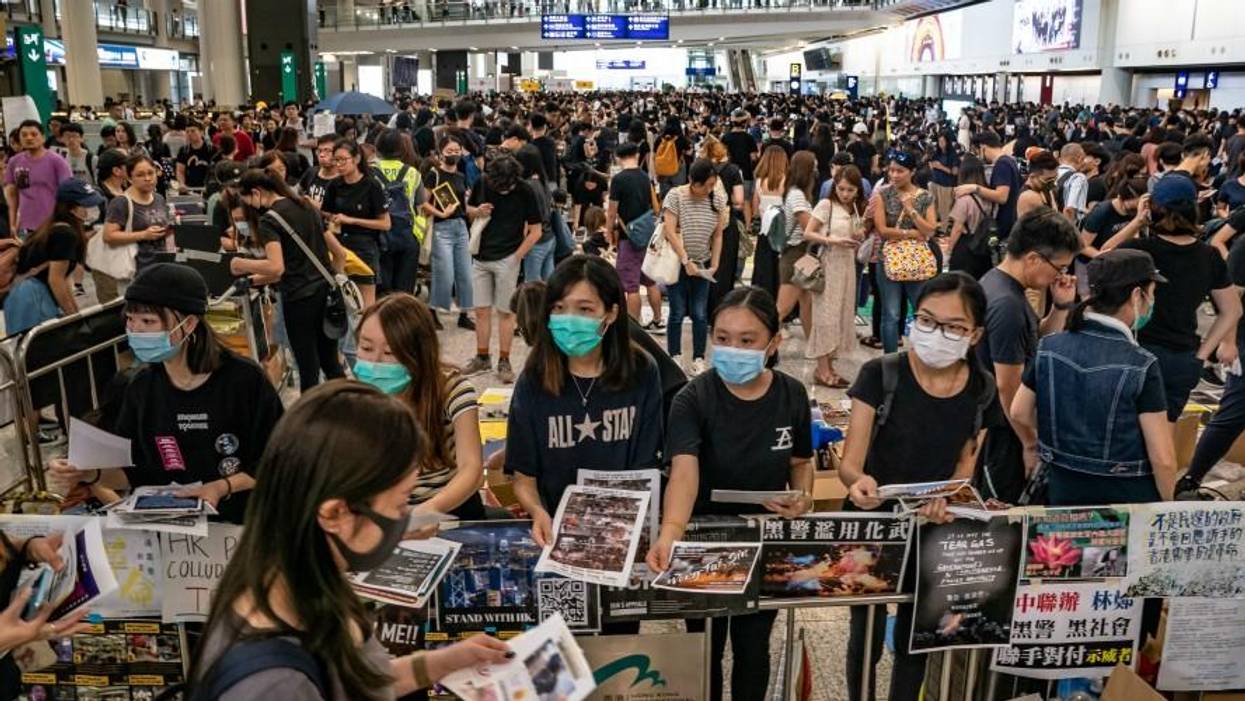
As United Nations high commissioner for human rights, I have been closely following the outbreak of mass protests across every region of the world this year. Demonstrators have taken to the streets for weeks on end, seeking to reclaim their economic, social, civil, political, and cultural rights and pushing back against inequalities in all these spheres.
My own experience as a head of state and as high commissioner for human rights demonstrates that the broadest possible dialogue is the only clear exit lane out of mass protest situations.
We have witnessed inspiring peaceful, even celebratory demonstrations--and we have also witnessed the use of force by security forces as well as violence by pockets of protesters, including in my own country, Chile, and of course in Hong Kong.
My own experience as a head of state and as high commissioner for human rights demonstrates that the broadest possible dialogue is the only clear exit lane out of mass protest situations.
As I have urged governments from Lebanon to Guinea, Iran to Chile, Sudan to Bolivia, Iraq to Zimbabwe and others, serious divisions, fears, frustrations with economic, social, political, and other inequalities must all be acknowledged and tackled in a process that is open and inclusive.
On November 24, Hong Kong voted in its district council elections; a record 71.2 percent of registered electors exercised their right peacefully after months of unrest, violence, and chaos.
The people of Hong Kong delivered a loud and very clear demand to be heard. It is now time to tackle difficult issues--with renewed resolve, clarity, and courage. There is not a moment to lose.
I urge the government to prioritize a long-overdue process of meaningful, inclusive dialogue, by making a concerted effort to bring to the table community leaders, student groups, business groups, trade unions, political leaders from various parties, civil society organizations, academics, legal professionals, minority groups, and others.
It is now time to listen directly to people from all walks of life, to work together with sincere resolve to address their concerns and grievances. Young people, especially, need to be heard.
I appeal to all sides to unequivocally condemn violence that has led to serious injury and death. And I appeal to the government to take important confidence-building measures, including a proper independent and impartial judge-led investigation into reports of excessive use of force by the police.
Such steps will take clarity and courage, and involve compromises, but they are crucial to restore trust, repair rifts, and make it possible to find peaceful resolutions to untenable situations.
Hongkongers have long had a reputation for resilience, adaptability, and pragmatism, and have--for decades--set a high standard with their courageous, persistent exercise of their rights to freedom of expression and peaceful assembly. The resort to extreme violence by a small proportion of the protesters--including against police officers, as well as harassment of some of their family members--is thus deeply regrettable.
I appeal to the government to take important confidence-building measures, including a proper independent and impartial judge-led investigation into reports of excessive use of force by the police.
Global experience shows that if governments and security forces treat their people as enemies, enemies is what they may become. The use of force breaks trust--in institutions, in leaders, and in the rule of law that places like Hong Kong, and my own country Chile, hold so dear. This is the case in many parts of the world.
In all such cases, by merely condemning the violence by some protesters while relying solely on security measures to respond to the protests--without inclusive efforts to address the demands put forth by large segments of the population--governments end up increasing the feeling among many that they are not being heard, and cause their grievances to fester and expand.
For these reasons, accountability is key--both in the case of allegations of excessive force by police and violence by individuals leading to death, serious injury, or major damage.
Calling for an independent investigation into the use of force by police does not tarnish the image of police and security forces, nor does it punish officers who have had to make immense personal sacrifices.
On the contrary, it sends a message that this is a force that works hard to comply with the rule of law and guidelines on the use of force, and is open to an examination of its conduct, and that it values accountability where those rules were not strictly followed.
We have much to learn from other societies that have recovered from periods of violence and social turmoil. For instance, in Tunisia, the National Dialogue Quartet brought together business, trade unions, the bar council, and human rights defenders in a common platform for dialogue with the government--and was awarded the Nobel Peace Prize or its work.
In Thailand and other countries, truth and reconciliation commissions have helped to defuse tensions and polarization that had led to political violence.
My office stands ready to offer advice and guidelines based on our experience and work in human rights around the world--in carving a peaceful, sustainable path forward.