SUBSCRIBE TO OUR FREE NEWSLETTER
Daily news & progressive opinion—funded by the people, not the corporations—delivered straight to your inbox.
5
#000000
#FFFFFF
To donate by check, phone, or other method, see our More Ways to Give page.
Daily news & progressive opinion—funded by the people, not the corporations—delivered straight to your inbox.
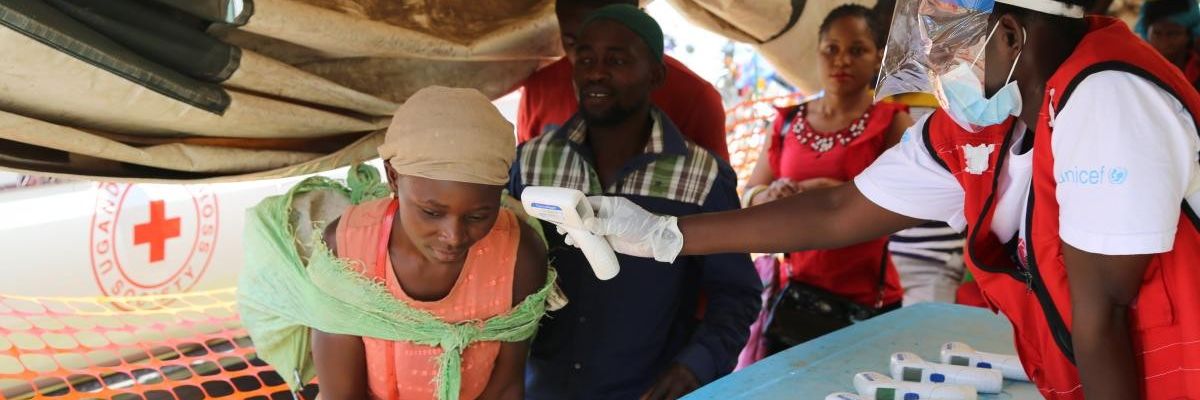
Health workers screen people for Ebola at a border crossing between Uganda and the Democratic Republic of Congo in this undated photo.
"This is pure stupidity that will only hurt us," warned one U.S. doctor and Ebola expert.
Public health experts pointed to the announcement of highly contagious hemorrhagic fever outbreaks in at least three central and eastern African nations this week to underscore what they say are the dangers of President Donald Trump's ideologically driven decision to withdraw the United States from the World Health Organization during a time of mounting pandemic threats.
Uganda Ministry of Health Permanent Secretary Diana Atwine said Thursday that a 32-year-old nurse died of Sudan Ebola virus the previous day in the capital Kampala amid the first new outbreak in two years. Atwine assured the public "that we are in full control" of the situation.
Uganda's alert followed reports of another potential Ebola outbreak, this one in the Western Democratic Republic of Congo. Additionally, health officials earlier this month announced an outbreak of suspected Marburg Virus Disease—a severe, often fatal illness similar to Ebola—in neighboring Tanzania. At least nine people have reportedly died.
World Health Organization (WHO) Director-General Tedros Adhanom Ghebreyesus said on social media Thursday that "a full-scale response is being initiated" by the Ugandan government and its international partners. In a statement, the WHO said it is "deploying senior public health experts and mobilizing staff from the country office to support all the key outbreak response measures."
During past outbreaks of Ebola—a severe viral disease spread via contact with infected bodily fluids, with a fatality rate of 50-90%—the U.S. Centers for Disease Control and Prevention (CDC) worked with the WHO to help stem the spread of the illness.
However, following Trump's January 20 executive order initiating a U.S. withdrawal from the WHO over its alleged "mishandling of the Covid-19 pandemic," CDC and other public health officials have been ordered to stop working with the United Nations body, effective immediately.
"The agencies that are statutorily responsible for protecting our health are unable to do that job because they are not able to pick up the phone and talk to people who might have information that could protect U.S. health and security," Jennifer Nuzzo, director of the Pandemic Center at Brown University's School of Public Health, told Stat this week.
"This is just one of the examples about how the United States loses access, loses the ability to protect American lives," Nuzzo explained. "We can't be everywhere, we can't have eyes and ears on the ground in every possible location [where] harm could be emerging. And this is what happens when we don't engage with institutions that can provide these lifesaving insights."
Experts said other existing or emerging epidemiological threats including bird flu underscore the lifesaving imperative of more, not less, international cooperation.
"Local health officials and doctors depend on the CDC to get disease updates, timely prevention, testing and treatment guidelines, and information about outbreaks," University of Southern California public health expert Dr. Jeffrey Klausner told The Associated Press in a recent interview.
"Shutting down public health communication stops a basic function of public health," he added. "Imagine if the government turned off fire sirens or other warning systems."
Dr. Ashish Jha, the former White House Covid-19 coordinator during the Biden administration, noted Thursday on social media that during Ebola outbreaks, the CDC "usually sends a team right away to help bolster staff that might already be there and support the ministry of health."
"There'd be clear communication from CDC and White House about what exactly is being done, what help we are sending, what American hospitals and others can do to be prepared should Ebola land here," Jha continued. "So what of this is happening? My sense is, not much—but we don't know."
"The communication freeze means CDC not sharing what if anything it is doing," he added. "Travel freeze means CDC staff likely not going. Directive to stop working with WHO means we're flying blind and don't have information about what is happening on the ground. None of this is good."
Dear Common Dreams reader, It’s been nearly 30 years since I co-founded Common Dreams with my late wife, Lina Newhouser. We had the radical notion that journalism should serve the public good, not corporate profits. It was clear to us from the outset what it would take to build such a project. No paid advertisements. No corporate sponsors. No millionaire publisher telling us what to think or do. Many people said we wouldn't last a year, but we proved those doubters wrong. Together with a tremendous team of journalists and dedicated staff, we built an independent media outlet free from the constraints of profits and corporate control. Our mission has always been simple: To inform. To inspire. To ignite change for the common good. Building Common Dreams was not easy. Our survival was never guaranteed. When you take on the most powerful forces—Wall Street greed, fossil fuel industry destruction, Big Tech lobbyists, and uber-rich oligarchs who have spent billions upon billions rigging the economy and democracy in their favor—the only bulwark you have is supporters who believe in your work. But here’s the urgent message from me today. It's never been this bad out there. And it's never been this hard to keep us going. At the very moment Common Dreams is most needed, the threats we face are intensifying. We need your support now more than ever. We don't accept corporate advertising and never will. We don't have a paywall because we don't think people should be blocked from critical news based on their ability to pay. Everything we do is funded by the donations of readers like you. When everyone does the little they can afford, we are strong. But if that support retreats or dries up, so do we. Will you donate now to make sure Common Dreams not only survives but thrives? —Craig Brown, Co-founder |
Public health experts pointed to the announcement of highly contagious hemorrhagic fever outbreaks in at least three central and eastern African nations this week to underscore what they say are the dangers of President Donald Trump's ideologically driven decision to withdraw the United States from the World Health Organization during a time of mounting pandemic threats.
Uganda Ministry of Health Permanent Secretary Diana Atwine said Thursday that a 32-year-old nurse died of Sudan Ebola virus the previous day in the capital Kampala amid the first new outbreak in two years. Atwine assured the public "that we are in full control" of the situation.
Uganda's alert followed reports of another potential Ebola outbreak, this one in the Western Democratic Republic of Congo. Additionally, health officials earlier this month announced an outbreak of suspected Marburg Virus Disease—a severe, often fatal illness similar to Ebola—in neighboring Tanzania. At least nine people have reportedly died.
World Health Organization (WHO) Director-General Tedros Adhanom Ghebreyesus said on social media Thursday that "a full-scale response is being initiated" by the Ugandan government and its international partners. In a statement, the WHO said it is "deploying senior public health experts and mobilizing staff from the country office to support all the key outbreak response measures."
During past outbreaks of Ebola—a severe viral disease spread via contact with infected bodily fluids, with a fatality rate of 50-90%—the U.S. Centers for Disease Control and Prevention (CDC) worked with the WHO to help stem the spread of the illness.
However, following Trump's January 20 executive order initiating a U.S. withdrawal from the WHO over its alleged "mishandling of the Covid-19 pandemic," CDC and other public health officials have been ordered to stop working with the United Nations body, effective immediately.
"The agencies that are statutorily responsible for protecting our health are unable to do that job because they are not able to pick up the phone and talk to people who might have information that could protect U.S. health and security," Jennifer Nuzzo, director of the Pandemic Center at Brown University's School of Public Health, told Stat this week.
"This is just one of the examples about how the United States loses access, loses the ability to protect American lives," Nuzzo explained. "We can't be everywhere, we can't have eyes and ears on the ground in every possible location [where] harm could be emerging. And this is what happens when we don't engage with institutions that can provide these lifesaving insights."
Experts said other existing or emerging epidemiological threats including bird flu underscore the lifesaving imperative of more, not less, international cooperation.
"Local health officials and doctors depend on the CDC to get disease updates, timely prevention, testing and treatment guidelines, and information about outbreaks," University of Southern California public health expert Dr. Jeffrey Klausner told The Associated Press in a recent interview.
"Shutting down public health communication stops a basic function of public health," he added. "Imagine if the government turned off fire sirens or other warning systems."
Dr. Ashish Jha, the former White House Covid-19 coordinator during the Biden administration, noted Thursday on social media that during Ebola outbreaks, the CDC "usually sends a team right away to help bolster staff that might already be there and support the ministry of health."
"There'd be clear communication from CDC and White House about what exactly is being done, what help we are sending, what American hospitals and others can do to be prepared should Ebola land here," Jha continued. "So what of this is happening? My sense is, not much—but we don't know."
"The communication freeze means CDC not sharing what if anything it is doing," he added. "Travel freeze means CDC staff likely not going. Directive to stop working with WHO means we're flying blind and don't have information about what is happening on the ground. None of this is good."
Public health experts pointed to the announcement of highly contagious hemorrhagic fever outbreaks in at least three central and eastern African nations this week to underscore what they say are the dangers of President Donald Trump's ideologically driven decision to withdraw the United States from the World Health Organization during a time of mounting pandemic threats.
Uganda Ministry of Health Permanent Secretary Diana Atwine said Thursday that a 32-year-old nurse died of Sudan Ebola virus the previous day in the capital Kampala amid the first new outbreak in two years. Atwine assured the public "that we are in full control" of the situation.
Uganda's alert followed reports of another potential Ebola outbreak, this one in the Western Democratic Republic of Congo. Additionally, health officials earlier this month announced an outbreak of suspected Marburg Virus Disease—a severe, often fatal illness similar to Ebola—in neighboring Tanzania. At least nine people have reportedly died.
World Health Organization (WHO) Director-General Tedros Adhanom Ghebreyesus said on social media Thursday that "a full-scale response is being initiated" by the Ugandan government and its international partners. In a statement, the WHO said it is "deploying senior public health experts and mobilizing staff from the country office to support all the key outbreak response measures."
During past outbreaks of Ebola—a severe viral disease spread via contact with infected bodily fluids, with a fatality rate of 50-90%—the U.S. Centers for Disease Control and Prevention (CDC) worked with the WHO to help stem the spread of the illness.
However, following Trump's January 20 executive order initiating a U.S. withdrawal from the WHO over its alleged "mishandling of the Covid-19 pandemic," CDC and other public health officials have been ordered to stop working with the United Nations body, effective immediately.
"The agencies that are statutorily responsible for protecting our health are unable to do that job because they are not able to pick up the phone and talk to people who might have information that could protect U.S. health and security," Jennifer Nuzzo, director of the Pandemic Center at Brown University's School of Public Health, told Stat this week.
"This is just one of the examples about how the United States loses access, loses the ability to protect American lives," Nuzzo explained. "We can't be everywhere, we can't have eyes and ears on the ground in every possible location [where] harm could be emerging. And this is what happens when we don't engage with institutions that can provide these lifesaving insights."
Experts said other existing or emerging epidemiological threats including bird flu underscore the lifesaving imperative of more, not less, international cooperation.
"Local health officials and doctors depend on the CDC to get disease updates, timely prevention, testing and treatment guidelines, and information about outbreaks," University of Southern California public health expert Dr. Jeffrey Klausner told The Associated Press in a recent interview.
"Shutting down public health communication stops a basic function of public health," he added. "Imagine if the government turned off fire sirens or other warning systems."
Dr. Ashish Jha, the former White House Covid-19 coordinator during the Biden administration, noted Thursday on social media that during Ebola outbreaks, the CDC "usually sends a team right away to help bolster staff that might already be there and support the ministry of health."
"There'd be clear communication from CDC and White House about what exactly is being done, what help we are sending, what American hospitals and others can do to be prepared should Ebola land here," Jha continued. "So what of this is happening? My sense is, not much—but we don't know."
"The communication freeze means CDC not sharing what if anything it is doing," he added. "Travel freeze means CDC staff likely not going. Directive to stop working with WHO means we're flying blind and don't have information about what is happening on the ground. None of this is good."